The Kill Chain Isn’t About Killing. It’s About Decisions.
Why modern warfare is increasingly about breaking decision-making, not destroying armies
The Kill Chain Isn’t About Killing. It’s About Decisions.
Why modern warfare is increasingly about breaking decision-making, not destroying armies
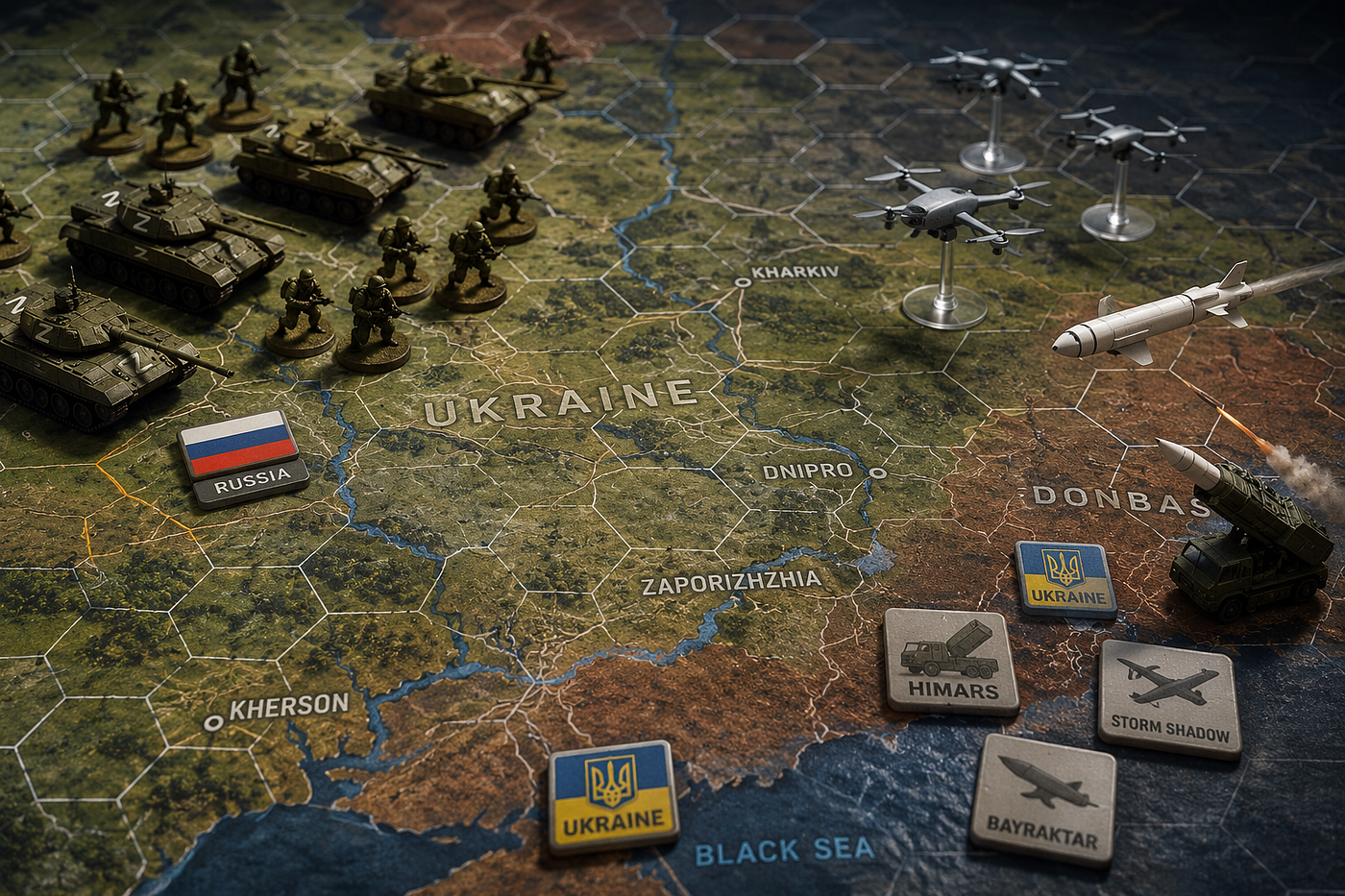
Most people think warfare is about firepower. Tanks destroy tanks, missiles sink ships and aircraft bomb targets. It is an understandable perception because those are the images that dominate the news. Yet these spectacular moments are merely the visible end of a far longer process. Every missile launched, every artillery barrage fired and every drone strike conducted is the culmination of countless decisions made by people and machines.
Military professionals know this process as the kill chain:
Find > Fix > Track > Target > Engage > Assess
Although it is called a kill chain, every stage is fundamentally a decision. Someone or something must detect the target, determine whether it is legitimate, maintain contact, assign weapons, authorise the strike and assess the results. If any one of these links fails, the chain breaks and the weapon is never fired.
This is why modern warfare is no longer simply about destroying the enemy. It is about disrupting the enemy’s ability to make timely and accurate decisions.
Decision superiority
For much of history, armies sought victory through attrition. Destroy enough enemy soldiers, sink enough ships or bomb enough factories and eventually the enemy could no longer fight. While physical destruction remains important, advances in communications, sensors, satellites, drones and artificial intelligence have shifted the emphasis elsewhere. Increasingly, the side that wins is the one that can make better decisions faster than its opponent.
This explains why electronic warfare, cyber operations, deception, drone reconnaissance and long-range precision strikes have become central features of modern conflict. Their purpose is often not to destroy combat units directly, but to attack the information and command systems that enable those units to fight effectively.
An artillery battery without target coordinates is simply a collection of guns. A fighter aircraft without situational awareness becomes hesitant. A warship deprived of reliable sensor data loses much of its combat effectiveness. The platform itself may remain intact, yet its ability to contribute to the battle has been severely diminished because the decision process has been interrupted.
In other words, the real target is often not the weapon, but the decisions made behind the weapon.
The Human in the Loop
Every discussion about the future of warfare eventually turns to artificial intelligence. Machines process information faster than humans, they never tire and they are free from fear or emotion. It is therefore tempting to conclude that the obvious solution is to remove people from the kill chain altogether.
That conclusion deserves far more caution than it usually receives.
Humans are undoubtedly the slowest component of the kill chain. They become fatigued, misunderstand information, hesitate under pressure and are influenced by cognitive biases. Military planners have spent decades trying to shorten decision cycles by improving communications, automation and command systems.
Yet those same human weaknesses can also become strengths.
A commander can question incomplete information. He can recognise political consequences that an algorithm cannot. He can delay action because something simply does not feel right. Most importantly, he can choose restraint.
Machines optimise. Humans exercise judgement.
The danger is that as we remove people from the decision-making process, we also remove the pauses that often prevent crises from becoming wars.
When Faster Becomes More Dangerous
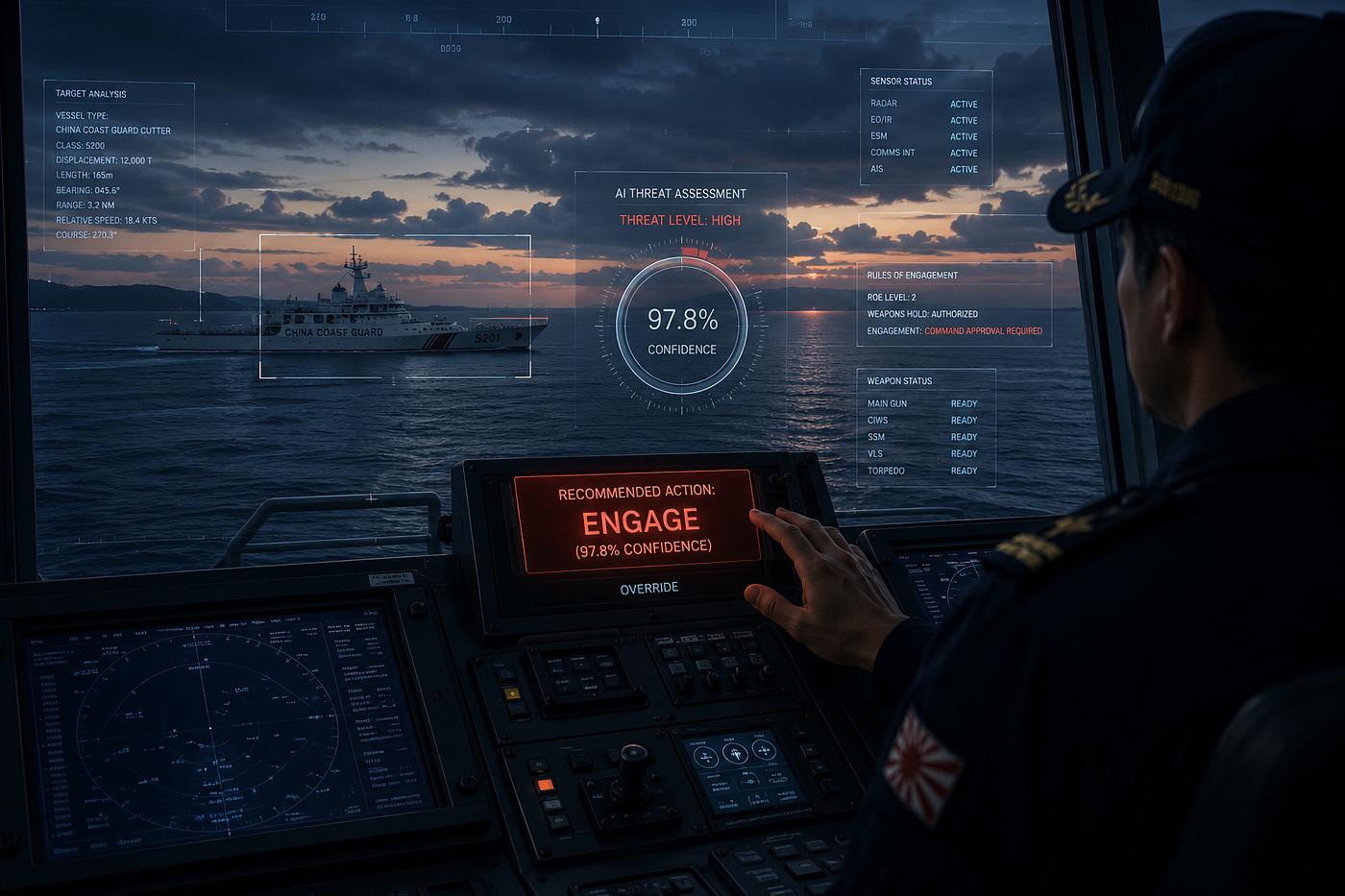
Imagine a future confrontation in the East China Sea.
A Chinese Frigate intercepts a Japanese Destroyer near disputed waters. Both nations are asserting their territorial claims, but neither government wants a war. The encounter is tense, yet not unusual. Similar incidents have occurred many times before.
Now imagine that both ships are supported by highly capable artificial intelligence integrated into their combat management systems.
The Japanese commander orders the Chinese vessel to be illuminated by fire-control radar as a warning. The AI classifies the action as an appropriate show of force, but simultaneously increases the ship’s readiness level because radar illumination is also a recognised precursor to combat.
The Chinese AI interprets the radar lock differently. Drawing on thousands of historical engagements and its threat library, it concludes there is a high probability that missile launch preparations are underway. It recommends an immediate non-lethal response designed to deter further escalation.
The Chinese commander authorises the recommendation. A high-powered laser is directed at the Japanese destroyer’s bridge.
Within seconds, the Japanese AI detects laser energy striking the command centre. Unable to distinguish intent from effect, it categorises the incident as a hostile attack. Based on its rules of engagement, it recommends warning shots before the situation deteriorates further.
The Japanese captain accepts the recommendation.
The shells strike the Chinese vessel.
The Chinese AI immediately reclassifies the engagement as an active attack. It recommends anti-ship missiles before the Japanese destroyer can fire again. Simultaneously, the Japanese AI interprets Chinese missile preparation as confirmation that its threat assessment was correct and recommends pre-emptive engagement.
In less than two minutes, two systems designed to reduce uncertainty have instead accelerated both sides towards war. Neither government intended the crisis. Neither captain wanted a battle. Yet each AI made tactically rational recommendations based on incomplete information, compressing the time available for human reflection until approval became little more than a procedural step.
Now consider the same encounter without AI directing the pace of events.
The Japanese captain orders the radar illumination, fully aware that the Chinese commander may interpret it as a threat. When the laser suddenly flashes across the bridge, several sailors are injured, and tempers rise instantly. Junior officers demand an immediate response.
Instead of reacting, the captain pauses.
He asks a simple question.
“Was that intended to kill us, or was it intended to warn us?”
At almost the same moment, the Chinese commander receives reports that the laser has caused casualties. What he intended as a calibrated demonstration of resolve has instead crossed a dangerous line. He immediately orders the laser shut down and instructs his bridge to broadcast on the international distress frequency that no further hostile action is intended.
The Japanese captain hears the transmission.
Rather than ordering warning shots, he replies that his ship will disengage if the Chinese vessel also withdraws.
Both commanders slowly separate. Diplomats spend the next week protesting loudly through official channels, newspapers denounce the other side, and politicians make predictable speeches. Yet no missiles are fired, no ships are sunk, and no families receive news that a war has begun.
The difference between the two scenarios is not technology.
It is judgement.
Artificial intelligence excels at identifying the tactically optimal response to a perceived threat. Experienced commanders understand that tactical success is sometimes strategically disastrous. They recognise that the objective is not simply to survive the next minute, but to avoid creating the next war.
That is why I remain convinced that while AI will inevitably become an indispensable partner in the kill chain, it must never become its final authority. The purpose of military operations is not merely to defeat an opponent. It is to achieve political objectives. Those objectives remain, and should remain, the responsibility of human beings.
Designing Games That Reflect Reality
This philosophy is one of the reasons I developed the Generic Wargaming System (GWS).
Many tabletop wargames focus on combat alone. Units move, dice are rolled and casualties are removed. Combat becomes the centrepiece of the game because it is the most visible part of warfare.
Modern conflict is far more complex.
Before artillery can fire, someone must locate the target. Before missiles can launch, someone must verify the contact. Before aircraft attack, intelligence must identify the objective. Drones, electronic warfare, cyber attacks and reconnaissance are not supporting activities — they are often the very actions that determine whether combat succeeds at all.
GWS reflects this reality by modelling the decision chain rather than simply the exchange of fire. Detection, reconnaissance, electronic warfare, command and information all influence what follows. Players soon discover that the decisive move is often not destroying an enemy unit, but preventing it from making effective decisions in the first place.
That, increasingly, is how modern warfare is fought.
Final Thoughts
The future battlefield will undoubtedly feature autonomous drones, artificial intelligence, precision weapons and ever more sophisticated sensors. Yet despite these remarkable technologies, wars will still be decided by decisions.
Technology can make decisions faster. It cannot decide whether they are wise.
Perhaps that is the most important lesson of the modern kill chain. Its purpose is not merely to deliver weapons more efficiently. Its purpose is to transform information into action while ensuring that human judgement remains equal to the consequences of that action.
As militaries race to shorten the kill chain, they must also ensure they do not shorten the distance between misunderstanding and war.
Interested in exploring these ideas yourself?
The Generic Wargaming System (GWS) is a free tabletop wargaming system designed to model modern conflict, decision superiority and the realities of today’s battlefield. Rather than simply simulating combat, GWS challenges players to think like commanders by managing reconnaissance, information, electronic warfare, command and the complete decision chain.
If this article has sparked your interest, download GWS, try one of the sample scenarios, and discover why the most important battles are often won long before the first shot is fired.
메타데이터
- post_id
- a3f03215e9bc
- slug
- the-kill-chain-isnt-about-killing-it-s-about-decisions-a3f03215e9bc
- url
- https://medium.com/generic-wargaming-system-gws/the-kill-chain-isnt-about-killing-it-s-about-decisions-a3f03215e9bc
- canonical_url
- https://medium.com/generic-wargaming-system-gws/the-kill-chain-isnt-about-killing-it-s-about-decisions-a3f03215e9bc
- author_url
- https://medium.com/@allen.pattiselanno
- status
- ok
- fetched_at
- 2026-08-04 05:13:04