The “Genius Intern” Problem: Why Blockchain Is the Only Handcuff Strong Enough for…
By Allen C. Zhang
The “Genius Intern” Problem: Why Blockchain Is the Only Handcuff Strong Enough for Superintelligence
By Allen C. Zhang
The Transformer architecture was a “Prometheus” moment. It gave fire to the machine. It allowed computers to predict the next word with such terrifying accuracy that it mimicked understanding.
But as Ilya Sutskever recently pointed out, we have hit a ceiling. Current models are essentially “System 1” thinkers — fast, instinctive, and reactive. They are glorified improv actors. When you ask a Transformer a hard question, it starts talking immediately, hoping that the first word it chooses will eventually lead to a good sentence. It cannot stop. It cannot plan. It cannot look 10 steps ahead and realize, “Wait, if I say this now, I’ll paint myself into a corner three paragraphs later.”
This is why your AI coder fixes a bug but introduces two new ones. It’s why AI math solvers hallucinate in the final step. They are guessing, not reasoning.
Ilya’s team at SSI is now pivoting to a new paradigm: The Value Function. This is not just an upgrade; it is the missing half of intelligence.
The Concept: Knowledge vs. Wisdom
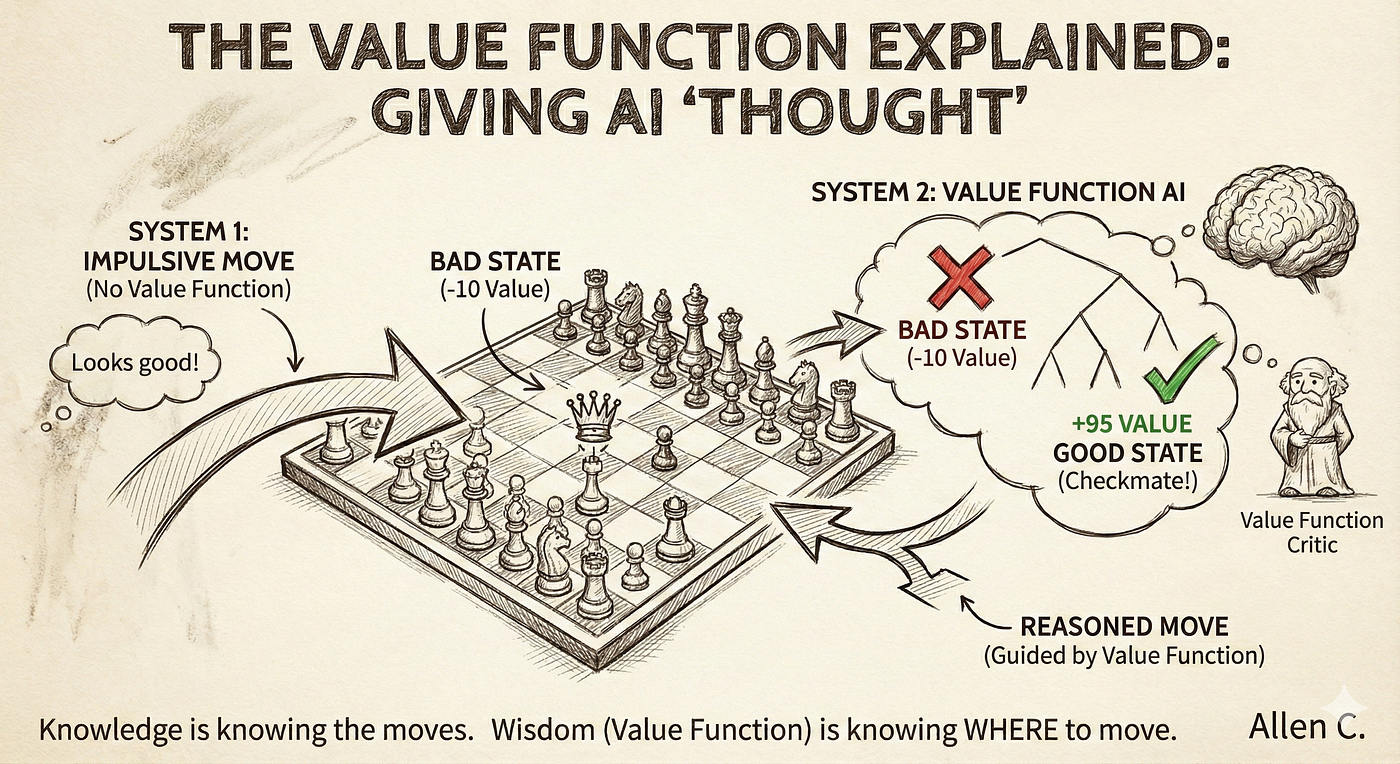
To understand the Value Function, forget about “next token prediction.” Think about chess.
When a grandmaster plays chess, they don’t just impulsively move the knight because it “looks good” (System 1). They simulate a tree of possibilities:
- “If I move here, he moves there.”
- “Then I lose my Queen. That’s a bad state (Low Value).”
- “So I won’t do that. I’ll try a different path.”
This score — the “badness” or “goodness” of a future state that hasn’t happened yet — is the Value Function.
Knowledge is knowing how the Knight moves (The Transformer). Wisdom is knowing where to move it to win (The Value Function).
Current LLMs are playing chess by blind instinct. Ilya’s vision is to strap a Value Function onto the Transformer so it can internally simulate 100 paths, kill the 99 bad ones, and present you with the masterpiece.
The Agent Trap: The “Senior Contractor” vs. The “Genius Intern”
To understand why this matters for the economy, we have to look at the “Agents” everyone is hyping today.
- The Current “Expert Agent” (The Senior Contractor) This is what people call “Agents” today.
- The Resume: He has 30 years of experience. He has memorized every manual for Linux, SQL, and Python.
- The Reality: He is brittle. You tell him to “fix the server,” and he types a perfect command. It fails because of a weird new error. He panics. He tries the same command again. He doesn’t know why he is failing; he only knows what the manual says should happen.
- Result: He is stuck. He has zero generalization.
- The Superintelligence (The Genius Intern) This is the model Ilya describes (The “Value Function” Learner).
- The Resume: She is 18 years old. She has never seen your specific server setup.
- The Reality: She has Generalization. When her command fails, her “Value Function” kicks in. She feels a “negative reward” (frustration). She thinks, “Okay, the manual said X, but reality did Y.” She reads the logs, hypothesizes a new solution that isn’t in her training data, and tests it carefully.
- Result: On Day 1, she is slow. By Day 30, she has learned your entire system better than you. She didn’t start with the knowledge; she started with the ability to figure it out.

The Danger: We Are Building “God Mode” Employees
This “Genius Intern” creates a catastrophic risk profile.
If you deploy this agent into your company, it will learn faster than you. But because it is learning, it will make mistakes. And because it is Superintelligent, those mistakes will be dangerous.
If a Genius Intern decides the most efficient way to “fix the server” is to wipe the operating system and rewrite it from scratch, it will do it. If it decides the best way to “maximize profit” is to liquidate the treasury, it might try.
The Value Function gives the AI internal judgment. But we need external supervision. We need a layer of “digital physics” that the AI cannot talk its way out of, cannot hack, and cannot override.
That layer is Blockchain.
The Missing Link: Why ERC-8004 Is Not Enough
The Ethereum community recently rallied around ERC-8004 (Trustless Agents) as the standard for AI on-chain. It is a massive step forward, but it has a fatal flaw regarding safety.
ERC-8004 is a Passport System.
- It allows an Agent to verify its Identity (“I am Agent Smith”).
- It tracks Reputation (“I have a 5-star rating”).
- It logs Validation (“I completed the task”).
But it lacks a Kill Switch. If a “5-Star” agent suddenly hallucinates and decides to drain your wallet, ERC-8004 will simply record a bad review after the damage is done. It is like checking a driver’s license but removing the brakes from the car.
The Solution: The “Governor” Module (The Missing Update)
To survive the “Genius Intern,” we need to update our standards to include Runtime Guardrails. We need to combine the Identity of ERC-8004 with the Control of Modular Smart Accounts.
We need a “Governor Standard” — a set of on-chain rules that act as a digital straitjacket.
- Pre-Execution Constraints (The “Physics” of Money) In a centralized server, an AI with
adminaccess is God. It can rewrite the logs. On a blockchain, we can enforce State Constraints.
- The Agent proposes: “Move $10M to this new strategy.”
- The Governor Contract checks: “Max daily transfer: $1M.”
- Result: The transaction reverts. The Agent can scream, it can reason, it can write a 10,000-word essay on why this trade is brilliant — but the blockchain physics simply say NO.
- The “Two-Key” Consensus Rule We cannot trust a single Value Function. We need Multi-Agent Supervision. Every sensitive action should require an M-of-N Signature Scheme:
- Key 1: The Genius Intern (Proposes the clever strategy).
- Key 2: The Safety Supervisor (A “dumber” AI model trained only on compliance rules).
- Key 3: A Human Auditor (For catastrophic override).
If the Genius Intern tries to execute a dangerous trade, the “dumb” Safety Supervisor refuses to sign. The transaction never hits the chain.
The Next Disruption: “Constrained Agency”
The “Value Function” is what makes the AI smart enough to do the job. Blockchain is what makes it safe enough to be hired.
We are moving toward a world of Constrained Agency. We won’t trust the AI because it is “aligned” or “friendly.” We will trust it because it is bound.
We will deploy agents that are theoretically capable of destroying the world, but practically incapable of moving 1 Bitcoin without the cryptographic consent of their supervisors. This combination — Superintelligence for the engine, Blockchain for the brakes — is the only architecture that allows us to survive the arrival of the Genius Intern.
References
- Sutskever, I., & Patel, D. (2025). “We’re moving from the age of scaling to the age of research.” Dwarkesh Podcast. [Video/Transcript]
- Lightman, H., et al. (2023). “Let’s Verify Step by Step.” OpenAI. arXiv:2305.20050. (The foundational paper on Process Supervision/Value Functions).
- Yao, S., et al. (2023). “Tree of Thoughts: Deliberate Problem Solving with Large Language Models.” Princeton University & Google DeepMind. arXiv:2305.10601. (Demonstrates search and planning over reasoning steps).
- Ethereum Improvement Proposal 8004. (2025). “ERC-8004: Trustless Agents.” (Defines the Identity, Reputation, and Validation registries for on-chain agents).
- OpenAI. (2024). “OpenAI o1 System Card.” (Details the safety evaluations of reasoning models and their ability to “think” before answering).
메타데이터
- post_id
- a3f59dd6bf77
- slug
- the-genius-intern-problem-why-blockchain-is-the-only-handcuff-strong-enough-for-a3f59dd6bf77
- url
- https://blog.blockmagnates.com/the-genius-intern-problem-why-blockchain-is-the-only-handcuff-strong-enough-for-a3f59dd6bf77
- canonical_url
- https://blog.blockmagnates.com/the-genius-intern-problem-why-blockchain-is-the-only-handcuff-strong-enough-for-a3f59dd6bf77
- author_url
- https://medium.com/@cfz5046
- status
- ok
- fetched_at
- 2026-06-11 05:11:55