Agentic AI Services vs Traditional AI Automation: Key Differences Explained
The shift from traditional, rule-bound algorithmic automation to dynamic, self-directed systems marks a profound evolution in engineering…
Agentic AI Services vs Traditional AI Automation: Key Differences Explained
The shift from traditional, rule-bound algorithmic automation to dynamic, self-directed systems marks a profound evolution in engineering. Traditional frameworks rely on predefined workflows, executing tasks within strict parameters. In contrast, autonomous ecosystems operate on statistical reasoning, contextual awareness, and the capacity to make independent execution decisions. Understanding the structural differences between fixed script runners and goal-oriented intelligent systems is essential for enterprises aiming to optimize operational efficiency and software quality.
The integration of AI in software testing highlights this paradigm shift. Where legacy automation requires constant manual maintenance for every UI to change, autonomous systems adapt dynamically to application modifications. This evolution minimizes human intervention and allows specialized systems to analyze complex data structures, predict failures, and execute self-healing protocols.
Architectural Core: Fixed Scripts vs. Goal-Oriented Autonomy
Traditional automation operates on a linear, reactive model. Engineers author specific test cases, and the machine executes those instructions verbatim. While this approach provides consistency, it lacks the flexibility to handle unexpected variations, complex decision trees, or dynamic user interfaces. The system only validates what it has been explicitly programmed to check, making it fragile when facing application updates.
Conversely, deploying AI agents for automation introduces a goal-oriented framework. Instead of following rigid steps, these systems are given an objective and autonomy to determine the optimal execution path. They continuously evaluate the environment, process unexpected feedback, and modify their behavior to achieve the desired outcome. This shifts the testing focus from rigid script execution to intelligent, context-aware verification.
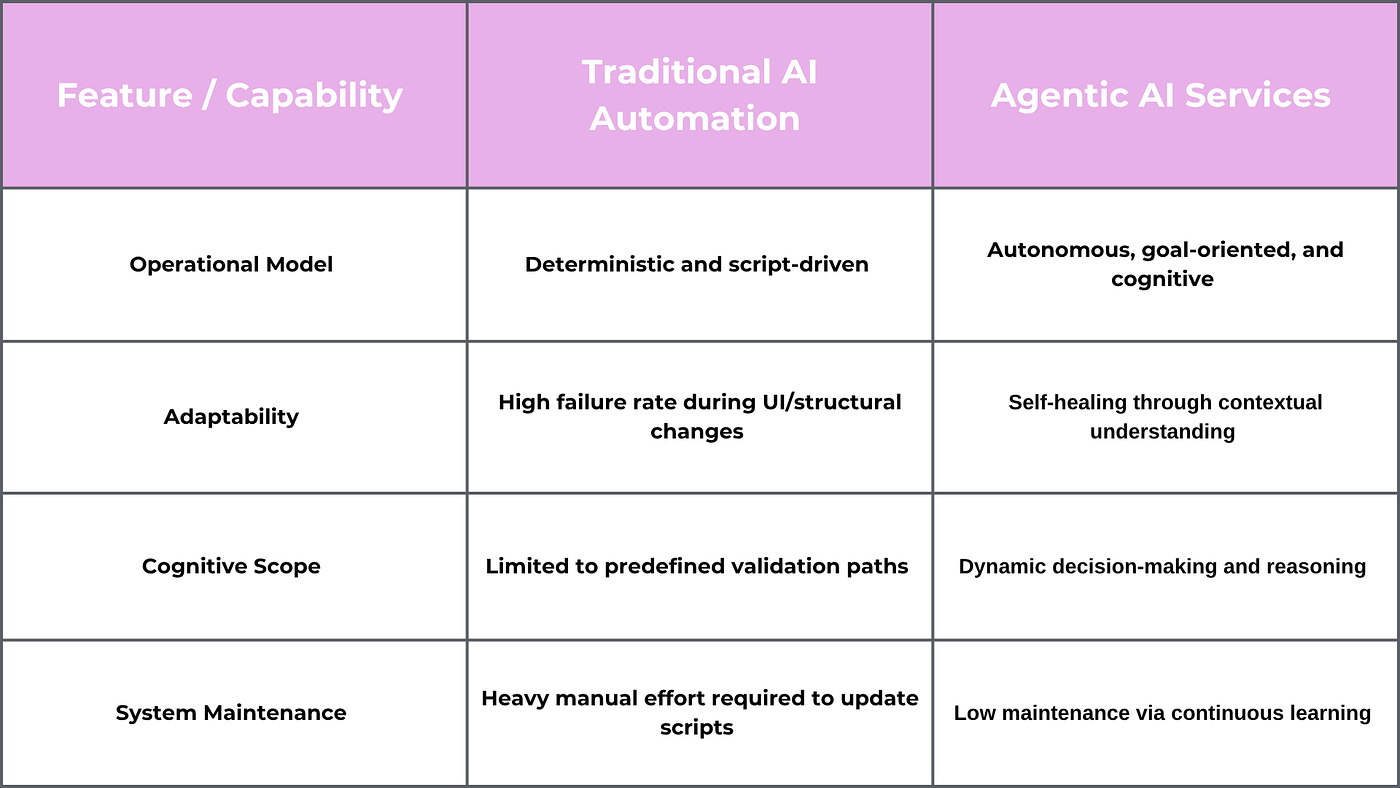
The implementation of AI automation agents fundamentally changes system interactions. These entities do not just run repetitive checks; they observe outcomes, learn from system variances, and generate new testing vectors independently. This cognitive layer allows enterprises to expand their testing coverage far beyond the constraints of human-authored scripts.
Furthermore, integrating comprehensive agentic AI services transforms quality engineering from a passive validation stage into an active, predictive optimization process. These specialized systems analyze multi-layered application architectures, map complex dependencies, and identify subtle flaws that traditional automation tools routinely miss.
Scaling Intelligence: Capabilities, Implementation, and Best Practices
Deploying advanced AI testing services requires a clear understanding of both operational advantages and deployment complexities. The transition introduces significant benefits, but it also demands a robust strategy to manage the inherent unpredictable nature of cognitive software models.
Key Strategic Advantages
- Autonomous Defect Remediation: Systems utilizing an AI testing Solution can independently detect broken object identifiers, update locator strategies in real-time, and continue execution without human intervention.
- Deep Cognitive Validation: Advanced platforms excel at LLM testing, ensuring that underlying large language models generate accurate, contextually appropriate, and non-deterministic outputs across varied user interactions.
- Comprehensive Conversational Auditing: Specialized chatbot testing methodologies evaluate conversational workflows, verify intent recognition accuracy, and validate contextual memory retention across complex customer journeys.
Implementation Challenges and Mitigation Strategies
- Managing Model Non-Determinism: Cognitive systems can yield different results for identical inputs. Teams must establish strict probabilistic baselines to distinguish actual application bugs from acceptable model variances.
- Enforcing Responsible Automation: Organizations must embed a strict ethical AI framework into their deployment pipelines to prevent algorithmic bias, secure data privacy, and ensure regulatory compliance.
- Controlling Operational Drift: Continuous learning models can drift from their original objectives over time. Implementing strict monitoring gates ensures that autonomous systems remain aligned with defined business logic.
To maximize return on investment, enterprises must adopt a structured deployment methodology for AI testing. Teams should establish rigorous evaluation metrics, build comprehensive data pipelines to train their validation models, and maintain a clear separation between autonomous decision-making and final deployment gates.
Selecting modern AI agent services empowers organizations to shift from reactive bug hunting to proactive quality assurance. These systems continuously analyze production logs, user journeys, and code commits to automatically generate relevant testing scenarios, ensuring validation keeps pace with rapid deployment schedules.
The Road Ahead
The transition toward self-directed testing ecosystems represents a permanent shift in how software reliability is achieved. As applications grow more interconnected, traditional validation methods will become increasingly unsustainable. Embracing autonomous validation models allows enterprises to achieve unprecedented scale, accuracy, and operational agility.
To successfully navigate this complex technology shift, partnering with specialized quality engineering experts is a prudent move. ImpactQA provides comprehensive, cutting-edge services designed to validate sophisticated cognitive systems effectively. Our specialized expertise in specialized AI system testing helps organizations seamlessly transition from legacy automation frameworks to advanced cognitive verification deployment models.
메타데이터
- post_id
- a3fb401d01e4
- slug
- agentic-ai-services-vs-traditional-ai-automation-key-differences-explained-a3fb401d01e4
- url
- https://medium.com/@josephwarner079/agentic-ai-services-vs-traditional-ai-automation-key-differences-explained-a3fb401d01e4
- canonical_url
- https://medium.com/@josephwarner079/agentic-ai-services-vs-traditional-ai-automation-key-differences-explained-a3fb401d01e4
- author_url
- https://medium.com/@josephwarner079
- status
- ok
- fetched_at
- 2026-07-19 08:56:17



