Blackwell Runs Hot: The Thermal Lesson Nvidia’s 72-GPU Racks Taught the Whole Industry
The most honest semiconductor stories are rarely about raw performance. They’re about what happens when performance meets reality.
Blackwell Runs Hot: The Thermal Lesson Nvidia’s 72-GPU Racks Taught the Whole Industry
The most honest semiconductor stories are rarely about raw performance. They’re about what happens when performance meets reality.
That’s why one of the most telling “thermal news” threads of 2024–2025 wasn’t a glamorous roadmap slide. It was the uncomfortable reporting that Nvidia’s Blackwell systems were hitting overheating headaches when packed into dense rack configurations — exactly the kind of configuration hyperscalers want, because it’s how you turn a data center into an AI factory.
If you work in hardware, this story feels painfully familiar: you can have a brilliant chip, but the system is the product. And the system doesn’t care about your benchmark chart. It cares about heat flux, airflow impedance, coolant distribution, and the tiny mechanical details that decide whether temperature is stable or chaotic.
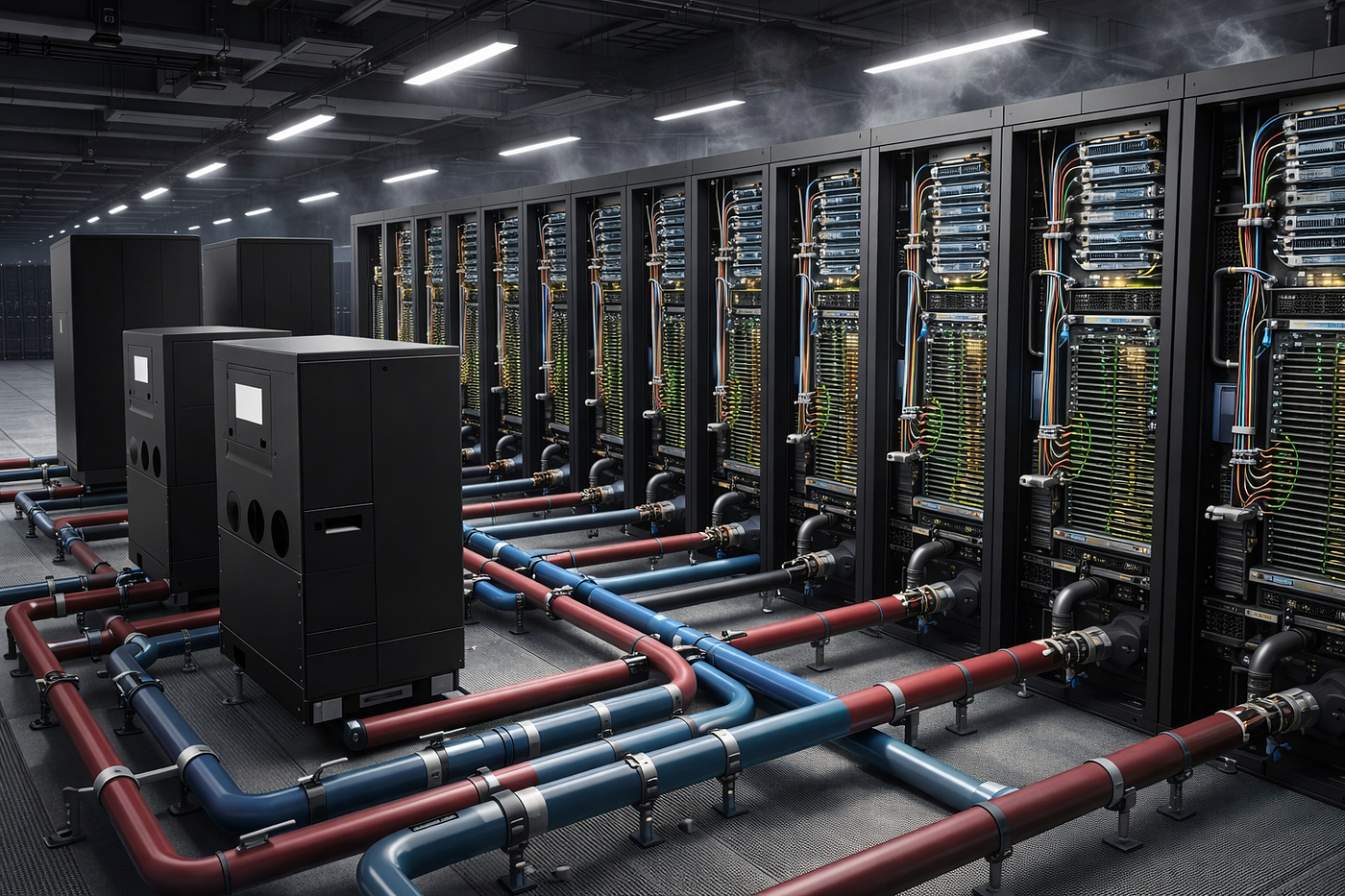
A Liquid Cooled Data Center Representation
Why the “72-GPU rack” became a stress test
Rack-scale AI isn’t just “a server with more GPUs.” Once you get into the 72-GPU class, you’re basically building a small power plant that happens to do math.
That means every weak link gets exposed:
- a hotspot that used to be manageable becomes a throttle point
- a small flow imbalance becomes a “why does tray 6 fail earlier than tray 3?” mystery
- a cable or manifold placement becomes a thermal obstruction
- and suddenly your deployment schedule is at the mercy of thermodynamics
What made the Blackwell overheating reports matter wasn’t the drama. It was the implication: even the best-funded teams in the world can get surprised at rack scale.
The uncomfortable truth: “air vs liquid” isn’t a preference anymore
For years, many companies treated liquid cooling like a lifestyle choice. Air was “simple,” liquid was “complex,” and you only went liquid if you had to.
Rack-scale AI flipped the question.
When power density rises and the goal is sustained performance, the job becomes less about removing heat somehow and more about removing heat predictably. Predictability is what protects uptime, keeps performance stable, and stops operators from living inside alarm dashboards.
So the industry is being nudged — sometimes gently, sometimes violently — toward direct liquid cooling, better cold-plate designs, and facility standards that make liquid feel less like custom plumbing and more like a repeatable infrastructure layer.
That’s why the “overheating story” is bigger than Nvidia. It’s the moment the market admits: the limiting factor for AI systems is increasingly the ability to move heat and power safely, not the ability to print transistors.
What hyperscalers learned the hard way
Hyperscalers don’t hate complexity. They hate uncertainty.
If a platform’s thermal behavior changes depending on rack layout, room temperature, load profile, or minor manufacturing variation, it creates a reliability tax. And at AI cluster scale, that tax turns into real money: downtime, reduced utilization, technician labor, and delayed deployment.
So the practical shift isn’t only “use liquid.” It’s “design for operability.” Things like:
- easier service access that doesn’t disturb airflow or coolant routing
- sensors and telemetry that help catch imbalance early
- tighter mechanical tolerances so trays behave consistently
- and clearer integration boundaries between chip vendor, server vendor, and facility operator
Thermal engineering becomes product engineering. And product engineering becomes a supply-chain problem. That’s the real lesson.
The bigger headline hiding behind the headline
If you zoom out, the Blackwell overheating reports were a preview of the next phase of competition:
The winners won’t only ship the fastest chips. They’ll ship the most deployable systems.
Deployable means: racks that can be installed, cooled, monitored, and serviced at scale without turning each new data hall into an experiment. It means designs that tolerate real-world variance and still behave.
And once you accept that, you realize something slightly funny: the “hottest” thermal story in semiconductors is not only about materials or microchannels. It’s about operational maturity — how quickly the ecosystem can turn extreme performance into boring reliability.
The takeaway
Blackwell didn’t “fail.” The industry simply met a new level of power density, and the thermal bill came due.
The overheating reports were a reminder that the AI era is forcing a redesign of the entire stack: silicon, packaging, boards, racks, and facilities. The chip might be the star, but cooling is the stage — and if the stage can’t hold the weight, the show doesn’t go on.
References Reuters — “New Nvidia AI chips face issue with overheating servers, the Information reports” — November 17, 2024 Reuters — “Nvidia’s biggest customers delaying orders of latest AI racks, the Information reports” — January 13, 2025 TrendForce — “NVIDIA’s Blackwell GPUs Reportedly Overheat in Server Racks, Sparking Delay Concerns” — November 18, 2024
메타데이터
- post_id
- a3fc12005c25
- slug
- blackwell-runs-hot-the-thermal-lesson-nvidias-72-gpu-racks-taught-the-whole-industry-a3fc12005c25
- url
- https://medium.com/@pasrar/blackwell-runs-hot-the-thermal-lesson-nvidias-72-gpu-racks-taught-the-whole-industry-a3fc12005c25
- canonical_url
- https://medium.com/@pasrar/blackwell-runs-hot-the-thermal-lesson-nvidias-72-gpu-racks-taught-the-whole-industry-a3fc12005c25
- author_url
- https://medium.com/@pasrar
- status
- ok
- fetched_at
- 2026-06-15 20:49:13