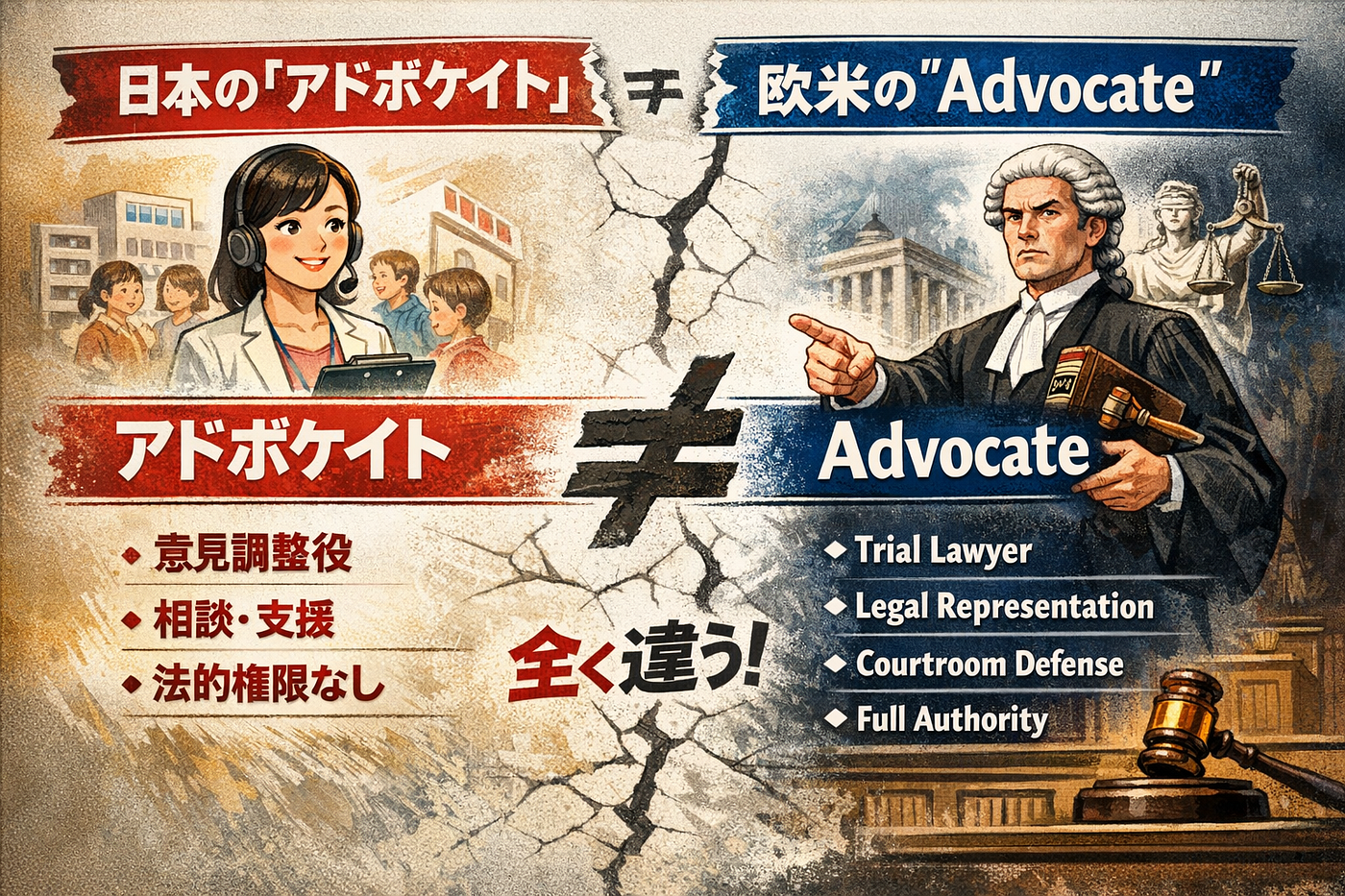
The Hidden Origins of Japan’s Child Guidance Centers
Welfare, public order, and administrative custody in postwar Japan
The Hidden Origins of Japan’s Child Guidance Centers
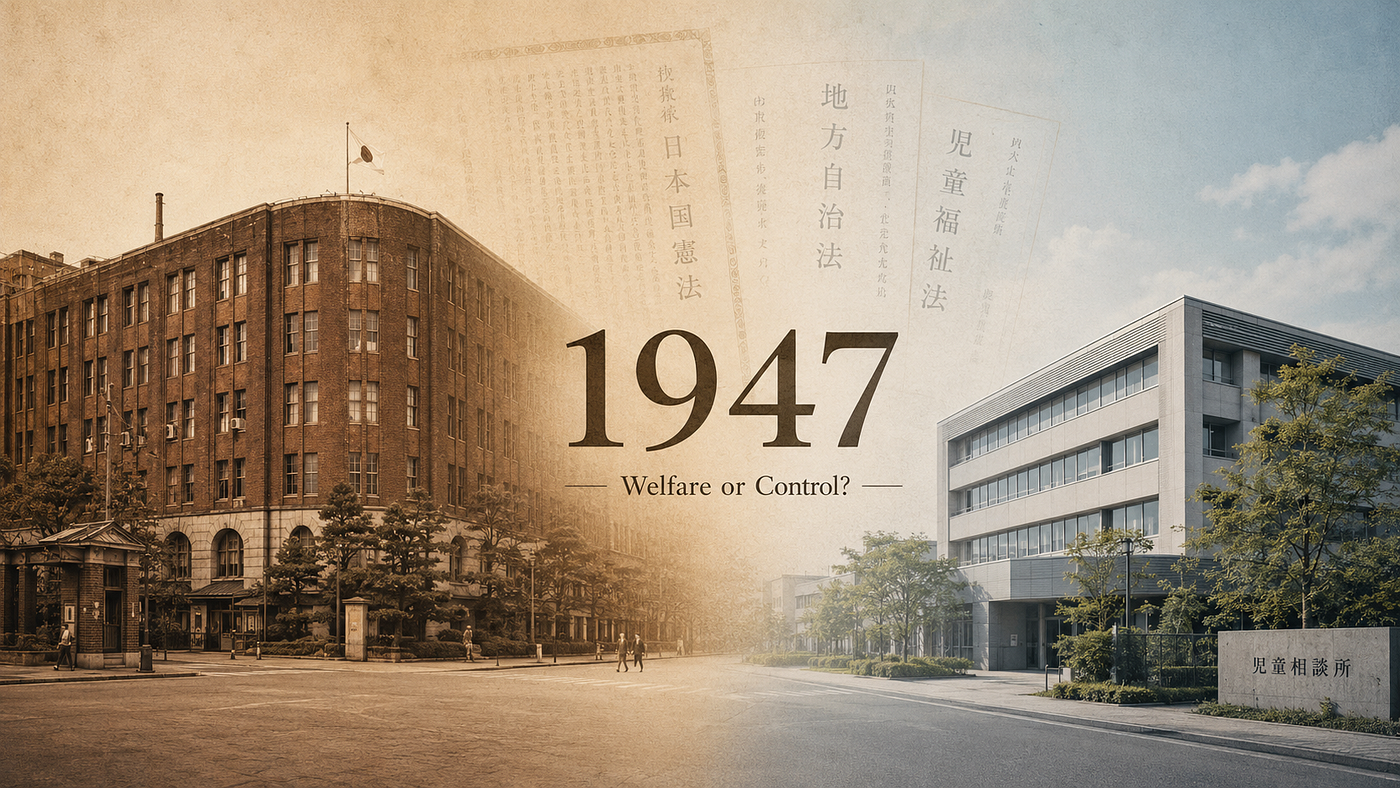
1947: Was Japan’s child welfare system born as protection, or as a new form of administrative control?
Welfare, public order, and administrative custody in postwar Japan
Most people in Japan think of Child Guidance Centers as welfare institutions.
They are commonly imagined as agencies that protect abused children, rescue vulnerable minors, and intervene when families are in crisis.
That image is not entirely wrong.
But it is incomplete.
When we trace the historical origins of Japan’s Child Guidance Centers back to the late 1940s, a very different picture begins to appear.
They were not born simply as modern child abuse response agencies.
Their origins lie at the intersection of Japan’s Penal Code, juvenile control, the collapse of the prewar Home Ministry system, the introduction of postwar local autonomy, and the urgent problem of war orphans and street children after World War II.
In other words, Japan’s Child Guidance Centers may not have been born merely as gentle welfare offices.
They may have been created as a postwar administrative mechanism for relocating prewar juvenile control into the language of child welfare.
A modern case that reveals the structure
A recent high-profile case in Japan illustrates why this matters.
According to reports by AP News and The Mainichi, Shinnosuke Abe, then manager of the Yomiuri Giants baseball team, resigned after being arrested over an alleged domestic incident involving his teenage daughter. Reports stated that the daughter had consulted ChatGPT, contacted a Child Guidance Center, and that the center then alerted the police.
For many readers, this may look like a surprising sequence.
A child seeks advice.
A Child Guidance Center becomes involved.
The police are alerted.
An arrest follows.
But from the perspective of institutional design, this is not surprising at all.
Japan’s Child Guidance Centers are not merely counseling offices.
They are gateways through which information about children and families can move into the administrative and police systems.
They receive reports.
They investigate households.
They assess risk.
They may take children into temporary custody.
They may connect cases to police action.
This is why the historical origin of these centers matters.
If a “welfare” agency has the power to trigger state intervention into the family, we must ask what kind of institution it really is.
The common explanation is too shallow
The usual explanation is simple.
Japan’s Child Guidance Centers were created after World War II to deal with war orphans and street children.
This is true.
But it is not enough.
If the issue had only been the care of war orphans, Japan could have expanded orphanages, children’s homes, or ordinary welfare facilities.
Instead, the state created a special administrative institution with a much broader set of functions.
A Child Guidance Center could receive information, investigate, classify, assess, temporarily take custody of children, and connect them to institutions.
That is not the structure of a simple welfare office.
It is the structure of an administrative custody system.
So the deeper question is not simply:
Why did Japan need to care for war orphans?
The deeper question is:
Why did Japan create an institution that could move children through an administrative route, outside ordinary criminal trial procedures?
The irony of age fourteen
One key to this question is Japan’s Penal Code.
Under Article 41 of Japan’s Penal Code, “an act of a person less than 14 years of age is not punishable.”
This is a crucial point.
Historically, this rule can be seen as a modern, child-protective idea.
In the Meiji era, when Japan was building a modern legal system, excluding children under fourteen from criminal punishment was, in one sense, a progressive safeguard. It recognized that very young children should not be treated in the same way as adult criminals.
That is the irony.
A rule that began as a protection against criminal punishment also created a category of children who could not be processed through ordinary criminal courts.
If a child under fourteen stole food, ran away, lived on the street, or committed an act that would otherwise be treated as a crime, the child could not be punished as a criminal.
But after the war, Japan faced a large number of children who had lost parents, homes, and stable social ties.
Some were war orphans.
Some were street children.
Some survived by stealing.
From the state’s point of view, these children were not only objects of protection.
They were also seen as a problem of public order.
Criminal punishment was not available.
But administrative intervention was.
This is where the Child Guidance Center becomes important.
It offered a route for dealing with children who could not be handled through ordinary criminal punishment.
A welfare route.
An administrative route.
A route that could appear humane, while still allowing the state to identify, classify, and remove children from the streets.
Before the war: the Home Ministry and local control
To understand this, we must look at prewar Japan.
Before 1945, Japan did not have local autonomy in the modern democratic sense.
The Home Ministry was one of the most powerful institutions in the Japanese state.
It controlled local administration, police administration, and public order.
Prefectural governors were not elected by local residents in the way they are today.
They were state officials operating within a centralized administrative structure.
Under this system, local governance and police power were deeply connected.
The state could deal with social disorder through a centralized chain of command.
This included juvenile problems.
Prewar Japan already had systems related to juvenile protection, guidance, correction, and control.
Some institutions even used the soft language of “consultation.”
But “consultation” did not necessarily mean a gentle, voluntary welfare service.
It could also function as an entry point into surveillance, classification, guidance, and custody.
This is an important point.
The idea of using a soft administrative name to identify and control children did not begin after the war.
The postwar Child Guidance Center did not appear out of nowhere.
It inherited a much older administrative logic.
Postwar reform changed the container, not necessarily the function
After Japan’s defeat, the Allied Occupation transformed the country’s governing structure.
The new Constitution placed local self-government within the constitutional order. Chapter VIII of the Constitution of Japan establishes local self-government, and Article 92 states that local government organization and operations shall be fixed by law in accordance with the principle of local autonomy.
The Local Autonomy Law introduced a new framework for local government.
The Home Ministry was abolished on December 31, 1947, as shown in this historical transition table by the Japan Center for Asian Historical Records.
The old centralized system could no longer operate in the same form.
But the social problems did not disappear.
War orphans still existed.
Street children still existed.
Children under fourteen who could not be punished under criminal law still existed.
The old machinery of centralized control had been dismantled.
Yet the state still needed a way to identify, manage, protect, and, when necessary, remove children from the streets.
This is the moment when the Child Welfare Act and Child Guidance Centers appear.
Japan’s Ministry of Foreign Affairs explains that the Child Welfare Law was established in 1947 in recognition of the need to promote child welfare, and the current Child Welfare Act still provides the legal framework for Child Guidance Centers.
The function of juvenile control did not vanish.
It was reorganized.
It was placed inside local government.
It was wrapped in the language of child welfare.
This is the historical structure that deserves more attention.
Why “welfare”?
The word “welfare” is not meaningless.
Postwar Japan genuinely needed systems to protect children.
War orphans needed care.
Children living on the streets needed food, shelter, and medical assistance.
No serious discussion should deny that.
But the word “welfare” also served another function.
After the war, Japan was no longer supposed to be a police-centered authoritarian state.
The new Constitution emphasized human rights.
A system openly described as “juvenile public order control” would have conflicted with the spirit of the new constitutional order.
But a system described as “child welfare” was different.
It sounded humane.
It sounded protective.
It sounded compatible with human rights.
This is why the purpose clause matters.
The Child Welfare Act presented itself as a welfare law.
Yet the actual institutional design allowed administrative authorities to gather information about children, intervene in families, take children into temporary custody, and connect them to facilities.
In this sense, welfare may have functioned as both a real objective and a legal covering.
A genuine protective purpose existed.
But so did an administrative custody function.
The problem is that the protective language can hide the coercive structure.
The contradiction remains today
Today, Child Guidance Centers are widely discussed as child abuse response agencies.
But the institutional structure they use was not originally designed only for abused children.
It was built on a broader administrative system that included war orphans, street children, and children below the age of criminal punishment.
That creates a serious contradiction.
A child who is abused is a victim.
A child who commits a delinquent act is not the same kind of subject.
The purposes are different.
The moral position is different.
The required safeguards should be different.
Yet in Japan, both can be handled under the same Child Welfare Act framework, by the same Child Guidance Center system, through the same logic of temporary custody and institutional placement.
This is one reason why abused children may be treated less like rights-bearing victims and more like objects of administrative management.
The system says it is acting for the child.
But once the child enters the administrative route, the child may lose contact with family, school, community, and outside support.
The language is welfare.
The structure is custody.
Why this history matters
This history changes how we see Child Guidance Centers.
If we think they were born simply as child-friendly welfare offices, we will misunderstand their power.
We will ask only whether individual staff members are kind or unkind.
We will ask only whether a specific intervention was necessary or unnecessary.
But if we understand their institutional origin, we can ask deeper questions.
Why does a “consultation center” have the power to separate children from families?
Why does a welfare agency function as a gateway to police involvement?
Why are children placed into temporary custody through administrative judgment?
Why is the same legal framework used for abused children and children accused of problematic behavior?
These are not minor operational issues.
They are questions about the design of the institution itself.
A postwar translation of prewar control
My argument is not that Child Guidance Centers do no good.
Some children are genuinely protected by them.
Some families need urgent intervention.
Some cases require state action.
The issue is not whether child protection is necessary.
Of course it is.
The issue is whether Japan’s current child protection system still carries the DNA of prewar juvenile control.
The Child Guidance Center may be best understood not as an institution born from pure welfare thinking, but as a postwar translation of older systems of juvenile control, local administration, and public order management.
The old Home Ministry system disappeared.
Local autonomy was introduced.
Human rights became constitutional language.
But the state’s need to identify, classify, and control children did not disappear.
It was relocated.
It was placed in local administration.
It was renamed child welfare.
And that structure still shapes Japan’s child protection system today.
The question we must ask
Japan’s Child Guidance Centers are usually presented as agencies that protect children.
But their historical roots suggest a more complicated story.
They emerged from a period when Japan had to reconcile three things:
a new human rights constitution,
the dismantling of the prewar Home Ministry system,
and the continuing need to manage children outside the criminal justice system.
That is why we should not treat Child Guidance Centers as ordinary welfare offices.
They are administrative institutions with the power to move children.
They stand at the intersection of welfare, public order, family intervention, and state custody.
If Japan wants to build a child protection system that truly respects children’s rights, it must begin by confronting this history.
The question is not whether children should be protected.
They must be.
The question is whether a system born from administrative custody can truly protect children’s rights without fundamental reform.
This essay is based on my Japanese article here:
메타데이터
- post_id
- a40e7dcac1e7
- slug
- the-hidden-origins-of-japans-child-guidance-centers-a40e7dcac1e7
- url
- https://medium.com/@childrightfirstchiba/the-hidden-origins-of-japans-child-guidance-centers-a40e7dcac1e7
- canonical_url
- https://medium.com/@childrightfirstchiba/the-hidden-origins-of-japans-child-guidance-centers-a40e7dcac1e7
- author_url
- https://medium.com/@childrightfirstchiba
- status
- ok
- fetched_at
- 2026-06-17 08:20:12