The Brick Moron: Robert Nixon, the Racist Press That Made Him a Monster, and the Novel That Told…
On April 4, 1937, two women were beaten to death in a Bunker Hill apartment in Los Angeles. The crime connected two cities, produced a…
The Brick Moron: Robert Nixon, the Racist Press That Made Him a Monster, and the Novel That Told the Truth About Both
On April 4, 1937, two women were beaten to death in a Bunker Hill apartment in Los Angeles. The crime connected two cities, produced a press campaign of weaponised racism, and eventually landed on the desk of a young Black writer in Chicago who used it to write one of the most important American novels of the twentieth century. The Chicago Tribune called the killer a jungle beast. Richard Wright called him Bigger Thomas. Neither name was the whole truth.
The apartment was on Bunker Hill.
In the spring of 1937 Bunker Hill was one of Los Angeles’s oldest and most densely inhabited neighbourhoods. A Victorian-era district of rooming houses and tenements rising steeply above the downtown grid, a place that had once been fashionable and had become, by the Depression years, the kind of neighbourhood where people came when they had run out of other options. Forty-two-year-old Edna Worden and her twelve-year-old daughter Marguerite lived at the Astoria Apartments on Bunker Hill. On the morning of April 4, 1937, they were found beaten to death. The weapon was a brick, a construction brick, taken from a site nearby, still coated in mortar. The violence was extreme and specific. There were no witnesses who had come forward. There was no suspect in custody.
The Worden murders did not immediately connect to anything, not to the earlier killing of Rose Valdez, a twenty-year-old mother beaten to death in Los Angeles on March 2, and not to the murder of Florence Castle, a nightclub hostess killed in Chicago in 1936. The geography separated them. The method linked them. But methods are only useful forensic evidence when someone is looking at the right things, and in 1937 across two American cities, each working its own files, nobody had yet drawn the line that ran through all of them. The line ran through Robert Nixon.
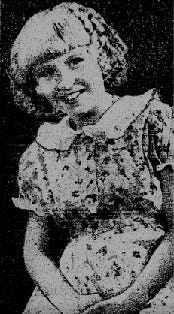
Marguerite Estelle Worden.
The Man And The Crimes
Robert Nixon was born on July 19, 1919, in Tallulah, Louisiana. A small rural town in the Mississippi Delta where the sharecropping economy offered Black families little that resembled opportunity and nothing that resembled safety. He was eighteen years old when Edna and Marguerite Worden were killed on Bunker Hill. He had come to Los Angeles as part of the steady migration of Black Southerners seeking something other than what the Delta offered, and he had found in California and then in Chicago not the something other but a different version of the same closed doors. He worked construction sites. He moved between cities. He committed crimes that escalated in violence across a period of two years.
On May 27, 1938, in Chicago; a year after the Worden murders, Nixon broke into the apartment of Florence Johnson, a fifty-two-year-old fireman’s wife, during a burglary attempt. He was accompanied by an accomplice, a nineteen-year-old named Earl Hicks. Johnson was beaten to death with a brick. Nixon was arrested the following day, his hands and clothes bloodied. Hicks, taken into custody separately, implicated Nixon as the primary perpetrator. Nixon maintained throughout, through the interrogation, through the trial, through every subsequent legal proceeding, that Hicks had delivered the fatal blows.
The fingerprint evidence ended the geographical distance between Los Angeles and Chicago. Prints lifted from the Wordens’ Bunker Hill apartment matched Nixon’s prints taken after his Chicago arrest. The connection was made. The Chicago police had a man who had committed murders in two cities, across multiple victims, with a consistency of method and a willingness for violence that the criminal record assembled around him had not previously captured in its full dimensions.
Nixon confessed under interrogation. He confessed to multiple murders and assaults. He later maintained that the confessions had been extracted by force, that the Chicago police had beaten him and offered him sweets and strawberry soda pop in alternation, the specific combination of coercion and inducement that the African-American newspaper the Chicago Defender documented in its coverage with a scepticism the white press did not share. The Defender always placed the word confession in quotation marks. It understood what the white press, in its eagerness to produce a villain proportionate to its headlines, had decided not to examine.

Robert Nixon, pictured following his arrest
The Press And The Monster It Built
The coverage of Robert Nixon in the Chicago Tribune and its contemporaries is one of the most documented examples of racialised press coverage in the history of American journalism, studied in media history, in criminology, in American literature, and in the specific academic literature on race and crime reporting that the Nixon case helped to generate.
Chicago Tribune, June 5, 1938: “Brick Slayer Is Likened to Jungle Beast;” subheadline: “Ferocity Is Reflected in Nixon’s Features”
White press, various: “The Brick Moron;” “slow witted colored youth;” “colored moron”
The language the white press used to cover Robert Nixon was not incidental to the coverage, it was the coverage. The depiction of Nixon as subhuman, as animalistic, as a figure whose violence was legible in his physical features rather than in his circumstances or psychology, served a specific social function. It reassured white readers that the violence had come from outside their world; from a jungle, from an alien biology, from something that could be named and contained and executed without requiring the reader to examine any of the conditions that had produced Robert Nixon or any of the conditions that had produced the press coverage describing him.
The Chicago Defender read it differently. The Defender’s coverage characterised the white press’s reporting as “lurid and inflammatory” and documented the coercive conditions of Nixon’s interrogation with a consistency and a scepticism that the Tribune did not apply. The Defender understood, because its readers understood, from their own lives, from the specific daily experience of being Black in 1930s Chicago, that the story the Tribune was telling about Robert Nixon was not primarily a story about Robert Nixon. It was a story about what the Tribune and its readers needed Robert Nixon to be.
“The nickname the white press gave Nixon- ‘the Brick Moron,’ accomplished something specific. It removed him from the category of persons whose psychology required examination, whose circumstances warranted investigation, whose humanity demanded acknowledgment. A moron does not have reasons. A moron does not have a history. A moron can be electrocuted and the story can end there, without anyone being required to ask what the story was really about.”
Richard Wright And The Newspaper On His Desk
Richard Wright was thirty years old and living in Chicago when the newspapers were full of the Brick Moron case. He was working on a novel. He was reading the Tribune accounts, the jungle beast headline, the photographs, the testimony, the specific way that the white press had assembled Robert Nixon into the figure it needed him to be and he was recognising something.
In his essay “How Bigger Was Born,” Wright wrote that many of the newspaper items and some of the incidents in Native Son were fictionalized versions of the Robert Nixon case and rewrites of news stories from the Chicago Tribune. He had been halfway through the first draft of his novel when the Nixon case broke in the papers, and he found in it not a distraction but a confirmation. The specific, documented, publicly available proof that the story he was trying to tell about a young Black man in Chicago whose violence was the product of a system rather than a biology was not a literary conceit but a piece of recent history playing out on the front pages of the city’s newspapers in real time.
Bigger Thomas, the protagonist of Native Son, killed a white woman. He was pursued and convicted. He was sentenced to death. He understood, in the novel’s final pages, something about his own violence that the society condemning him had not understood and did not want to understand, that it had not emerged from a jungle or a biology but from a specific American arrangement of race and poverty and exclusion that produced, with reliable consistency, exactly the kind of man it then executed with theatrical disgust. Wright used the Nixon case as raw material. He used the Tribune’s coverage as a document of the lie he was writing the novel to expose. The connection between the two: the real case and the fictional one, was not a source of anxiety for Wright but of purpose.
The Trial And The Electric Chair
Nixon was convicted by the Cook County Criminal Court on August 6, 1938, and sentenced to die in the electric chair. The jury was composed entirely of white men. No fingerprint evidence linked him to the Florence Johnson murder specifically, the conviction rested substantially on the confession that he and his attorney argued had been extracted by force, and on the felony murder rule that made both Nixon and Hicks equally culpable regardless of who had actually struck the fatal blows. Hicks, who pleaded guilty and cooperated with the prosecution, received fourteen years. Nixon, who maintained his limited culpability throughout, received death.
He received eight stays of execution across the following year as appeals were filed, heard and denied. The Illinois Supreme Court rejected the argument that the confession had been coerced. The courts moved through their process with the specific pace of institutions that have already reached their conclusions and are working through the formalities required to implement them.
On June 16, 1939, Robert Nixon was electrocuted at Cook County Jail in Chicago. He was nineteen years old. He had been born in Tallulah, Louisiana, and had come north looking for something the north had not provided, and had committed crimes for which the state of Illinois determined he should die, and had been described in the city’s newspapers as a jungle beast whose ferocity was reflected in his features, and had inspired a novel that sold millions of copies and was studied in universities for decades and was considered one of the most important works in American literary history. Nixon did not know about the novel. Richard Wright had already written it. It was published in March 1940, nine months after Nixon’s execution. The character Wright had built in part from Nixon’s story survived the execution by eighty years and counting.

Edna Worden was forty-two years old and Marguerite was twelve and they were beaten to death in their Bunker Hill apartment on April 4, 1937, and the crime connected Los Angeles to Chicago through a fingerprint lifted from a milk bottle, and the Chicago Tribune put the connection on its front page under a headline that called the killer a jungle beast and noted that his ferocity was reflected in his features. The Chicago Defender put the word confession in quotation marks and documented the beatings and the strawberry soda pop. Richard Wright read both papers and wrote Bigger Thomas into existence from what he found in the gap between them. Robert Nixon was nineteen years old when they put him in the electric chair. He had never heard of Native Son. He had been the Brick Moron in seventeen cities of newspaper type and he had been the thing that happened to women on Bunker Hill and in Chicago apartments and he had been, somewhere beneath all of it, a nineteen-year-old from Louisiana for whom the American century had produced exactly one role and had been preparing exactly one ending. The novel outlived him. The headlines did too, in their way. The truth about which of them was the better account of what had actually happened is not something the Tribune ever published.
메타데이터
- post_id
- a410910312fe
- slug
- the-brick-moron-robert-nixon-the-racist-press-that-made-him-a-monster-and-the-novel-that-told-a410910312fe
- url
- https://medium.com/@nikitagomes.stories/the-brick-moron-robert-nixon-the-racist-press-that-made-him-a-monster-and-the-novel-that-told-a410910312fe
- canonical_url
- https://medium.com/@nikitagomes.stories/the-brick-moron-robert-nixon-the-racist-press-that-made-him-a-monster-and-the-novel-that-told-a410910312fe
- author_url
- https://medium.com/@nikitagomes.stories
- status
- ok
- fetched_at
- 2026-06-27 23:56:40