Greenland’s Oldest Argument. This Land Was Never Yours
Greenland’s history is a powerful reminder that, despite increasing international discourse, Greenland is not up for grabs.
Greenland’s Oldest Argument. This Land Was Never Yours
Image: Annie Spratt (2018), Photo taken in Ittoqqortoormiit, Greenland on Unsplash
Written by Ringisai Campbell
We acknowledge the Inuit of Greenland (Kalaallit), the traditional owners and stewards of the land, who have lived there for thousands of years. We recognise their continued connection to the lands, waters, and sea ice of Kalaallit Nunaat, we pay our respects to elders past and present and honour their journey towards self-determination. This work is intended to inform and contextualise Kalaallit histories and perspectives, not to represent or define them. Their stories remain their own.
It’s 2026, and Greenland is a major topic of conversation in global politics. For me, and perhaps others, it was not a place we knew too much about. It was a familiar shape on maps. The ‘green land’ is always white, covered in ice and snow. Certainly, not a place, people, and history that we could begin to map in political discourse… Until now.
In January 2026, the USA’s President Donald Trump pushed for ‘immediate negotiations’ to acquire Greenland from Denmark for its national security. And while this seemingly came out of the blue for many, looking back, Greenland has been on the US’ radar for some time. Not entirely surprising considering that strategically, Greenland ticks a lot of boxes in terms of: military, natural resources, Arctic shipping, and geopolitical competition. As climate change continues to melt the ice around Greenland, shorter shipping routes are opening up, and geopolitical tensions are heating up in the north. Its location makes it critical for the USA’s early defence systems against Russia and China.
This is all unfolding against an already complicated history of colonialism, governance, and control with Denmark since 1721. Today, Greenland is an autonomous Danish territory. The road to autonomy from Denmark for more control over its external and international affairs has not been simple and is likely still undetermined. Questions of independence and continued relations, and what that could look like, were raised in 200X polls.
Trump and his offers to buy Greenland have only shed more light on the country’s history of acquisition, independence, and self-determination. The ‘Hands off Greenland’ protests in Nuuk, Greenland, and Copenhagen, Denmark, in January showed that people were, to put it mildly, not keen.
The USA has maintained a military presence in Greenland since World War II (lots to unpack here), and Greenland holds huge deposits of natural and critical rare minerals. According to the Atlantic Council (2026), approximately 1.5 million tons of rare earth minerals are estimated to be found under the ice, which is much needed for green energy and defence technology. There is a lot at play here with the US seeking to counter the increasing investments in Arctic infrastructure by Russia and China.
And while Greenland was not in our (at least mine, until now) peripheral vision, it has now found itself right at the centre of some key global political conversations. Greenland’s history is a powerful reminder that, despite increasing international discourse, Greenland is not up for grabs. Like many nations and Indigenous lands, it never was.
So, let’s start there.
Early Arrivals, Culture and Movement in Kalaallit Nunaat and the Arctic
Image: Photo by Visit Greenland on Unsplash
Before it was called Greenland, it was (still is) called Kalaallit Nunaat, which translates to ‘Land of People’. Kalaallit Nunaat’s early inhabitants arrived in about 2500 BCE (over 4500 years ago), this early history is characterized by multiple waves of movement from Arctic North America.
The Inuit (meaning ‘People’) adapted to Kalaallit Nunaat’s extreme environment, making the most of hunting and fishing. Inuit communities are spread across the Arctic regions of Alaska, Canada, and Kalaallit Nunaat; despite the large geographic range, they continue to share strong cultural, linguistic, and genetic ties.
There are multiple theories about where the Inuit people originated from. Anthropologists have believed that they crossed the ‘land bridge’ into Alaska before moving across the Arctic region, developing the unique Arctic cultures seen across the Saqqaq, Dorset (Tuniit), and Thule people.
Let’s go all the way back to 2400 BCE, to the earliest known arrival of people to Kalaallit Nunaat.
2500 BCE: The Independence I Culture is the earliest known arctic-paleo settlement in the northern Kalaallit Nunaat region and Arctic Canada as part of the Arctic-Small Tool tradition. The Independence I Culture specialized in a nomadic lifestyle relying on muskox and marine animals.
They lived in extreme environments of harsh freezing temperatures and long periods of darkness. The independence I Culture lived in mobile skin-covered tents. This culture is known to produce small, intricate micro-blades and tools. They mysteriously disappeared between 1900 to 1300 BCE.
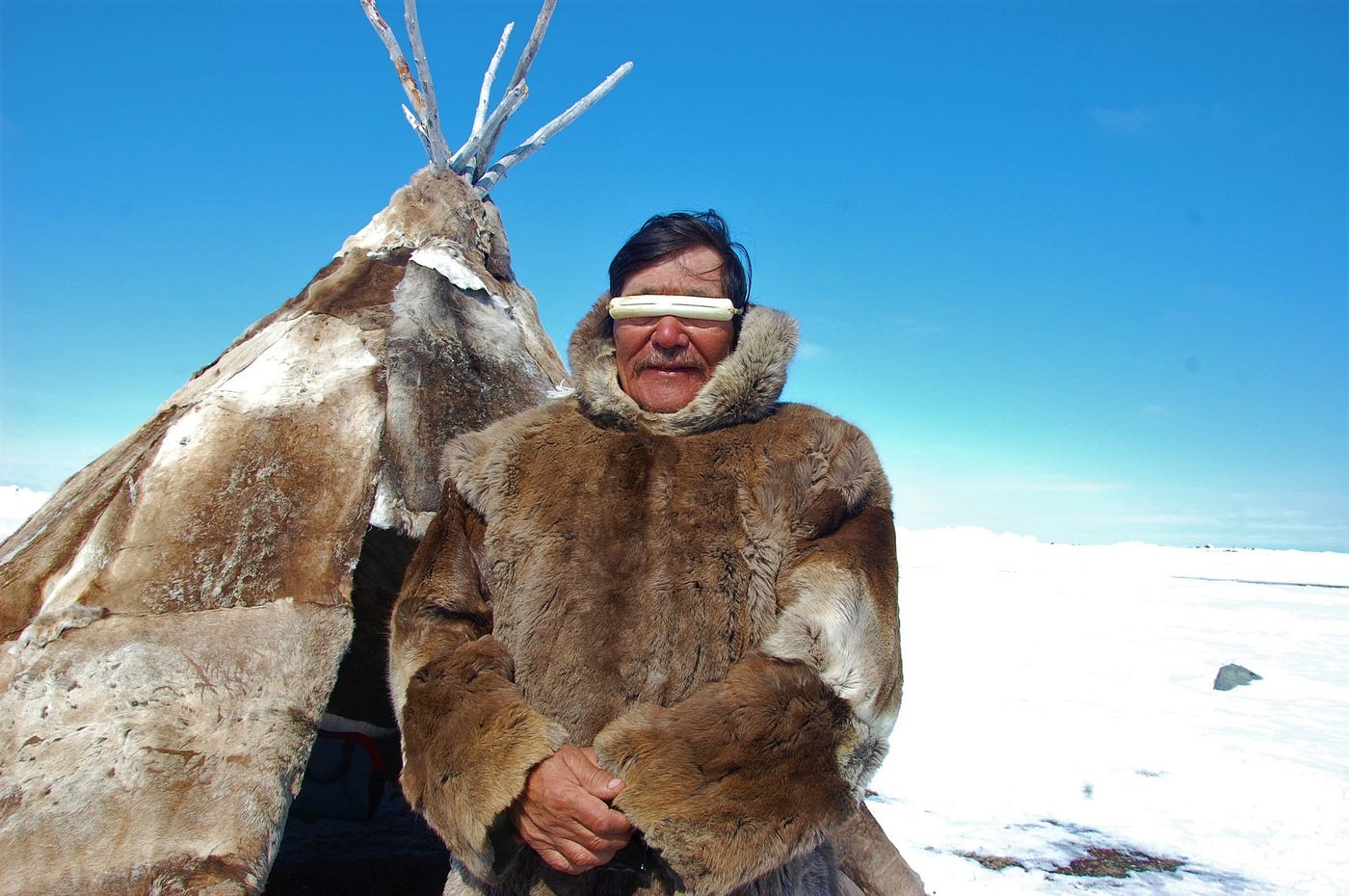
Image: from Arctic History Arctic Peoples: History of the Dorset and Thule Peoples
In 2400–900 BCE, the Saqqaq culture arrived from North America. They are the first known settlers of southern Kalaallit Nunaat. Frozen remains of a person found in Qeqertarsuaq (town on Disko Island, western Greenland) confirm that people lived in Kalaallit Nunaat over 4000 years ago.
At this time, they lived in small groups and relied on oxen and ringed seal hunting, using stone and bone tools. The Saqqaq culture was the longest-residing culture of Kalaallit Nunaat in all of history.
1200–700 BCE: The Independence II Culture replaced the Independence I in the north of the country, around the Independence Fjord and Pearly land areas. They settled in the north and the Canadian High Arctic regions, living in tents. The culture disappeared around 700 BCE, with the area being completely deserted in 1CE.
600 BCE-1200 CE: 600 BCE brought in the Dorset (Tuniit) I and II Cultures, who inhabited the coastal regions. The Dorset Culture is distinct from the Saqqaq Culture because they used different hunting techniques in the tundra and along the coast. The hunters were able to catch whales, seals, fish, birds, and land mammals.

Image: from Arctic History Arctic Peoples: History of the Dorset and Thule Peoples
The Vikings and Norse arrivals, and the creation of Greenland

Image: Erik the Red, 17th-century image from Scanné de Coureurs des mers, Poivre d’Arvor.
The Norse cultures not only brought a wave of settlers from the east, but a new name as well. Erik the Red arrived in 982AD, bringing a culture of husbandry, churches, and trade that lasted over 500 years. These movements were well documented by the Icelandic Sagas.
982: According to the Icelandic Sagas, 982AD saw the immigration of Norse settlers led by Erik the Red. It was Erik the Red who named Kalaallit Nunaat as ‘Greenland’, as a marketing strategy, to make it more attractive to new settlers, whom he brought over in 986AD when he returned. One could only imagine their shock upon arriving at their new home.
1000: After converting to Christianity in Norway, Leif Eriksson (Erik the Red’s son), brought the Christian faith to Greenland and established the first church.
On his voyage from Norway to Greenland, he was blown off course and landed in the Americas. Leif was the first European to set foot in North America, 500 years before the renowned Christopher Columbus. He arrived in northern Newfoundland and established a short-lived settlement. In 1963, Viking remains, similar to the constructions in Greenland and Iceland, at L’Anse aux Meadows were found to confirm Leif’s settlement
1100–1300 CE (approximately): Back in Greenland, the Thule Culture arrived from Alaska, and the Thule people expanded across the Canadian Arctic, replacing the Dorset culture. The Thule brought technologies equipped for the Arctic conditions, such as dog sleds (qimmit), skin-covered boats (umiaks), and advanced hunting tools, such as harpoons, kayaks that could take on bowhead whales and larger marine animals.

Image: from Arctic History Arctic Peoples: History of the Dorset and Thule Peoples
The Thule adapted to the changing environments and are the direct ancestors of modern-day Greenlandic Inuit (Kalaallit).
1200–1300: The Thule Culture spanned across the Arctic (Alaska, Canada, and Greenland), and transitioned into regional variations, such as the Inugsuk Culture that developed in the North-west of Greenland. This culture prioritised kayak hunting and sea-mammal hunting. While continuing to rely on dog sledging, whale bone houses were used for winter to protect them against the winter environment.
1500: One of the biggest mysteries is the sudden disappearance of the Norse settlers. Some theories point to an Ice Age that threatened their husbandry way of life, others consider hostilities between the Inuit and Nordic settlements, and others predict that they moved away due to economic situations.
What we do know is that the last recorded event was a wedding in 1408 between Sigríður Björnsdóttir and Þorsteinn Ólafsson in Hvalsey Church. This wedding documentation serves as proof of the Norse settlements in Greenland before they vanished.
After this point, the Inuit are the only inhabitants of Greenland, with visitors from England and Norway (from the 16th and 17th centuries).
Greenland as a Danish colony
Editors Note: Offensive language, such as the term “eskimo” appears in this article, used in historical quotations and re-telling.
1721: Hans Egede arrives in Greenland with the wish to ‘regain Greenland for God’ and to find Norse descendants and connect the Inuit to the Lutheran faith. Egede founded a church and colony near present-day Nuuk.
On arrival, Egede was faced with the challenge that there were no Norse settlers and that local shamans resisted his Christian faith. To connect Christianity to the Inuit culture, Egede tried translating words like ‘daily bread’ to ‘daily seal’ and adapting the Christian faith to the culture. Today, Egede is known to have established the first long-lasting Danish-Norwegian presence in Greenland.
Hans Egede was deeply prejudiced and characterised the Inuit culture as ‘primitive, intellectually inferior, uncivilised often describing them as ‘savages’ and ‘heathens’. He aimed to replace the Inuit spiritual beliefs and bring about a ‘superior’ way of living, using literacy to change local culture. Hans Egede brought about the beginning of the colonial era in Greenland, involving a ‘non-violent’, systematic approach to changing Inuit culture.
Image: Hans Egede in Greenland, sourced from Visit Greenland
1776: The Danish Government assumed full monopoly of trade with Greenland by closing foreign access by the Royal Greenland Trading Company (Den kongelige gronlandske Handel). This allowed Denmark to control all imports and exports for the rest of the world for nearly two centuries. The purpose of this was to create a monopoly where Denmark could fully reap the profits from the colony without external economic forces. Royal Greenland Trading Company closed for operations in 1908.
1818–19: British explorer John Ross visited Greenland and came in contact with the Inughuaq (people from Northwestern Greenland), and took note of their tools made from iron. The Inughuaq told Ross that the Iron had come from a nearby mountain or rock, but bad weather prevented Ross from seeing for himself. This exhibition kick-started a wave of European explorers and interest in minerals from Greenland. The Inughuaq started trading, gaining access to factory-made goods.
1852: The book ‘Eskimo Tales and Legends’ (1866 and 1871) was originally published in Danish by explorer Hinrich Rink. This book is considered to be a key foundational record of Greenlandic and Inuit culture from the 19th century.
This book records folklore stories, creation myths, animal fables, heroic legends, shamans, runaway hermits, supernatural beings, as well as ethnographic studies on Inuit life, customs, and religious beliefs. It also features illustrations by the Inuit people themselves.
Rink aimed to preserve the culture and respect the originality of dialect and storytelling styles. Inuit culture is rooted in an oral culture of storytelling of myths, folktales, and monsters. Many of these stories date back 5000 years and are used to keep traditions alive. There is a belief that every natural object has a soul, and that supernatural powers rule the world around us. Gods and goddesses represent the natural elements (i.e., the sea, sun, and moon).
1861: The Atuagagdliutit (Things to Read) newspaper is recognised as the first text written in the Greenlandic language. 53 years later, in 1914, Singnagtugaq (The Dream) by Mathias Storch was published, recognised as the first novel written in the Greenlandic language.

Image: The first issue of Atuagagdliutit published on January 1, 1861. The woodcut depicting the capital Godthåb (Nuuk) appears in each subsequent release, and is attributed to the local artist Aron of Kangeq.
1897: The American explorer, Robert Peary (who led the first expedition to the North Pole in 1909), wanted to make a name for himself and brought back a giant iron meteorite along with 6 Inughuaq people after the failure of his North Pole expedition. The Inughuaq were promised to return home, but many passed away from tuberculosis within months of their arrival in New York.
Among the Inughuaq people taken to New York was a young boy, Minik Wallace. They were taken to be studied by the American Museum of Natural History, which aimed to disprove evolutionary theories.
In New York, the Inughuaq (who survived) lived in the museum’s basement, becoming a ‘living museum’ for visitors.
The Museum held a fake funeral for Minik’s father (filled a coffin with stones and performed a burial by lantern), but whose skeleton was on display at the museum. Minik found out about this in 1901, through a newspaper article, but was never able to reclaim his father’s remains. Minik visited Greenland in 1910; however, he returned to the United States, where he worked, before passing away from influenza in the 1918 flu pandemic.
[embed]Video: By Vox tited The tragic story of this famous meteorite. Story abut Minik
1940s: As an effort to prevent further German expansion following the Nazi occupation of Denmark, as per the Monroe Doctrine, the United States assumed a ‘protective custody’ of Greenland.

Image: Tampa’ class gunboat type cutter USCG Mojave (WPG-47), 1942, operating amid ice floes off Greenland.
1941: During World War II, the United States started its permanent military presence in the country. The United States established 50 military installations over the Cold War period. Initially, 13 Army bases and 4 military bases were established, the larger ones including the Thule Air Base (now known as the Pituffik Space Base), Sondrestrom Air Base, and Narsarsuaq.
Today, the Pituffik Space Base is the last remaining US military base in Greenland. Although the abandoned bases are still visible today, where one might find ‘American flowers’, a slang term used to describe the over 20,000 barrels and ruins left behind. Environmentalists fear for fuel leaks into the surrounding environment as the barrels rust and decay, asbestos contamination from ruined buildings, heavy metal contamination, as well as undetonated ordnances.

Image: Ken Bower’s project American Flowers showing remains from US military activities
1945: With the end of World War II, Greenland ‘returns’ to Denmark, but the US maintains its military presence in the country.
1951: A defence agreement between Denmark and the United States brought a stronger US military presence in Greenland. In 1943, the US military presence was upgraded to Thule Air Base (now known as the Pituffik Space Base).
1951: 22 Greenlandic children were permanently separated from their families and forcibly taken to Denmark to be reintroduced as ‘Little Danes’. This experiment aimed to see if Denmark could create a group that could bridge the gap between the cultural differences between Denmark and Greenland.
Many of these children passed away young, or ended up in orphanages, suffered trauma, and lost connection to their Greenlandic culture. In 2022, the Danish government apologised and paid compensation to the survivors.

Image: 1951 photo, Queen Ingrid of Denmark greets Inuit children taken from the homes in Greenland in an experiment to make them “little Danes.” (BBC/Wikipedia via Courthouse News)
1953: A big step towards autonomy; Greenland is officially ‘decolonised’.
But Denmark continues to play a key role in socio-political affairs, where schools, government systems, and modernisation are key. As Greenland is now officially part of the Danish kingdom as a district, Greenlandic people are entitled to Danish citizenship. Greenland is represented in the Danish Parliament (Folketing*) by 2 Members of Parliament. Its industry is centred around resource extraction and cod.
1953: The Danish government expelled the Inughuit tribe and hunters from Northern Greenland to expand the US airbase. The residents were given four days to leave their homes and ancestral hunting grounds. In 1999, the Danish High Court found that this decision was illegal; however, the community was not able to return. A 2003 appeal was rejected by the High Court, and they were not allowed to return to their ancestral lands.
1959–1965: During World War II, the USA secretly stored nuclear weapons at the Thule Air Base. The American ‘Project Ice worm’ aimed to build underground networks and missile launch sites to store nuclear missiles. Plans were abandoned in 1966 due to ice shifts.
1960s: Before the 1960s, any child born of Greenlandic mothers and Danish fathers was legally not allowed to take on their father’s last name or inherit because Greenlandic law did not recognise these children.
1960’s: Denmark started a 30-year-long forced contraception campaign (also known as the Spiral Campaign or Spiralkampagnen). The campaign aimed to control the Greenlandic population growth by forcing thousands of women and girls to be fitted with intrauterine devices (IUDs or ‘coils’) without their knowledge or consent. This campaign caused long-term health problems, pain, infections, and infertility. It was not until 2025 that it was confirmed that thousands of these women were eligible for compensation.

Image: Bula Larsen is another Inuit woman who had a coil implanted inside her while at school, https://lacuna.org.uk/justice/greenlands-coil-campaign-the-forced-contraception-of-inuit-women/
1972: The Danish government chose to close the town of Quillssat, a mining town, forcing an evacuation of the residents under its G-60 urbanisation strategy. This was a continuation of the Danish government shutting down small settlements between the 1950s and 60s to create centralised housing, however again affected cultural identities and practices.
1979: Another big step towards Greenlandic autonomy and independence came in the form of the Greenland Home Rule Referendum, which passed with 73.06% in favour and a 63% voter turnout. This meant that Greenland gained home rule to manage its internal affairs.

Image: Th. N. Krabbe photos from Greenland in early 1900s.
1985: In that same momentum, Greenland leaves the European Community; this means that the EU must give an annual subsidy of 30 million euros for access to fishing in Greenlandic waters.
1989: International news reports that Danish and Canadian geologists have located the ‘largest ever’ gold deposits in Greenland, but conditions make mining difficult.
2004: The USA and Denmark sign a deal to modernise the Thule airbase. Until 2004, an American flag was flown; however, after 2004, an agreement was made for the Greenlandic flag to be flown over the base, and the Greenlandic government gained the ability to appoint a liaison officer to be stationed at the base. The current Danish PM, Mette Frederiksen, said that any further expansion of the base has to be done in consultation with both the Greenlandic and Danish governments.
2007: Denmark agrees to pay for the first prison, the Ny Anastat, to be built on Greenland, allowing criminals to serve time at home and not in Denmark.
Greenland / Kalaallit Nunaat on a road to autonomy
Photo by Johannes Plenio on Unsplash
2008: Greater autonomy is gained in the 2008 referendum, where Greenland votes for greater control over energy resources, and recognising Kalaallisut (Western Greenlandic) as the official language in place of Danish. 75% of the population voted in favour of this referendum. The Greenlandic parliament (landsting’ or ‘Inatsisartut’) was created.
2009: Greenland adopts an Act on Self-Government. Self-governance was established, which recognises Greenlanders as people under international law, with more control over resources and justice. However, Denmark continues to govern defence and foreign policy.
2010: Greenland’s ice sheets are melting quickly, contributing greatly to sea-level rise.
Image: Photo by Francois Falanga on Unsplash
2013: The Greenlandic government lifted the 25-year Uranium Mining Ban on the mining of radioactive materials.
2014: The government announces an inquiry into abuses by Denmark, including the removal of children from families in the 1950s and integrating them into Danish society.
2019: USA’s President Donald Trump makes the first attempt to ‘purchase’ Greenland. The Danish Government dismissed this.

Image: January 2026 Protests in Nuuk (BBC)
2020s: Greenland pushes on conversations on independence, economic development, and mining and tourism. There is an increased interest in Greenland by the USA as a strategic location.
2020s: Globally, debates over the use of the term ‘Eskimo’ to refer to Inuit people. The word is thought to originate from the Latin word ‘excommunicati’, meaning the excommunicated ones, because people from the Arctic were not Christian. Other theories believe that it originated from the French word ‘esquimaux’, meaning one who wears net snowshoes.
Regardless of its origins, it is rooted in a racist history used by colonisers who referred to barbarism and violence. Despite backlash from activists, many brands continue to use and sell items labelled with the word.
2021: The Foreign Security and Defence Policy Contact Committee was established between the countries in the Danish Kingdom (Greenland, the Faroe Islands, and Denmark). With the achievement of Greenland becoming a member (non-sovereign status) of the Nordic Council and establishing bilateral relations. The Greenlandic government has representations in Copenhagen, Washington, DC, Brussels, Reykjavik, and Beijing.
2021: Greenland’s PM, Múte B. Egede, attended the COP26 Conference in Glasgow, sharing that Greenland had become a signatory of the Paris Agreement, and promised an ‘ambitious’ stance against climate change. Outlining that while Greenland is a part of Denmark, it holds autonomy over its environmental matters.
2021: The government stays true to its promise at COP26 and bans all future oil and gas exploration
2023: Greenland drafts a constitution by a Constitutional Commission. They outlined plans for a future for post-independent Greenland.
2024: Greenland strengthens its foreign affairs by opening a representation in Beijing to strengthen economic, trade, and tourism.
2023–24: The Greenlandic MP Aki-Matilda Høegh-Dam challenged the Danish Parliament’s (Folketing) by delivering speeches in Greenlandic and refusing to immediately translate them to Danish. She highlighted the need for MPs to be able to express themselves in their native language (especially for Greenlandic and Faroese MPs). The Folketing had to look into integrating translation into the proceedings.
[embed]Video: Aki Matilda Høegh delivering her opening speach in Greenlandic in the Danish Parliment.
2023–2024: Greenland takes on a guiding principle of ‘Nothing About Us Without Us’, asserting that no decisions about the Arctic or Greenland can be made without the active participation of Nuuk. This includes internal development, geopolitical strategy, and foreign relations, which were formally governed by Denmark.
2024: International airport opens in Nuuk, intending to make Greenland more accessible. Direct flights between Nuuk and Iqaluit (Canada) to boost further Inuit cultural exchange.
2024: Scientific evidence from an ice core study collected in 1993 revealed fossilised remains of willow wood, fungi and insects, seeds that suggest that Greenland had once been completely ice-free over 400,000 years ago. Proving that, Greenland had once indeed been ‘green’.
2025: Greenland (within the Danish Kingdom) assumes chairship of the Arctic Council and Arctic Mayors Forum. In this position, Greenland has shared its priorities over indigenous people and communities, renewable energy and sustainability, oceans and marine pollution, as well as climate change and biodiversity.
2024–2026: The USA makes new threats to acquire Greenland and refuses to rule out military intervention to secure it. Denmark responds by giving a 14 billion DKK (2.2 billion USD) defence boost and strengthening Arctic defence.
2030: Looking forward, the Greenlandic Strategy for 2030 outlines the key pillars of research and development, aiming to improve the quality of life, the educational sector, and economic growth. The second pillar of mineral resources looks at developing a sector to supply green energy, local jobs, and economic development. The third sector on Infrastructure and Sustainability aims to incorporate green building practices into construction. The last pillar incorporates the geopolitical position of Greenland, underscores the importance of its mineral reserves and geographic location for partnerships and climate change.
A story of resilience and culture
Kalaallit Nunaat, or Greenland, is the world’s largest island, home to over 50,000 people. Today, its culture is a mix of modern and traditional. Kalaallit Nunaat is in a critical position in addressing climate change, as the glaciers are melting, revealing critical minerals such as neodymium and praseodymium, which are essential for global wind turbines and electric vehicles. Kalaallit Nunaat is thus not only a ‘victim’ of climate change, but an architect in leading global solutions.
Historically, Kalaallit Nunaat has been a territory discussed by others. Today, its guiding principle ‘Nothing about us without us’ marks an influential shift, and with the 2025 Arctic Council chairmanship and new diplomatic offices around the world, Kalaallit Nunaat has asserted itself as a political player to make its own calls. The 2023–4 language battle in the Danish Folketing serves as a powerful symbol that emphasises that independence and autonomy are not only about land and borders, but also about reclaiming language, culture, and the right to speak one’s language.
While the global powers see Kalaallit Nunaat as a strategic prize for their missile defence and strategy, Kalaallit Nunaat’s focus on its 2030 Strategy on education, tourism, and healing from colonial trauma, underscores its power of resilience in ensuring that the people of Kalaallit Nunaat come first.
The decision of Kalaallit Nunaat lies in their own hands.
메타데이터
- post_id
- a412f34ed96c
- slug
- greenlands-oldest-argument-this-land-was-never-yours-a412f34ed96c
- url
- https://medium.com/the-geopolitical-economist/greenlands-oldest-argument-this-land-was-never-yours-a412f34ed96c
- canonical_url
- https://medium.com/the-geopolitical-economist/greenlands-oldest-argument-this-land-was-never-yours-a412f34ed96c
- author_url
- https://medium.com/@nesunasu.stories
- status
- ok
- fetched_at
- 2026-06-09 14:34:10