Why UTXO Still Wins: Stablecoins, Hybrid Models, and Proof-of-Activity
1. UTXO — A Settlement Primitive
Why UTXO Still Wins: Stablecoins, Hybrid Models, and Proof-of-Activity
1. UTXO — A Settlement Primitive
Among those who study blockchain architecture, few topics provoke as much quiet debate as the Unspent Transaction Output model, or UTXO. Its reputation is oddly split. For some, it represents the unambiguous rigor of Bitcoin’s early design, that models value through ownership rather than account balances. For others, it seems artifact — that of a slower era — overtaken by account-based architectures that dominate today’s programmable networks.
UTXO is not a technology bound to a decade; it is a settlement paradigm. A formality that architects how ledgers define ownership, enforce and conserve value, and then record the movement of assets with mathematical determinism.
In the same way that double-entry bookkeeping still underpins global finance centuries after its invention, the UTXO model continues to anchor the most verifiable systems in digital value exchange. Its logic remains precise: every transaction consumes discrete inputs, creates new outputs, and leaves behind a record that is internally self-auditing.
This quality — self-verifying settlement — is exactly what makes UTXO an ideal substrate for Stable Assets. Stability demands more than market price control; it requires integrity of accounting, finality of settlement, and transparency of provenance. These are not side effects of the UTXO model, rather inherent benefits.
Before we delve deeper, it is worth restating what UTXO actually is.
- UTXO, or Unspent Transaction Output, represents a discrete token of value created by a transaction and spendable only once. When that token is spent, it disappears, replaced by new outputs in the next transaction.
- In contrast, an Account-based model records balances in mutable global state. Each transaction mutates that state, subtracting from one address, adding to another.
The difference is subtle yet profound; an account ledger is a snapshot of balances. A UTXO ledger is a graph of transfers. The former tracks state; the latter tracks provenance. The provenance is precisely what a stable monetary instrument requires.
2. UTXO as Modern Infrastructure for Governed Value and Settlement
Muvor’s architecture approaches stability through governance, value integrity, and settlement finality rather than fiat linkage. Its network design treats value as a governed computational state; not a price peg, rather a continuously verifiable equilibrium maintained through transparent, on-chain rules.
In doing so, three free-trade compliances must align:
- Governance participants, who uphold the legitimacy and distribution of network value through collective policy.
- Value actors — miners, validators, and issuers — who maintain predictable supply and transactional consistency.
- Participants and institutions, who depend on credible, audit-ready settlement and fair value representation in every transaction.
The underlying infrastructure must sustain this triad simultaneously. It must express governance as verifiable computation, preserve value as auditable state, and finalize settlement as a deterministic event observable by all participants.
UTXO provides the mechanical clarity for that alignment. Its discrete, input-output logic enforces value conservation directly on-chain; its determinism provides a transparent foundation for governance policies; its verifiable audit trail establishes the settlement integrity that both institutional and public participants require.
Through UTXO, governance, value, and settlement converge into a single computational structure — a network where authority is transparent, circulation is provable, and every unit of value carries its own proof of legitimacy.
2.1 What Stablecoins Require at the Protocol Layer
A stablecoin ledger must ensure five structural guarantees:
- Conservation of value — the total of all outstanding tokens always matches issued reserves.
- Transparent mechanics — creation and redemption must be observable and provable.
- Traceable provenance — every token should carry an unambiguous lineage from issuance to redemption.
- Deterministic validation — all nodes must reach identical conclusions about transaction correctness.
- Finality — once a transaction is validated, it should stand beyond dispute or rollback.
A blockchain architecture that cannot enforce these properties at the protocol level will ultimately rely on trusted intermediaries to maintain them — a contradiction of the entire premise of digital settlement.
2.2 How UTXO Also Fits Stablecoins
When viewed through these requirements, UTXO is not outdated — it is perfectly aligned.
- Explicit supply objects — Each stablecoin unit exists as a discrete output. Supply is observable as a finite, countable set of unspent tokens.
- Deterministic settlement — Validation occurs locally by verifying transaction inputs and scripts; there is no mutable balance to synchronize.
- Built-in auditability — Every transfer forms a cryptographic proof chain from issuance to redemption. Auditors can reconstruct full circulation history without special permissions.
- Structural soundness — Errors like negative balances or state corruption are impossible under deterministic input-output logic.
Account-based systems attempt to recreate these qualities through secondary tooling — indexers, snapshots, and proofs. UTXO achieves them as a matter of design.
2.3 Stablechains: Purpose-Built for Stability
A stablechain is a blockchain where stability is not an afterthought but a design constant. In such networks, the primary unit of account is a stable asset, and all other functions — staking, validation, governance — exist to maintain predictable settlement.
Stablechains require absolute integrity of accounting. Their users, whether institutions or payment networks, cannot tolerate ambiguity in supply or finality. For that reason, the conservative determinism of the UTXO model is an asset, not a limitation.
3. Stablecoins on a Pure UTXO Chain
Designing stablecoins atop a pure UTXO chain begins with a simple concept: each token is an output. Ownership equals control over the script that can spend that output. Transfer occurs by consuming one output and creating another, forming an immutable chain of provenance.
3.1 Multi-Asset Representation
A UTXO transaction may encode multiple asset types.
Each output typically includes three fields:
(asset_id, amount, locking_script)asset_ididentifies the stablecoin or asset type.amountdefines denomination.locking_scriptspecifies spend conditions—who can use the output and under what constraints.
Emitting and burning occur as controlled events:
- Emissions generate new outputs from an authorized policy script, typically linked to a governance or issuer key.
- Burning destroys outputs through provable redemption — often a spend to a null address or controlled destruction function.
Every issued or redeemed unit leaves an auditable trace. No ambiguity exists about how the supply has changed.
3.2 Compliance and Policy Controls
Regulatory compliance can coexist with the purity of UTXO design. Instead of relying on mutable balances, compliance policies are embedded directly into script conditions.
- Freezes can prevent specific outputs from being spent by disallowing signature paths.
- Allowlists can require issuer co-signature on regulated transfers.
- Blacklists can reject spends that reference certain disallowed scripts or hashes.
These measures preserve deterministic validation. Each rule is expressed as code evaluated at spend time, not as mutable global logic.
3.3 Institutional and Operational Benefits
For custodians, exchanges, and auditors, UTXO provides clarity impossible in account-based systems.
- Cold storage accounting becomes precise: holdings correspond to specific outputs.
- Incident analysis becomes tractable: every movement has explicit linkage to prior state.
- Proof of reserves aligns naturally with cryptographic proof of ownership.
An exchange can show regulators exactly which outputs correspond to user liabilities and reserves without revealing user data. Each number reconciles directly to an immutable on-chain record.
ASCII Diagram: Pure UTXO Flow for a Stablecoin
+---------------------------+
|   Authorized Emit Script  |
|   -> Creates Outputs      |
+-------------+-------------+
              |
              v
+-------------+-------------+
|  UTXO Ledger:             |
|  [Output1] -> spendable   |
|  [Output2] -> spendable   |
|  [Output3] -> burned      |
+-------------+-------------+
              |
              v
+-------------+-------------+
|  Authorized Burn Script   |
|  -> Destroys Outputs      |
+---------------------------+
This flow expresses an entire monetary lifecycle using the same deterministic logic: Creation, transfer, and redemption all occur through explicit, auditable scripts.
4. Hybrid UTXO + Account-Based Systems: Merging Precision and Usability
As blockchain infrastructures mature, the tension between rigor and usability has become intrinsically viable. UTXO delivers unparalleled precision and audibility, but it can feel foreign to users accustomed to the simplicity of accounts and balances. Governance frameworks, exchanges, and enterprises often seek both — the mathematical determinism of UTXO and the human legibility of account-style interfaces.
This is the design space of the Hybrid UTXO + Account Model, where UTXO remains the canonical source of truth while accounts act as projections — abstractions that improve accessibility without undermining verifiability.
4.1 The Core Principle: Truth and Projection
UTXO defines the truth. Accounts provide the view.
The hybrid model functions under this one simple rule. Every balance displayed in a wallet, every transaction summary on a dashboard, and every accounting snapshot in an enterprise system is derived from UTXO data. Nothing authoritative exists outside the ledger.
This confirmation of truth separate from representation mirrors how modern databases operate. Where immutable event logs serve as the canonical state and cached tables exist only to improve query performance.
In blockchain terms, this distinction transforms the user experience while retaining deterministic settlement.
4.2 What Hybridization Enables
A hybrid system unifies two domains that previously required compromise.
- For users, it restores the familiar comfort of account-based navigation: “send X,” “check balance,” “view history.”
- For networks and auditors, it preserves explicit provenance: each unit of value exists as a specific UTXO with verifiable lineage.
- For governance, it allows transparent enforcement: policy and permission rules remain attached to outputs, not abstracted in off-chain logic.
Hybridization does not dilute UTXO’s precision, rather extends its reach. It allows the protocol to operate with enterprise-grade determinism while the interface speaks the language of human finance.
4.3 Practical Implementations
Hybrid systems can be realized at multiple layers of the stack:
- Wallet-Side Projection — Wallets maintain the local UTXO set associated with a user’s keys, periodically aggregating it into an account-style display. The balance is a computed view, not stored state.
- Server-Side Indexing — Nodes or indexers maintain account snapshots for faster query performance in temporary cache that can always be rebuilt from chain data.
- Policy-Aware Accounts — Governance conditions can be projected as permissions in the account layer. For example, spending limits or authorized counterparties derived from UTXO-level scripts.
In each case, the hybrid system remains self-correcting. Any desynchronization can be reconciled by recomputing from the canonical UTXO ledger.
4.4 Why Hybridization Matters for Governed-Value Systems
Governed-value economies rely on two forms of credibility: computational and perceptual. Computational credibility ensures that rules execute predictably. Perceptual credibility ensures that participants can understand and verify what those rules produce.
Hybrid architectures align these layers perfectly. They let governance remain computationally binding at the protocol level while rendering its outcomes intuitively navigable to participants. This duality makes UTXO viable not just for financial cryptography, but for entire economic ecosystems from enterprise coordination to multi-stakeholder governance.
5. Proof-of-Activity: Finality Through Participation
Consensus mechanisms define how truth is recognized. In governed-value networks, truth is about who produces the next block and how every participant, from validator to auditor, agrees that a transaction has reached final settlement.
Proof-of-Activity (PoA), introduced by Iddo Bentov, Charles Lee, Alex Mizrahi, and Moti Naor in 2012, provides a model for this: blending the probabilistic security of Proof-of-Work with the explicit finality of Proof-of-Stake. Under PoA, miners propose blocks through computational effort, and validators sign off on those blocks to confirm finality.
5.1 Why Proof-of-Activity Matters for Governed-Value Systems
PoA introduces two critical qualities: finality and participation weighting.
- Finality: Once a quorum of validators attests to a block, it becomes cryptographically final. No reorganizations can revert it without breaking signature consensus.
- Participation weighting: Validators’ influence corresponds to stake or governance rights, linking economic participation with network security.
This dual structure reflects the same philosophy as governed-value economies — combining objective computation (mining) with subjective consensus (stakeholder validation).
5.2 Why UTXO Complements PoA
The UTXO model aligns naturally with Proof-of-Activity’s layered validation process.
- Independent Verification: Each node can validate UTXO spends deterministically without consulting global state. This reduces complexity for attesting validators and enhances transparency.
- Reduced Reorganization Depth: Finality is explicit, networks can minimize confirmation delays and rollback risks — critical for real-world settlements and cross-chain operations.
- Audit-Ready Records: Each validator signature corresponds to a specific ledger state, simplifying the verification of finality and governance compliance.
In essence, UTXO provides the perfect settlement substrate for a PoA consensus system: granular, deterministic, and mathematically verifiable.
5.3 User and Wallet Implications
For users and enterprises, PoA offers a tangible operational improvement. Transactions no longer linger in probabilistic limbo; they either finalize or expire deterministically.
Wallets can reflect this instantly:
- Pending represents transactions awaiting validator attestation.
- Finalized represents transactions now sealed into consensus history.
For regulated environments or governed-value economies, this property matters deeply. It provides measurable thresholds for legal settlement, revenue recognition, or cross-ledger interoperability.
5.4 Governance and PoA
In a network like Muvor, governance is itself a consensus layer — a formal process by which authority is distributed, delegated, and verified. Proof-of-Activity reinforces this dynamic by embedding governance directly into block finality. Each validator attestation functions as both a confirmation of transaction validity and a reaffirmation of participatory governance.
The result is a governance-through-finality model, where political consensus and computational consensus converge into one act of validation.
6. Stable Value on a Proof-of-Activity UTXO Chain
When combined, the UTXO model and Proof-of-Activity consensus form an architecture uniquely suited to stable-value economies — systems where the focus is not speculation but credible circulation.
6.1 Reference Architecture
At the foundation of a governed-value system lies the UTXO set — the immutable, verifiable ledger of ownership and state transitions. Everything else, from consensus to user experience, operates in reference to this truth. Consensus validates it; Projections interpret it; UTXO defines it.
+---------------------------------------------------+
|          Account Projection / Wallet Layer         |
| (UX, Indexing, Governance APIs, Institutional UI)  |
|    -> Derives readable states from UTXO truth      |
+---------------------------------------------------+
|             Proof-of-Activity Consensus            |
| (Mining Proposals, Validator Attestations, Finality)|
|    -> Validates and seals transitions in UTXO set  |
+---------------------------------------------------+
|                 UTXO Settlement Layer              |
| (Single Source of Truth: Ownership, Value, State)  |
|    -> Defines all balances, transfers, and proofs  |
+---------------------------------------------------+
Each layer depends directionally on the one below it:
- Projection / Wallet Layer — The interpreter of truth. It derives human-readable balances, governance dashboards, and institutional reporting views directly from validated UTXO data. No projection can alter state; it can only represent it.
- Proof-of-Activity Consensus Layer — The validator of truth. It confirms that proposed updates to the UTXO set comply with network rules and governance signatures, finalizing only legitimate transitions.
- UTXO Settlement Layer — The canonical truth engine. It defines ownership, enforces value conservation, and records every transaction deterministically. All upper layers read and validate against this state.
This architecture reverses the common logic within account-based systems. Those systems treat consensus as the arbiter of truth and accounts as mutable global state. A governed UTXO chain treats the ledger itself as an immutable structure of truth, verified by consensus and viewed through projections.
The result is architectural sovereignty: a blockchain where truth is not negotiated or reconstructed, but mathematically enforced at its base layer and transparently represented above it.
6.2 UTXO Governance
- Governance Integrity — Validator attestations double as governance actions, producing a cryptographically verifiable history of participation.
- Value Credibility — UTXO ensures that every token or asset is accounted for explicitly, with full traceability from creation to finality.
- Settlement Efficiency — Deterministic validation and explicit finality remove the need for probabilistic confirmations.
This combination achieves a rare balance: institutional-grade trust without centralization.
6.3 The Path Forward
As blockchain networks evolve toward institutional and intergovernmental adoption, the distinction between stability and governance will continue to narrow. The most credible systems will not be those with the most features, but those with the clearest rules of verification.
UTXO and Proof-of-Activity embody that principle. They define a framework where governance, value, and settlement are not separate functions but facets of a single, verifiable computation — one that can stand as the foundation for digital economies operating in full daylight.
7. Practical Implementation Considerations
Building a governed-value network around the UTXO model requires more than consensus alignment; it demands operational tooling that preserves determinism from node to user interface.
7.1 RPC and Node Infrastructure
Nodes should expose only minimal, canonical RPC endpoints — enough to retrieve the raw state of the ledger and submit new transactions:
- Enumerate UTXO sets by address or hash.
- Fetch asset metadata (
asset_id,amount, andspend conditions). - Broadcast and validate transactions.
Every endpoint must reflect authoritative data derived directly from the chain, not mutable or aggregated state. By limiting node interfaces to deterministic functions, the network retains a clean, auditable boundary between truth and interpretation.
7.2 Indexing and Projection
Wallets, explorers, and governance dashboards rely on fast access to readable balances, but these must remain views rather than state.
- Maintain hash indices for quick aggregation.
- Generate rebuildable snapshots, not databases of record.
- Attach metadata tags to outputs for policy, identity, or governance context.
If an indexer fails or diverges, it can be emitted deterministically from the UTXO truth layer — an architectural guarantee that every projection remains subordinate to the ledger itself.
7.3 Script and Policy Templates
UTXO networks achieve flexibility through reusable script conditions that express rules at the level of individual outputs.
For a governed-value system, key templates include:
- Mint scripts — authorize controlled issuance based on governance thresholds.
- Burn scripts — provably remove units from circulation.
- Emit scripts — embed compliance or authorization checks within the spend logic.
- Freeze / escrow scripts — manage delegated or time-bound authority.
These templates keep policy transparent and composable; every rule is visible, reproducible, and verifiable by design.
7.4 Testing and Validation
Validation in a UTXO-based architecture depends on replay determinism: the ability to reconstruct the entire chain from genesis and reach identical results.
- Each transaction consumes unique inputs and satisfies script conditions.
- Governance and policy rules execute consistently across nodes.
- Consensus and finality mechanisms withstand adversarial replays.
This replay capability is the highest form of audit — mathematical assurance that every node can verify history without external trust.
8. The Broader Context: UTXO in a Post-Quantum, Governed Ledger
As digital economies move toward quantum-resistant cryptography and institutional-grade compliance, architectural clarity matters more than throughput. Account models emphasize flexibility through mutable global state. UTXO emphasizes determinism — finite inputs, explicit outputs, and locally verifiable proofs.
That determinism aligns naturally with post-quantum primitives such as lattice-based and hash-based signatures. These systems rely on predictable mathematical structures that evaluate proofs without referencing changing global variables. UTXO, with its locality of validation, provides exactly that substrate.
From a governance perspective, this decoupling of verification logic from signature scheme grants evolutionary stability. A network can replace or upgrade cryptographic primitives without altering its economic structure because the proof semantics — inputs, outputs, and rules — remain constant. UTXO defines how verification happens, not what algorithm performs it.
This continuity is vital for long-lived digital institutions. It allows a network to advance cryptographically while maintaining uninterrupted legitimacy of its records.
9. Conclusion: The Enduring Logic of UTXO
The central question in any verifiable economy is not how much value exists, but how that value is proven to exist. All credible blockchain design flows from that premise.
UTXO persists because it grounds this proof in structure rather than in trust. It expresses ownership as discrete, verifiable units; defines settlement as the irreversible transformation of those units; and ensures auditability through immutable lineage.
When paired with Proof-of-Activity consensus, UTXO closes the loop: computation proposes, consensus validates, and the ledger itself retains the immutable truth. This creates a complete cycle of verifiable governance where each participant — human or institutional — can confirm the integrity of every record independently.
In account-based frameworks, governance, value, and settlement are distinct layers requiring mediation. In a governed UTXO system, they are unified through mathematics. Governance becomes executable logic; Value becomes measurable state; Settlement becomes certainty.
As digital economies mature into regulated, AI-integrated, and quantum-secure infrastructures, the architectures that endure will be those that can prove correctness, not simply claim it. UTXO provides that foundation: a single, self-verifying ledger where governance, value, and settlement coexist as verifiable truth.
#BlockchainERP #Blockchain #UTXO #Governance #ProofOfActivity #Security #DigitalEconomy #Web3 #Muvor
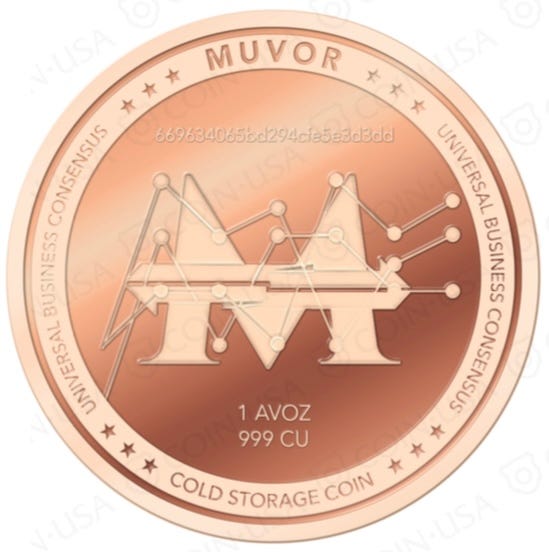
Muvor® Cold Storage
메타데이터
- post_id
- a413f214322f
- slug
- why-utxo-still-wins-stablecoins-hybrid-models-and-proof-of-activity-a413f214322f
- url
- https://medium.com/@muvor/why-utxo-still-wins-stablecoins-hybrid-models-and-proof-of-activity-a413f214322f
- canonical_url
- https://medium.com/@muvor/why-utxo-still-wins-stablecoins-hybrid-models-and-proof-of-activity-a413f214322f
- author_url
- https://medium.com/@muvor
- status
- ok
- fetched_at
- 2026-08-09 15:47:23