Cosmetics throughout the Centuries
A History of Cosmetics From Ancient Times
The History of Cosmetics
How the beauty industry has evolved
Crystal Gabriela, CC BY-SA 4.0 https://creativecommons.org/licenses/by-sa/4.0, via Wikimedia Commons
The modern term “cosmetic” originated in the ancient Roman public baths, used for an elegant physical hygiene system. The men’s bath included an unctuarium (a warm space of the ancient Roman bathrooms). Ointments for skin and facial care were applied to bathers by aliptes.
In the women’s bath, the ornatrix (A woman who beautifies another. A tire-woman managed female slaves who styled and dyed hair, applied facial makeup, performed manicures, and applied ointments to the skin.) The term for these slaves, cosmetae from the Greek cosmetikos (to arrange or to order), evolved into our modern word “cosmetic,” meaning to “beautify the body.”
For over 10,000 years, cosmetics have played a significant role in advancing from ancient civilization to the modern-day. Ancient men and women improved their looks and smell while curing irritating challenges to their vanity as baldness, grey hair, and wrinkles. In addition, cosmetics and perfumes were part of important religious beliefs and rituals in many ancient cultures, especially the dead’s burial.
Cosmetic products have a long, rich, and colorful history. They have been used worldwide for thousands of years to emote beauty, ceremonial and religious symbolism.
Ancient Egypt 3300 BC-
One of the earliest humans to use cosmetics were the ancient Egyptians. Both men and women used makeup to enhance their appearance. Ancient Egyptians were very concerned about losing hair and hiding wrinkles.
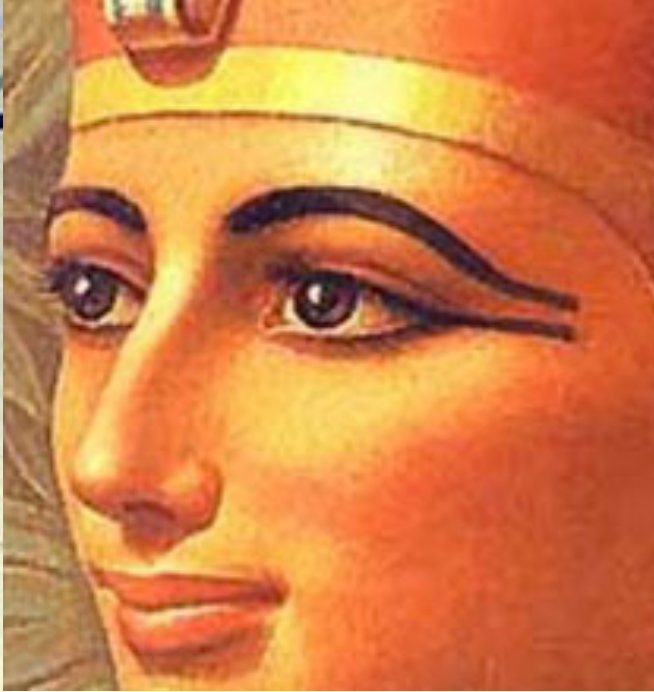
To promote hair growth, ointments were made from the fat or blood of various animals and reptiles. Creams to get rid of facial wrinkles were made of incense, wax, fresh olive oil, and ground cypress bark rubbed on the face. In addition, they used alabaster, natron, sea salt, and honey, all mixed with milk, to enhance their appearance. The use of black kohl eyeliner and eyeshadows in dark colors such as blue, red, and black was commonly shown and described in Egyptian art.
Indus Valley Civilization 3000–1600BC
The early art of cosmetics is believed to have originated in Egypt and India, but the earliest records of cosmetic substances and their application dates back to Circa 2600 and 1900 B.C., to the Indus valley civilization.
There is evidence of highly advanced self- beautification ideas and a vast array of several cosmetic usages both by men and women in ancient India. Many of these practices were for everyday rituals. The use of cosmetics was not only for improving the look and attractive personality but also for gaining honor and a long life with good health and happiness. In this context, the earliest evidence of a beautician is from the epic Mahabharata.
Chinese women used tea oil and rice powder masks they left during the night to beautify their faces and hide wrinkles. Their cosmetics were scented with incense, sandalwood, and other fragrances. Women used the black powder kajal, like kohl, on their eyes and painted or sometimes tattooed caste marks in the form of diamonds on their foreheads or their hands.
The following day after removing the mask, they would apply another powder, meen-fu, to their faces and red coloring to lips, cheeks, nostrils, and the tip of the tongue. The final touch was another rice powder to whiten their complexions. Some customs spread to Japan, where women used nioiabra, a cream for facial wrinkles made of wax and oil. Another preparation was made by grinding the azuki bean and mixing it with water to form a paste to be rubbed onto the face.
Ancient Greece and Rome 1000BC
The ancient Greeks and the Romans are also used cosmetics mentioned in the Old Testament, where the biblical character Jezebel painted her eyelids. Cosmetics are also incorporated into the book of Esther, where several beauty treatments are described. The use of oils and waxes for topical balms was common.
The Greek word kesmetikon means beautifying makeup that mainly refers to protecting hair, face, and teeth. Plants, flowers, spices, and fragrant woods from myrrh to oregano were infused in oil to make a rich perfume. As oil was used as the base, most perfumes were a thick paste; a unique fine spoon was used to scoop up the perfumes. Cosmetics and perfumes were used as a status symbol and in rituals (especially burials).
Wealthy women adopted some cosmetic practices from the Egyptians. The Roman upper class sometimes hired “cosmetae,” slaves entitled to apply cosmetics to rich Roman women.
The Common Era
After the Roman Empire fell, the use of cosmetics in Europe started to decrease. Catholic Church openly controlled their use, promoting their religious and medicinal threats. In the next five centuries, healing became a matter of faith, the sick being cared for by monks in monasteries. The Church dominated medicine. 100 BC — Christian females decided not to use many cosmetics, which started the belief of the future Catholic Church that cosmetic products are heretics and devil worshipers, especially red lipsticks. 200 to 1000 AD — Cosmetic products almost disappeared from Europe.
Cosmetics In the Middle Ages
The fall of the Roman Empire marked the end of Greek-Roman medicine and the rise of Islamic medicine. Paulus Aegineta formed a bridge of knowledge between the two religions, spreading their advancement to Europe. He recommended a type of dermabrasion using powdered ivory and crushed jellyfish.
From the 9th to 12th centuries, the Arabs united a civilization. Arab physicians had learned alchemy and medicine in Alexandria. These physicians had an in-depth knowledge of cosmetics. They developed a facial mask with rice powder, seashells, marble, crystal, limes, eggs, beans, and ground lentils. It was rubbed onto the face to produce superficial dermabrasion. A skin cleanser, hemsia, was made of almond oil.
Another facial ointment, shnouda, was scented with jasmine and benzoin. Their hair was dyed black with minium and litharge or golden-red with henna, perfumed with clove and other fine aromatic herbs. The Koran prohibited tattoos, so this technique died in the Islamic world. Avicenna (Ibn Sina), who was of Persian origin but whose works were widely known throughout the Arabic and Spanish worlds, is credited with the alembic and the first distillation of rose water.
When Arabs began to use distillation processes, a skin lotion made with rose water, honey, and Arabic gum became very popular. Arab physician, surgeon, and chemist Abulcasis (also known as “father of the modern surgery”) invented solid lipsticks, which women could apply to the lips without a paintbrush.
The Renaissance- 1300s to 1600s
In the 16th century, Italy and France emerged as the leading European cosmetic product centers, and only the nobility had access. As a result, the current concept of complex scent-making originates in France. Early fragrances were amalgams of naturally occurring ingredients. For example, arsenic was sometimes used in face powder instead of lead. Later, synthetic processes for mixing and testing perfumes surpassed their strenuous and labor-intensive predecessors.
European women often attempt to lighten their skin using a variety of products, including white lead paint. Queen Elizabeth I of England was one well-known user of white lead, with which she created a look known as “the Mask of Youth.” Blonde hair rose in popularity as it was considered holy. Mixtures of black sulfur, alum, and honey were painted onto the hair.
17th Century Europe
The first stores to make perfumes appeared in Paris. Perfumes were made fashionable by France’s kings. Perfumers also made ointments to treat facial wrinkles. These original ointments, treated as secret formulae, were made from apples that contain malic acid, an alpha-hydroxy acid.
In England, the Restoration brought a reaction to Puritan austerity. Baths on the Roman model were installed in London. Self-styled beauty specialists increased very quickly. Women and ladies of the court had learned cosmetology from other European countries. Like the other beauty specialists, they advertised via pamphlets and worked out of their own wealthy houses.
No one knows what was in these products. The formula for making cosmetics was kept secret. Because their manufacturers had no chemical knowledge, references to the contents are very scarce. Mainly women of the upper classes used such products.
18th Century Europe
Excessive use of makeup, perfumes, and other artifices in England motivated the introduction in Parliament of a bill that all women wearing scents, paints, cosmetic washes, hoops, high-heeled shoes, and lipstick shall be punished. This bill was not made into law. Still, a mandate from the British Council of Churches prohibited women from using tattoos, from applying facial cosmetics or black patches, and from wearing immodest dresses.
Some English perfumeries combined the sale of perfumes and cosmetics with that of medicine, a concept still practiced in our new drug stores. Under the protection of the law, some barber surgeons established businesses that offered baths, pedicures, manicures, shaving, powdering of wigs and hair, teeth extraction, and bloodletting.
Many barbers traveled from town to town in extravagant style. They dressed even more extravagantly to attract business. They rode in exotic chariots pulled by fine horses and equipped with bells and the means to drench this noisy atmosphere with their sweet perfumes.
Sometimes they traveled with troops of musicians and animals. Barbers and noble ladies were now competing — the latter knew how to perform the cosmetic procedures, but barbers had more credibility among people. Probably because of this conflict, in 1745, George II created a legal separation between physicians and barber-surgeons. Afterward, physicians regrouped to form what would become, some decades later, the Royal College of Surgeons. By the middle of the 18th century, the cosmetic disease was well recognized. When the Countess of Coventry, one of the famous Gunning sisters, died on October 1, 1760, she was identified in the press as “a victim to cosmetics.”
The 19th Century United States
Because of the limited lighting in the theatrical world, men and women had to resort to using unhealthy substances to brighten their appearance, one of which was white lead.
Typical of the tragedy was a 19-year-old Ohio woman who, after prolonged use, became so incapacitated from the metal that she could no longer apply the whitening to her face herself. Instead, she hired others to do this for her. At length, she could no longer keep her head straight without a supporting apparatus strapped to her neck. Another device was necessary to camouflage her wrist drop and keep her fingers straight. No physician in Ohio seemed able to help her, so she consulted several celebrated New York specialists, one of whom finally identified the cause.
The 20th Century
Several practical yet powerful inventions facilitated the modern use of cosmetics:
- The toothpaste tube
- The compact powder
- The safety razor
- The aerosol container
- The retractable lipstick container springing from the clever mind of one Maurice Levy
But the advance on middle-class reluctance that altered the cosmetic mood in the 20th century can be connected to the vigor and the daring business chances of a Polish immigrant moving to the United States, the remarkable Helena Rubenstein. By 1908, when Ms. Rubenstein began to work her magic, actresses were the only women in America who dared to be seen in public with, as she put it, “anything but the lightest glim of rice powder. But makeup as it was to develop,” she continued, “was unheard of outside the world of the theater, although I experimented privately and learned many valuable lessons from stage personalities, which in turn I taught to a few of my more daring clients. They spread the word, and I knew that the public would soon topple another beauty barrier.”
Photo by freestocks on Unsplash
21st Century
We have come a long way in terms of beauty and cosmetics. The 21st century brought a surge of innovation to the beauty industry, taking it to a whole new level. As a result, permanent makeup, botox to treat wrinkles, and breast enlargement have become very common.
The popular idea of the 20th century and before that was only rich women could use cosmetics. This idea has changed in the 21st century; now, beautification is for everyone. Cosmetics are widely available at affordable prices.
As gender equality movements progress, the line separating who can and can’t wear cosmetics blurs. Now everyone, regardless of their gender or wealth, has access to beautification.
The cosmetic industry has become a huge part of our economy, at $511 BILLION as it’s worth.
References
https://en.wikipedia.org/wiki/History_of_cosmetics
https://www.ncbi.nlm.nih.gov/pmc/articles/PMC2825132/#CIT3
https://en.wikipedia.org/wiki/Beauty_and_cosmetics_in_ancient_Egypt
메타데이터
- post_id
- a44c0b92df7d
- slug
- cosmetics-throughout-the-centuries-a44c0b92df7d
- url
- https://medium.com/@gupta-monika2050/cosmetics-throughout-the-centuries-a44c0b92df7d
- canonical_url
- https://medium.com/@gupta-monika2050/cosmetics-throughout-the-centuries-a44c0b92df7d
- author_url
- https://medium.com/@gupta-monika2050
- status
- ok
- fetched_at
- 2026-08-12 09:31:03