Zero Trust Security and Its Implementation in Java Microservices
Modern applications are increasingly built using microservices architectures, where multiple small services communicate with each other…
Zero Trust Security and Its Implementation in Java Microservices
Modern applications are increasingly built using microservices architectures, where multiple small services communicate with each other over networks. While this architecture improves scalability and flexibility, it also expands the attack surface. Traditional security models assume that everything inside the network is trusted. However, with cloud computing, remote work, and distributed systems, this assumption is no longer safe.
This is where Zero Trust Security comes in.
Zero Trust is a modern security model based on the principle:
“Never trust, always verify.”
Every request — whether from inside or outside the network — must be authenticated, authorized, and validated before access is granted.
What is Zero Trust Security?
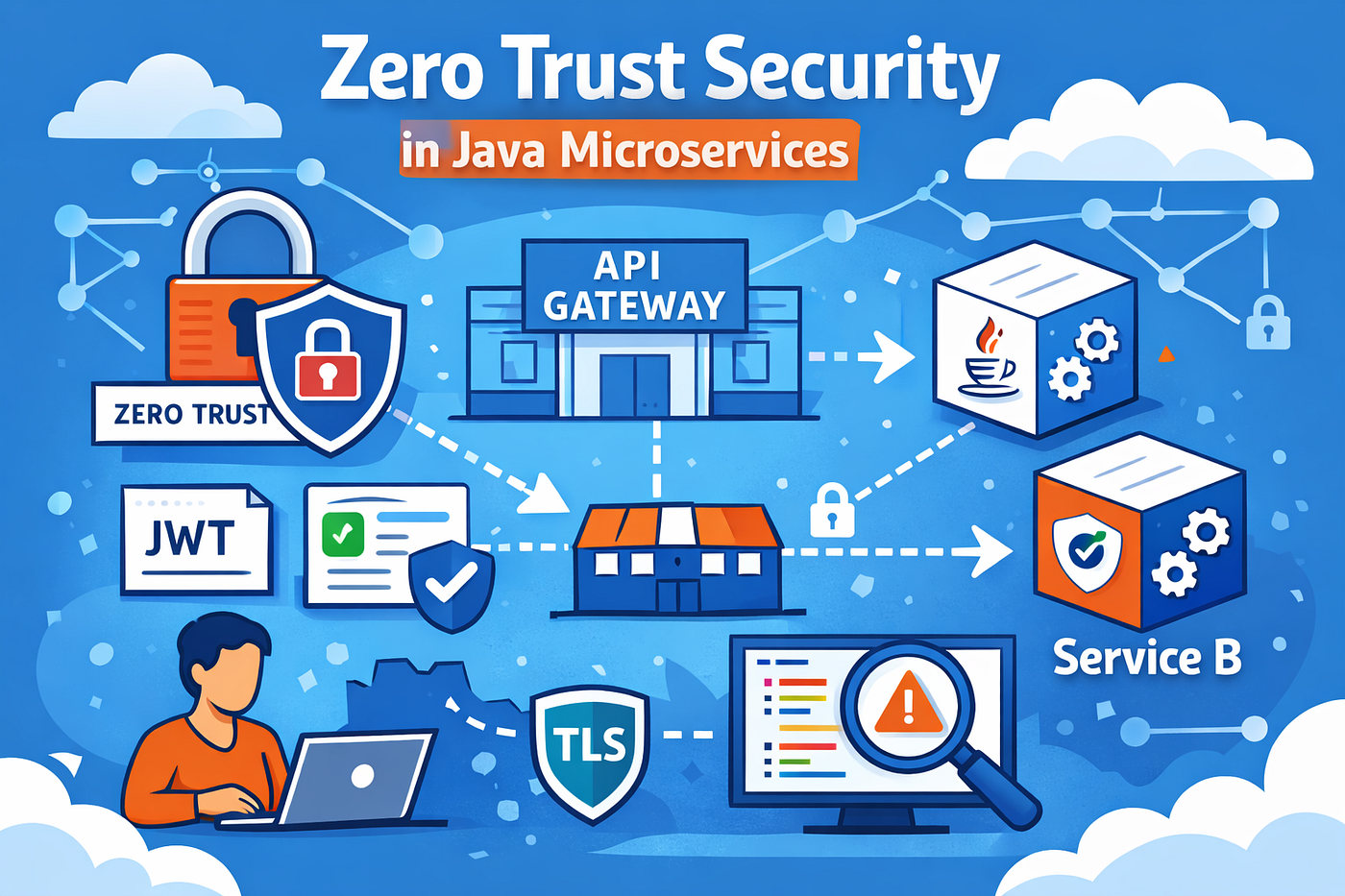
Zero Trust is a cybersecurity framework where no user, device, or service is trusted by default, even if they are inside the network perimeter.
Instead, every interaction must pass security checks.
Core Principles of Zero Trust
1. Verify explicitly
- Authenticate and authorize every request.
- Use identity, location, device health, and risk signals.
2. Least privilege access
- Give users and services only the permissions they need.
3. Assume breach
- Design systems assuming attackers may already be inside the network.
4. Continuous monitoring
- Monitor and validate requests throughout the session.
Why Zero Trust is Important for Microservices
In a microservices architecture, services communicate with each other through APIs. Without strong security, attackers can exploit internal services.
Challenges include:
- Service-to-service authentication
- Unauthorized internal access
- API abuse
- Lateral movement of attackers
- Credential leakage
Zero Trust addresses these by ensuring every service call is authenticated and authorized.
Key Components of Zero Trust Architecture
1 Identity and Access Management (IAM)
Identity becomes the new perimeter. Users and services must authenticate using strong mechanisms such as:
- OAuth 2.0
- OpenID Connect
- JWT tokens
- Multi-factor authentication (MFA)
2 Strong Authentication
Every request must include verifiable credentials.
Common authentication methods:
- JWT tokens
- API keys
- OAuth access tokens
- Mutual TLS (mTLS)
3 Service-to-Service Authentication
Microservices must verify each other.
Common approaches:
- mTLS certificates
- Signed JWT tokens
- Service mesh identity (SPIFFE)
4 API Gateway Enforcement
All requests should pass through a secure gateway that enforces policies such as:
- Authentication
- Rate limiting
- Authorization
- Logging
Examples include:
- Kong
- Apigee
- Spring Cloud Gateway
5 Continuous Monitoring
Security teams must monitor:
- API requests
- Access patterns
- Unusual behavior
- Token misuse
Implementing Zero Trust in Java Microservices
Java ecosystems provide strong frameworks for implementing Zero Trust.
Typical stack:
- Spring Boot
- Spring Security
- OAuth2 / OpenID Connect
- JWT
- API Gateway
- Service Mesh (Istio / Linkerd)
Step 1: Secure APIs using Spring Security
Spring Security enables authentication and authorization for microservices
Step 2: Use JWT Tokens for Identity Verification
JWT tokens securely carry identity and authorization data.
Step 3: Implement OAuth2 Authorization Server
Use an identity provider such as:
- Keycloak
- Auth0
- Okta
- Spring Authorization Server
Flow:
- User logs in
- Identity provider issues JWT
- Client calls API with token
- Microservice validates token
Step 4: Implement Service-to-Service Security
Microservices must authenticate when calling each other. (using JWT propagation)
Service A calls Service B with the same token.
Step 5: Implement Mutual TLS (mTLS)
mTLS ensures both client and server verify certificates.
Benefits:
- Strong service identity
- Encrypted communication
- Prevents unauthorized services
This is often implemented through a service mesh like Istio.
Step 6: Use an API Gateway
API Gateway acts as the security enforcement point.
Responsibilities include:
- Token validation
- Rate limiting
- Authentication
- Logging
- Request filtering
Example: Spring Cloud Gateway
Step 7: Implement Fine-Grained Authorization
Use Role-Based Access Control (RBAC) or Attribute-Based Access Control (ABAC).
Best Practices for Zero Trust in Java Microservices
- Enforce authentication for every request
- Use strong identity providers
- Secure service-to-service communication
- Implement API gateways
- Encrypt all communication using TLS
- Monitor logs and security events
- Rotate credentials regularly
- Apply least privilege access
Challenges of Zero Trust
Despite its benefits, implementation can be complex:
- Managing certificates
- Token lifecycle management
- Identity federation
- Latency due to security checks
- Operational overhead
However, modern tools and automation make adoption easier.
Conclusion
Zero Trust Security is essential for modern cloud-native applications and microservices architectures. By removing implicit trust and enforcing strong verification at every layer, organizations can significantly reduce security risks.
In Java ecosystems, frameworks like Spring Security, OAuth2, JWT, API Gateways, and Service Mesh technologies make it possible to implement Zero Trust effectively.
Organizations adopting Zero Trust gain:
- stronger protection against breaches
- better visibility into system access
- improved control over microservices communication
As distributed systems continue to grow, Zero Trust will become a foundational security standard for microservices architectures.
메타데이터
- post_id
- a44f4e031284
- slug
- zero-trust-security-and-its-implementation-in-java-microservices-a44f4e031284
- url
- https://medium.com/@code.chandrashekhar/zero-trust-security-and-its-implementation-in-java-microservices-a44f4e031284
- canonical_url
- https://medium.com/@code.chandrashekhar/zero-trust-security-and-its-implementation-in-java-microservices-a44f4e031284
- author_url
- https://medium.com/@code.chandrashekhar
- status
- ok
- fetched_at
- 2026-08-15 22:52:36