When AI Finishes Efficiency, What Is a Human Still Worth?
AI is faster, cheaper, and more accurate than humans. When efficiency becomes the default, it stops being valuable. So the real question is…
When AI Finishes Efficiency, What Is a Human Still Worth?
AI is faster, cheaper, and more accurate than humans. When efficiency becomes the default, it stops being valuable. So the real question is no longer what AI can do — but what humans are still paid for.
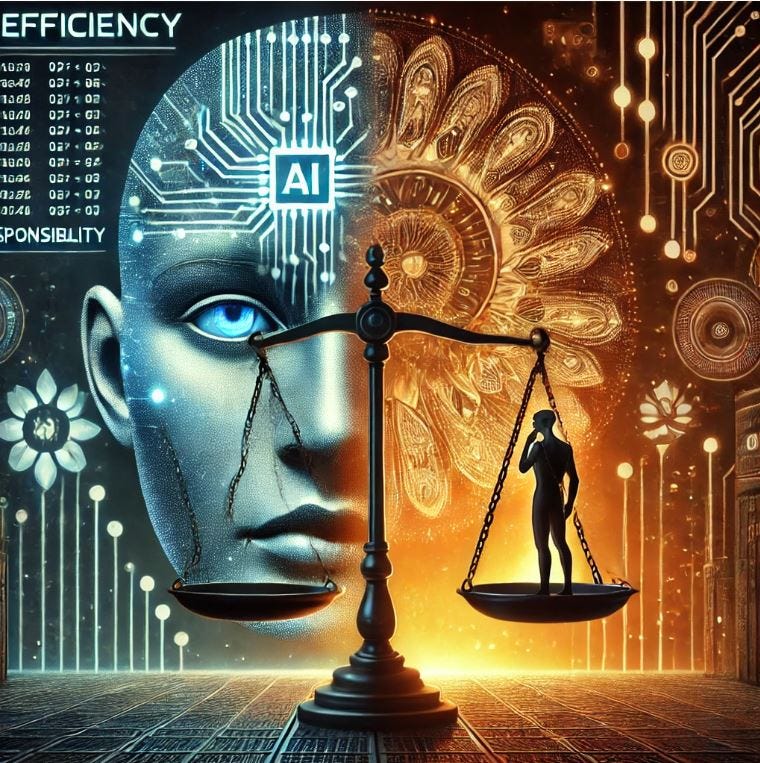
When AI Finishes Efficiency, What Is a Human Still Worth?
For centuries, humans were defined by inefficiency. We got tired, made mistakes, hesitated, and wasted resources. Technology evolved to correct exactly that.
Faster. Cheaper. More accurate.
AI represents the near-completion of this trajectory. Computation, summarization, optimization, prediction — all approaching zero marginal cost.
Efficiency is no longer a competitive advantage. It is the environment.
And that raises the real problem.
In a world where everyone is efficient, what still has a price?
Why Humans Desired Efficiency in the First Place
Humans desired efficiency because they lacked it.
We are biologically constrained. Emotionally unstable. Prone to error. Limited by time and energy.
Efficiency was never our essence. It was a response to scarcity.
The slow wanted speed. The uncertain wanted clarity.
Efficiency was not who we were — it was what we wanted to escape from.
Why AI Does Not Desire Inefficiency
AI is structurally different.
It does not experience lack. It does not reject its own state. It does not want to become something else.
AI does not desire inefficiency. It only deploys it when useful.
This is the first real divergence between humans and machines.
The urge to seek what one does not possess is uniquely human.
Where Inefficiency Turns Into Value
A common misconception persists: that things become expensive because they take more time.
That is false.
People do not pay for labor time. They pay for risk removed from their future.
Time has layers.
- Physical time: execution and labor
- Cognitive time: thinking, comparing, hesitating
- Existential time: irreversible consequences of wrong choices
Only the third layer carries real price.
People are not buying time. They are buying the right not to lose it.
Why Judgment Remains Expensive
Information is now free. Explanation is abundant.
Judgment is not.
Because information carries no responsibility. Judgment produces consequences.
People do not pay to know more. They pay to know what choice is acceptable.
Expensive judgment shares one feature:
Being wrong is costly.
The Illusion of ‘AI Can Decide What Not to Do’
A frequent counterargument appears here.
Doesn’t AI already tell us what not to do?
Yes — but with a crucial distinction.
AI eliminates options through calculation. Humans eliminate futures through commitment.
AI can say: “This option has low expected value.”
Only humans can say: “We are not taking this path.”
And live with the aftermath.
Reputation loss. Career damage. Ethical accountability.
AI does not absorb consequences. Humans do.
Where Free Ends and Paid Begins
The dividing line is clear.
Free content expands possibilities. Paid judgment reduces them.
Free information opens doors. Paid judgment closes most of them.
And closing doors always requires responsibility.
The Roles That Become More Valuable After AI
The highest-paid human roles after AI share a structure — not a job title.
They are roles that:
- Decide yes or no when data is already available
- Design the criteria others must follow
- Eliminate most options after considering all of them
Their common trait is simple.
They absorb outcomes.
Conclusion
After efficiency is completed, human value emerges from inefficiency — but not slowness or incompetence.
It comes from:
- Time spent thinking so others don’t have to
- Responsibility carried so others can move forward
- Futures eliminated so mistakes don’t compound
When these converge, inefficiency becomes price.
FrameLAB
AI can calculate for us. But the cost of judgment remains human.
The most valuable people in the AI era will not be those who know more — but those who can narrow choices and live with the consequences under their own name.
The world looks complex — until you see the frame. — FrameLAB by BeomView
메타데이터
- post_id
- a45e9b6574c2
- slug
- when-ai-finishes-efficiency-what-is-a-human-still-worth-a45e9b6574c2
- url
- https://medium.com/@beomview/when-ai-finishes-efficiency-what-is-a-human-still-worth-a45e9b6574c2
- canonical_url
- https://medium.com/@beomview/when-ai-finishes-efficiency-what-is-a-human-still-worth-a45e9b6574c2
- author_url
- https://medium.com/@beomview
- status
- ok
- fetched_at
- 2026-06-17 12:55:42