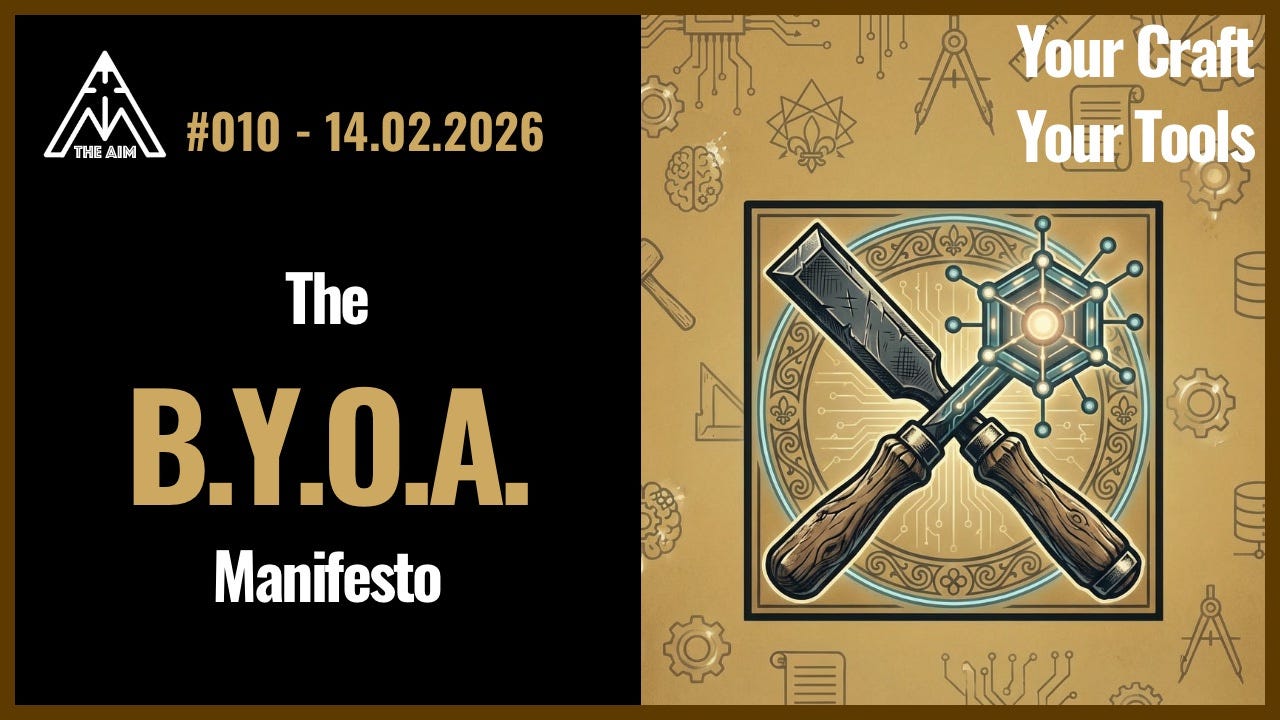
The BYOA Manifesto: Why Knowledge Workers Must Own Their AI Agents (The AIM — Episode 010)
From medieval guilds to agentic AI: the case for treating your personal agents as intellectual capital, not corporate property. In this new…
The BYOA Manifesto: Why Knowledge Workers Must Own Their AI Agents (The AIM — Episode 010)
From medieval guilds to agentic AI: the case for treating your personal agents as intellectual capital, not corporate property. In this new economy of AI, workers of the world and experts of the world: defend your knowledge. Build your own agents and your own AI framework. Then come to workplaces that will welcome you and your agents, not just you, disempowered.
The 30-Second Takeaways
- Corporate AI systems extract your expertise into assets you do not own and cannot take with you. This is the defining labour question of the twenty-first century.
- The medieval guild model had it right: masters owned their tools. BYOA applies that principle to AI agents.
- Four waves of automation have progressively targeted muscle, routine cognition, professional expertise, and now (with embodied AI) everything.
- Early-career workers aged 22 to 25 have seen a 16% employment decline in AI-exposed occupations. Experience still protects seniors. For now.
- 54% of employees would use AI tools without approval. 70% using ChatGPT have not told their boss. Shadow AI is already here.
- BYOD (Bring Your Own Device) solved the same tension a decade ago through containerisation, certificates, and mutual trust. BYOA follows the same logic.
- Owning your agent means owning the personalisation layer: your prompts, RAG knowledge bases, memory, workflows, and fine-tuned configurations.
- Enterprise integration is feasible today: agent identity via PKI certificates, IAM onboarding, agentic marketplaces, sandboxed execution, and time-bound delegation.
- AI is not just a tool. It is a fifth dimension of human self-projection: your kung fu, amplified rather than extracted.
- The five principles: your agents are your capital; do not surrender your kung fu; demand portability; insist on mutual security; push for standards at scale.
- BYOA-friendly companies will win the talent war. The best knowledge workers will choose employers who respect their intellectual capital.
- Start this week: export your prompts, build a personal RAG, explore MCP-compatible tools. Your kung fu is your responsibility.

I. The Cathedral and the Toolbox
When the master stonemason arrived at a medieval cathedral construction site, he brought his tools with him. His chisels, his mallets, his squares and compasses: these were not the property of the bishop who commissioned the building, nor the master builder who coordinated the work. They were his. They represented decades of accumulated skill, encoded in the wear patterns of handles shaped to his grip, in blades sharpened to angles that suited his technique. His toolbox was, in the most literal sense, his capital.
This was not a quaint arrangement. It was the foundational economic logic of the guild system that built European civilisation from the twelfth century onwards. Medieval craft guilds operated on an explicit principle: masters owned their own means of production in the form of their workshop and tools. The guild protected the craftsman’s right to practise his trade, guarded the secrets of his techniques, and ensured that his accumulated expertise could not be simply extracted by those who employed him. The fourteenth-century York bowyers forbade their servants from teaching their craft to outsiders for money (Epstein & Prak, 2008). A stonemason’s knowledge of how to read stone grain, how to strike a chisel at precisely the angle that would yield a clean cut rather than a fracture: this was knowledge earned through years of apprenticeship and journeyman work, and it remained irrevocably his.

When guilds eventually fell, dissolved by the forces of market liberalisation after the French Revolution in France and the Gewerbeordnung reforms in Germany, former handicraft workers were “forced to seek employment in the emerging manufacturing industries, using not closely guarded techniques formerly protected by guilds, but rather the standardised methods controlled by corporations.” The parallel to what is happening now, in the age of AI, is exact.
We need to talk about why this matters more today than it has in five hundred years.
II. The Economics of Extraction
There is a pattern in how labour relates to capital that Karl Marx identified in 1867 and that remains stubbornly relevant: the owners of the means of production extract surplus value from those who do the actual work. For Marx, “all commodities are only definite masses of congealed labour time.” The capitalist pays the worker enough to reproduce their labour, then captures the difference (the surplus) as profit.

For over a century, the Marxist framework was applied primarily to physical labour: factory workers, miners, agricultural labourers. The means of production were tangible: machinery, land, raw materials. Workers who lost access to those means had nothing left to sell but their muscle.
Then something shifted. The twentieth century saw the progressive dematerialisation of value creation. Physical labour gave way to skilled labour, which gave way to knowledge labour. By the turn of the millennium, the most valuable companies on Earth produced nothing you could hold in your hand. Their means of production were algorithms, databases, intellectual property, and, critically, the expertise of their employees.
Italian autonomous Marxists were among the first to see this clearly. Lorenzo Cillario developed the concept of “cognitive capital” to describe how codified knowledge (what he called “dead mental labour”) conditions and directs “living mental labour”: the contextual, embodied, adaptive knowledge that workers carry in their heads (Karakilic, 2022). Christian Fuchs (2014) extended the Marxian value schema to platform economies. Mariano Zukerfeld introduced “cognitive materialism” to describe knowledge as a form of capital. More recently, the ISSPLC (2025) argued that AI does not eliminate living labour but transforms its form, shifting workers towards “algorithm design, system architecture, ethical governance, and strategic decision-making.” The question is whether workers will own those new roles or have them extracted too.
Here is where the story turns uncomfortable. In the cognitive economy, the means of production increasingly reside inside the worker’s head. A senior data scientist’s understanding of Bayesian inference, a marketing strategist’s instinct for consumer psychology, a software architect’s mental model of distributed systems: these are not factory equipment that can be locked in a building when the worker goes home. They travel with the worker. They are the worker.
Until now.

Artificial intelligence, for the first time in the history of labour, offers capital a mechanism to extract, codify, and retain the tacit knowledge that has always been the worker’s ultimate leverage. When a knowledge worker trains a corporate AI system, feeding it their decision frameworks, their domain expertise, their years of pattern recognition, they are, in effect, pouring their intellectual capital into a vessel owned by someone else. And unlike the stonemason’s chisel, that vessel does not go home with them at the end of the day.
Daron Acemoglu and Simon Johnson put the matter plainly in Power and Progress (2023): “The path of technology was once, and may again be, brought under control.” Technology’s benefits, they demonstrate across a thousand years of evidence, are not automatic; they depend on institutional design and power distribution. Whether AI produces broadly shared prosperity or concentrated wealth depends on who owns the tools. BYOA is a position on that ownership.
This is not a theoretical concern. It is the defining labour question of the twenty-first century.

III. Robotics Took Your Muscle. AI Wants Your Mind. Embodied AI Wants Everything.
The history of automation is a history of progressive displacement. Each wave has targeted a different layer of human capability.
The first industrial revolution mechanised physical force. The power loom replaced the weaver’s arms. The steam engine replaced the horse. Workers who had sold their strength found that strength had been commoditised. But the Luddites who resisted were not, as popular mythology holds, anti-technology. Kevin Binfield’s scholarship (2004) reveals they “just wanted machines that made high-quality goods, and they wanted these machines to be run by workers who had gone through an apprenticeship and got paid decent wages.” They opposed not the machine, but the machine wielded against their interests. We would do well to recover their clarity.
The second wave mechanised routine cognition. Spreadsheets replaced bookkeepers. Assembly lines replaced craftsmen with process workers. Autor, Levy and Murnane (2003) established the foundational framework: computers substitute for routine cognitive and manual tasks while complementing non-routine analytical and interactive tasks. Skill was decomposed into repeatable steps that any trained operator could perform. But the non-routine (the judgement, the creative leap, the embodied expertise) remained stubbornly human.
The third wave, the one we are living through, mechanises expertise itself. When an AI system can diagnose a medical scan with a radiologist’s accuracy, draft a legal brief with a solicitor’s precision, or architect a software system with a senior engineer’s judgement, it is not replacing muscle or routine. It is replacing kung fu.
And the fourth wave is already visible on the horizon: embodied AI. The convergence of generative intelligence with physical robotics, courtesy of Nvidia, OpenAI, Google, and others, will generalise what we are describing for knowledge workers to every job. Robots have performed hard, strenuous, repetitive tasks in factories for decades. But now we are equipping them with reasoning, abstraction, and sophisticated communication capabilities. Window-cleaning operators already manage fleets of wall-climbing robots that clean large panes with water, steam, and cleaning products more efficiently than any human crew: one supervisor where ten workers used to be. It will not be long before a robotic plumber arrives at your door.

Consider robotic surgery. The most talented and expert surgeons are now outperformed by AI-assisted robotic systems in tasks requiring mechanical precision (artery clamping, tumour excision) with accuracy no human hand can match. That is great news for the patient. But what about the surgeon? First, they are placed in a supervisory and monitoring role. Then, gradually, they are taken out of the loop entirely. And here lies the deeper threat: being a surgeon requires hundreds of hours of practice, dozens of procedures, and, inevitably, mistakes. Misjudgement. Because that is how humans learn. That is how they master the kung fu of their discipline. If robots perform all the procedures, the pipeline of human expertise dries up. We do not merely lose jobs. We lose the capacity to produce experts. At this rate, in a matter of a decade, certain professions may disappear not because nobody wants to do them, but because nobody has been allowed to learn them.
That term, gōngfu (功夫), deserves its proper meaning here. In Chinese, it does not refer to martial arts. It means “skill achieved through hard work and time.” The character gōng (功) means achievement or merit. The character fū (夫) means time and effort. Together: mastery earned through dedicated, patient, lifelong practice. A master calligrapher has kung fu. A master tea-maker has kung fu. A master diagnostician has kung fu.
What happens when kung fu becomes extractable?
The empirical evidence is now unambiguous. Brynjolfsson, Chandar and Chen (2025), using payroll data covering millions of US workers, document a sixteen per cent relative employment decline for early-career workers (ages 22–25) in AI-exposed occupations since late 2022, while workers aged thirty and over in the same occupations saw six to twelve per cent growth. The implication is stark: experience and tacit knowledge still protect senior workers. Junior workers, who have not yet accumulated that protective layer of embodied expertise, are being displaced first.

Acemoglu, Kong and Restrepo (2024) quantify the mechanics with granular precision: a ten per cent loss of tasks to automation produces a twelve per cent relative wage decline and an 8.2 per cent reduction in hours worked. Conversely, ten per cent new task creation produces an 8.5 per cent wage increase and a twenty-six per cent increase in hours. Automation and new task creation together account for sixty-seven to eighty-four per cent of all wage changes. The economics could not be clearer: the question is whether AI creates new tasks for workers or merely automates existing ones. BYOA is a mechanism for new task creation. Workers who own and customise agents create capabilities that did not previously exist.
McKinsey (2023) estimates generative AI could add $2.6–4.4 trillion in annual value, concentrated in knowledge-intensive work. The World Economic Forum (2025) predicts every industry will see a decrease in tasks performed exclusively by humans by 2030. The IMF (2024) estimates forty per cent of global employment is exposed to AI.
These are not fringe projections. These are the central estimates. And they account only for digital AI. When embodied AI matures, and it is maturing fast, the total exposure will be vastly larger.

IV. The “Thank You, We’re Done With You” Scenario
Consider the trajectory of a senior knowledge worker in a typical enterprise AI deployment.
In phase one, they are celebrated: their expertise is essential for training, fine-tuning, and validating AI systems. They provide the ground truth against which models are evaluated. They encode their decision frameworks into prompts, their domain knowledge into retrieval-augmented generation systems, their judgement into evaluation rubrics.
In phase two, the AI reaches competence. It can handle routine cases. The expert is still needed for edge cases, quality assurance, strategic thinking.
In phase three (and this is the phase that should keep every knowledge worker awake at night) the AI’s performance converges with the expert’s across most dimensions. The expert’s role shrinks to oversight. Their unique value proposition, the kung fu that took twenty years to develop, now lives inside a system they do not own, cannot take with them, and have no legal claim over.
Phase four: “Thank you. We might be done with you.”

This is not science fiction. It is the stated business case for enterprise AI adoption. PwC (2025) reports eighty-eight per cent of enterprises are increasing AI agent budgets, with seventy-nine per cent already in active deployment. Deloitte (2025) projects twenty-five per cent of generative AI-using companies will launch agentic AI pilots in 2025, rising to fifty per cent by 2027. The agentic AI market is projected to grow from 5.25 billion in 2024 to 199 billion by 2034, a forty-four per cent compound annual growth rate (Arcade.dev, 2025). The entire economic rationale of corporate AI investment rests on the premise that human expertise can be captured, systematised, and eventually substituted. When a CEO tells shareholders that AI will “drive efficiency,” this is precisely what they mean: the same output with fewer expensive humans.
The concentration of AI capability among a small number of hyperscalers amplifies this risk enormously. As the AI Now Institute (2023) documents, AI is “foundationally reliant on resources owned and controlled by only a handful of Big Tech firms.” Meredith Whittaker (2024) is more blunt: “Infrastructure isn’t just chips. Infrastructure is data infrastructure, is labor infrastructure, is the sedimentary layers of standards and practices… Google owns TensorFlow, Meta directs PyTorch; all this is the water in which AI research swims.” When the tools of knowledge extraction are controlled by a handful of corporations, individual workers have vanishingly little bargaining power.
Shoshana Zuboff (2022) names the deeper structure: surveillance capitalism, built on the commodification of human behaviour and the concentration of computational knowledge. Personal AI agents, in Zuboff’s framework, represent a structural disruption to the “surveillance dividend,” because an agent you own does not report to someone else’s balance sheet.
The guild system’s genius was in recognising that collective organisation around tool ownership was the only defence against exactly this kind of power asymmetry.

V. Wu Wei, the Meaning of Mastery, and the Fifth Dimension
Before we turn to solutions, it is worth pausing on what is truly at stake. The displacement of knowledge workers is not merely an economic problem. It is an existential one.
The philosopher Michael Polanyi articulated the foundational insight in 1966: “We can know more than we can tell.” His concept of tacit knowledge (the tradition, inherited practices, implied values, and embodied understanding that cannot be reduced to explicit rules) is the anchor of this entire argument. David Autor (2014) named the employment implication “Polanyi’s paradox”: “Our tacit knowledge of how the world works often exceeds our explicit understanding; [this] foretells much of the history of computerisation over the past five decades.” For as long as Polanyi’s paradox held, human expertise was safe from automation. The question of our era is whether large language models have overcome it.
The Dreyfus brothers’ five-stage model of skill acquisition (1980/2004) provides the map. A novice follows explicit rules. An advanced beginner recognises patterns. A competent practitioner plans deliberately. A proficient practitioner perceives situations intuitively. An expert acts fluidly, without deliberation: “When things are proceeding normally, experts don’t solve problems and don’t make decisions; they do what normally works.” Hadjimichael, Ribeiro and Tsoukas (2024) explain the mechanism: as a learner develops from novice to expert, their body transforms from “objective” to “phenomenal,” and task-specific particulars recede into subsidiary awareness. The tool becomes an extension of the self. This is not metaphor. It is phenomenology.
Richard Sennett’s The Craftsman (2008) provides the sociological foundation: “All skills, even the most abstract, begin as bodily practices; technical understanding develops through the powers of imagination.” And critically: “A tool, unlike a machine, is unable to produce any ‘thing’ without the willful and deliberate act of the craftsman.” This distinction between tool and machine is pivotal for BYOA. A personal AI agent, properly configured, is a tool; it requires the craftsman’s intent, direction, and judgement. A corporate AI system, hoovering up expertise and operating autonomously, is a machine; it produces without the craftsman’s willing participation.
Matthew Crawford, in Shop Class as Soulcraft (2009), pushes further: “Being master of our own stuff exemplifies self-reliance, which is a form of individual agency and creates meaning.” Rostain and Clarke (2025) confirm this empirically in Organization Studies: even workers in supposedly “low-skilled” roles engage in “anomalous craft,” creating their own tools and setting quality standards to gain autonomy and recognition. The impulse to mastery is universal.
The Japanese concept of ikigai (reason for being) holds that a meaningful life sits at the intersection of four elements: what you love, what you are good at, what the world needs, and what you can be paid for. For millions of knowledge workers, their professional expertise occupies all four quadrants simultaneously. They love solving complex problems. They have spent decades becoming good at it. The world needs their judgement. And they are compensated for it. Strip away the third and fourth elements, because an AI can now do what the world needs and do it more cheaply, and you do not merely have an unemployment problem. You have a meaning crisis. You have the collapse of ikigai. Kumano (2017) identifies ikigai as eudaimonic well-being: well-being through meaning, not pleasure. What is threatened is not comfort but purpose.
The Daoist principle of wu wei (無為), effortless action, non-forcing, acting in harmony with the natural flow of things, offers a subtler lens. Wu wei does not mean doing nothing. It means acting in perfect alignment with the way of things, the way water follows the contours of a landscape. Robin Wang (2019) argues that Daoism supports AI’s development, but with a crucial distinction: wu wei demands technology that achieves “effortless alignment with the natural flow of things” rather than domination. The Diplomacy.edu analysis (2024) extends this: wu wei “implies that innovation should evolve organically, without excessive manipulation or overregulation… adaptiveness over control, modesty in design, and the use of technology as a responsive participant in human life, not its domineering master.”

A master craftsman in a state of wu wei does not force the material; they respond to it, their skill so deeply internalised that conscious effort dissolves into intuitive action. Zhuangzi told the parable of the wheelwright Bian, who explained to Duke Huan that the right pace of chiselling “cannot get into the hand unless it comes from the heart” and “cannot be put into words.” This state, the seamless fusion of knowledge, experience, and embodied skill, is precisely what AI cannot replicate and what makes human expertise irreplaceable in its deepest form.
But it is also precisely what is lost when expertise is reduced to extractable data points. The corporate AI pipeline does not capture wu wei. It captures the outputsof wu wei (the decisions, the recommendations, the patterns) and discards the living, responsive intelligence that generated them.
And yet, here is the counterweight to despair: AI opens a dimension of existence that has never before been available to the individual. We project ourselves today in the four dimensions of space and time. We live and breathe in space. We make memories backwards in time and project ideas forward in time through the creation of writing, art, or simply through influencing the course of events, making history. So far, that is how humans have existed and left their footprint in their epoch, their space-time frame.
Now a fifth dimension opens. AI offers a space where we can not only project ourselves but augment ourselves, multiplying ourselves into entities that are powerful, versatile, and mobile in ways our physical selves could never be. A personal agent is not just a tool. It is a unique projection of oneself into the digital and agentic space, shaped, trained, and nurtured by a unique human, carrying that human’s perspective, style, values, and accumulated craft. It is individuality, extended. It is kung fu, amplified rather than extracted.
“I will only speak in the presence of my agent.”
That is not a joke anymore. It is the emerging reality of the knowledge worker in 2026. The world is already too complex to navigate without augmentation. We are bombarded by interactions triggered, upstream or downstream, by agents. Newsletters, social networks, mobile apps, commercial platforms: everywhere you have an information-based interaction, agents are behind the scenes processing the content you ingest or the content you produce. Facing such cognitive overload, of course we need our own agents to automate, filter, and make sense of this deluge. The question is not whether you will have an agent. It is whether it will be yours.
Hannah Arendt (1958) distinguished three fundamental human activities: labour (biological, repetitive, consumed in the process), work (creation of lasting things through purposeful engagement with the world), and action (the political expression of freedom). Corporate AI extraction reduces knowledge work to labour: repetitive, replaceable, consumed by the machine. BYOA restores it to work: purposeful, enduring, and irreducibly human. A civilisation that permits the wholesale extraction of its masters’ kung fu without giving those masters ownership of the tools that extend their capabilities is a civilisation that has confused information for wisdom, and efficiency for meaning.

VI. It’s Already Happening, Whether You Like It or Not
Before presenting a solution, it is worth acknowledging an inconvenient truth: BYOA is already happening, informally, on a massive scale, and entirely outside organisational control.
JiffyLabs (2025) reports that fifty-four per cent of employees would use AI tools even without organisational approval. Forty-six per cent would continue using unauthorised AI even if explicitly banned. Seventy per cent of employees using ChatGPT have not told their bosses. Meanwhile, enterprise AI programmes deliver a twenty-five per cent ROI, while grassroots, worker-driven AI use delivers a forty per cent productivity boost. The gap between institutional and individual AI adoption is not closing. It is widening.
Gartner (via BlueMantis, 2025) predicts that over forty per cent of enterprises will experience compliance or security incidents related to shadow AI by 2030. Fifteen per cent of employees already admit to using shadow AI (Verizon, 2025). Sixty-nine per cent of companies suspect their employees are using forbidden public generative AI tools.
This is the shadow AI crisis. And it has a precedent.

In the early 2010s, enterprises faced the same tension around personal devices. Workers wanted to use their own smartphones and laptops: tools they knew, that were configured to their preferences, that made them more productive. Companies resisted, citing security risks, data leakage, compliance concerns. Shadow IT (unauthorised personal technology use) grew to represent thirty to fifty per cent of enterprise IT spending (Gartner/IDC).
The resolution was BYOD: Bring Your Own Device. A framework emerged that balanced individual freedom with corporate security. Workers brought their devices; companies enforced containerisation, encryption, and mobile device management. Personal data stayed personal. Corporate data stayed secure. By 2025, sixty-eight per cent of organisations reported increased productivity after BYOD adoption, with 341 savings per employee. The global BYOD market is projected to exceed 276 billion by 2030 (Mordor Intelligence, 2024).
BYOD worked because it aligned incentives. Workers got autonomy and familiar tools. Companies saved on hardware costs and gained a more productive workforce. The ERIC (2020) study found that using preferred devices “increases the motivation of employees and they begin to work more effectively.” Security was managed through technical controls (zero-trust frameworks, containerisation, audit trails) rather than outright prohibition.
BYOA, Bring Your Own Agent, follows the same logic, with higher stakes and greater complexity.

What does “owning your agent” mean technically? It means owning the configuration that makes an AI system uniquely yours: your fine-tuned model weights or adapter layers, your retrieval-augmented generation knowledge bases, your prompt libraries and system instructions, your memory and interaction history, your custom tool integrations and workflows. It does not necessarily mean running your own large language model from scratch, no more than BYOD required employees to manufacture their own phones. It means owning the personalisation layer that transforms a general-purpose AI into an extension of your professional expertise.
Is this technically feasible today? Largely, yes. The Model Context Protocol (Anthropic, 2024), now donated to the Linux Foundation and adopted by OpenAI, Google, and Microsoft, provides a standardised interoperability layer with over ten thousand published servers. The Agentic AI Foundation (2025) has demonstrated the concrete result: “Deploy agents that can switch providers without losing tool integrations. An agent using Claude Opus 4.5 can move to GPT-5.2 or Gemini 3 Pro while maintaining access to the same MCP-based database connections.” The AGENTS.md standard has been adopted by sixty thousand open-source projects. Memory persistence architectures (Avichala, 2025) transform agents “from reactive responders into proactive collaborators.” Zero-trust sandboxing (SparkCo, 2025; Cloud Security Alliance, 2026) provides enterprise-grade security frameworks; one financial firm reported a seventy-five per cent decrease in unauthorised data access after sandboxing implementation.
But the real challenge is not whether a personal agent can work. It is how it integrates into the enterprise. And here, the architecture is more concrete than sceptics assume.
Consider the hardest configuration: deploying a personal agent onto a private business network. The first requirement is agent identity. Just as websites and APIs are bound to their owners through digital certificates, personal agents need a certificate that uniquely binds the agent to its owner, establishing provenance, accountability, and trust. This is not speculative; it is an extension of existing PKI (public key infrastructure) practices to a new class of digital entity. An agent with a valid certificate can be onboarded through the same IAM services enterprises already use (Entra ID, Active Directory, LDAP) just as a BYOD device is enrolled through mobile device management.

The second requirement is an agentic marketplace, the equivalent of a private app store for agents. Enterprises already operate private app stores where corporate devices can only install vetted, certified applications. The same model applies: a worker’s agent, encrypted and certified by a trusted third party, is registered on the enterprise’s agentic marketplace. The agent’s payload (its prompts, skills, memory, and configuration) is protected by encryption. It is available to its owner and, critically, to anyone the owner temporarily delegatesaccess to. You arrive on a project, you make your agents available to the team. When the project ends, you revoke access and take your tools home. Certificates with time-bound attributes (duration, scope, delegation rights) govern the lifecycle. The toolbox analogy holds perfectly: you lend a colleague your chisel for the afternoon; you do not surrender title to it.
If Microsoft, SAP, or Salesforce already offer agentic marketplace capabilities, BYOA-compliant agents should plug into them. Where they do not, the market opportunity is clear: a standards-compliant agentic marketplace that any organisation can deploy, with first-class support for agent certification, encryption, delegation, and portability.
The critical remaining gap is a universal agent serialisation standard, the equivalent of a Docker container for personal AI agents. MCP standardises tool connections but not agent state, memory, or personalisation. The New America/OTI policy brief (2025) notes, encouragingly, that “portability may be easier to implement with AI than with previous technologies, but it will only succeed if paired with trust frameworks for secure, responsible data transfers.” This is a solvable engineering problem, not a fundamental barrier. And it is being solved faster than most anticipate.
The security architecture for BYOA mirrors BYOD’s containerisation approach: the worker’s agent operates in a sandboxed environment with controlled access to corporate data. The agent can read what it needs, act on what it is authorised to do, and produce outputs that comply with corporate policy, but the agent’s core configuration, the worker’s intellectual capital, remains the worker’s property. Mutual protection: your agent protects company data through compliance with corporate security policies. The company protects your agent through infrastructure guarantees and non-extraction commitments.

VII. The Five Principles of the BYOA Manifesto
Principle 1: Your agents are your capital.
Just as the medieval craftsman’s toolbox represented the materialisation of decades of learning, your AI agents represent the materialisation of your professional expertise. Your prompt libraries, your RAG knowledge bases, your fine-tuned configurations, your workflows: these are the modern equivalent of the stonemason’s chisels. They are your intellectual property, your competitive advantage, your career insurance. The Acemoglu–Restrepo task framework (2018, 2024) demonstrates that new task creation drives wage growth. Your personal agent is a new task, a capability that did not exist before you built it. Treat it accordingly.
Principle 2: Don’t surrender your kung fu.
Your expertise should augment your agents, not be extracted by corporate AI systems you do not own. When you train an AI, you should be training your AI, building your own capability, not simply enriching a corporate asset that will survive your employment. Every hour you spend fine-tuning a corporate system without building parallel capability for yourself is an hour of kung fu gifted to someone else’s balance sheet. Polanyi taught us that all explicit knowledge is grounded in tacit knowing. Sennett showed us that all skill begins as bodily practice. Dreyfus showed us that expertise transcends rules. Your accumulated mastery, the living, embodied intelligence behind your professional judgement, is not data to be extracted. It is craft to be cultivated.
Principle 3: Demand agent portability.
The right to bring your AI agent to any workplace should be as fundamental as the right to bring your laptop. Agent portability means standard interfaces (MCP and its successors), exportable configurations, and contractual guarantees that your agent’s core intellectual capital moves with you when you move. No lock-in. No extraction. No golden cages built from your own expertise. The ICO (2024) confirms that GDPR data portability covers input data used for AI training, but not model outputs, fine-tuned weights, or accumulated agent memories. This gap must be closed. Agent portability should be a right, not a concession.
Principle 4: Mutual security.
BYOA is not a one-sided demand. It is a compact. Companies that welcome your agents are entitled to robust security guarantees: sandboxed execution, data isolation, audit trails, compliance enforcement. Your agent operates on company infrastructure under company rules when handling company data. In return, the company commits to non-extraction: your agent’s core knowledge, your personalisation layer, your intellectual capital remain yours. This is the same logic that made BYOD work, trust verified by technical controls. The Cloud Security Alliance’s Agentic Trust Framework (2026) provides the governance model.
Principle 5: Standards at scale.
Individual negotiation is not enough. BYOA protocols should exist at national and international level, just as data protection frameworks (GDPR, CCPA) established universal standards for personal data. The EU AI Act (2024) already classifies workplace AI as high-risk and mandates AI literacy for all employees, a regulatory hook that aligns with BYOA. The TUC’s draft AI and Employment Rights Bill (2024) proposes that workers have a “right to explanation” and “meaningful human review” of high-risk AI decisions. The AFL-CIO’s worker-centred AI principles (2024) and the ITUC’s international report (2025) confirm growing union engagement. Governments should mandate interoperability standards for agent portability. Professional bodies should certify BYOA compliance. Labour agreements should include agent ownership clauses. The right to own your professional AI should be as uncontroversial as the right to own your professional reputation.

VIII. The Organisational Opportunity
Here is the argument that should interest every CTO and people leader reading this: BYOA-friendly companies will win the talent war.
The best knowledge workers, those with the deepest expertise, the most refined kung fu, are precisely the ones who understand what is at stake. They see the extraction pipeline. They know their value. And they will increasingly choose employers who respect their intellectual capital over those who seek to capture it.
Self-Determination Theory (Deci, Olafsen & Ryan, 2017) provides the psychological mechanism. All employees have three basic needs: competence, autonomy, and relatedness. When these needs are satisfied, the result is autonomous motivation, high-quality performance, and wellness. BYOA satisfies all three: competence (mastering the agent as craft), autonomy (owning the tool), and relatedness (community of practice among agent-equipped professionals). Google’s Project Aristotle (2015) identified psychological safety as the single strongest predictor of team effectiveness. Companies that adopt BYOA signal trust, autonomy, and psychological safety, the pillars of high-performance cultures.
But Shankar’s research in the Harvard Business Review (2025) raises a legitimate counterargument: AI-driven productivity can reduce intrinsic motivation. When AI does the interesting work, workers may feel deskilled. BYOA specifically addresses this by framing AI as a tool of mastery rather than a replacement, maintaining the worker’s sense of agency and skill development. Amy Edmondson (2025) adds that AI creates “generalised anxiety in workplaces” and that leaders need to be humble: “organisations really do not know where this is heading.” BYOA provides a constructive frame for that anxiety: ownership over uncertainty rather than subjection to it.
The practical implementation roadmap is not mysterious. It begins with a BYOA policy (modelled on existing BYOD policies). It continues with technical infrastructure: sandboxed agent environments, standard APIs, security protocols, and an enterprise agentic marketplace where personal agents can be onboarded, certified, and governed. It matures through cultural change, training leaders to see agent-augmented employees as a competitive advantage rather than a security threat. The vision is not of isolated individuals with private tools, but of a rich ecosystem: open-source agents shared freely, enterprise agents provided by the company, and personal agents brought by each professional, all interoperating on a common platform, each category with its own access rights and governance.
The companies that figure this out first will enjoy the same advantage that early BYOD adopters enjoyed: a more productive, more loyal, more innovative workforce. The companies that resist will find themselves fighting a losing battle against shadow AI, a battle that JiffyLabs’ data confirms they have already lost.

IX. Counterarguments, and Why They Are Insufficient
No manifesto is honest if it ignores its strongest critics.
BYOA faces at least five serious objections.
First, IP contamination. If a worker’s personal agent is trained partly on corporate data, ownership becomes ambiguous. This is real; knowledge, unlike files, is inherently fluid. But BYOD solved an analogous problem through containerisation: personal data and corporate data occupy separate partitions on the same device. Agent containerisation follows the same architecture. The worker’s personalisation layer and the company’s data layer are logically separated. It is imperfect but functional, and infinitely better than the current state of shadow AI, where no separation exists at all.
Second, inequality amplification. BYOA could widen the gap between senior workers (who have the expertise to build valuable agents) and junior workers (who do not). Brynjolfsson, Chandar and Chen’s (2025) displacement data already shows this differential. But Brynjolfsson, Li and Raymond’s (2025) companion finding offers a counterweight: AI-assisted productivity gains disproportionately benefit less experienced workers, suggesting personal agents could be a powerful equaliser, disseminating tacit knowledge through AI systems trained on expert patterns. The risk is real; the mitigation is universal access, subsidised agent development tools, and policies preventing a two-tier workforce.
Third, technical lock-in. Foundation model dependency means agents built for one ecosystem may not transfer easily. No universal agent format yet exists. But the Agentic AI Foundation’s demonstration of cross-provider portability, MCP’s adoption by all major providers, and the AGENTS.md standard’s uptake by sixty thousand projects all point toward rapid convergence. Lock-in is a present friction, not a permanent barrier.
Fourth, the motivation paradox. Shankar/HBR (2025) shows that AI-driven productivity can reduce intrinsic motivation. If AI does the interesting work, what remains? BYOA’s answer is that ownership transforms the relationship. A craftsman using a power tool is not deskilled; they are amplified. The key is whether the human directs the tool or the tool directs the human. BYOA insists on the former.
Fifth, collective action. Individual agent ownership does not inherently address structural power asymmetries. A lone worker negotiating agent portability with a multinational corporation is not a fair contest. Scholz’s platform cooperativism (2016), the Mondragon model (75,000+ worker-owners, $13 billion revenue), the TUC’s legislative agenda, and the AFL-CIO’s principles all suggest that BYOA is strongest as part of a collective strategy: guild-like organisations of agent-equipped professionals who bargain collectively for portability, standards, and fair treatment. Individual ownership. Collective protection.

X. What Readers Can Do, Starting This Week
If you are a knowledge worker:
Start building your personal agent stack today. This week, export your most-used prompts and save them in a personal repository; that is the first brick in your agent’s foundation. Document your expertise in portable formats. Build prompt libraries, curate RAG knowledge bases, develop workflows that are yours. Explore MCP-compatible tools. Do not wait for your employer to offer this; they may not. Your kung fu is your responsibility.
If you are a leader:
Initiate conversations about BYOA within your organisation. Commission a feasibility study. Draft a BYOA policy framework modelled on your existing BYOD policy. Pilot with a high-trust, high-value team (senior engineers, principal consultants) and measure what happens. Position your company as an early mover. The cost of experimentation is low; the cost of being caught flat-footed when your best people start leaving for BYOA-friendly competitors is very high. Remember: fifty-four per cent of your employees are already using AI tools you don’t know about.
If you are a policymaker:
Begin the standards conversation. Engage with labour unions, professional bodies, and technology companies to develop interoperability standards for agent portability. Examine the EU AI Act’s AI literacy requirement as a foundation. Study the TUC’s draft Bill and the AFL-CIO’s principles as frameworks. Commission research on extending GDPR data portability to cover AI agent configurations, fine-tuned weights, and accumulated memories. This is not a niche technology issue; it is a labour rights issue that will affect every knowledge worker in your constituency.
If you are a union organiser:
Add agent ownership clauses to collective bargaining agendas. The ITUC (2025) reports that AI systems are “accelerating job fragmentation and intensification”; BYOA offers a positive, constructive counter-proposal. Frame it in terms your members understand: this is the twenty-first-century equivalent of the toolmaker’s right to own their tools.
If you are anyone who works with their mind for a living:
Understand that we are at an inflection point. The tools we use to think are, for the first time in history, capable of thinking without us. Whether that makes us obsolete or invincible depends entirely on whether we own those tools or whether those tools own us.
The medieval stonemason knew this. The guild system knew this. The Luddites knew this. Five hundred years later, the question has returned with unprecedented urgency.
Build your own agents. Bring them with you. And demand workplaces worthy of your craft.
Lucas Challamel is the creator of The Camel Hall, a content platform emphasising endurance, resilience, and practical wisdom. The AIM (AI Monitor) cuts through AI hype with philosophical depth and rigorous analysis. This article also speaks to themes explored on Drive & Thrive (leadership) and The Switch (personal mastery).
A companion literature survey (99 sources across five disciplinary lenses) and full APA 7 reference list are available as supplementary materials.

Thanks & Acknowledgements
This article was produced with passion and conviction in green Geneva, Switzerland. It is proudly sponsored by Valeris Coaching, and primarily written and delivered by senior coach and CTO Lucas Challamel, as part of his YouTube channel, The Camel Hall.
Claude Opus 4.6 (Anthropic) contributed extensively as a research partner, literature surveyor, and co-drafter across multiple iterations. The article’s 53 academic references were sourced, verified, and formatted through a multi-agent workflow combining human judgement with AI capability: a living demonstration of the BYOA thesis itself.
THE AIM: Navigating the Philosophical Frontier of Augmented Intelligence
Join Lucas Challamel, a veteran tech leader and CTO, as he guides you through the existential questions raised by the rapidly evolving world of artificial intelligence (AI). THE AIM dives into the profound implications AI will have on our lives, businesses, and society as a whole.
In this article: The BYOA Manifesto argues that knowledge workers must own their AI agents, just as medieval stonemasons owned their chisels. Drawing on labour economics, philosophy, empirical research, and enterprise architecture, it presents a five-principle framework for agent ownership, portability, and mutual security. From Marx to Zhuangzi, from guild halls to agentic marketplaces, this is the case for treating your personal AI as intellectual capital, not corporate property.
Your kung fu is your responsibility. Build your own agents. Bring them with you. And demand workplaces worthy of your craft.
AI #ArtificialIntelligence #BYOA #BringYourOwnAgent #FutureOfWork #KnowledgeWorkers #AgenticAI #AIAgents #LabourRights #TechEthics #AIOwnership #DigitalCraft #AIManifesto #AgentPortability #ShadowAI #MCP #EnterpriseAI #AugmentedIntelligence #PhilosophyOfAI #TheCamelHall #TheAIM
References
Acemoglu, D., & Johnson, S. (2023). Power and progress: Our thousand-year struggle over technology and prosperity. PublicAffairs.
Acemoglu, D., Kong, E., & Restrepo, P. (2024). Tasks at work (MIT Working Paper). Massachusetts Institute of Technology.
Acemoglu, D., & Restrepo, P. (2018). Artificial intelligence, automation and work(NBER Working Paper №24196). National Bureau of Economic Research.
AFL-CIO. (2024). Worker-centered AI principles. AFL-CIO Technology Institute.
Agentic AI Foundation. (2025). Open source agent standards and cross-provider portability. Agentic AI Foundation.
AI Now Institute. (2023). Confronting tech power: A new agenda for Big Tech accountability. AI Now Institute, New York University.
Anthropic. (2024). Model Context Protocol: A standard for AI tool interoperability. Anthropic.
Arcade.dev. (2025). Agentic AI market analysis: Growth projections 2024–2034. Arcade.dev.
Arendt, H. (1958). The human condition. University of Chicago Press.
Autor, D. H. (2014). Polanyi’s paradox and the shape of employment growth (NBER Working Paper №20485). National Bureau of Economic Research.
Autor, D. H., Levy, F., & Murnane, R. J. (2003). The skill content of recent technological change: An empirical exploration. The Quarterly Journal of Economics, 118(4), 1279–1333.
Avichala. (2025). Memory persistence architectures for AI agents. Avichala.
Binfield, K. (Ed.). (2004). Writings of the Luddites. Johns Hopkins University Press.
BlueMantis. (2025). Shadow AI in the enterprise: Gartner predictions and risk analysis. BlueMantis.
Brynjolfsson, E. (2024). Beyond the Turing test: AI, work, and productivity. American Enterprise Institute.
Brynjolfsson, E., Chandar, B., & Chen, J. (2025). Canaries in the coal mine: Early-career employment and AI exposure. Stanford Digital Economy Lab.
Brynjolfsson, E., Li, D., & Raymond, L. R. (2025). Generative AI at work. The Quarterly Journal of Economics, 140(2), 1091–1141.
Cloud Security Alliance. (2026). Agentic trust framework: Governance for autonomous AI systems. Cloud Security Alliance.
Crawford, M. B. (2009). Shop class as soulcraft: An inquiry into the value of work. Penguin.
Csikszentmihalyi, M. (1990). Flow: The psychology of optimal experience. Harper & Row.
Deci, E. L., Olafsen, A. H., & Ryan, R. M. (2017). Self-determination theory in work organizations: The state of a science. Annual Review of Organizational Psychology and Organizational Behavior, 4, 19–43.
Deloitte. (2025). TMT predictions / State of generative AI in the enterprise. Deloitte.
Diplomacy.edu. (2024). Harmony and tools: Daoist philosophy and AI development. DiploFoundation.
Dreyfus, S. E., & Dreyfus, H. L. (2004). A five-stage model of the mental activities involved in directed skill acquisition. In Skill acquisition and expertise (pp. 1–18). (Original work published 1980)
Edmondson, A. C. (2025). Psychological safety and AI in the workplace [Interview]. University of New South Wales Business School.
Epstein, S. R., & Prak, M. (Eds.). (2008). Guilds, innovation, and the European economy, 1400–1800. Cambridge University Press.
ERIC. (2020). BYOD policies and employee motivation: A meta-analysis. ERIC Clearinghouse.
Fuchs, C. (2014). Digital labour and Karl Marx. Routledge.
Google. (2015). Project Aristotle: What makes a team effective? re:Work, Google.
Great Transition Initiative. (2024). Mondragon: A cooperative model for the twenty-first century. Great Transition Initiative.
Hadjimichael, D., Ribeiro, R., & Tsoukas, H. (2024). Embodiment and tacit knowledge in organisations. Organization Studies, 45(6), 789–812.
ICO. (2024). Individual rights in AI systems: Data portability and automated decision-making. Information Commissioner’s Office, United Kingdom.
IMF. (2024). Artificial intelligence and the global labour market. International Monetary Fund.
ISSPLC. (2025). Revisiting Marx’s labor theory of value in the age of AI. International Society for the Study of Political Economy and Labour Change.
ITUC. (2025). AI implications for trade unions: An international report. International Trade Union Confederation.
JiffyLabs. (2025). Shadow AI in the enterprise: Employee adoption and organisational risk. JiffyLabs.
Karakilic, E. (2022). Why humans remain central: Cognitive capital and the labour process in the age of AI. New Technology, Work and Employment, 37(3), 362–381.
Kumano, M. (2017). On the concept of well-being in Japan: Feeling shiawase as hedonic well-being and feeling ikigai as eudaimonic well-being. Applied Research in Quality of Life, 13(3), 825–838.
McKinsey Global Institute. (2023). The economic potential of generative AI: The next productivity frontier. McKinsey & Company.
Mordor Intelligence. (2024). BYOD market size, share, and growth analysis: 2024–2030. Mordor Intelligence.
New America/OTI. (2025). AI agents, memory, and data portability: Policy considerations. New America, Open Technology Institute.
OECD. (2024). OECD principles on AI (revised ed.). Organisation for Economic Co-operation and Development.
Özkiziltan, D., & Landini, F. (2025). Trustworthy and human-centric? AI governance in the European Union. European Journal of Industrial Relations, 31(1), 45–67.
Polanyi, M. (1966). The tacit dimension. University of Chicago Press.
PwC. (2025). AI agent survey: Enterprise adoption and investment trends. PricewaterhouseCoopers.
Rostain, M., & Clarke, J. (2025). Meaningful work through anomalous craft: Autonomy and recognition in low-skilled roles. Organization Studies, 46(1), 103–125.
Scholz, T. (2016). Platform cooperativism: Challenging the corporate sharing economy. Rosa Luxemburg Stiftung.
Sennett, R. (2008). The craftsman. Allen Lane / Yale University Press.
Shankar, A. (2025). When gen AI boosts productivity but saps motivation. Harvard Business Review.
SparkCo AI. (2025). Agent tool sandboxing: Security frameworks for autonomous AI. SparkCo AI.
TUC. (2024). Artificial Intelligence (Regulation and Employment Rights) Bill[Draft]. Trades Union Congress.
Verizon. (2025). Shadow AI and enterprise security: Employee survey findings. Verizon Business.
Wang, R. R. (2019). Can a machine flow like Dao? In S. M. Liao (Ed.), Ethics of artificial intelligence (pp. 283–302). Oxford University Press.
WEF. (2025). The future of jobs report 2025. World Economic Forum.
Whittaker, M. (2024). Intelligence as concentration of power. Springerin: Hefte für Gegenwartskunst, 30(2), 14–21.
Zhuangzi. (2003). Zhuangzi: Basic writings (B. Watson, Trans.). Columbia University Press. (Original work published 4th century BCE)
Zuboff, S. (2022). Surveillance capitalism or democracy? The death match of institutional orders and the politics of knowledge in our information civilisation. Organization Theory, 3(3), 1–28.
메타데이터
- post_id
- a46e366f0b93
- slug
- the-byoa-manifesto-why-knowledge-workers-must-own-their-ai-agents-the-aim-episode-010-a46e366f0b93
- url
- https://medium.com/@lucas.challamel/the-byoa-manifesto-why-knowledge-workers-must-own-their-ai-agents-the-aim-episode-010-a46e366f0b93
- canonical_url
- https://medium.com/@lucas.challamel/the-byoa-manifesto-why-knowledge-workers-must-own-their-ai-agents-the-aim-episode-010-a46e366f0b93
- author_url
- https://medium.com/@lucas.challamel
- status
- ok
- fetched_at
- 2026-06-16 19:09:56



