My Child Understands Darija… But Never Speaks It
My Child Understands Darija… But Never Speaks It
My Child Understands Darija… But Never Speaks It
My Child Understands Darija… But Never Speaks It
If you’re a Moroccan parent raising children abroad, this situation may feel very familiar.
You speak to your child in Darija.
They understand everything.
You ask, “Kidayr?”
They understand.
You say, “Jib lia lma.”
They understand.
You tell them stories about Morocco, family traditions, childhood memories, and life back home.
They understand.
But when it’s their turn to answer, something changes.
They reply in English.
Or French.
Or Dutch.
Or Spanish.
At first, it doesn’t seem like a problem.
After all, they understand the language.
Isn’t that enough?
For many parents, the answer eventually becomes clear: understanding a language and speaking it are not the same thing.
And that difference matters more than we often realize.
The Silent Shift Many Parents Don’t Notice
Language loss rarely happens overnight.
It happens gradually.
One conversation at a time.
One reply in another language.
One missed opportunity to practice.
One year becomes five.
Five years become ten.
And suddenly, your child can understand their grandparents but struggles to have a meaningful conversation with them.
They can listen, but they cannot fully participate.
They know the words, but they lack the confidence to use them.
For many diaspora families, this is the moment when the emotional impact becomes real.
Because language was never just about communication.
It was about connection.
Language Is More Than Words
When we think about language, we often focus on vocabulary and grammar.
But language carries much more than that.
Language carries family stories.
Language carries humor.
Language carries traditions.
Language carries values.
Language carries identity.
Every language gives children access to a different part of who they are.
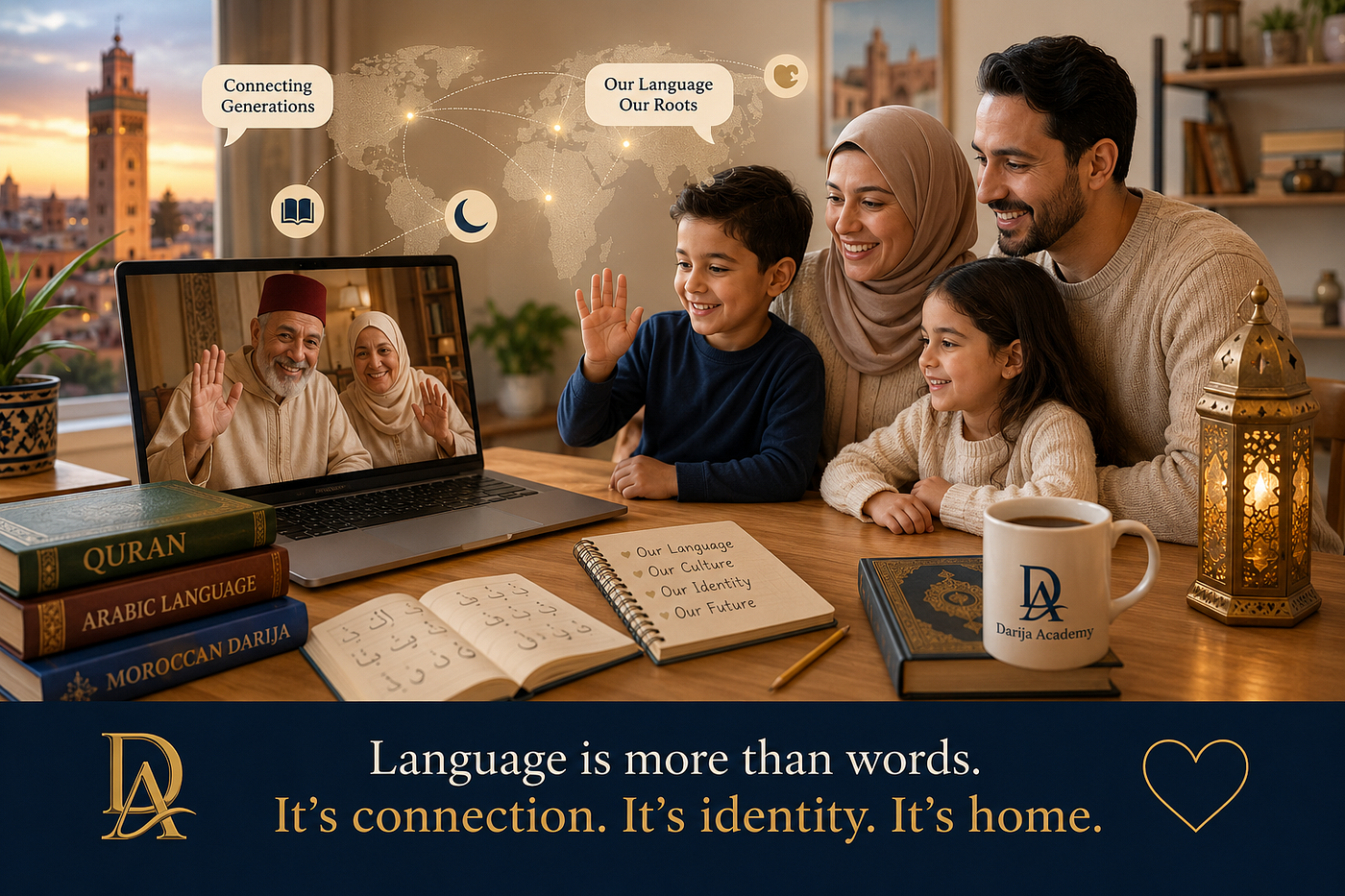
For Moroccan families abroad, Darija is often the language of grandparents, family gatherings, childhood memories, and cultural belonging.
When children stop speaking Darija, they don’t simply lose a skill.
They lose direct access to a part of their heritage.
The Grandparent Connection
Perhaps the strongest reason many parents want their children to speak Darija is simple:
Grandparents.
Many Moroccan grandparents do not speak English, Dutch, Spanish, or French fluently.
The relationship between grandparent and grandchild depends heavily on language.
Without a shared language, conversations become shorter.
Relationships become more dependent on translation.
Stories become harder to pass down.
Wisdom becomes harder to share.
And some of the most precious family bonds become limited.
No parent wants their child to need a translator to speak to their grandparents.
Yet this is becoming increasingly common in diaspora families around the world.
Why Children Stop Speaking Heritage Languages
Many parents wonder:
“If my child understands Darija, why don’t they speak it?”
The answer is usually not because they dislike the language.
In fact, most children value their heritage.
The challenge is that speaking requires confidence.
Children naturally choose the language they use most often with friends, teachers, classmates, media, and everyday life.
When Darija becomes a language they only hear but rarely use, their speaking ability slowly weakens.
Understanding remains.
Speaking disappears.
This is a common pattern among bilingual and multilingual families worldwide.
The Goal Isn’t Perfect Darija
Many parents make the mistake of focusing on perfect pronunciation or perfect grammar.
Children don’t need perfection.
They need confidence.
The goal isn’t to raise a language expert.
The goal is much more meaningful:
A child who can call their grandparents and have a real conversation.
A child who can visit Morocco and feel at home.
A child who can understand family stories without translation.
A child who feels proud of their roots.
A child who knows where they come from.
Preserving Identity in a Global World
Today’s children are growing up in a global environment.
They may speak multiple languages.
They may have friends from many cultures.
This is a gift.
But preserving heritage does not conflict with integration.
Children can be fully part of the country where they live while remaining deeply connected to their Moroccan identity.
In fact, research consistently shows that strong cultural roots often strengthen confidence and self-esteem.
Knowing where you come from helps you understand who you are.
A Future Worth Protecting
Imagine your child twenty years from now.
Imagine them speaking effortlessly with their grandparents.
Sharing stories.
Passing traditions to the next generation.
Teaching their own children the language that connects your family across borders and generations.
That future starts today.
Not with perfect lessons.
Not with memorization.
But with conversations.
With practice.
With confidence.
With connection.
Because language is more than words.
Language is family.
Language is belonging.
Language is identity.
And every conversation helps keep that connection alive.
About Darija Academy
Darija Academy helps Moroccan and Arab diaspora families preserve their language, culture, and connection to their roots through engaging online learning for children and families.
Language. Culture. Belonging.
메타데이터
- post_id
- a47f99ca2582
- slug
- my-child-understands-darija-but-never-speaks-it-a47f99ca2582
- url
- https://medium.com/@darijaacademy2026/my-child-understands-darija-but-never-speaks-it-a47f99ca2582
- canonical_url
- https://medium.com/@darijaacademy2026/my-child-understands-darija-but-never-speaks-it-a47f99ca2582
- author_url
- https://medium.com/@darijaacademy2026
- status
- ok
- fetched_at
- 2026-06-25 16:53:31