How to Build a ‘Fable’-Class MoE LLM: The Blueprint Behind Frontier AI
Everyone Wants a Frontier AI Model. Few Understand What Makes One Possible…Go beyond Anthropic !
How to Build a ‘Fable’-Class MoE LLM: The Blueprint Behind Frontier AI
Everyone Wants a Frontier AI Model. Few Understand What Makes One Possible…Go beyond Anthropic !
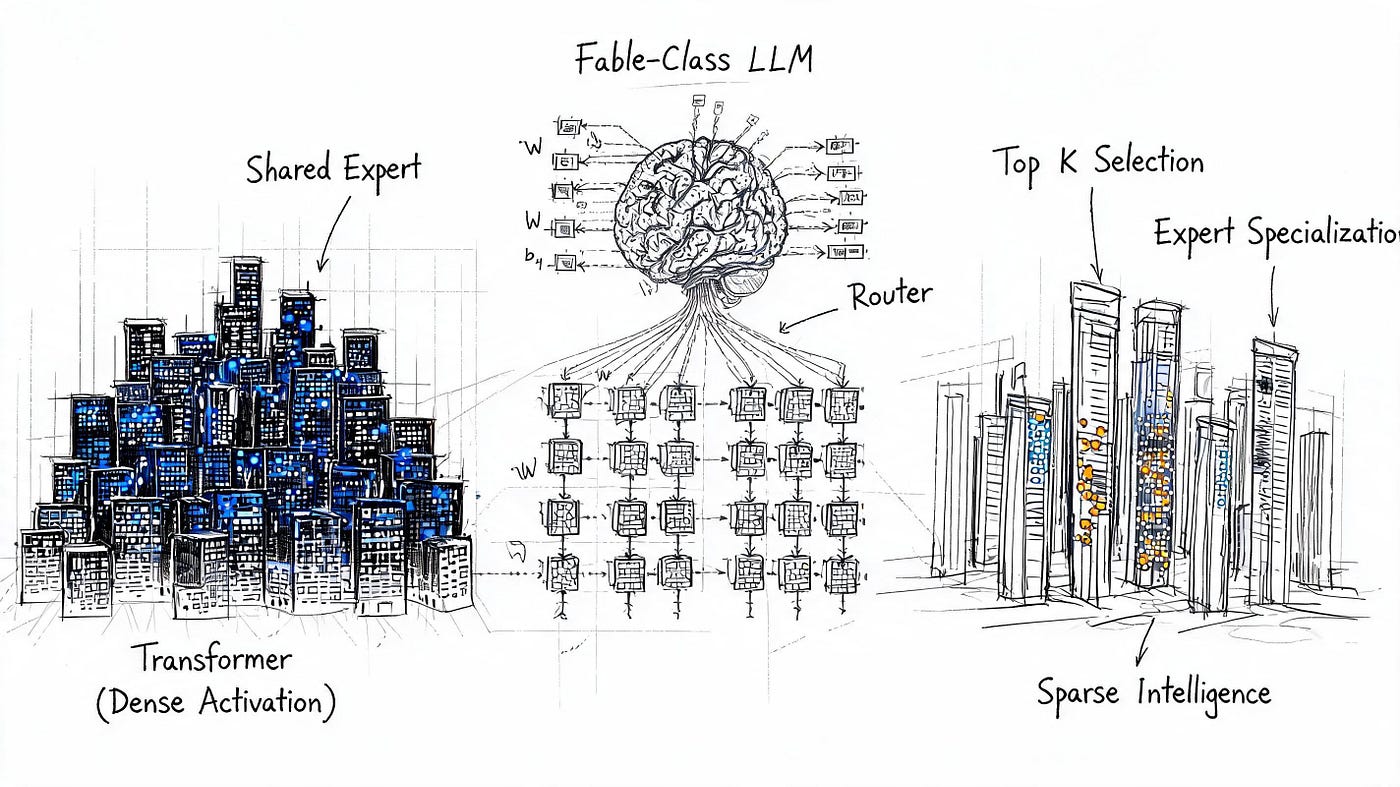
Credit : AI Generated Image (2026)
Imagine being handed a challenge:
Build an AI assistant that can reason across disciplines, write production-quality code, solve complex mathematics, maintain long conversations, and operate at a scale serving millions of users daily.
The obvious answer is simple:
Make the model bigger. 🚀
The problem?
That strategy quickly becomes financially unsustainable.
Every additional billion parameters increases training cost, memory requirements, deployment complexity, and inference expenses. At some point, throwing more hardware at the problem stops being a strategy and becomes an accounting nightmare.
Yet something remarkable happened between 2024 and 2026.
Almost every major frontier model family converged on the same architectural idea:
• DeepSeek V3 • Llama 4 • Qwen 3 • Kimi K2 • GLM • GPT-OSS
Different companies.
Different research teams.
Different objectives.
Yet all moving toward the same destination.
That destination is called Mixture of Experts (MoE).
And that convergence tells us something important.
When the world’s most capable AI laboratories independently arrive at the same solution, it is usually because the underlying mathematics is winning.
The Secret Behind Modern Frontier Models
Traditional transformers are built like generalists.
Every parameter participates in every prediction.
Every neuron works for every token.
Every layer processes every piece of information.
That sounds efficient until scale enters the picture.
A trillion-parameter dense model forces all trillion parameters to wake up every time a single token appears.
The result is immense computational waste.
Mixture of Experts approaches the problem differently.
Instead of one gigantic generalist, imagine a company filled with specialists.
A legal specialist.
A mathematics specialist.
A coding specialist.
A reasoning specialist.
A scientific specialist.
Now imagine a highly intelligent manager deciding which specialists should handle each incoming problem.
That manager is the router.
The specialists are the experts.
The organisation is the MoE layer.
Only a small fraction of experts activate for any token.
Most remain idle.
The model behaves like a massive network while spending compute like a much smaller one.
This single idea fundamentally changes the economics of frontier AI.
Read more:
Why This Matters More Than Most People Realise
The history of large language models can be viewed as a search for one thing:
More capability per unit of compute.
For years the industry followed a simple equation:
More Parameters → Better Performance
Then researchers discovered something surprising.
The relationship was incomplete.
What really matters is not merely how many parameters exist.
What matters is:
How many parameters are activated for each token.
That distinction unlocked an entirely new scaling frontier.
A model can possess hundreds of billions of parameters while activating only a small percentage at inference time.
Capacity keeps increasing.
Compute stays manageable.
Quality improves.
Costs remain controllable.
That is why sparse architectures have become the dominant design pattern across frontier AI.
Not because they are fashionable.
Because they work.
A Necessary Reality Check
Before going deeper, an important clarification.
Anthropic has not publicly disclosed the internal architecture behind Claude or any model that may sit behind names such as Fable.
Anyone claiming to know the exact configuration is speculating.
This article does not attempt to reverse engineer proprietary systems.
Instead, it asks a more useful question:
If we were asked to build a frontier assistant in the same capability class today, what would the science suggest?
The answer emerges from published research, engineering evidence, scaling studies, and lessons learned from the strongest open-weight models available today.
Think of this article as a blueprint.
Not a leak.
Not a rumour.
Not marketing.
A blueprint.
And as we move forward, we will build that blueprint piece by piece — from routing mathematics and expert specialisation to balancing strategies, training stability, inference economics, and production deployment.
By the end, you will understand not only how a Fable-class system could be built, but also why modern AI engineering increasingly revolves around sparse intelligence rather than brute-force scale.
Let’s begin…

메타데이터
- post_id
- a48554edc57b
- slug
- how-to-build-a-fable-class-moe-llm-the-blueprint-behind-frontier-ai-a48554edc57b
- url
- https://medium.com/write-a-catalyst/how-to-build-a-fable-class-moe-llm-the-blueprint-behind-frontier-ai-a48554edc57b
- canonical_url
- https://medium.com/write-a-catalyst/how-to-build-a-fable-class-moe-llm-the-blueprint-behind-frontier-ai-a48554edc57b
- author_url
- https://medium.com/@rogt.x1997
- status
- ok
- fetched_at
- 2026-06-20 20:29:01