Medical Summary Services: The Shortcut to Stronger Case Review
Every Personal Injury case begins with a story. But that story is rarely told in order.
Medical Summary Services: The Shortcut to Stronger Case Review
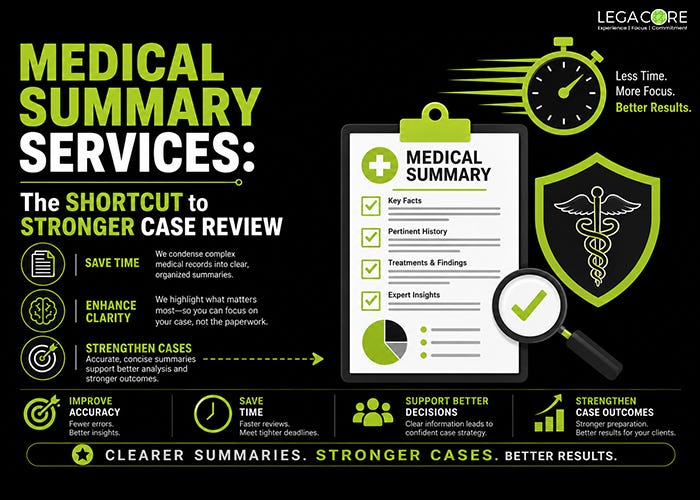
Medical Summary Services
Every Personal Injury case begins with a story. But that story is rarely told in order.
Instead, it comes scattered across thousands of pages of physician notes, hospital records, imaging reports, surgery reports, prescriptions, therapy notes, and billing statements. Somewhere within that mountain of paperwork, hidden in plain sight, are the facts that determine causation, damages, liability, and ultimately case value.
The challenge? Attorneys don’t have unlimited time to peruse through them.
What if we tell you **Medical Summary Services** are the way to take the burden off of your attorneys while simultaneously processing thousands of pages of medical record data that can help you build a strong case?
Medical Records Don’t Arrive Ready for Litigation
Law and medicine speak two different languages. They might share some of the main principles, but they are two different worlds.
Healthcare providers document treatment to ensure continuity of care. Attorneys review those same records to establish case facts like causation, liability, damages, and future medical needs. These objectives don’t overlap. Even if the information does.
A physician might note that a patient’s pain has improved by 30%. A surgeon may recommend that the patient get another procedure done in six months. A therapist might observe inconsistent attendance of sessions. Separately, they seem unrelated and mundane.
Together? They can shape the narrative & value of an entire case. That’s why reviewing medical records isn’t just an administrative task. It’s investigative.
The Purpose of Medical Summaries
Instead of handing an attorney a stack of records and expecting them to connect the dots, trained reviewers organize the medical data into a clear narrative. The result is a document that explains the patient’s journey from injury through treatment, highlighting the facts of the incident.
But here’s where a lot of people misunderstand the service. A good medical summary isn’t a shorter version of the records. Just a smarter one. Rather than repeating every physician note, it identifies the milestones that have the power to influence the outcome.
Let’s think about the key moments attorneys care about the most:
- The first emergency room visit
- Delayed diagnosis
- MRI findings confirming the injury
- Surgery reports
- Maximum Medical Improvement (MMI)
- Future treatment plans
These aren’t just medical events. In the right hands, they can be legal turning points.
Beyond Organization: Finding the Narrative Scattered in the Records
Medical records rarely ever tell a chronological story. Patients switch doctors, clinics, hospitals. Hospitals have their own document formats and standards. Specialists focus on different body systems. Some records are handwritten, others are electronic. Most contain repeated information copied from previous reports and visits.
It’s messy, hard to piece together, and navigate. And that’s exactly why summarization requires more than simply reading facts. It needs interpretation without opinions, organization without distortion.
What Separates an Average Medical Summary from an Exceptional One?
Not all summaries are created equally. Some just condense information. Others create clarity and strategy. The difference usually comes down to one thing: understanding how attorneys use the summary. A summary should not read like a medical test paper. Nor should it resemble a copy-paste of a physician’s notes. It should anticipate the questions an attorney is most likely to ask.
Where did treatment begin? When did the diagnosis change? What evidence supports causation? Is there any permanent impairment or future care?
Those are the questions that can shape your argument strategy. An exceptional summary guides you toward answers without telling you directly what conclusion to draw. It’s factual, objective, and easy-to-navigate.
Another thing to keep in mind is that it should make returning to the original medical records easy. Every finding should be traceable, enabling attorneys to verify information whenever necessary.
A timeline explains “when”. A summary explains “why”.
Medical Records Chronologies and medical summaries often work together. But they are designed to answer different questions.
A chronology gives answers to: what happened, and when it happened?
A medical summary asks a different question: why does any of this matter?
That’s where nuance and context become important. Why did the medications change after the MRI? Why did the patient stop physical therapy? How big a financial strain are the treatments, medications, and therapy sessions? How is the patient doing currently?
Building a smarter litigation workflow
Medical summaries have become even more valuable when they are part of a larger litigation support procedure. For example, a Personal Injury firm might begin by requesting medical records from multiple providers. Once those records come in, they are reviewed and summarized. A medical chronology is created to establish the medical timeline. Deposition summaries help attorneys prepare witness examinations and put together the demand draft for insurance carriers.
These services don’t exist in isolation. Each one supports the next one. When they are integrated into a single workflow, attorneys spend much less time managing documents and more time building strategy. Providers like Legacore Solutions don’t just provide individual work product. We support the entire lifecycle of a case through a suite of Legal Support Services, including Litigation Support Services, Medico-Legal Support Services, and Secretarial-Admin Support Services.
Our objective isn’t just efficiency. It’s consistency across every stage of litigation.
The Hidden Value of Medical Summaries
Medical records will only become more complex as time goes on. Healthcare providers generate more documents than ever before. Diagnostic testing is becoming increasingly detailed too. Multi-provider treatment is now common in moderately complex injuries. None of these are likely to reverse. The firms that adapt won’t necessarily be the ones with the biggest team or budget. They will be the firms that build smarter.
Legacore Solutions helps busy law firms reduce the time they spend searching for basic facts. We help improve case organization & preparation. We enable attorneys to have faster access to information that shapes the legal strategy around a case.
Because at the end of the day, your clients aren’t paying you to read medical records. They have hired you to win the case.
Frequently Asked Questions:
For a Personal Injury case, what information would be included in a medical summary?
A medical summary for a Personal Injury case typically should include the patient’s treatment history, diagnosis, procedures, test reports, medications, physician’s notes, future treatment plans, and other medically important events that would help an attorney understand the case more efficiently.
What’s the difference between medical summary service and Medical Records Review?
Medical record review is the broader process of examining medical documentation to identify relevant facts and issues. A medical summary is the final product that presents a structured narrative in an attorney-friendly format.
When should a law firm request medical summaries?
A lot of law firms request medical summaries as soon as records are received, allowing legal teams to evaluate the claim early on. Others use them before demand drafting, mediation, deposition, or trial to help with case preparation.
Do medical summaries help with settlement negotiation?
Yes, a well-crafted summary highlights the injuries, treatment, surgeries, future care plan, and other medical evidence that can influence a case evaluation and settlement discussions.
What to look for in a medical summary provider?
Look for providers with strong experience in supporting U.S. litigation. Strong quality assurance, secure data handling, consistent formatting, knowledge of legal practices & medical terminology, and the ability to find details that might advocate for your claims are some of the non-negotiable marks you need to look for.
Ready to spend less time reviewing records? Get in touch with us today!
메타데이터
- post_id
- a4885d40dbda
- slug
- medical-summary-services-the-shortcut-to-stronger-case-review-a4885d40dbda
- url
- https://medium.com/@legacore/medical-summary-services-the-shortcut-to-stronger-case-review-a4885d40dbda
- canonical_url
- https://medium.com/@legacore/medical-summary-services-the-shortcut-to-stronger-case-review-a4885d40dbda
- author_url
- https://medium.com/@legacore
- status
- ok
- fetched_at
- 2026-08-18 08:23:09





