The Canadian MSB License
Why So Many Payment Entrepreneurs Are Looking at Acquisition Instead of Application

Apply, Buy or Become an Agent of a Canadian License?
The Canadian MSB License
Why So Many Payment Entrepreneurs Are Looking at Acquisition Instead of Application
Over the last several years, a noticeable shift has occurred in the cross-border payments and money transfer industry.
Many entrepreneurs initially entered the sector believing they could build businesses as affiliates, introducers, agents, referral partners, software providers, or intermediaries operating outside the flow of funds. For some business models, that approach works. For many others, however, it eventually becomes limiting.
At some point, a large percentage of founders arrive at the same conclusion:
“If I want real control over my business, I probably need a license.”
That realization is usually followed by another.
Obtaining a license is often far more complicated than most people expected.
Licensing introduces an entirely new set of challenges: regulatory obligations, compliance programs, audits, reporting requirements, banking relationships, governance frameworks, AML controls, risk management procedures, and ongoing supervision. Many founders who were comfortable building products suddenly find themselves navigating a world dominated by regulators, compliance officers, auditors, and banking partners.
Among the various licensing opportunities available globally, one of the most frequently discussed remains the Canadian Money Services Business (MSB) registration.
The Canadian MSB registration is administered by FINTRAC, Canada’s financial intelligence unit responsible for anti-money laundering and counter-terrorist financing oversight.
Historically, obtaining a FINTRAC MSB registration was relatively straightforward compared to many other jurisdictions. There was no substantial licensing fee, and as a result, thousands of businesses applied. Some actively operated. Others maintained registrations for future use. Some acquired registrations simply to keep strategic options open.
For years, this abundance of registrations created an active secondary market.
It was not unusual to see Canadian MSB registrations change hands for anywhere between USD $20,000 and $30,000. Occasionally, distressed sellers would accept lower amounts. Brokers often marketed licenses for significantly higher prices depending on the accompanying assets, relationships, or infrastructure.
Then the landscape changed.
The introduction of the Retail Payment Activities Act (RPAA) fundamentally altered how many market participants viewed Canadian licensing.
While the RPAA introduced a broader regulatory framework for payment service providers operating in Canada, it also reinforced a simple regulatory principle: businesses operating under Canadian regulatory authority should have a meaningful connection to Canada.
The era of maintaining a Canadian registration while operating almost entirely offshore became significantly less attractive.
As implementation deadlines approached and grandfathering periods expired, market participants increasingly focused on obtaining RPAA-compliant structures rather than simply possessing a FINTRAC registration.
At the same time, the industry faced additional complications.
Following a cyber incident affecting FINTRAC systems and the resulting operational disruptions, market participants began reporting longer processing times and growing backlogs. New applicants found themselves facing uncertainty regarding review timelines, file assignments, and approval schedules.
Today, estimates vary considerably, but many industry participants believe a new application may require anywhere from eight or nine months under ideal circumstances to well over a year in more complex cases.
Whether those estimates prove accurate for every applicant is less important than the broader reality: obtaining a new registration is no longer viewed as a quick path to market.
As a result, three distinct approaches have emerged for companies seeking Canadian market access.
Option 1: Apply for Your Own License
The first option is to submit a new application and build everything from the ground up.
This provides maximum independence and control. The business owns its compliance framework, its regulatory relationship, and its long-term strategy.
The drawback is time.
For founders trying to launch quickly, extended regulatory timelines can create substantial opportunity costs. Markets move. Competitors launch. Banking relationships evolve. Customer acquisition windows do not remain open forever.
Option 2: Operate as an Agent
The second option is to become an agent or authorized representative of an existing licensed entity.
This can be a highly effective strategy, particularly for founders who want to validate a business model before investing heavily in infrastructure and compliance.
The challenge is usually not the structure itself.
The challenge is trust.
Many first-time founders are uncomfortable relying on another organization for regulatory sponsorship, operational support, or access to payment rails. Even when the arrangement is commercially sensible, entrepreneurs often prefer direct ownership and control.
Option 3: Acquire an Existing Licensed Entity
The third option is acquisition.
Instead of waiting for a new registration, a buyer acquires an existing company that already possesses the necessary regulatory approvals and operational infrastructure.
This route has become increasingly attractive as licensing timelines have expanded.
Naturally, pricing has adjusted accordingly.
Where Canadian MSB registrations were once frequently discussed in the USD $20,000–$30,000 range, RPAA-compliant structures today are often marketed at substantially higher valuations. Depending on factors such as compliance readiness, banking relationships, corporate history, transaction activity, and supporting infrastructure, market discussions commonly fall somewhere between USD $50,000 and $75,000 or more.
As always, each opportunity should be evaluated individually.
Finding Buyers, Sellers, and Licensing Opportunities
One challenge that continues to exist in the licensing market is fragmentation.
Buyers struggle to find legitimate sellers.
License holders struggle to find qualified buyers.
Companies seeking agent relationships often do not know where to begin.
Service providers capable of supporting licensing, compliance, banking, sponsorship, or acquisition transactions are similarly difficult to locate.
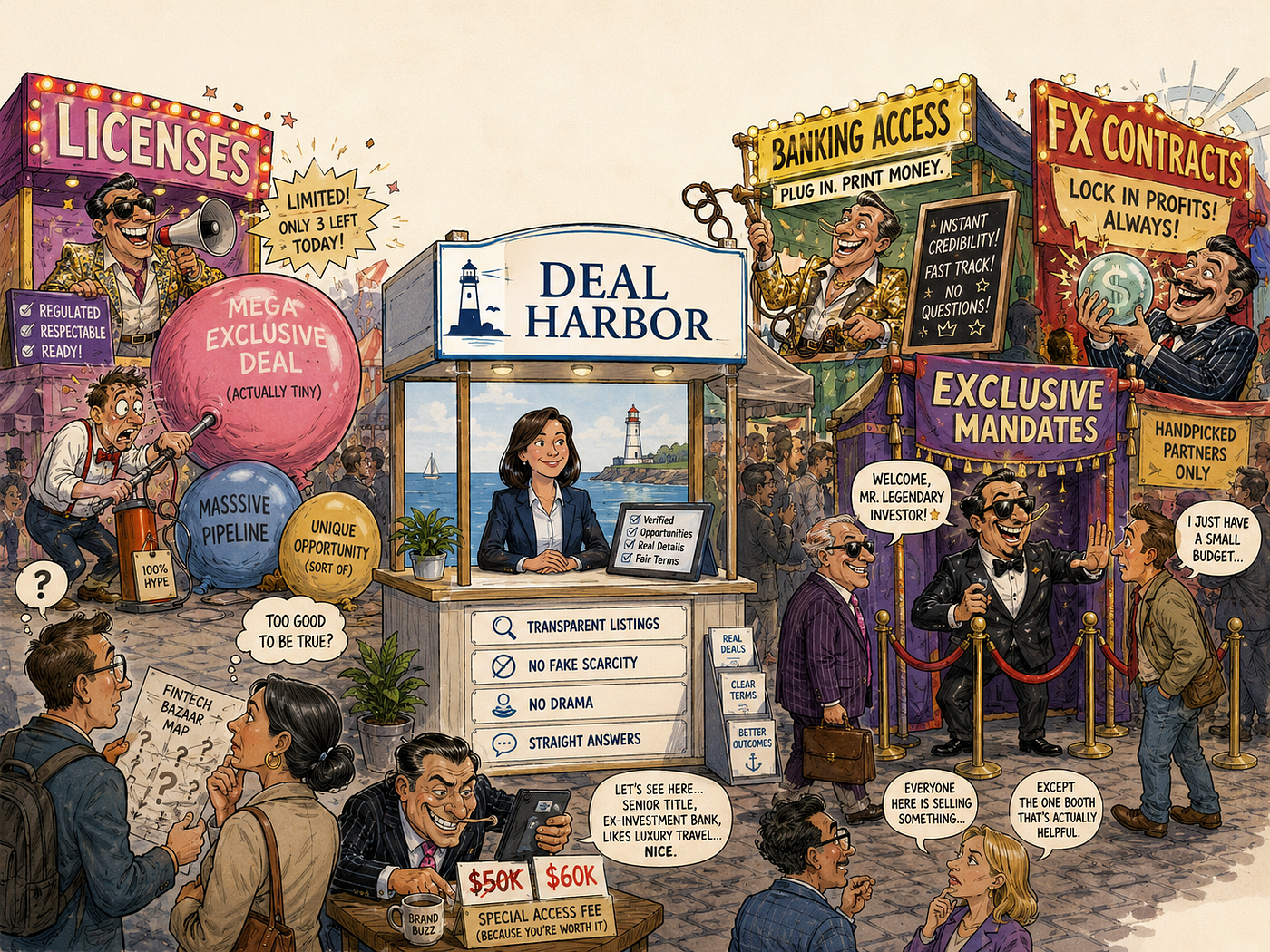
This fragmentation is one of the reasons **DealHarbor** was created.
DealHarbor is a marketplace focused on banking, payments, licensing, compliance, and fintech infrastructure opportunities. Companies can post requirements, list licenses for sale, seek acquisition targets, search for sponsorship arrangements, or connect with specialized service providers operating within the regulated financial services sector.
Whether your preferred route is applying for a new license, operating under sponsorship, or acquiring an existing regulated entity, the key is understanding the trade-offs between cost, speed, control, and regulatory complexity.
There is no universally correct path.
There is only the path that best aligns with your timeline, budget, risk tolerance, and long-term business objectives.
Please note: Regulators of all kinds despise that licenses are bought, traded, and sold, but that’s the reality of it. By the way, you never really buy a license. What you do is you do a change of control. You buy the company that actually has the license and apply for a change of control. Just wanted to slide that in.
About Faisal Khan
Faisal Khan has spent over 30 years working in cross-border payments, banking access, remittances, stablecoins, money transmitter licensing, and MSB-friendly banking. He runs Faisal Khan LLC, a consultancy that helps companies navigate the hard parts of regulated financial services: getting banked, getting licensed, structuring compliant payment flows, and finding the right partners to make it all work.
He is the founder of DealHarbor, a marketplace for regulated financial services deal flow, and The Money Wiki, a knowledge platform covering banking, payments, licensing, and financial systems globally.
If something in this article is relevant to what you are working on, book a free 15-minute call. No pitch, no obligation. Just a straight conversation about whether there is something worth exploring together.
메타데이터
- post_id
- a48981ecf56d
- slug
- the-canadian-msb-license-a48981ecf56d
- url
- https://cogni.faisalkhan.com/the-canadian-msb-license-a48981ecf56d
- canonical_url
- https://cogni.faisalkhan.com/the-canadian-msb-license-a48981ecf56d
- author_url
- https://medium.com/@faisalk
- status
- ok
- fetched_at
- 2026-06-13 12:55:53