10 Java Concurrency Patterns That Unlock Massive Throughput
Proven patterns to scale Java applications with parallelism, synchronization, and non-blocking design.
10 Java Concurrency Patterns That Unlock Massive Throughput
Proven patterns to scale Java applications with parallelism, synchronization, and non-blocking design.
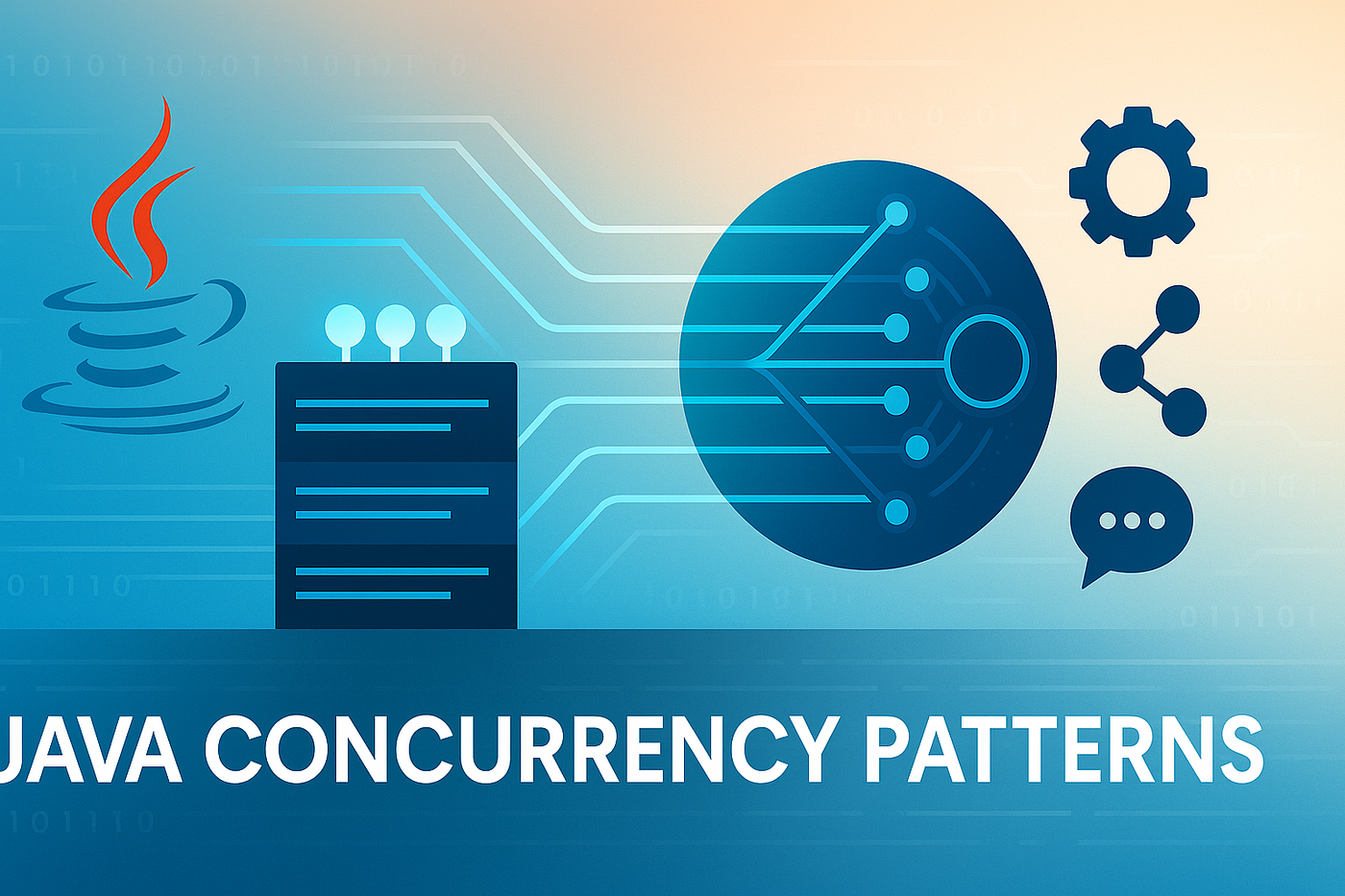
Master 10 powerful Java concurrency patterns to boost throughput, reduce latency, and scale applications for modern high-performance workloads.
Every millisecond counts when your Java application serves thousands — or millions — of users. But raw hardware won’t save you if your concurrency model is flawed. Efficient concurrency is the difference between a sluggish bottleneck and a high-throughput system that feels instant.
The good news? Java’s concurrency toolkit has matured into a powerhouse. From executors and thread pools to reactive pipelines and lock-free algorithms — modern Java can scale like never before. Let’s explore 10 concurrency patterns that unlock massive throughput in 2025 and beyond.
1. The Executor Pattern: Abstracting Thread Management
Instead of manually managing threads with new Thread(), use Executors to simplify lifecycle, pooling, and scheduling.
- Why it matters: Prevents thread explosion and leverages re-use.
- Real-world analogy: Think of it as a taxi fleet dispatcher, sending passengers (tasks) to the next available driver (thread).
- Code Snippet:
ExecutorService executor = Executors.newFixedThreadPool(10);
executor.submit(() -> System.out.println("Task executed!"));
SEO Tip: Search engines love “Java Executor Pattern” and “Thread Pooling in Java” — use these strategically.
2. Fork/Join Pattern: Divide and Conquer
Perfect for tasks that can be broken into smaller subproblems, solved in parallel, and then recombined.
- Introduced in Java 7.
- Great for recursive algorithms like sorting, matrix operations, or aggregations.
ForkJoinPool pool = new ForkJoinPool();
pool.invoke(new RecursiveTaskExample());
Throughput Gain: By dividing work evenly, CPUs run at full utilization.
3. Producer-Consumer Pattern with Blocking Queues
Classic concurrency pattern where producers generate tasks and consumers process them asynchronously.
- Use
BlockingQueuefor built-in thread-safe communication. - Prevents overproduction and consumer starvation.
BlockingQueue<String> queue = new ArrayBlockingQueue<>(100);In the wild: Kafka, RabbitMQ, and messaging systems follow this principle.
4. The Reactor Pattern: Event-Driven Non-Blocking I/O
The backbone of high-performance servers like Netty and frameworks like Spring WebFlux.
- Non-blocking I/O ensures threads aren’t idle waiting for responses.
- Useful for chat apps, trading systems, and APIs under heavy load.
SEO boost keywords: “Java Reactor Pattern,” “Reactive Programming Java”.
5. CompletableFuture & Async Composition
Instead of callback hell, Java 8’s CompletableFuture gives fluent APIs for chaining async tasks.
CompletableFuture.supplyAsync(() -> fetchUserData())
                 .thenApply(data -> enrichData(data))
                 .thenAccept(System.out::println);
Why it scales: Threads never block — they hand work back to the runtime until results are ready.
6. Read-Write Locks: Optimized Synchronization
When many threads read frequently but write rarely, ReentrantReadWriteLock maximizes throughput.
- Multiple readers can access simultaneously.
- Writers get exclusive access.
Analogy: Think of a library — many people can read books at once, but only one librarian updates the catalog.
7. Disruptor Pattern: Lock-Free Queues for Extreme Performance
Created by LMAX Exchange, this pattern replaces traditional queues with ring buffers for nanosecond latency messaging.
- Eliminates contention by using mechanical sympathy.
- Ideal for financial systems, telemetry, and trading platforms.
Real-world stat: LMAX Exchange processed 6M+ TPS with the Disruptor.
8. Actor Model with Akka
Instead of sharing memory, actors exchange messages. Each actor has its own state, reducing race conditions.
- Akka brings actor concurrency to Java.
- Great for microservices, IoT, and simulations.
SEO tip: “Java Actor Model,” “Akka concurrency patterns.”
9. Parallel Streams: Declarative Concurrency
Java 8 introduced parallel streams to process collections concurrently with minimal code.
list.parallelStream()
    .filter(x -> x > 10)
.forEach(System.out::println);- Works well for CPU-intensive batch workloads.
- Not always optimal — measure before using.
10. Thread-Per-Core with Virtual Threads (Project Loom)
The future of Java concurrency: Virtual Threads (Java 21).
- Lightweight threads mapped to underlying OS threads only when running.
- Millions of concurrent tasks with minimal overhead.
try (var executor = Executors.newVirtualThreadPerTaskExecutor()) {
    executor.submit(() -> doWork());
}
Why it’s game-changing: Simplifies concurrency without callback complexity.
Wrapping It Up: Choosing the Right Pattern
No single concurrency pattern is a silver bullet.
- Small batch jobs? Use parallel streams or Fork/Join.
- High-frequency APIs? Reactor pattern + virtual threads.
- Financial apps? Disruptor.
- Enterprise systems? Executors, CompletableFuture, and actors.
The key is matching the concurrency model to your workload. That’s how you unlock true throughput.
Final Thoughts
Concurrency isn’t just about running multiple threads — it’s about designing for scalability, efficiency, and maintainability.
If you’re serious about high-performance Java systems:
✅ Experiment with these patterns. ✅ Measure throughput and latency. ✅ Adopt Project Loom early.
What concurrency patterns do you rely on most? 💬 Share your thoughts in the comments — I’d love to hear from you.
메타데이터
- post_id
- a48d83c58cf1
- slug
- 10-java-concurrency-patterns-that-unlock-massive-throughput-a48d83c58cf1
- url
- https://medium.com/@ThinkingLoop/10-java-concurrency-patterns-that-unlock-massive-throughput-a48d83c58cf1
- canonical_url
- https://medium.com/@ThinkingLoop/10-java-concurrency-patterns-that-unlock-massive-throughput-a48d83c58cf1
- author_url
- https://medium.com/@ThinkingLoop
- status
- ok
- fetched_at
- 2026-08-02 20:41:19