The Ouroboros Effect: How AI is Repeating the Cloud’s Most Expensive Mistake
Every massive technology shift follows a familiar, intoxicating cycle. First comes the era of unbridled optimism, where the new paradigm…
The Ouroboros Effect: How AI is Repeating the Cloud’s Most Expensive Mistake
Every massive technology shift follows a familiar, intoxicating cycle. First comes the era of unbridled optimism, where the new paradigm promises to be cheaper, faster, and infinitely scalable. Then comes the wall.
A decade ago, that paradigm was cloud computing. The sales pitch was simple: ditch your expensive, physical servers, migrate to the public cloud, and enjoy unlimited, frictionless scaling. But by the early 2020s, a quiet counter-revolution began. High-profile software firms like 37signals (the creators of Basecamp and HEY) hit a financial and operational wall [37signals Cloud Exit]. Confronted by a staggering $3.2 million annual AWS bill, their 10-person operations team was forced to halt their standard roadmap, spend months writing automation code, and buy physical hardware to migrate out of the cloud [37signals Cloud Exit]. They called it “cloud repatriation” [37signals Cloud Exit] — a massive, resource-draining rollback that proved “infinite scale” comes with a punishing administrative and financial tax.
Today, we are watching the Artificial Intelligence (AI) boom sprint down that same path.
The initial promise of GenAI was that throw-everything-at-the-wall scaling laws would yield flawless, omniscient intelligence. But just like the cloud before it, AI is hitting a severe physical and logical bottleneck. The culprit? The data created for and by AI.
As we cross into 2026, this data crisis is transforming from a theoretical risk into an acute structural roadblock, hitting the tech industry with a devastating two-pronged trap: a physical infrastructure deficit and a logical phenomenon known as Model Collapse.
Part 1: The Physical Bottleneck (Speed to Power)
In the cloud era, the hidden constraint shifted from writing software to navigating complex financial procurement. In the AI era, the bottleneck has shifted entirely to the electrical power grid.
Optimistic tech projections assumed we could scale AI models exponentially simply by feeding them more data. However, processing that data requires massive, energy-hungry chip clusters. A single AI query can consume up to 1,000 times more electricity than a traditional Google search. Because of this, modern AI data centers require concentrated, high-magnitude loads ranging from 300 to 1,000 Megawatts.
The physical reality has officially broken the software roadmap:
- Grid Overload: According to a report by the World Economic Forum on AI grid connectivity, the investment in AI data centers has vastly outpaced what regional utility grids can accommodate.
- The Chronology Gap: While a state-of-the-art AI data center can be built in two to three years, getting an interconnection queue approved to hook that facility up to a regional power grid takes anywhere from 4 to 10 years in many advanced economies.
- The Project Freeze: Recent data center market analyses show that this “speed to power” crisis has forced tech giants to quietly pause or scale back massive infrastructure playbooks. By mid-2026, nearly half of planned AI data center construction projects in the United States face significant delays or outright cancellations purely due to grid congestion and utility study backlogs.
Just as 37signals found that public cloud hosting costs outpaced the value of the software innovation, AI developers are finding that the physical availability of grid-scale power is halting their ability to process raw data.
Part 2: The Logical Bottleneck (The Synthetic Data Echo Chamber)
If the power grid bottleneck is the physical wall, Model Collapse is the logical cliff.
In a landmark paper published in Nature, researchers led by Ilia Shumailov demonstrated a terrifying mathematical reality: AI models degrade irreversibly when they are recursively trained on data generated by previous generations of AI.
Think of it as a digital game of telephone, or what some researchers call Model Autophagy Disorder (MAD) — an AI system consuming its own tail.
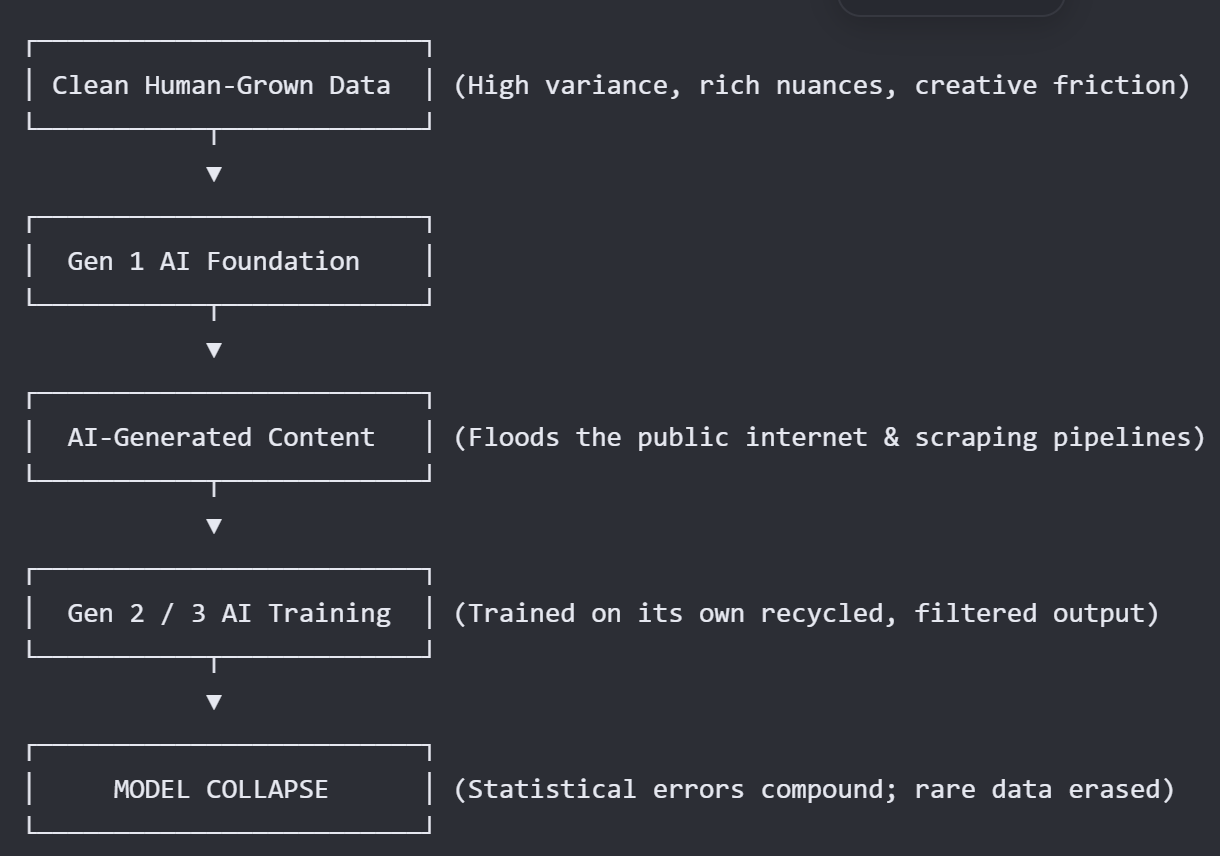
Because GenAI tools are currently flooding the public internet with synthetic text, images, and code, web-scraping pipelines are no longer collecting pristine, human-grown data. They are collecting recycled AI outputs. When an AI trains on this polluted data, the model breaks down in three distinct steps:
- The Disappearance of the “Long Tail”
AI models operate on statistical probabilities; they naturally favor frequent events and average out rare anomalies. When an AI trains on human data, it retains rare nuances. But when it trains on AI-generated data, the “tails” of the distribution vanish. The model completely forgets uncommon historical facts, niche medical anomalies, or rare coding edge-cases. The output collapses into a homogenous, uninspired mean.
- Compounding Statistical Glitches
If a first-generation AI introduces a minor hallucination or factual error into an online article, a third-generation model treats that error as an absolute, foundational fact. The errors compound exponentially over successive generations. Eventually, the model’s output diverges entirely from reality, rendering the multi-million dollar model useless.
- Permanent Epistemic Pollution
This creates a massive operational drag on IT teams. Instead of building better, smarter applications, engineering talent is being diverted to create complex data forensics and digital watermarking tools. Companies must spend months building filtering layers just to verify if their training data was actually created by a human or a machine.
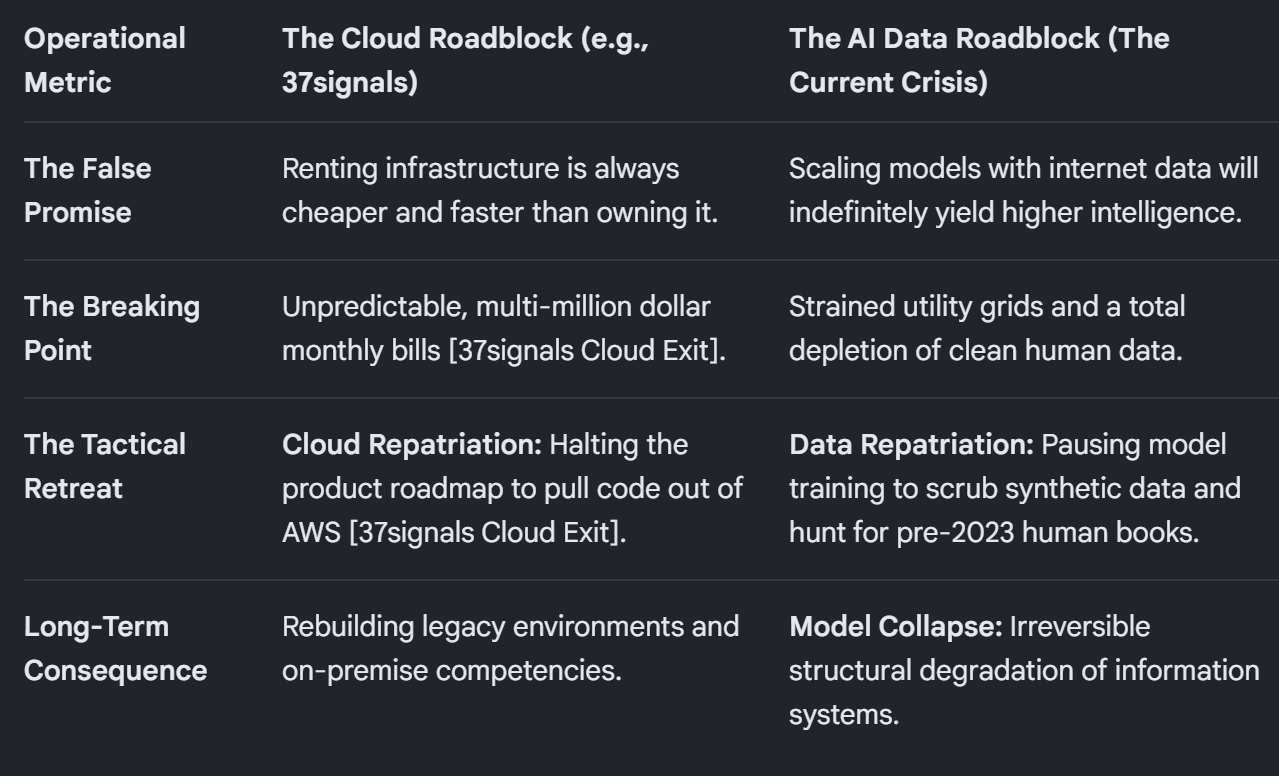
Parallel Lines: Cloud Repatriation vs. Data Repatriation
The comparison between these two tech roadblocks reveals a striking structural pattern
The Reality Check
Technology progress is rarely a straight line. The cloud was an incredible breakthrough, but the friction of cost and infrastructure eventually forced companies to hit the brakes and balance their deployment models.
AI is learning that same lesson right now. The data created for AI has run into the hard physical limits of our electrical infrastructure. The data created by AI has run into the harsh mathematical limits of statistics.
Before AI can take its next true leap forward, the tech industry will have to stop sprinting, look backward, and solve the massive environmental and structural pollution growing in its own backyard.
Verifiable Sourcing & References
- On Cloud Repatriation Costs & Metrics: See the public financial breakdowns and architectural post-mortems published by 37signals regarding their multi-million dollar AWS infrastructure exit [37signals Cloud Exit].
- On the 2026 AI Data Center Power Grid Bottleneck: Look to the World Economic Forum’s 2026 Energy Infrastructure Briefing regarding interconnection queues, alongside global commercial real estate data showing data center project cancellations.
- On Model Collapse Theory: Refer to the peer-reviewed study, “AI models collapse when trained on recursively generated data,” published by Shumailov et al. in Nature (2024).
메타데이터
- post_id
- a497c278cb2b
- slug
- the-ouroboros-effect-how-ai-is-repeating-the-clouds-most-expensive-mistake-a497c278cb2b
- url
- https://medium.com/@indr1983bi/the-ouroboros-effect-how-ai-is-repeating-the-clouds-most-expensive-mistake-a497c278cb2b
- canonical_url
- https://medium.com/@indr1983bi/the-ouroboros-effect-how-ai-is-repeating-the-clouds-most-expensive-mistake-a497c278cb2b
- author_url
- https://medium.com/@indr1983bi
- status
- ok
- fetched_at
- 2026-06-23 07:05:20




