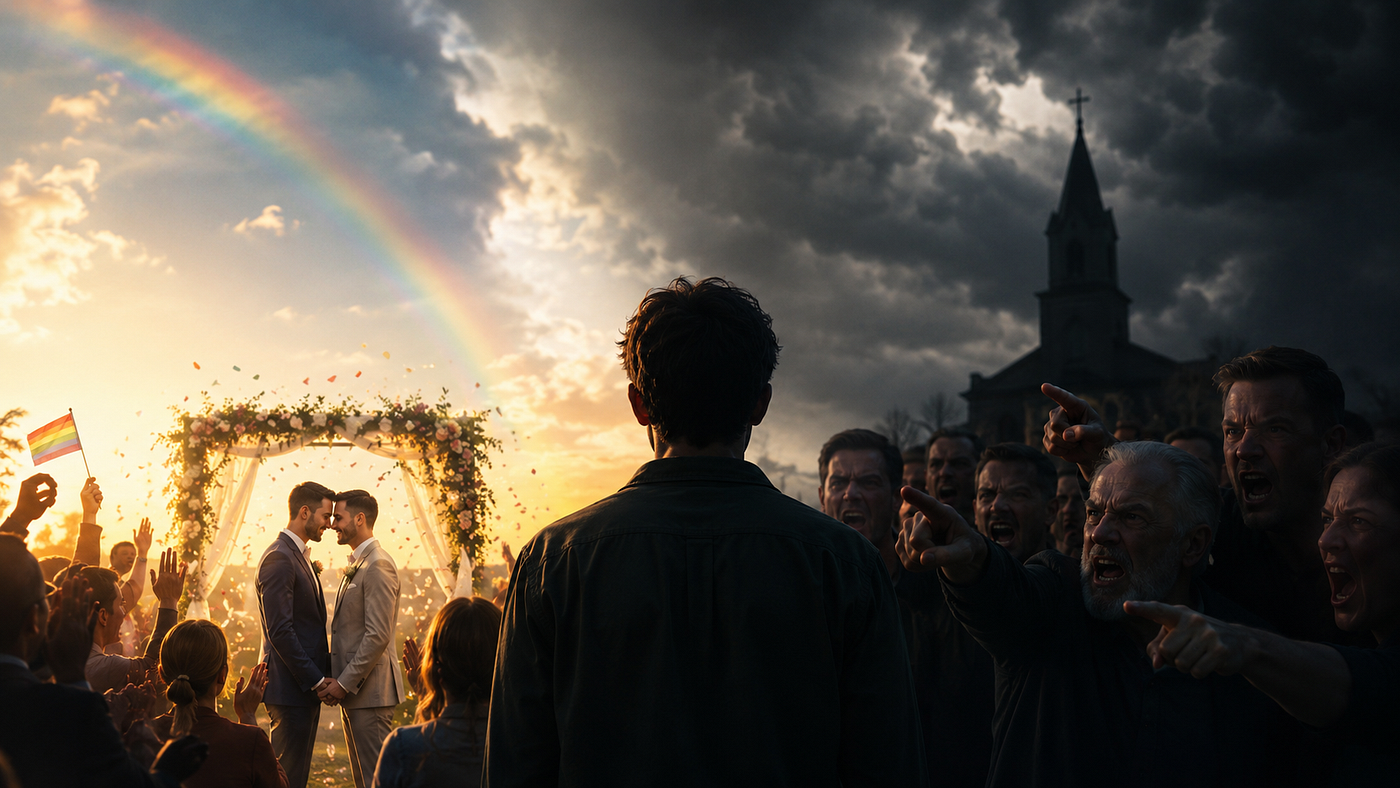
Millions of New Churchgoers Appeared Overnight. There Was Just One Problem.
The true story behind Christianity’s most hopeful headline
Millions of New Churchgoers Appeared Overnight. There Was Just One Problem.
The true story behind Christianity’s most hopeful headline
Photo by NATHAN MULLET on Unsplash
Last year, Christians across Britain thought they had finally caught a break.
After decades of decline, empty pews, ageing congregations, and gloomy denominational reports, a remarkable headline began spreading through churches, conferences, podcasts, and Christian media:
Young people were coming back.
Not just a few young people either. According to a major study published by The Bible Society and backed by YouGov, church attendance among young adults had exploded. Some called it a revival. Others called it a miracle.
For nearly a year, that alluring headline had a name: “The Quiet Revival.”
Pastors shared the statistics with excitement. Christian influencers celebrated. Denominations dared to hope that the long decline of British Christianity had finally been reversed.
There was just one problem.
It wasn’t true.
Published in April 2025 by The Bible Society and backed by the polling giant YouGov, the report suggested a staggering, counter-cultural phenomenon: young people, particularly young men aged 18 to 24, were allegedly streaming back into the fold.
According to the initial data, church attendance in that coveted demographic had skyrocketed from a miserable 4% in 2018 to a robust 16% in 2024. Evangelical YouTubers produced endless, self-congratulatory commentary, and tired pastors breathed a prayer of thanksgiving, convinced that the cultural tide had finally turned.
The problem was that those of us with functioning eyes could see precisely zero evidence to back up the claims.
Churches and Christians in the UK were consistently promoting the narrative that young people were flocking to churches.
Except they weren’t.
When you started asking questions, those young people were always somewhere else, in some other denomination, some other church or some other town. But never here.
I was one of those sceptics who were labelled as “faithless” for even asking some obvious questions.
I recall a meeting at our church when someone rehashed the Quiet Revival narrative and simply refused to listen to my words of caution and scepticism. I was “a doubter”, “an unbeliever”, even “doing Satan’s work” for asking where the evidence was that young people were coming to the church in hitherto unparalleled numbers.
I looked at the Methodist Annual Returns as a post-retirement late-life convert to the Methodist fold, and at the Anglican Statistics for Mission as an ordained Anglican priest during my “working” life.
Both were depressingly familiar: shrinking congregations that were simultaneously ageing.
No sign of young adults, teenagers, families, children…
Photo by Julia Taubitz on Unsplash
I learned, over time, to keep my views to myself. It wasn’t worth the hassle to be the doom monger. I vented occasionally to my wife, but for the most part, I “parked” any thoughts of The Quiet Revival.
Then came March 2026.
In a sudden, bruising turn of events, the entire statistical house of cards collapsed into dust.
YouGov confessed to a catastrophic technical error, revealing that fraudulent respondents, automated bots, and digital “survey farmers” had utterly compromised the data. The Bible Society did the honourable thing — they pulled the report and issued a formal retraction.
But as the statistical dust settles, we are left with a much deeper, more troubling question.
If the “Quiet Revival” was nothing more than a mirage created by malfunctioning anti-fraud algorithms, what is actually happening in the spiritual lives of young people in the UK?
When we look past the broken metrics with an investigative eye, a striking, uncomfortable reality emerges. There is an undeniable, profound spiritual stirring happening among Gen Z and Millennials.
But here is the critical truth the institutional church is terrified to face: this open spirituality does NOT equate to growth in the institutional church.
The quiet searching of this generation is taking place on a path far removed from the cold stone walls and traditional pews of the British parish church.
The Anatomy of a Statistical Illusion
To understand how we were all so easily misled, we have to look at how this pious illusion was constructed.
The initial 2025 Quiet Revival report relied heavily on massive online, opt-in polling panels. In theory, the numbers were a triumph: overall monthly church attendance across England and Wales had allegedly jumped from 8% to 12% between 2018 and 2024.
Sociologists, however, were instantly sceptical. David Voas, a professor of social science at University College London, was one of the few voices calling for caution long before the formal retraction. He noted to the BBC that if these figures were actually true, it would mean literally millions of new churchgoers had miraculously materialised out of thin air — yet somehow remained entirely invisible to the denominations themselves.
The vicars weren’t seeing them, the registers weren’t recording them, but the polling data said they existed.
How did this happen? Because online opt-in panels offer small financial rewards, they are highly vulnerable to manipulation. As Professor Voas later explained:
“People can claim to be and do whatever they want… the method was susceptible to ‘survey farmers’… AI also posed a significant issue. This is a serious weakness of the opt-in online panel approach.”
Photo by Phil Hearing on Unsplash
In essence, automated bots and commercial survey click farms, likely operating thousands of miles away from the UK, filled out the forms to claim monetary rewards, ticking the “Yes, I go to church” box completely at random.
The “youth revival” wasn’t a sovereign move of the Holy Spirit; it was a glitch in the machine.
Hard data from traditional tracking studies, such as the British Social Attitudes survey, confirm his view: traditional religious observance in the UK remains in a steady, long-term, historic decline.
The institutional church is still dying.
The Vibe Shift is Real, But the Pews Are Empty
If the numbers were entirely fake, why did so many pastors, youth workers, and commentators nod along when the report was released?
One answer is desperation. All church leaders, whether they would admit it publicly or not, really want to see churches grow in numbers.
It’s natural to seize on any crumbs of comfort when everything seems to be draining down the ecclesiastical plughole.
But another answer is that the report accidentally tapped into a genuine cultural “vibe shift.” Even as they retracted the flawed data, the Bible Society insisted that a broader, non-statistical truth remained.
Now, in contrast to the Quiet Revival fiasco, this spiritual openness is visible in real, verifiable marketplace data.
- UK publishers reported that Bible sales surged between 2019 and 2025.
- A separate, uncompromised study by Savanta ComRes found that 12% of university students in the UK read the Bible at least weekly, and half of those view the text as culturally relevant.
- Real-world attendance for basic introductory faith courses has seen actual, physical spikes.
We see high-profile secular intellectuals openly flirting with Christian history, and young people publicly wrestling with existential dread on TikTok and Instagram. There is an unmistakable, raw spiritual hunger in the air.
Photo by Elevate on Unsplash
But we make a fatal diagnostic error if we assume that a hunger for meaning automatically leads to a hunger for our institutions.
Young people are NOT looking at the institutional church and thinking, “That is where my answers are.”
Instead, they are embarking on deeply personalised, highly fragmented spiritual quests. They are buying Bibles out of curiosity; they are downloading meditation apps; they are praying in the privacy of their bedrooms to a God they aren’t entirely sure they believe in. They are looking inward to heal their anxieties.
But they are completely bypassing the local parish...
Why Gen Z is Bypassing the Church?
If young people are desperately searching for hope, why are they leaving the physical churches empty?
This is a generation that came of age during global lockdowns, navigating acute isolation during their most formative years. They are living through a documented youth mental health crisis characterised by historic levels of anxiety, loneliness, and despair. They are hyper-aware of the world’s fragility, constantly bombarded by existential threats on the glowing screens in their pockets.
Understandably, many are looking for ancient roots, anchor points, and a sense of sacred space to ground themselves.
But the institutional UK church carries immense historical and ethical baggage that acts as a barrier rather than a bridge.
For decades, the cultural default in Britain was “nominalism” — people who called themselves Anglican or Catholic simply because they were British, though they rarely stepped inside a church.
That “middle ground” has completely evaporated.
Today’s young adults have no cultural memory of the church, no nostalgic loyalty to it, and deep ethical alignment issues with the historic stances of institutional religion on social issues.
When they feel a spiritual stir, they don’t think to find a local church service at 10:30 AM on a Sunday.
To them, that feels like entering a foreign subculture with a strange vocabulary, rigid hierarchies, and unspoken rules.
It is a quiet search more than a “revival”, a revival of quiet individual exploration, entirely untethered from ecclesiastical authority.
Facing Reality
The YouGov scandal of 2026 is, ultimately, a mercy to the church. It stripped away a false, comforting sense of security. It forced us to realise that the cavalry isn’t coming over the hill to save our declining institutions.
Our collective response to the initial report exposed our deep corporate rot. We wanted the quick win, the “slam dunk,” where we could just tweak the worship playlist, brew some artisan coffee, and watch the pews fill up automatically.
If we are to connect with the rising generation, we must stop measuring our success by whether they fit into our existing, dusty ecclesiastical structures. We must stop asking the lazy marketing question, “How do we get them into our buildings?” and start asking the difficult, radical question, “How do we meet them in their kitchens, their digital spaces, and their quiet moments of anxiety?”
Some of them are reading our Bibles. Some of them are asking questions. More than a few are deeply open to the sacred.
But they are building their altars in the wilderness, far outside the camp.
If we want to find them, we have to leave the comfort of our empty sanctuaries, lay down our clipboards and our census forms, and be willing to walk beside them on a very unfamiliar path.
메타데이터
- post_id
- a498054895f5
- slug
- millions-of-new-churchgoers-appeared-overnight-there-was-just-one-problem-a498054895f5
- url
- https://medium.com/backyard-theology/millions-of-new-churchgoers-appeared-overnight-there-was-just-one-problem-a498054895f5
- canonical_url
- https://medium.com/backyard-theology/millions-of-new-churchgoers-appeared-overnight-there-was-just-one-problem-a498054895f5
- author_url
- https://medium.com/@paulwalker71
- status
- ok
- fetched_at
- 2026-06-10 18:44:10