The Invisible Wire: How ₹1 Travels Across India in 0.3 Seconds
A masterclass in distributed systems, hidden in plain sight.
The Invisible Wire: How ₹1 Travels Across India in 0.3 Seconds
A masterclass in distributed systems, hidden in plain sight.
Every day, Over 500 million Indians perform a ritual that has become as natural as breathing. We open an app, scan a black-and-white pixelated square, and tap a button. In less time than it takes to blink twice — roughly 300 milliseconds — The “Payment Successful” chime rings out.
To the average user, it’s magic. To an engineer, it’s a high-stakes relay race involving five distinct organizations, dozens of API calls, and cryptographic hardware. As we move into 2026, with UPI processing over 14 billion monthly transactions and moving ₹20 trillion in value, it is time to pull back the curtain on the most sophisticated payment protocol ever built.
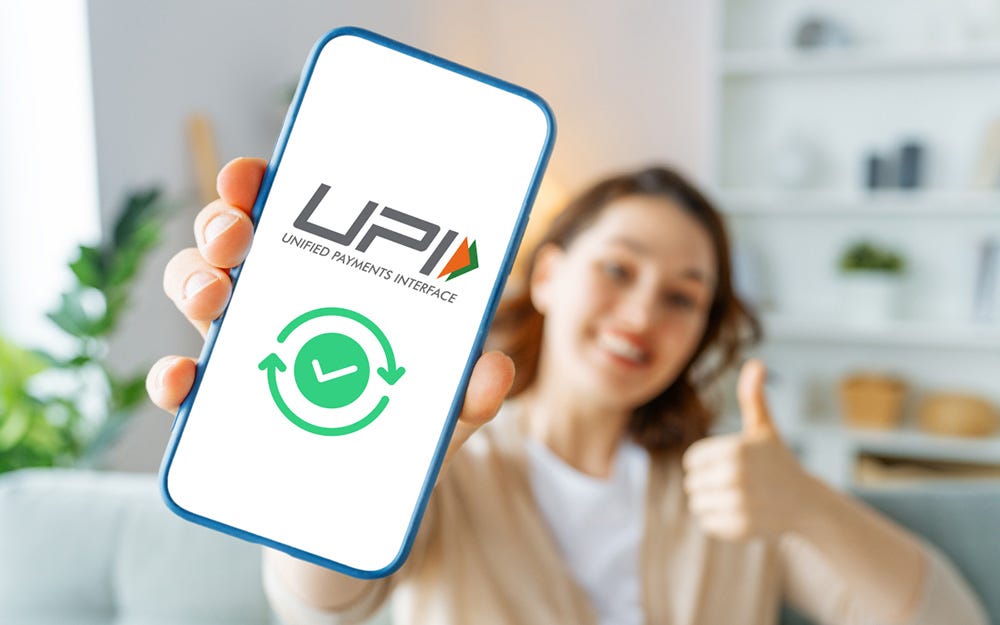
source: Paytm
Chapter 1: The Protocol vs. The App
The first thing to understand about UPI is what it isn’t. UPI is not an app, and it is not a digital wallet. Unlike a wallet (like the early days of Paytm), where money is held in a separate “pot” outside your bank, UPI is a protocol.
Think of it as the “email of money.” Before 2016, if you wanted to transfer funds, you needed a digital map: an 11-digit IFSC code and a 15-digit account number. UPI solved this by introducing the Virtual Payment Address (VPA).
Your VPA (e.g., rohan@okaxis) acts as a human-readable pointer. The "handle" after the @ tells the system which Payment Service Provider (PSP) handles your address. @okicici belongs to Google Pay’s ICICI handle; @ybl belongs to PhonePe. This interoperability means Rohan (on Axis) can pay Priya (on SBI) without either person ever knowing the other’s bank details. The protocol handles the translation.
Chapter 2: The Five Players in the Room
When you tap “Pay,” you aren’t just talking to your bank. You are initiating a conversation between five specific entities:
- The Payer PSP (The App): This is the interface you see — PhonePe, GPay, or BHIM.
- NPCI (The Central Switch): The National Payments Corporation of India acts as the air traffic controller. It resolves where the money needs to go and coordinates the “handshakes” between banks.
- The Payer Bank (Remitter Bank): This is your bank. It holds your money, verifies your PIN, and executes the debit.
- The Payee Bank (Beneficiary Bank): This is the recipient’s bank. It receives the credit instruction.
- The Payee PSP (Merchant App): This is the app that pings the merchant’s phone with a “Money Received” notification.
Chapter 3: The Anatomy of a 300ms Transaction
Let’s trace the journey of ₹500 from Rohan’s PhonePe app to Raju’s Chai Stall.
The Scan and Parse
The QR code at the chai stall isn’t a secret code; it’s a standardized URL. Your phone’s OS detects the upi:// scheme and immediately hands the data to your preferred app.
The PIN: India’s Most Secure 6 Digits
This is the most critical security step. When you enter your UPI PIN, it is never sent in plain text. Your smartphone has a *Secure Enclave or Trusted Execution Environment (TEE)* — a separate, tamper-proof processor.
The app passes your PIN to this secure zone. This app is hashed and signed with a private key. Your bank only holds the matching public key. This means even if a hacker compromised the servers of the app you’re using, they would find zero usable PIN data.
The Two-Phase Commit (2PC)
NPCI operates on a logic borrowed from database engineering called Atomic Transactions.
- Phase 1 (Debit): NPCI sends a request to SBI. SBI checks Rohan’s balance, verifies the PIN hash, and deducts ₹500.
- Phase 2 (Credit): Only after SBI confirms the debit does NPCI send a credit instruction to ICICI.
If the credit fails (perhaps Raju’s bank is undergoing maintenance), NPCI triggers an automatic reversal. This ensures that money is never “lost” in the wires. It either exists in the sender’s account or the receiver’s — never nowhere.
Chapter 4: The Fraud Engine — A Silent Guardian
Every transaction passes through NPCI’s real-time fraud detection in roughly 5 milliseconds. This machine-learning engine analyzes dozens of signals:
- Velocity: Is this the 50th payment from this ID in 10 minutes?
- Behavioral: Does this match Rohan’s historical spending patterns?
- Device Fingerprint: Is this a new device or the one Rohan usually uses?
If a transaction scores too high on the risk threshold, it is auto-declined before the bank even sees it. This technology is why technical hacking of UPI is nearly non-existent; instead, scammers rely on “social engineering” — tricking you into entering your PIN on a “Collect Request.” Remember: You never need a PIN to receive money.
Chapter 5: Why It’s So Fast (Engineering 0.3 Seconds)
How does a system touching five organizations complete in under a second? It’s a result of four brilliant design choices:
- Persistent Sockets: NPCI keeps “always-open” connections with all member banks. They don’t waste time on a “handshake” for every transaction; the pipe is already warm.
- Geographic Co-location: NPCI’s data centers are physically located near the major banks’ servers. Network latency is reduced to under 5ms.
- In-Memory Processing: Transaction states are held in RAM (using distributed stores like Redis) rather than waiting for slow physical disk writes.
- Parallel Execution: While waiting for a debit confirmation from Bank A, NPCI is already resolving the VPA and checking the status of Bank B.

Chapter 6: The Difference Between “Payment” and “Settlement”
Here is a secret: when the chai-wala receives your ₹500, the bank hasn’t actually moved the physical money yet.
UPI operates on a deferred net settlement model.
- At T+0ms: Raju sees “Received” on his screen. His bank (ICICI) updates its internal ledger to show he has ₹500 more.
- Every 30 Minutes: NPCI tallies all transactions between SBI and ICICI. If 1,000 people paid ICICI merchants from SBI, and 800 people did the reverse, the banks only settle the “net” difference via the RBI’s RTGS system.
This decoupling of the information (telling the user the money is there) from the settlement (actually moving the billions) is what allows the system to scale to 500 million users without crashing the banking backbone.
Chapter 7: The Evolution — Lite, Autopay, and Credit
UPI has evolved beyond a simple “Scan and Pay” tool.
UPI Lite
For small transactions under ₹500, we don’t need the whole bank-to-bank dance. UPI Lite allows you to “pre-load” a balance onto your phone’s secure chip. The payment happens locally and offline, syncing with the bank later. No PIN, no internet, no failure.
UPI Autopay
Mandates for Netflix or insurance are now handled via UPI. You approve a mandate once with your PIN, and the merchant can debit you automatically. Unlike credit cards, you can pause or cancel these mandates instantly from your app.
Credit on UPI
The most recent game-changer is linking Credit Cards to UPI. You can now use the credit limit of your RuPay card to pay a street vendor who doesn’t have a card machine. The merchant receives it as a standard UPI payment, while you enjoy the 45-day credit period.
Chapter 8: Why India Succeeded Where Others Failed
Compare UPI to the world:
- USA (Venmo/Zelle): Often closed ecosystems. You can’t always pay a Venmo user from Zelle seamlessly.
- China (WeChat/Alipay): “Walled gardens.” You stay within their app ecosystems.
UPI succeeded because it is Open and Interoperable. By making the protocol a public good — managed by the non-profit NPCI — India ensured that competition happens at the app level (who has the best UI?), while the plumbing remains shared and efficient.
Conclusion: The Strongest Wire Ever Built
The “Invisible Wire” is a testament to what happens when a nation treats digital infrastructure as a public good. It has brought 800 million people into the formal financial system in less than a decade.
The next time you see that green checkmark, take a second to appreciate the 300-millisecond journey you just witnessed. Your identity was verified by cryptographic hardware, your bank was queried across a persistent connection, and an atomic transaction was coordinated across the country — all for the price of a single rupee.
The wire may be invisible, but it is the strongest one ever built.
Are you curious about how other parts of the Indian stack work? I’m a CS student documenting the architecture of the digital world. Follow me for more deep dives into the code that runs our lives.
메타데이터
- post_id
- a4980f7c8d50
- slug
- the-invisible-wire-how-1-travels-across-india-in-0-3-seconds-a4980f7c8d50
- url
- https://pub.towardsai.net/the-invisible-wire-how-1-travels-across-india-in-0-3-seconds-a4980f7c8d50
- canonical_url
- https://pub.towardsai.net/the-invisible-wire-how-1-travels-across-india-in-0-3-seconds-a4980f7c8d50
- author_url
- https://medium.com/@manasviwalia
- status
- ok
- fetched_at
- 2026-08-08 23:09:43