Tidal Power’s Quiet Advantage: Consistency
Tidal power converters aren’t the flashiest renewables — but they may be the most schedule-friendly way to turn oceans into dependable…
Tidal Power’s Quiet Advantage: Consistency
Tidal power converters aren’t the flashiest renewables — but they may be the most schedule-friendly way to turn oceans into dependable electricity.
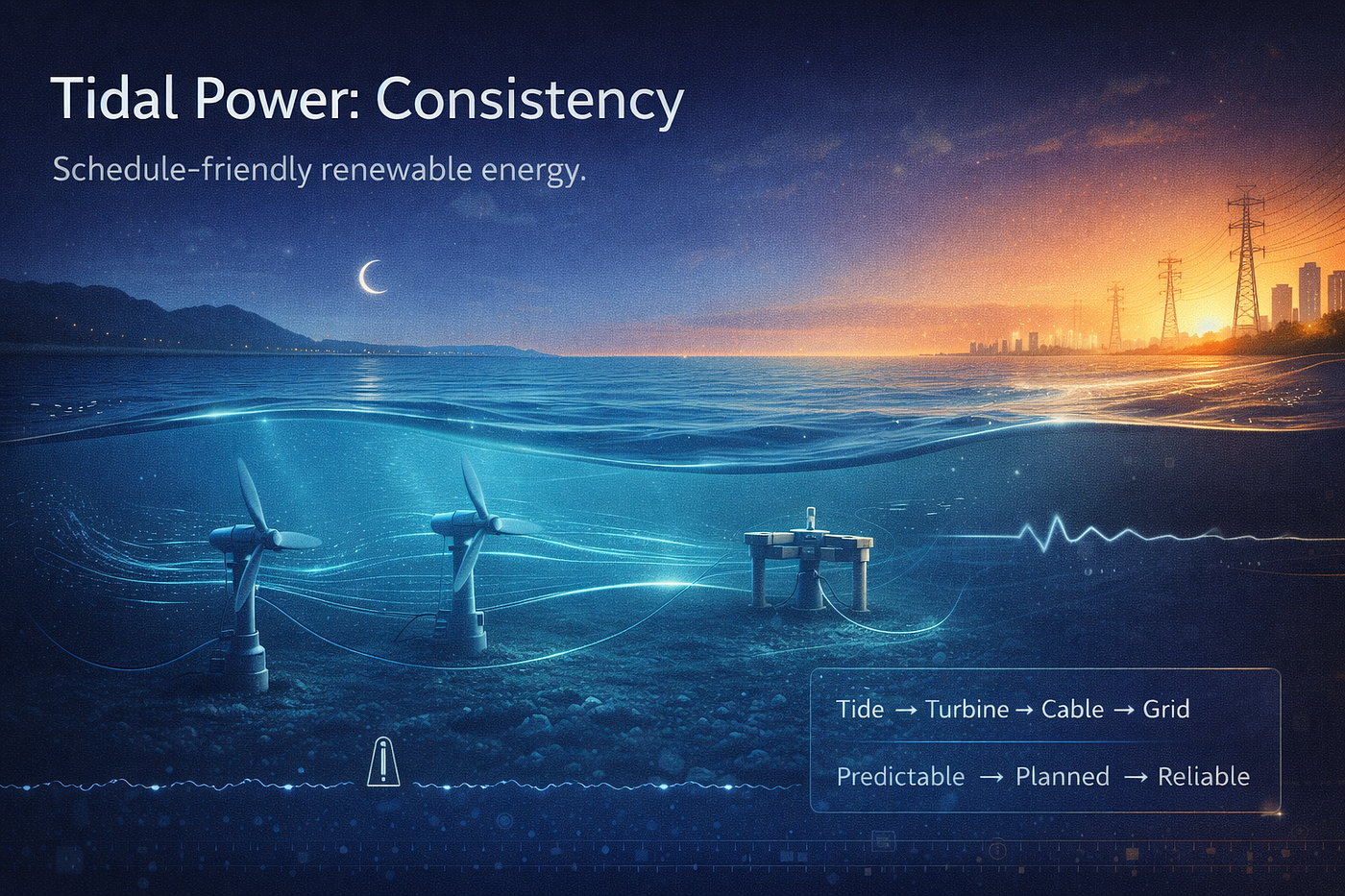
Tidal power converters harness predictable ocean motion for steady renewable energy. Learn converter types, real projects, grid integration, and scaling challenges.
Let’s be real: renewable energy doesn’t just compete on “clean.” It competes on reliability.
Wind is powerful but moody. Solar is cheap but clock-bound. Batteries help, but they’re still a cost line item with supply-chain baggage.
Tidal power is different. Not because it’s easy — tidal is hard — but because it shows up with something grid operators love: a schedule. Tides follow astronomical cycles that can be forecast years ahead.
So if you’re exploring tidal power converters, the right mental model isn’t “another renewable gadget.” It’s “ocean infrastructure that behaves more like a utility asset.”
Let’s unpack what tidal power converters are, why consistency is their superpower, and what needs to click for tidal to scale.
What tidal power converters actually convert
Tidal energy comes in two big flavors:
Tidal range (height difference)
This is the classic “barrage” approach: use a dam-like structure across an estuary or bay, then run water through turbines as the tide moves in and out — like a reversible hydropower plant.
Two landmark examples still anchor the category:
- Sihwa Lake in South Korea (~254 MW)
- La Rance in France (~240 MW)
Tidal range can deliver serious capacity, but the civil works and ecological impact considerations are major. It’s not a “deploy fast” technology.
Tidal stream (moving water)
This is the newer wave: capture energy from fast-flowing tidal currents using underwater “wind turbines” (plus a few clever variations).
These are the tidal power converters most people mean today when they talk about ocean energy scaling.
Why tides feel “consistent” in a grid sense
Tidal isn’t constant — there are slack periods when flow slows — but it’s highly predictable.
That predictability changes planning:
- You can forecast output windows.
- You can schedule maintenance around known low-energy intervals.
- You can integrate tidal into dispatch planning as a “shaped” resource rather than a surprise.
Think of it like a metronome compared to a jazz drummer.
1) The main converter types you’ll actually see in the water
If you’ve never toured tidal hardware, it helps to classify by how the device “meets” the flow.
Horizontal-axis tidal turbines (HATTs)
The closest analog to wind turbines — rotors spin from current flow. Common in many deployments and test programs.
Crossflow turbines
Vertical-axis or crossflow designs can handle multi-directional flow without yaw systems (in some implementations). They’re often discussed for robustness and simplification.
Oscillating hydrofoils
Instead of spinning blades, a foil moves through the water like a controlled wing, converting lift into mechanical power.
Ducted turbines and venturi concepts
Use a shroud/duct to accelerate flow through the rotor for higher power density — at the cost of added structure and drag.
Floating tidal platforms
Some of the most visually iconic systems are floating, making installation and retrieval easier in certain sites. Orbital Marine’s O2 is a notable commercial turbine rated at 2 MW, deployed at EMEC in Orkney.
2) A quick physics check: why water is a big deal
Water is dense. That’s why relatively compact turbines can produce meaningful power in strong currents.
The simplified power relationship (same shape as wind) is:
P ≈ 0.5 × ρ × A × v³ × Cp
ρ  = fluid density (water >> air)
A  = swept area of rotor
v  = current speed
Cp = efficiency coefficient (Betz-like, plus losses)
Notice the killer term: v³. Small increases in current speed massively increase power. That’s why site selection matters more than marketing.
3) Site selection is everything (and most coastlines won’t qualify)
Not every ocean is a tidal goldmine.
Tidal stream needs:
- narrow channels or headlands that accelerate flow
- predictable high-speed currents
- survivable seabed conditions for anchoring
- acceptable environmental impact profiles
- viable grid connection
This is why tidal is often regional-first: places like the UK, parts of Canada, and certain straits have unusually strong resources.
4) Real projects show what’s working (and what hurts)
Tidal energy has matured enough that we can stop speaking purely in hypotheticals.
MeyGen: the “array” story
The MeyGen project in Scotland’s Pentland Firth is widely cited as the world’s largest tidal stream array in development. Phase 1 is an operational 6 MW array (four 1.5 MW turbines), with continued development and maintenance updates reported recently.
This matters because tidal doesn’t scale by heroic prototypes. It scales by repeatable arrays.
Nova Innovation: endurance and operating hours
Nova’s Shetland Tidal Array has accumulated years of operational experience, with industry reporting noting long cumulative operating hours — exactly the boring reliability signal investors want.
Verdant Power: “urban tidal” proof of concept
Verdant’s Roosevelt Island Tidal Energy (RITE) project in New York is often referenced as a U.S. record-setter for delivered marine energy over continuous operation windows.
Not huge capacity — but strategically important: it shows how tidal can fit into constrained waterways with strict oversight.
5) The hidden complexity: maintenance is the real battlefield
Tidal converters live in a brutal environment:
- corrosion
- biofouling (things grow on everything)
- cavitation and blade wear
- debris impacts
- storms and extreme currents
- costly vessel time for retrieval and service
This is why many designs obsess over maintenance strategy as much as efficiency.
The “serviceability-first” architecture
Device (turbine + generator)
   ↓ mounted on
Foundation / mooring system
   ↓ connected to
Subsea cable → shore substation
   ↓ into
Grid (with forecasting + controls)
The key question for any design: can you retrieve and service the device fast enough to keep availability high without spending the entire revenue on boats?
6) Environmental acceptance is earned, not assumed
Tidal proponents often say “it’s invisible and underwater,” but regulators care about:
- marine mammal interactions
- fish behavior and migration
- sediment transport and seabed changes
- underwater noise
- cumulative impacts at array scale
For tidal range projects, system-wide ecological and sediment effects are even more central to the debate — La Rance has decades of study precisely because large barrages reshape estuaries.
This is also where tidal has a chance to win trust: transparent monitoring, adaptive operations, and designs that prioritize coexistence.
7) The economics are improving — but learning curves take time
Tidal stream is still early in commercialization. That’s not an insult; it’s just the phase it’s in.
There are credible, detailed efforts to model and reduce tidal LCOE — especially as arrays grow, installation is standardized, and O&M becomes less bespoke.
And the macro market signal is: ocean power remains small globally, but it’s inching forward — total operating ocean power capacity is still only in the hundreds of megawatts, with small additions in recent years.
That’s not “breakout.” But it is “still alive, still improving,” which matters in hard-tech energy.
A practical grid-integration sketch
This is how tidal becomes “consistent energy” in practice — not by being flat, but by being forecastable and controllable.
Tidal forecast model (astronomical + site calibration)
   ↓
Expected power curve (time-indexed)
   ↓
Grid scheduling (day-ahead / intra-day)
   ↓
Real-time control (curtailment, ramp management)
   ↓
Storage / flexible load (optional, smaller than for wind/solar)
Because tidal has predictable ramps, you can often pair it with:
- electrolyzers
- desalination
- cold storage
- industrial loads that can follow a timetable
In other words: tides can support planned flexibility, not just emergency balancing.
Conclusion: Tidal converters are a “boring power” play — in the best way
Tidal power converters won’t replace solar or wind. That’s not the job.
Their job is to be:
- predictable
- site-optimized
- array-scalable
- serviceable
- environmentally accountable
And if the industry nails those five, tidal becomes something rare in the energy transition: a renewable resource you can schedule like infrastructure.
If you want a follow-up, tell me which path you’re more curious about:
- tidal range (barrages/lagoons)
- tidal stream arrays (underwater turbines)
- or hybrid “tidal + industrial load” projects
Drop it in the comments, and follow for the next deep dive.
메타데이터
- post_id
- a49aeac8b4f1
- slug
- tidal-powers-quiet-advantage-consistency-a49aeac8b4f1
- url
- https://medium.com/@Quaxel/tidal-powers-quiet-advantage-consistency-a49aeac8b4f1
- canonical_url
- https://medium.com/@Quaxel/tidal-powers-quiet-advantage-consistency-a49aeac8b4f1
- author_url
- https://medium.com/@Quaxel
- status
- ok
- fetched_at
- 2026-07-20 15:04:06