Ever Wondered Why Some Sites Feel Instant, and Others Don’t? HTTP/3 Has the Answer
Some sites open before you even realize you clicked. Others make you sit there, watching the tab spin, on the same connection. Most people…
Ever Wondered Why Some Sites Feel Instant, and Others Don’t? HTTP/3 Has the Answer

HTTP/3 Has the Answer
Some sites open before you even realize you clicked. Others make you sit there, watching the tab spin, on the same connection. Most people shrug and blame their Internet Service Provider (ISP). Sometimes that’s fair. But a lot of the time, the connection isn’t the problem — it’s how the site is being delivered to your browser.
Every website you’ve ever opened ran on HTTP. It’s gone through a few versions over the years — HTTP/1.1 to HTTP/2, and now to HTTP/3. This latest version focuses on improving how quickly and reliably data moves between servers and users.
How Data Actually Moves When You Visit a Site
Hit a URL and your browser get to work. It doesn’t download a page — it fetches pieces. HTML comes first, then everything on that page depends on stylesheets, scripts, fonts, and images. The protocol is what keeps that process from falling apart. It sets out the rules for how requests go out, how many at a time, and what happens when something doesn’t arrive.
HTTP/1.1 ran the web for a long time. The problem was simple — one thing at a time. A request goes out, you wait, it comes back, next one goes. HTTP/2 broke that pattern. Multiple requests, one connection, running together. That’s what multiplexing meant in practice, and for most use cases, it was a clear step up.
But HTTP/2 still ran on Transmission Control Protocol (TCP) underneath. And TCP has a problem that multiplexing alone couldn’t fix.
When a packet gets lost in transit, it happens constantly on real-world networks, and TCP stops the entire connection and waits. Not only the affected stream, but everything. Other requests that have nothing to do with that lost packet still sit frozen until retransmission is confirmed. This is head-of-line blocking. It’s not a bug, but this is how TCP was designed — reliability over speed. HTTP/2 helped by letting multiple requests share one connection, but it never escaped TCP. The bottleneck was still there, just less visible.
It needed a different foundation entirely. That’s where QUIC (Quick UDP Internet Connections) comes in.
What QUIC Actually Fixes HTTP/3 took a different route entirely. It’s built on QUIC — something Google put together internally before the IETF (Internet Engineering Task Force) got involved and made it a standard. QUIC runs on UDP (User Datagram Protocol), not TCP. That’s not just a technical footnote, it’s the whole point.
UDP doesn’t enforce packet ordering or guarantee delivery at the transport layer. That sounds worse, but QUIC implements its own reliability per stream. So, when a packet drops, only that specific stream is affected. Every other request keeps going. Head-of-line blocking doesn’t exist in the same way because streams don’t share a single ordered queue anymore.
That one change has a compounding effect on unstable networks.
What This Looks Like When You’re Actually Browsing
Packet loss stops cascading In HTTP/2, one dropped packet freezes all multiplexed streams on that connection. In HTTP/3, streams are isolated at the QUIC layer — a loss in one doesn’t touch the others.
The connection starts faster TCP needs a handshake before anything flows. TLS on top of TCP adds more round-trips, you’re often waiting through 2–3 exchanges before the first byte of content arrives. QUIC integrates TLS directly into its own handshake, cutting this to one round trip for new connections. For returning connections, 0-RTT resumption means data can go out before the handshake finishes. It adds faster than you’d expect, especially over long distances between client and server.
Network switches don’t break the session TCP knows you by your IP address. That’s it. So, when you walk out of the house, and your phone drops Wi-Fi for mobile data, your IP changes, and as far as the server is concerned, you’re a completely different person. The connection breaks. QUIC gets around this by giving each connection its own ID — one that has nothing to do with your IP or which network you’re on. Change networks mid-page, the ID stays the same, the server stays connected, and the page keeps loading. Nothing is reloaded. Nothing breaks.
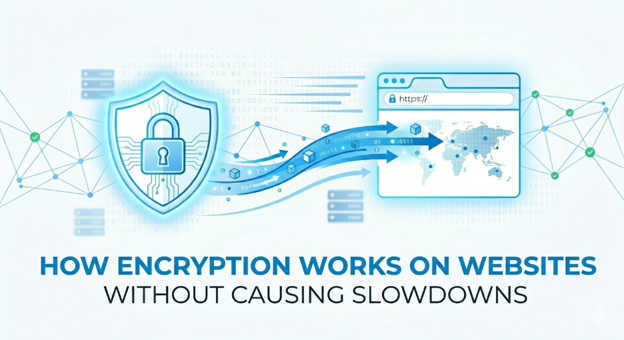
Encryption isn’t optional HTTP/2 technically allows unencrypted connections. HTTP/3 doesn’t — TLS is mandatory, built into QUIC rather than sitting on top as a separate layer. Fewer round-trips to establish security, and no configuration path that accidentally leaves traffic unencrypted.
Why HTTP/3 Feels More Reliable in Real-World Conditions
The result is not always dramatic in terms of raw speed, but it is noticeable in consistency. Pages load more smoothly, with fewer interruptions or uneven delays. This is why HTTP/3 improvements show up more in how stable a site feels than in speed tests.
Networks are not always stable. Users switch connections, experience signal drops, and operate across varying levels of latency. These are normal conditions, not edge cases.
HTTP/3 is designed with these realities in mind. Packet loss no longer freezes everything on the page. Streams are handled independently, so delays stay contained instead of spreading across the entire connection. At the same time, connection IDs allow sessions to persist even when the underlying network changes.
The result is simple in practice — fewer visible breaks, fewer reloads, and a browsing experience that holds together even when the network doesn’t.
Why HTTP/3 hasn’t taken over yet
HTTP/3 isn’t everywhere yet, and that’s not because it isn’t ready. The bigger hurdle is on the infrastructure side. The websites have to actively update their setup to support it, and not every hosting environment has made that shift. It’s also worth keeping in mind that the protocol is only one piece of the puzzle. Where your server sits, how well caching is configured, how lean the front-end is — all of that still matters just as much. HTTP/3 fixes what was broken at the transport level. But a well-optimized protocol won’t save a poorly built website.
Final thoughts
Fast and slow sites don’t always look different on the surface. The gap usually lies in how data moves underneath — how requests are handled, how losses are recovered, and how quickly a connection gets off the ground. HTTP/3 tightens all of that. Users won’t see it in any obvious way, but they’ll feel it every time a page behaves the way it should.
메타데이터
- post_id
- a4a755f5458d
- slug
- ever-wondered-why-some-sites-feel-instant-and-others-dont-http-3-has-the-answer-a4a755f5458d
- url
- https://medium.com/h7w/ever-wondered-why-some-sites-feel-instant-and-others-dont-http-3-has-the-answer-a4a755f5458d
- canonical_url
- https://medium.com/h7w/ever-wondered-why-some-sites-feel-instant-and-others-dont-http-3-has-the-answer-a4a755f5458d
- author_url
- https://medium.com/@primesslcert
- status
- ok
- fetched_at
- 2026-06-24 04:09:36