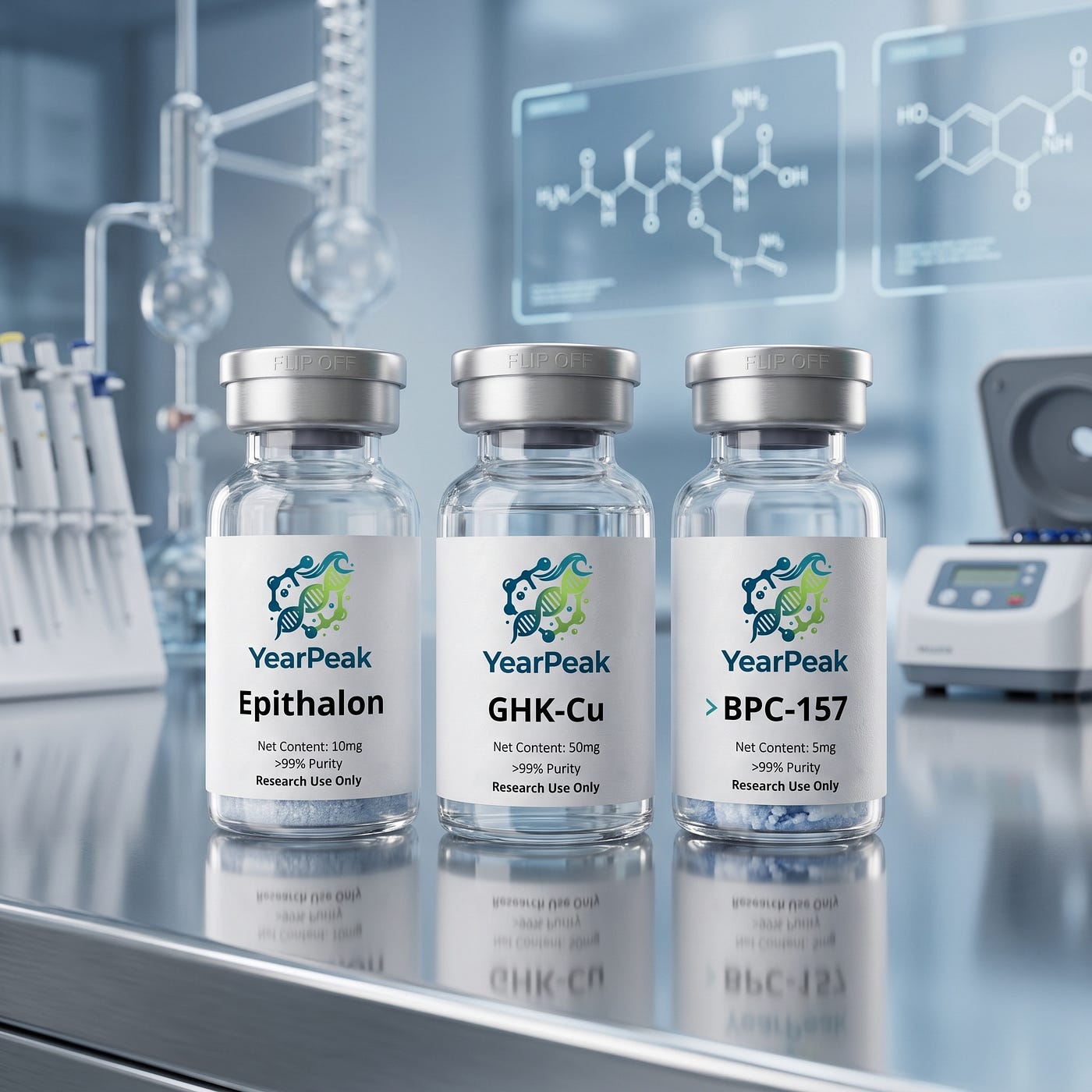
The Independent Researcher’s Guide to Peptide Degradation: Why Pure Epitalon (AEDG) Fails in…
How subtle pH shifts and improper reconstitution vehicle selection trigger premature hydrolytic cleavage in short-chain tetrapeptides.
The Independent Researcher’s Guide to Peptide Degradation: Why Pure Epitalon (AEDG) Fails in Standard Sterile Water
How subtle pH shifts and improper reconstitution vehicle selection trigger premature hydrolytic cleavage in short-chain tetrapeptides.
For independent researchers and biohacking enthusiasts dedicated to longevity protocols, sourcing 99% HPLC-verified Epitalon is only half the battle. The true vulnerability lies in the reconstitution phase.
Epitalon is a linear tetrapeptide with a remarkably simple amino acid sequence: Ala-Glu-Asp-Gly (AEDG). Unlike larger, complex proteins that feature tertiary folded structures to shield their molecular backbones, short-chain peptides have zero structural defense mechanisms against localized environmental shifts.
The Chemistry of Hydrolytic Cleavage
When you introduce a reconstitution vehicle into a lyophilized vial of Epitalon, you are not just dissolving powder; you are initiating a chemical environment. If you use standard sterile water for a multi-dose vial intended to sit in a refrigerator for weeks, or an uncalibrated bacteriostatic water that drifts outside the strict pH 4.5–7.0 sweet spot, you inadvertently trigger rapid hydrolytic cleavage.
Because the peptide backbone is exposed, hydroxyl ions or excessive acidity will systematically attack the peptide bonds. Within 48 to 72 hours, your active tetrapeptide can completely degrade into basic, inactive individual amino acids. The solution remains perfectly clear — there is no visible mold, cloudiness, or precipitation — but the compound is scientifically dead.
Maximizing Research Repeatability
To achieve reproducible, high-fidelity data from your longevity assays (especially when designing advanced stacks combining AEDG with GHK-Cu or mitochondrial vectors), stabilizing the sequence baseline is paramount.
Independent laboratories always prioritize pre-buffered, pH-calibrated bacteriostatic solutions specifically designed to resist atmospheric carbon dioxide absorption, which typically causes unbuffered water to turn acidic over time.
For researchers looking to benchmark their protocols against certified baselines, utilizing reference-grade standards is essential. You can review the technical specifications and structural profiles of fully verified lots at the YearPeak™ Research Portal.
메타데이터
- post_id
- a4b2df1da12e
- slug
- the-independent-researchers-guide-to-peptide-degradation-why-pure-epitalon-aedg-fails-in-a4b2df1da12e
- url
- https://medium.com/@YearPeak/the-independent-researchers-guide-to-peptide-degradation-why-pure-epitalon-aedg-fails-in-a4b2df1da12e
- canonical_url
- https://medium.com/@YearPeak/the-independent-researchers-guide-to-peptide-degradation-why-pure-epitalon-aedg-fails-in-a4b2df1da12e
- author_url
- https://medium.com/@YearPeak
- status
- ok
- fetched_at
- 2026-08-03 07:19:48