Why Is Autism Increasing? (Part 2)
Tracking the Historical Inflection Point of Rising Prevalence and Severity
Why Is Autism Increasing? (Part 2)
Tracking the Historical Inflection Point of Rising Prevalence and Severity
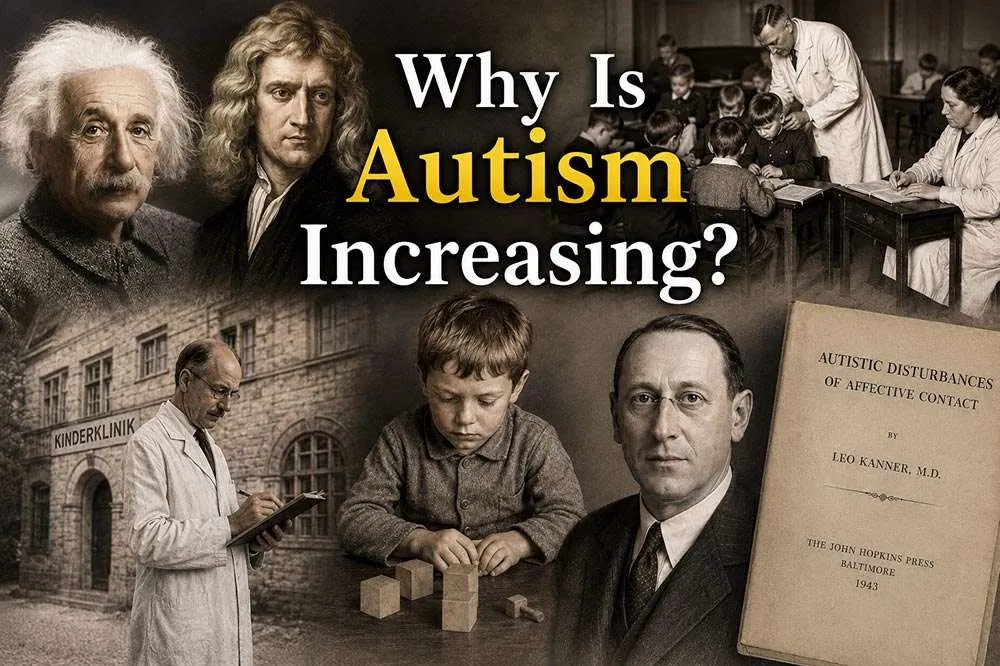
Today, it is an undeniable reality that the prevalence of Autism Spectrum Disorder (ASD) is continuously rising, and its clinical manifestations are becoming increasingly severe. Understanding the epigenetic factors driving this modern trajectory is one of the most critical research mandates in our quest to discover definitive treatments for ASD. To uncover the root cause, our first step must be to pinpoint the exact historical inflection point where this surge in ASD prevalence and severity actually began. By investigating the environmental shifts that occurred just prior to this critical juncture, we can uncover the definitive clues to why autism is expanding so rapidly.
Before the 1900s: Symptoms Existed, but the Disease Did Not
A synthesis of surviving historical records and modern retrospective analyses suggests that prior to the 1900s, ASD in its modern, severe presentation was exceedingly rare, or existed primarily in a relatively mild form. While explicit diagnoses of ASD are absent from European medical literature before the 20th century, we do find clear documentation of individuals who exhibited behaviors highly indicative of the condition.
The Case of Hugh Blair (1747): This Scottish court record holds immense retrospective medical value. In a legal proceeding brought to annul a marriage based on the husband’s mental capacity, records detailed that he exhibited highly unstable social communication, impaired social judgment, and prominent “repetitive behaviors”. Modern researchers evaluate this case as a highly probable representation of ASD.
The Eccentricities of Henry Cavendish: The 18th-century scientist Henry Cavendish demonstrated extreme social avoidance — minimizing human interaction to an absolute limit — alongside an obsessive, singular focus on his specific fields of research. Reviewing these accounts, the late neurologist Oliver Sacks concluded that it was “highly probable that he was on the autism spectrum”.
Insights from Eastern Medicine: Xiao’er Yaozheng Zhijue (小兒藥證直訣)
Similarly, traditional Eastern medical texts contain no records that fully align with modern ASD. Instead, they approached these traits under a different clinical umbrella: pediatric language delay.
Most notably, the Song Dynasty pediatric text Xiao’er Yaozheng Zhijue explicitly documents nonverbal states and developmental delays, using phrases such as “a child who remains silent for a prolonged period” (兒久不語), “delayed speech” (語遲), and “the inability to speak” (不能言). Modern developmental research confirms that language delay is robustly linked to social developmental delays, and a substantial portion of these historical cases are presumed to have carried underlying autistic traits. What we can infer from these cross-cultural historical fragments is that while individuals with autistic traits certainly existed, their numbers were incredibly small — which explains why autism was never codified as a distinct medical entity. Furthermore, given that these individuals still managed to marry or sustain highly productive careers as scientists, their condition was evidently not severe enough to cause the complete social isolation or profound functional deficits that require full-time external support today. In short, the powerful epigenetic triggers capable of catalyzing an explosive spike and severe presentation of ASD had not yet emerged in the human environment.
Asperger-like Traits in History’s Greatest Minds
Modern researchers have frequently retrospectively identified ASD or Asperger-like traits in some of the most influential figures in modern history — most notably, Albert Einstein and Isaac Newton. Their documented biographies provide compelling evidence.
Albert Einstein: Einstein famously suffered from a severe language delay, failing to speak in full sentences until he was four or five years old. He also struggled significantly with social relationships, maintained an almost obsessive restriction of interests, and relied heavily on visual rather than verbal thinking. These distinct clinical features led Galina Weinstein to suggest a retrospective diagnosis of Asperger’s Syndrome.
Isaac Newton: Renowned psychiatrist Simon Baron-Cohen, along with several other clinicians, has posited that Newton possessed prominent Asperger-like traits. The historical evidence points to his extreme isolation — maintaining virtually no social circle — an obsessive, near-manic immersion in his research, and highly volatile emotional regulation.
Piecing these historical profiles together confirms a vital thesis: prior to the 1900s, individuals on the spectrum existed only in small numbers and generally remained in a “mild state”. They retained enough social communication and functional capacity to integrate into society, meaning their condition never manifested as a widespread public health crisis.
The Early 1900s: The Great Inflection Point
The landscape shifted dramatically at the turn of the 20th century. For the first time in human history, autism transitioned from an individual quirk into an object of systematic medical observation.
1. 1908 (Theodor Heller, Austria): Austrian special educator Theodor Heller documented cases of children who, after showing completely normal early development, underwent a rapid and devastating regression around ages 3 to 4, exhibiting autism-like symptoms. This stands as humanity’s very first record of regressive autism, though it was limited to a single subject.
2. 1925 (Grunya Sukhareva, Ukraine): Seventeen years later, the first clinical group study emerged. Child psychiatrist Grunya Sukhareva published a detailed medical report tracking six boys who displayed distinct autistic tendencies.
3. 1943 & 1944 (Leo Kanner & Hans Asperger): In 1943, American pediatrician Leo Kanner published his landmark paper on 11 children, officially coining and defining the concept of “autistic”. In a striking historical parallel, Austrian pediatrician Hans Asperger published Autistic Psychopathy in Childhood in 1944, detailing his close observations of four young boys.
As we enter the 20th century, we see these clinical observations suddenly surface, multiply, and mirror each other across both Europe and the American continent. This identical timeline confirms that the early 1900s was the historical inflection point for the emergence of modern ASD. — -
A Change in Diagnosis, or a True Surge in Severity?
Skeptics often argue that the rising numbers are merely the result of expanding diagnostic criteria. However, historical data reveals that this period marked not just a rise in numbers, but a profound trend toward worsening severity. In 1971, Leo Kanner published a definitive long-term follow-up study tracking the original 11 autistic children he had first reported on in 1943.
(Reference: “Follow-up Study of Eleven Autistic Children Originally Reported in 1943,” Journal of Autism and Childhood Schizophrenia)
The long-term outcomes were devastating:
Only 2 out of the 11 children achieved enough functional capacity to live independently.
The remaining 9 children languished in states of severe disability, with the vast majority requiring institutionalization in hospitals, specialized facilities, or care homes.
Kanner’s follow-up proves that we are not looking at a benign shift in administrative definitions. Instead, it signals a genuine, unprecedented biological surge in cases where children completely lost the ability to maintain independent social and cognitive functioning.
Conclusion: Why We Must Look Closely at the Late 1800s
Stepping back to look at the macro-historical view, the early 1900s represents a definitive turning point where ASD transformed into a rapidly expanding, severe pathological condition. If this escalation and worsening prognosis are indeed real biological phenomena, we must look past modern diagnostic shifts and rigorously examine the environmental variables that were introduced just prior to this explosion. This directs our scientific gaze squarely at the late 1800s. What radical transformations occurred during this period across Europe and North America regarding dietary habits (the dawn of industrial food processing and refined sugars) and the medical landscape? How did these shifts interact with the fragile neuro-immune systems of developing children?
In my next article, I will dissect the specific environmental and dietary upheavals of the late 1800s, tracing the direct biological mechanisms that tied these historical shifts to the modern autism epidemic.
For a more detailed explanation, please visit our English website or read the full article on Substack.
🌐 Dr. Tomato Website: https://dr-tomato.com/report/autism-epigenetic-history/
📖 Substack: https://drmoonjookim.substack.com/p/why-is-autism-increasing-part-2
메타데이터
- post_id
- a4b7548a9bbc
- slug
- why-is-autism-increasing-part-2-a4b7548a9bbc
- url
- https://medium.com/@itomatokids/why-is-autism-increasing-part-2-a4b7548a9bbc
- canonical_url
- https://medium.com/@itomatokids/why-is-autism-increasing-part-2-a4b7548a9bbc
- author_url
- https://medium.com/@itomatokids
- status
- ok
- fetched_at
- 2026-06-10 08:34:46