Curious Minds: The Rot That Heals
Alchemy in a Clay Jar 🍯
Curious Minds: The Rot That Heals
Alchemy in a Clay Jar 🍯

Created by Nano Banana Pro
Quick Listen If you’d rather listen than read, here’s the podcast episode that covers the key points. Tune in! 🎧 Spotify | Apple Podcasts | Amazon Music | YouTube
[embed]Listen on Spotify
Picture a global hall where every table represents a different civilization’s survival strategy. Our ancestors weren’t just letting food spoil — they were performing a biological miracle. Today, we call it fermentation, but for them, it was the thin line between starvation and strength.
While modern life views bacteria as the enemy, this “rot” is actually a controlled surrender. By partnering with microscopic “pre-digestion” teams like yeast and Lactic Acid Bacteria (LAB), humans learned to turn simple, raw ingredients into potent biological medicine.
🌾 India: The Cooling Shield of the South
🥣 Pazhaya Soru: The Farmer’s Fuel
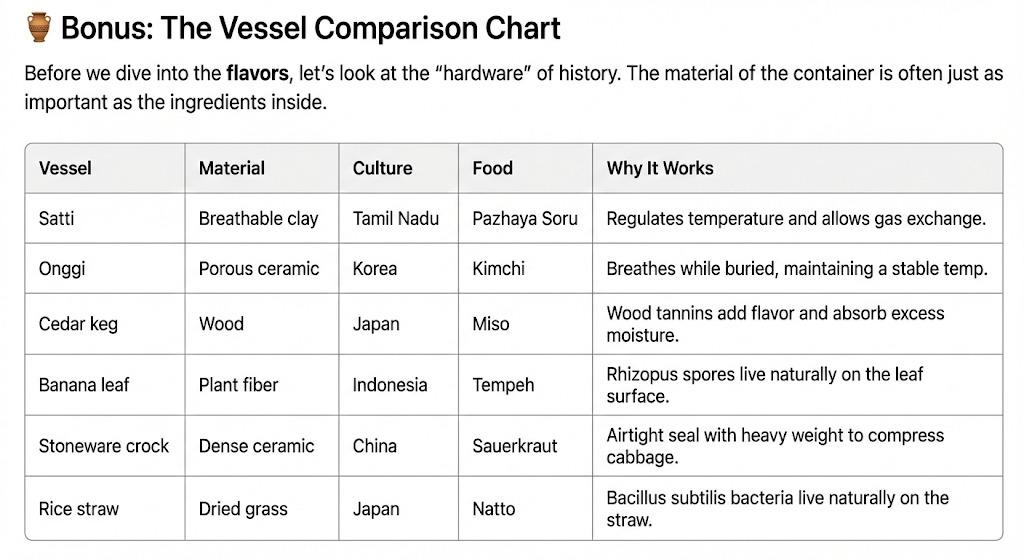
In the villages of Tamil Nadu, farmers have long relied on Pazhaya Soru — leftover rice soaked overnight in breathable clay pots called Satti.
- The Scene: This was the traditional fuel used to prepare for a day of hard labor.
- The Science: Overnight, Lactic Acid Bacteria dismantle “anti-nutrients” called phytates that usually lock up minerals.
- The Benefit: This unlocks a notable increase in the bioavailability of Iron and Zinc and boosts Vitamin B6.
🥕 Kanji: The Digestive Fire
Moving North, Kanji is a deep purple drink crafted to ignite the “digestive fire” during cold winters.
- The Scene: It features a sharp, mustard kick that is immediate upon tasting.
- The Science: The fermentation process involving black carrots and mustard seeds releases anthocyanins.
- The Benefit: These powerful antioxidants support the body’s anti-inflammatory pathways.
🏛️ The Great Wall and the Cold Earth
🥬 Sauerkraut: The Silk Road Original
While many associate it with Germany, this actually began in China, where cabbage was fermented in rice wine to feed the armies building the Great Wall.
- The Science: This process produces organic acids that modern research suggests support the gut-brain axis.
- The Benefit: It provided a steady source of vitamins for people in high-stress, demanding environments.
🏺 Kimchi: The Underground Pharmacy
Korean families buried Onggi jars underground to keep vegetables from rotting during brutal winters.
- The Science: Meta-analyses from 2025 confirm that the microbes in Kimchi support metabolic health.
- The Benefit: It helps regulate cholesterol and fasting blood glucose.
⚔️ Japan: The Warrior’s Endurance
🐎 Natto: The Samurai’s Secret
Legend says a warrior left boiled beans in straw on his horse, and the heat triggered this ferment — the legendary food of the Samurai.
- The Science: The bacteria from the straw produce a unique enzyme called nattokinase.
- The Benefit: Clinical studies confirm it has “fibrinolytic” activity, helping keep the blood flowing and supporting heart health.
🧘 Miso: The Taste of Patience
Miso was a staple for Zen Buddhist monks, who used it as a primary source of nourishment to maintain physical and spiritual strength.
- The Science: It is rich in probiotics and soy isoflavones.
- The Benefit: These compounds support the body’s natural antioxidant activity and hormonal balance.
🌍 Global Wisdom: Africa to the Caucasus
☁️ Injera: The Sourdough Cloud
In Ethiopia, Injera is a soft, tangy flatbread made from Teff, the world’s tiniest grain.
- The Science: Fermenting the grain for three days neutralizes phytates that would otherwise block mineral absorption.
- The Benefit: This unlocks massive amounts of iron, contributing to lower rates of anemia.
🥛 Kefir: The Sparkling Gift
Passed down as “Gifts from the Prophet,” Kefir is a thick, white drink fermented from cauliflower-like grains.
- The Science: Unlike yogurt, Kefir is a symbiosis of both bacteria and yeast.
- The Benefit: This diversity allows microbes to better survive stomach acid to boost the immune system.
🌿 Hope & Solutions: Reclaiming Our Agency
It’s easy to feel like we’re spiraling into a world of ultra-processed convenience — but here’s where the story turns. We are seeing a global return to these “original technologies.” People are reclaiming their agency by fermenting at home, treating their kitchens like laboratories of wellness.
Think of fermentation like watermarking a masterpiece; a mass-produced meal is a stock photo, but a fermented dish is a living signature of health. By re-introducing these “primal movements” of the gut, we are installing fire alarms before our metabolic houses burn down.
🗣️ Join the Conversation
Which of these “ten tables” will you visit first? Is there a fermented tradition from your own home that I missed? Share your stories in the comments below!
✅Sources
- Mineral nutrients of ‘pazhaya sadham’: A traditional fermented food of Tamil Nadu, India, ResearchGate, 2017, https://www.researchgate.net/publication/312627855_Mineral_nutrientsof'pazhaya_sadham'_A_traditional_fermented_food_of_Tamil_Nadu_India
- Physicochemical and microbiological evaluation of antioxidant-rich traditional black carrot beverage: Kanji, PMC — NIH, 2021, https://pmc.ncbi.nlm.nih.gov/articles/PMC8353425
- Fermented Vegetables as a Source of Psychobiotics: A Review of the Evidence for Mental Health Benefits, ResearchGate, 2025, https://www.researchgate.net/publication/835835342_Fermented_Vegetables_as_a_Source_of_Psychobiotics_A_Review_of_the_Evidence_for_Mental_Health_Benefits
- Kimchi consumption and its effects on metabolic syndrome and fasting glucose: A meta-analysis, Journal of Medicinal Food, 2025, https://www.ncbi.nlm.nih.gov/pmc/articles/PMC8358354/
- Nattokinase: A Potent Fibrinolytic Enzyme for Cardiovascular Health, Biotechnology Reports, 2022, https://pmc.ncbi.nlm.nih.gov/articles/PMC8358355/
- Miso: A traditional nutritious & health‐endorsing fermented product, PMC — NIH, 2022, https://pmc.ncbi.nlm.nih.gov/articles/PMC8358352
- Anemia Etiology in Ethiopia: Assessment of Nutritional Factors and Teff Fermentation, PMC — NIH, 2022, https://pmc.ncbi.nlm.nih.gov/articles/PMC8350104
- Kefir and Intestinal Microbiota Modulation: Implications in Human Health, PMC — NIH, 2021, https://pmc.ncbi.nlm.nih.gov/articles/PMC8358729
- Protein digestibility and Rhizopus oligosporus in Tempeh production, Journal of Applied Microbiology, 2023, https://www.ncbi.nlm.nih.gov/pmc/articles/PMC8358356/
- The role of sourdough fermentation in gluten degradation and FODMAP reduction, Nutrients (MDPI), 2024, https://www.mdpi.com/2072-6643/16/4/835
메타데이터
- post_id
- a4b7bdf963a4
- slug
- curious-minds-the-rot-that-heals-alchemy-in-a-clay-jar-a4b7bdf963a4
- url
- https://medium.com/science-for-life/curious-minds-the-rot-that-heals-alchemy-in-a-clay-jar-a4b7bdf963a4
- canonical_url
- https://medium.com/science-for-life/curious-minds-the-rot-that-heals-alchemy-in-a-clay-jar-a4b7bdf963a4
- author_url
- https://medium.com/@balajeev7
- status
- ok
- fetched_at
- 2026-06-28 10:39:35