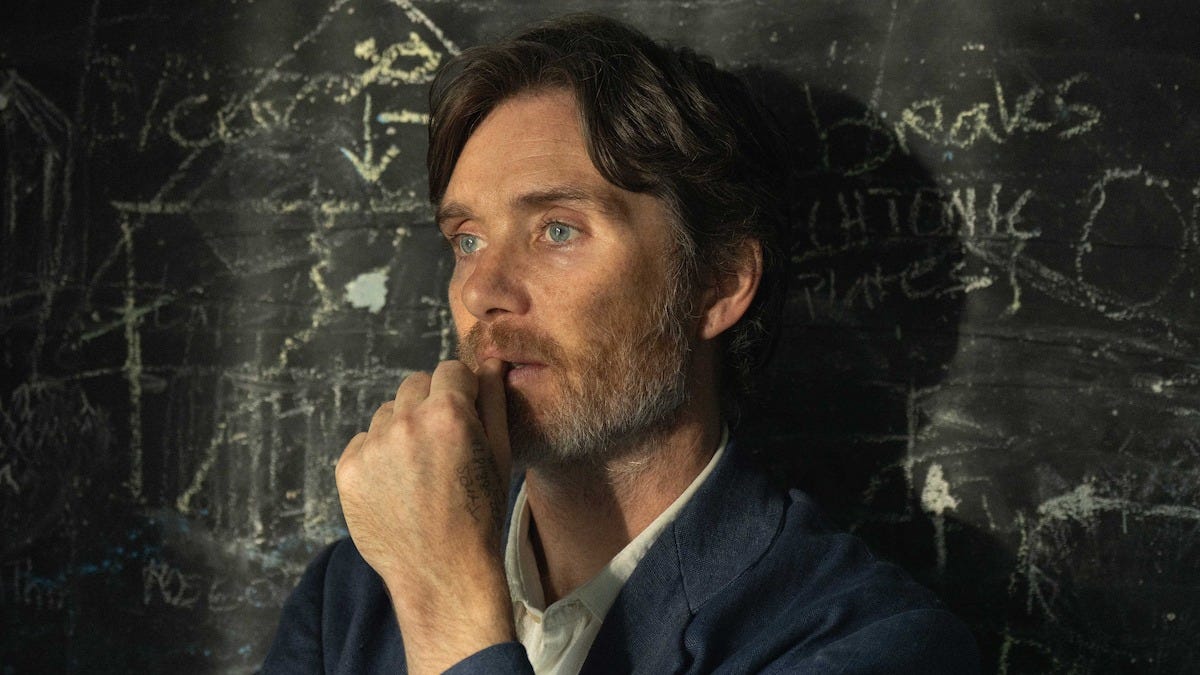
Chris Nolan Movies as Greek Gods (part 1)
I had to wait in a queue for IMAX tickets; I inverted the queue and got myself some big popcorn.
Chris Nolan Movies as Greek Gods (part 1)
I had to wait in a queue for IMAX tickets; I inverted the queue and got myself some big popcorn.
Spoiler alert for: Christopher Nolan movies, and a story older than most religions. I hope this alert is redundant.
Despite his complex and sometimes mind-boggling plots, the simplistic element that has taken the spotlight in the lead up to Christopher Nolan’s adaptation of The Odyssey is simple: size. Since 1998, Christopher Nolan has grown as a filmmaker. His budgets, starting at a rumoured few thousand pounds on his first feature, have grown to the hundreds of millions. The scope, whether it’s travelling across galaxies or through the depths of the human mind, have reached massive sizes. In simple, salesman’s terms Nolan has become a by-word for ‘big.’

This ain’t your Daddy’s ‘Best to Worst’ ranking list. Image credit: AMPAS
But like an onion or an ogre, Nolan’s film making has layers. There’s been a lot of talk about The Odyssey being the culmination of all of his work. A zeal for twists and turns. Propping things up on the largest scale possible. An insistence on analogue not out of ornery rigidity, but because it’s what’s best for the film. This is a summary of Christopher Nolan’s work.
His films are grand, and they touch on themes as old as the spoken word tales from Ancient Greece. And, like characters from Greek myth, even though they’re not perfect, they have left a lasting impression on how we tell stories and on culture as a whole. So which of Nolan’s twelve movies to date are which of the twelve Olympian Gods?
The Dark Knight (2008) is Zeus

Bat-Scowl sold separately. Image credit: TIME/Warner Bros. Pictures
Despite arguably more interesting movies in his filmography, this is the one that is best-known and made the most money, therefore decreeing itself most powerful and above all. It’s interesting how we view power nowadays, isn’t it? God of, among other things, law and order, Zeus is best-suited to link up with Nolan’s tales of justice, twisted to fit the machinations of these most powerful.
The Dark Knight is known for many things. Heath Ledger’s performance; making a billion dollars when that was noteworthy; and a much-publicised love of all things practical and realistic come to mind. But what stands out watching this movie in 2026 is that theme of broken justice, transmutated into vengeance.
Memento and Insomnia showed us characters bringing a sense of order to their own individualised spaces, but here we have justice being brought to an entire city. And like Zeus, Bruce Wayne will bring order with all the power he has and in the form he sees fit, whether it’s extraordinary rendition of criminal suspects or using everyone’s personal devices as his own collection of spy cameras. A relatively subtle allegory for the war on terror among everything else going on. But this theme isn’t really discussed in any great detail and like the other gods lucky enough to call Mount Olympus their home, we must accept things as they are.
With The Dark Knight Rises, everything including the politics became muddled. Here, it’s just another example of Nolan’s propensity toward protagonists who’re flawed; this isn’t a Batman who swoops in and saves the day and rolls the credits. This is a more complex, morally murky world where an audience can decide what they think. Some will side with its protagonist, doing whatever he must to stop a terrorist. Others will wonder whether the loss of privacy, one of the tenets of freedom, is worth it and whether Batman could’ve done it another way. But in the end, like Zeus, Batman is in charge because he says so.

What great power… and what great curls in that beard! Image credit: Mythopedia
And like Zeus acting as the poster-child for Greek gods, The Dark Knight is also, arguably, the poster-child for comic book movies in the mainstream. It wasn’t the first, but it is the oft-cited example. Perhaps Tim Burton’s Batman and M. Night Shyamalan’s Unbreakable are the progenitors, the Kronos and Rheia to The Dark Knight’s Zeus. Of all the Dark Knight trilogy’s borrowed DNA, it’s Burton’s films that stand out the most.
If we were to take this genealogical road even further back this would, hilariously, make Adam West-starring Batman: The Movie Chaos. Not the originator of all things but the first to arrive, with chalk eyebrows and anti-shark spray. We’ve come a long way since.
Coming back on track to the movies, The Dark Knight was followed by numerous imitators and wannabes. The Amazing Spider-Man featured a much darker tone than the Sam Raimi-directed trilogy before it, despite the New York-friendly ‘we’re all in this together’ scene that seemed ham-fisted and obligatory at the time. And essays could be written about how Bond stole from the Bat (disappearing with the weave of a shadow; he has a butler, and a hidden cave under his house; the villain plans to be caught by the hero partway through; even the soundtrack borrows from Batman Begins). It’s the movie every other movie wanted to be, and they all paled in comparison.
It’s also the movie that cemented Christopher Nolan’s place as the mainstream filmmaker who treated cinema-goers as if they had brains. This has the flipside of sometimes coming across plots that don’t make sense (try to work out exactly what and how The Joker does his thing and prepare for a headache) but as a comic book action movie it’s perfect. It feels grand, like a Greek tragedy. And these comic book characters are the modern-day versions of the ancient myths with their talismanic predilections and imperfect perfections. Perhaps with The Odyssey Nolan has just come full circle.
Insomnia (2002) is Hera

(breathing quietly) Who-ha… who-ha… Image credit: Warner Bros. Pictures
Hera is God of women and here we have a rare fleshed-out female character in Nolan’s filmography. Apart from perhaps Murphy Cooper and Amelia Brand (both featuring later in Interstellar), Christopher Nolan’s women have never quite been as well rounded since Hilary Swank’s young, idealistic detective (indeed, in Inception this lack of dimension is even a plot point).
Perhaps appropriately-named for such a cold setting, Swank’s Detective Burr is given the space and time to show us who she wants to be. This is as Al Pacino’s corrupt Detective Dormer visits, bringing darkness to a town of uninterrupted light.
Like Hera’s tales of revenge against the perpetual cheat that is Zeus, Nolan shows us a complex set of lies and counter-lies. And like the best of Nolan’s movies, the story can be told clearly even if it’s complicated (Dormer is under investigation himself; he shoots the only person within a hundred miles who will speak out against him; this accidental shooting is witnessed by the killer Dormer is already chasing). This funnelled web threatens to become too complex, but again like the best of his films Nolan ably communicates these finicky twists and turns with a minimum of fuss.

If there’s one thing all the Gods have, it’s such beautiful, soulful eyes (screams incoherently). Image credit: Greek Mythology Tours
This is perhaps where Nolan as a filmmaker is misunderstood. Complexity of ideas does not equal complexity of themes. His movies deal with many complex ideas (entropy, relativity, Patch Adams murdering kids), but he occasionally refuses to explore his thematic choices in any great depth. This unwillingness could stem from a need to balance complicated notions with a mainstream studio system, or even something as practical as using his runtime for what interests him. But often it comes from a desire to allow audiences to make up their own mind. At times liberating, at other times frustrating. It is simply a matter of taste. It is also not a slamming of his filmography; some of his films are built for thematic discussion, whilst others are more a straight exercise in storytelling devices and editing tricks, and are intended as so.
Characters in Greek myth often come a cropper when they engage in behavioural extremes (overindulging in one aspect of life, essentially), and if there is one consistent moral lesson across Homer, Hesiod and the rest it’s that balance must be achieved or you risk tipping your life into disorder. Dormer moves to a place of permanent light and this threatens to crush him. Does Nolan achieve balance in all he creates?
Batman Begins (2005) is Poseidon

(music starts; dance number initiates) Image credit: Warner Bros. Pictures
Not just a link between the god of storms and the cliché ‘a storm is coming’ line growled by Bale’s Batman to Oldman’s old man. And not even in the way that Bruce Wayne fights in order to control his very own water tower. But because in a bizarre way, we find that Batman Begins is somehow the middle child of the bat bunch.
If The Dark Knight is an action-crime movie, and The Dark Knight Rises claims to be a war movie, then Batman Begins is a Batman movie. It somehow finds some space in all the Bat-lore for a part of Bruce Wayne’s life that, while touched upon, wasn’t ever explored in great detail. It was also an appropriate sign of things to come. What shall we call the movie where Batman begins his war on crime?
In this way, we get the juxtaposition of Nolan’s movies attempting to explore ideas you need a degree to fully understand, paired with the most benign, simplistic flourishes. Is this Nolan’s choice? This is the tricky thing about working for a big studio, where your name and reputation can be tied to a tagline pitched on a hot Friday afternoon.
But why Poseidon? In various stories, this god is portrayed as benign himself; neither forced to maintain his grip on power (Zeus), nor bitter and overworked by bureaucracy (Hades). Poseidon is God of the seas, hurricanes, earthquakes and (seemingly decided at random) horses. And he’s very satisfied with his lot. But this is where his dichotomy comes into play. In other tales Poseidon is seen as a destroyer, rage-filled and petty. Indeed, in The Odyssey he is the one Olympian who really takes issue with Odysseus, his anger fuelled by Odysseus’ treatment of his son. It’s this idea of dichotomy that pops up so much in Greek myths, all the way through to stories from today. Take in any number of stories from anyone and it’s clear: Western storytelling is biologically linked to the idea of two.

“Just chillin’, man, you?” Image credit: GetGreece
Nolan is hardly the first director to come across and use dichotomy to tell his stories, but looking at his filmography makes it clear that he seems just as obsessed with the idea as he is with time (Nolan’s The Odyssey even uses an aulos, a two-fluted instrument from Ancient Greece, in its soundtrack).
As a filmmaker, he consistently sets up and lets play opposing ideas. A billionaire playboy who gallivants around Gotham’s dirtiest streets at night. Time running both forward and backward simultaneously. Twin magicians trying to live the same life twice. A man who must abandon his child in order to save her. A filmmaker who is interested in complex, knotty concepts communicated in simple ways. Sometimes these two approaches dovetail beautifully (Cooper’s argument with Brand about time in Interstellar; Nolan also just about manages it throughout Inception). But at other times, it reduces parts of the screenplay to explaining gibberish, and it’s here we encounter Nolan’s main weakness as a filmmaker: expositional dialogue.
Every film has it. Some disguise it wonderfully; others seem to have it and nothing else. Expositional dialogue is (let me pause the article just to explain) when dialogue is used to explain what is happening in a movie. Maybe you need to let your audience know two characters are related. How could you do this? Could you show them engaging in behaviour only siblings would engage in? Maybe you could get them to talk about one of their parents. Or maybe you could just have them say, “Hey, you’re my brother, and that means…” How well you disguise your expositional dialogue will often be reflected in how bored your audience looks in that moment.
When Cooper is told his own job in Interstellar (‘And a trained pilot’) it reads more like a dialogue beat for the trailer. When Batman quickly and gruffly growls to Lucius Fox that ‘the clowns are the hostages’ in The Dark Knight, it reads more like a line thrown in due to a lack of trust in the audience’s brains. Expositional dialogue can take an audience out of a film and make everything feel like it’s just… stopped.
Matthew D. Smith likes to overshare his views on movies and TV shows whenever and wherever he can. Indulge him, and follow him on Twitter or enjoy the podcast he co-hosts with Leslie Wai.
메타데이터
- post_id
- a4b7f0ba4aaa
- slug
- chris-nolan-movies-as-greek-gods-part-1-a4b7f0ba4aaa
- url
- https://medium.com/@midnightreviews/chris-nolan-movies-as-greek-gods-part-1-a4b7f0ba4aaa
- canonical_url
- https://medium.com/@midnightreviews/chris-nolan-movies-as-greek-gods-part-1-a4b7f0ba4aaa
- author_url
- https://medium.com/@midnightreviews
- status
- ok
- fetched_at
- 2026-08-10 16:44:30