Resultant Velocity vs. Relative Velocity: How They Are Related
Many students find relative velocity difficult because it appears to be completely different topic from vector addition. In reality, the…
Resultant Velocity vs. Relative Velocity: How They Are Related
Many students find relative velocity difficult because it appears to be completely different topic from vector addition. In reality, the two ideas are closely related.
In this article, we will see that relative velocity is simply a special application of resultant velocity. Once this connection is understood, many relative velocity questions become much easier to solve.
We will begin by defining both concepts and then apply them to worked examples involving cars, wind, and ships.
What is Resultant Velocity?
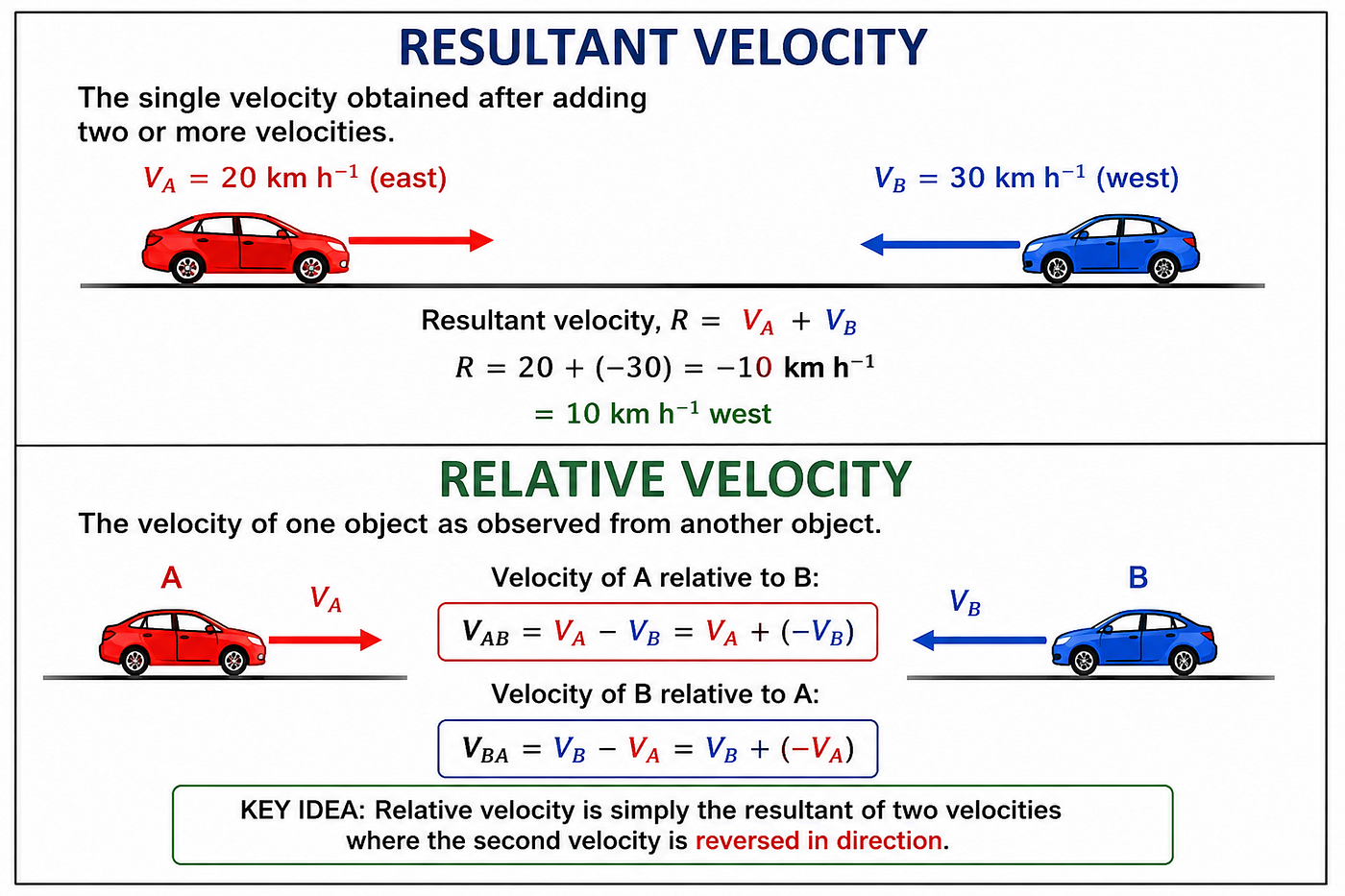
Resultant velocity is the single velocity obtained when two or more velocities are combined vectorially.
For example, if Car A moves east at 20 km/h and car B moves west at 30 km/h, the resultant velocity is obtained by adding the velocities while taking their directions into account.

If we establish east as positive direction and west as negative direction, then the resultant velocity R, will be:

The negative sign indicates that the resultant velocity is 10 km/h westwards.
What is Relative Velocity?
Relative velocity is the velocity of an object as observed from the moving viewpoint of another object. If you are sitting in a car, the rest of the world isn’t stationary to you; its motion depends on how fast you are moving.
For two objects P and Q:
The relative velocity of P with respect to Q(how Q sees the velocity of P) is:

The relative velocity of Q with respect to P(how P sees the velocity of Q) is:

The Secret Connection
Look closely at those subtraction formulas. We can rewrite the relative velocity equations like this:


This reveals an important idea:
Relative velocity is simply the resultant of two velocities after reversing the direction of the second velocity.
This single observation provides a straightforward way to solve many relative velocity problems using vector addition already learned from resultant vectors.
Example 1: Motion in a Straight Line
Two cars A and B are moving eastwards and westwards respectively. If the velocity of A is 120 km/h and that of B is 140 km/h, find:
a. the velocity of A relative to B
b. the velocity of B relative to A.
Solution

The velocity of A relative to B is:

Reversing the direction of B:


The velocity of A relative to B is 260 km/h eastwards.
The velocity of B relative to A is:

Reversing the direction of A:


The velocity of B relative to A is 260 km/h westwards.
Example 2: Motion at an Angle
Car X travels at 30 km/h in the direction 40° south of east. Car Y travels at 20 km/h in the direction 60° north of east. What is the velocity of car Y relative Car X?
Solution
We need to find:


Reversing the direction of X:


The angle between the two vectors is 80°.
Using:


Direction:
Using


Thus, the direction is:

Example 3: Finding the wind velocity
To a motorcyclist traveling due North at 50 km/h, the wind appears to come from the Northwest at 60 km/h. What is the true velocity of the wind?
Solution
The velocity of the wind relative to the motor cyclist is:


The true wind speed is:

The wind direction:

Conclusion
Whenever you encounter a relative velocity problem, remember this principle: reverse the direction of the second velocity and find the resultant.
Try this yourself and provide your response in the comment section
A ship X, steaming in a direction of 030° at a steady speed of 12 km/h, sights a ship Y. The velocity of Y relative to X is 10 km/h in a direction 270°. Find the magnitude and direction of ship Y.
For more simplified physics lessons and problem-solving techniques, check out my other articles on medium:
Is Deceleration Always Negative?
Understanding Distance and Displacement
Weight, Normal Force and Newton’s Third Law: Clearing Common Misconceptions
Vertical Motion Under Gravity: Distance vs Displacement
Vector Direction: Bearings vs Mathematical Angles
Beyond the Parallelogram Law: A Faster, Simpler Way to Find Resultant Vectors
Cartesian Sign Convention: A Simple Way To Describe Images in Mirrors and Lenses
메타데이터
- post_id
- a4b855b9033f
- slug
- resultant-velocity-vs-relative-velocity-how-they-are-related-a4b855b9033f
- url
- https://medium.com/@bonyahisaac26/resultant-velocity-vs-relative-velocity-how-they-are-related-a4b855b9033f
- canonical_url
- https://medium.com/@bonyahisaac26/resultant-velocity-vs-relative-velocity-how-they-are-related-a4b855b9033f
- author_url
- https://medium.com/@bonyahisaac26
- status
- ok
- fetched_at
- 2026-06-23 03:48:11






