Beyond Document Storage: The Complete Guide to Records Lifecycle Management for Modern Enterprises
Creating a document is easy. Managing it from creation to secure disposal is where enterprises succeed — or fail.
Beyond Document Storage: The Complete Guide to Records Lifecycle Management for Modern Enterprises
Creating a document is easy. Managing it from creation to secure disposal is where enterprises succeed — or fail.
Every day, organizations generate thousands of documents: contracts, invoices, HR files, engineering drawings, customer records, compliance reports, emails, and countless other business records. Most companies focus on where these files are stored, but few consider what happens to them over time.
Who can access them? How long should they be retained? What if they’re needed during an audit? When should they be archived — or securely destroyed?
These questions are at the heart of Records Lifecycle Management (RLM), a discipline that helps organizations manage information from creation to disposal while maintaining security, compliance, and operational efficiency.
As regulations tighten and data volumes grow, Records Lifecycle Management is becoming a strategic priority rather than just an IT function.
What Is Records Lifecycle Management?
Records Lifecycle Management is the process of governing records through every stage of their existence.
Instead of treating documents as static files stored in folders, RLM views them as assets with a defined lifecycle.
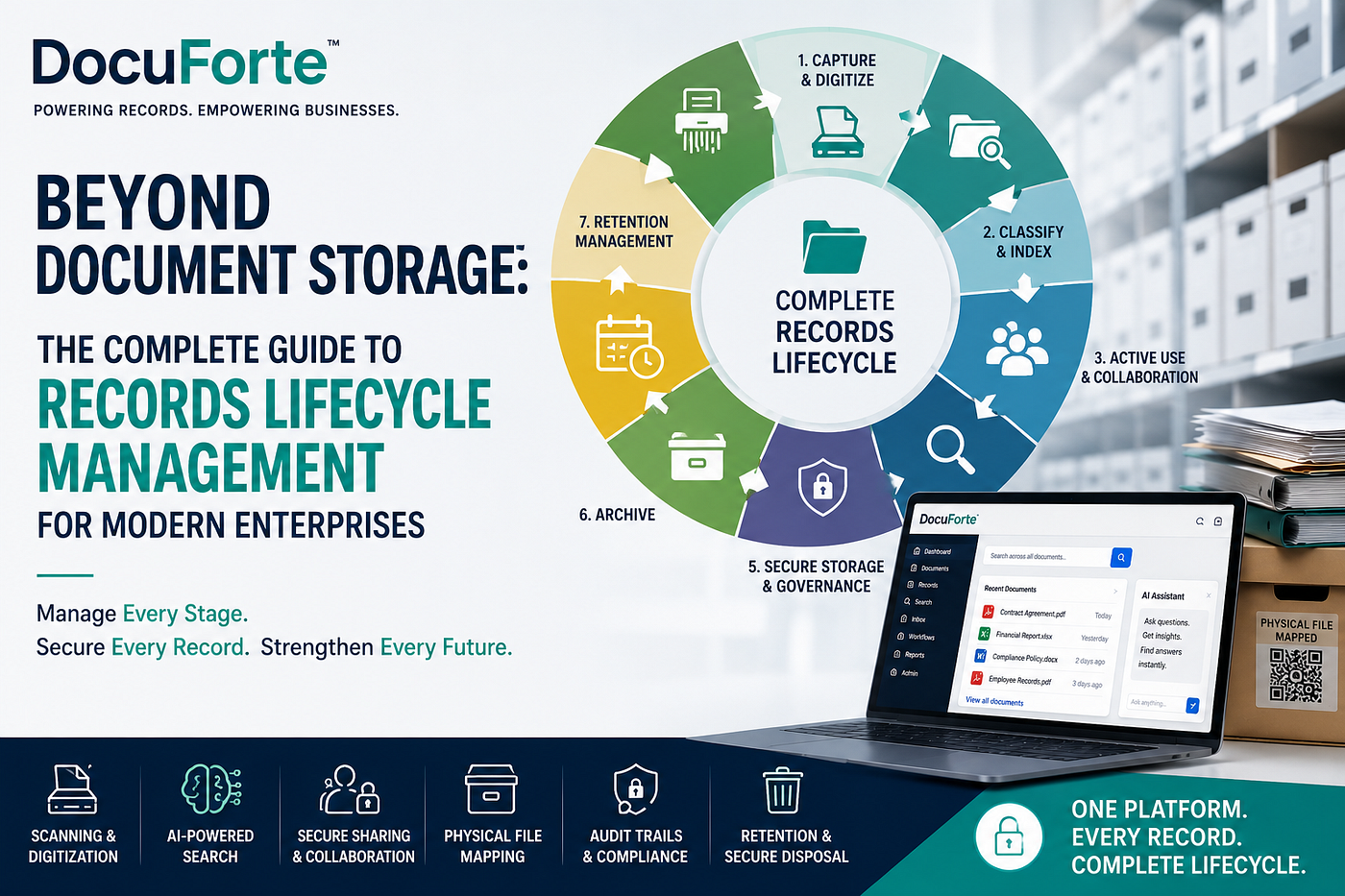
A typical lifecycle includes:
- Capture or creation
- Classification and indexing
- Active use and collaboration
- Storage and protection
- Retrieval and discovery
- Archiving
- Retention management
- Secure disposal
Managing each stage effectively ensures that records remain accessible when needed, protected from unauthorized access, and disposed of according to business and regulatory requirements.
Why Managing the Entire Lifecycle Matters
Many organizations invest in document storage but overlook the broader lifecycle. The result is fragmented systems, inconsistent processes, and increasing compliance risks.
Without a lifecycle approach, businesses often encounter:
Duplicate Information
Multiple versions of the same file circulate across teams, creating confusion and increasing the risk of using outdated information.
Rising Storage Costs
Keeping every document forever is neither practical nor cost-effective. Unmanaged data consumes valuable storage resources and complicates retrieval.
Compliance Challenges
Industries such as healthcare, banking, legal services, and government are subject to strict record retention requirements. Failing to retain — or dispose of — records appropriately can result in regulatory penalties.
Inefficient Retrieval
Employees spend valuable time searching across shared drives, emails, and filing cabinets instead of focusing on higher-value work.
Lifecycle management addresses these issues by bringing structure, governance, and automation to the way records are managed.
Stage 1: Capture and Digitization
The lifecycle begins when information enters the organization.
Records may originate from:
- Paper files
- Scanned documents
- Email attachments
- Office documents
- Customer forms
- Contracts
- Engineering drawings
- Historical archives
Digitization plays a crucial role at this stage. High-resolution scanning combined with Optical Character Recognition (OCR) converts physical documents into searchable digital records while preserving their original content.
Organizations with decades of paper archives often begin their transformation here, making previously inaccessible information available to the entire enterprise.
Stage 2: Intelligent Classification
Once captured, records need context.
Classification involves assigning metadata such as department, document type, customer name, project, retention period, or business function.
Manual classification becomes increasingly difficult as organizations scale.
Modern platforms use Artificial Intelligence to automatically identify document types, extract metadata, and organize records consistently, reducing human effort and improving search accuracy.
Stage 3: Active Collaboration
Most records are actively used after creation.
Teams edit documents, review contracts, approve invoices, share reports, and collaborate across departments.
This stage requires features such as:
- Version control
- Secure sharing
- Online editing
- Permission management
- Audit trails
- Activity monitoring
These capabilities ensure that collaboration remains productive without compromising governance.
Stage 4: Intelligent Discovery
One of the biggest challenges in enterprise information management is finding the right information at the right time.
Traditional folder structures rely on users remembering filenames or storage locations.
Modern Records Lifecycle Management platforms replace this with intelligent discovery.
Employees can search using document content, metadata, keywords, or even natural language.
Instead of browsing dozens of folders, they simply ask:
- Find all vendor agreements signed in 2025.
- Show invoices above ₹10 lakh.
- Summarize this compliance report.
- Locate engineering drawings related to Project Orion.
Artificial Intelligence dramatically reduces search time while improving productivity.
Stage 5: Secure Storage and Governance
Not every record is accessed daily, but every record should remain protected.
A robust governance framework includes:
- Role-based access controls
- Encryption
- Audit logs
- User activity tracking
- Approval workflows
- Records retention policies
These controls help organizations maintain trust while supporting regulatory compliance.
Stage 6: Archiving
As records become inactive, they move into long-term storage.
Archiving differs from simple storage.
Archived records remain searchable and accessible when needed but no longer occupy primary operational space.
Organizations benefit from:
- Reduced infrastructure costs
- Better organization
- Faster production systems
- Improved compliance
For businesses managing both digital and physical records, archiving also includes indexing and mapping physical storage locations for quick retrieval.
Stage 7: Retention Management
Every organization should define how long records must be retained.
Retention policies vary depending on:
- Industry regulations
- Legal requirements
- Internal governance
- Business value
Automated retention management ensures records remain available for the required period without relying on manual tracking.
Stage 8: Secure Disposal
Eventually, every record reaches the end of its lifecycle.
Keeping obsolete information indefinitely increases costs and creates unnecessary legal risks.
Secure disposal ensures that expired records are permanently destroyed according to organizational policies and regulatory standards.
For physical documents, this includes certified shredding.
For digital records, it involves secure deletion with documented audit trails.
Proper disposal completes the lifecycle responsibly.
Why AI Is Transforming Records Lifecycle Management
Artificial Intelligence is changing how enterprises interact with records throughout every lifecycle stage.
AI can:
- Classify documents automatically.
- Extract metadata from scanned files.
- Search handwritten content.
- Summarize lengthy reports.
- Answer questions directly from records.
- Recommend related documents.
- Improve search accuracy over time.
Rather than replacing records management, AI enhances it by making information easier to discover and use.
Building an End-to-End Records Strategy
Organizations often adopt individual tools to solve isolated problems — a scanner for digitization, cloud storage for files, and another application for collaboration.
Over time, these disconnected systems create information silos.
A more effective approach is to build a unified records strategy that connects every stage of the lifecycle.
This includes:
- Document capture
- AI-powered search
- Records management
- Physical file tracking
- Secure collaboration
- Compliance controls
- Lifecycle governance
- Certified disposal
When these capabilities operate together, organizations gain greater visibility, stronger governance, and improved operational efficiency.
How DocuForte Supports the Entire Records Lifecycle
Managing records effectively requires more than storing documents in the cloud. It requires a platform that connects physical records, digital information, governance, and intelligence.
DocuForte is designed to support the complete records lifecycle — from scanning and digitization to AI-powered search, enterprise document management, online collaboration, audit trails, physical file mapping, records governance, secure sharing, retention, and lifecycle management. By bringing these capabilities together, organizations can reduce manual effort, strengthen compliance, and ensure that critical information remains accessible throughout its lifecycle.
Final Thoughts
The volume of enterprise information will continue to grow.
The organizations that succeed won’t be those with the largest storage capacity — they’ll be the ones with the smartest information strategy.
Records Lifecycle Management transforms documents from isolated files into governed business assets that support compliance, collaboration, and better decision-making.
As businesses continue their digital transformation journey, managing records from creation to secure disposal isn’t just good practice — it’s becoming essential for building resilient, future-ready enterprises.
메타데이터
- post_id
- a4cbac91d4de
- slug
- beyond-document-storage-the-complete-guide-to-records-lifecycle-management-for-modern-enterprises-a4cbac91d4de
- url
- https://medium.com/@DocuForte/beyond-document-storage-the-complete-guide-to-records-lifecycle-management-for-modern-enterprises-a4cbac91d4de
- canonical_url
- https://medium.com/@DocuForte/beyond-document-storage-the-complete-guide-to-records-lifecycle-management-for-modern-enterprises-a4cbac91d4de
- author_url
- https://medium.com/@DocuForte
- status
- ok
- fetched_at
- 2026-07-13 06:23:13