Building Scalable Rights Management Systems for Digital Content Platforms
Digital media platforms operate in an environment where content is licensed, monetized, and distributed under strict legal and commercial…
Building Scalable Rights Management Systems for Digital Content Platforms
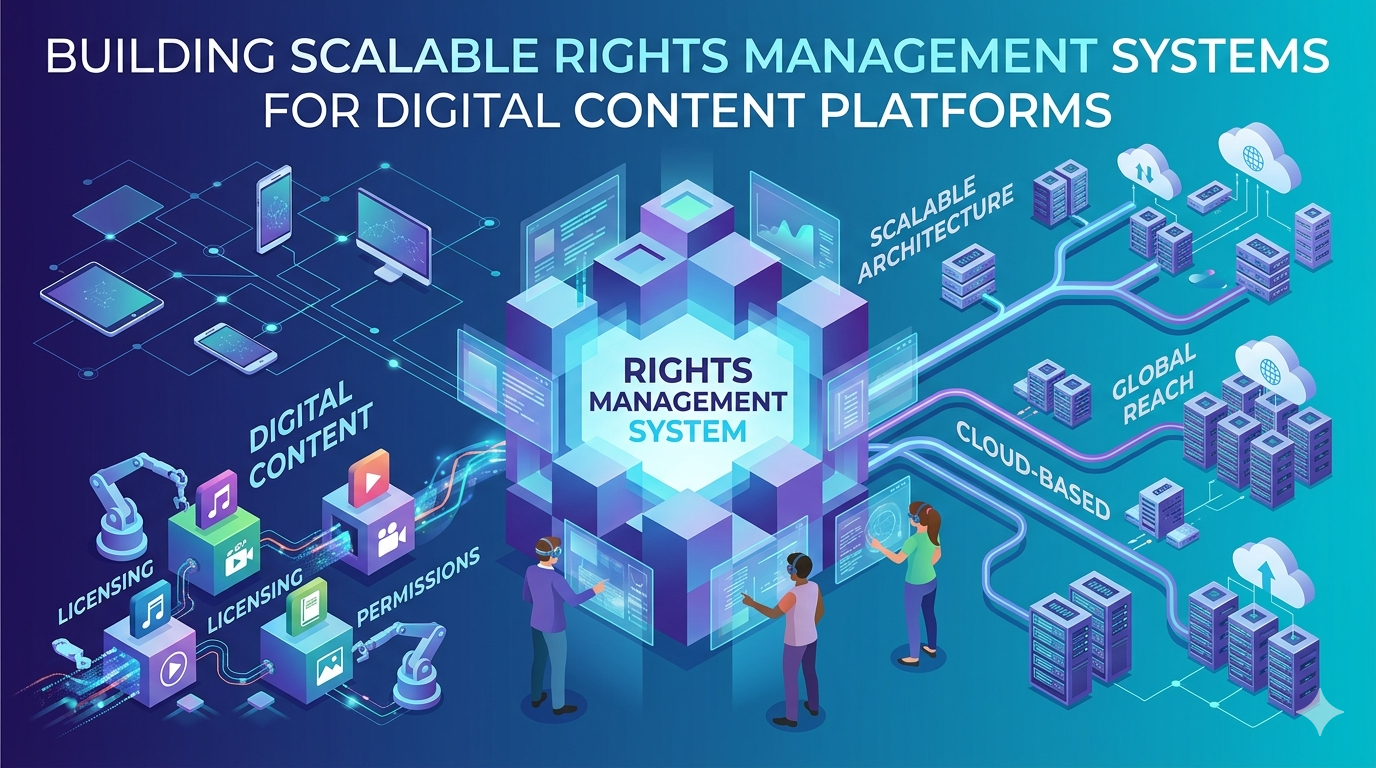
Digital media platforms operate in an environment where content is licensed, monetized, and distributed under strict legal and commercial constraints. Every movie, live event, or TV show is governed by contractual rules that define where, when, and how it can be accessed.
To enforce these rules at scale, modern OTT systems rely on DRM system architecture for streaming apps, a structured framework that ensures secure, policy-driven access to digital content.
As streaming platforms grow globally, rights management is no longer just a compliance requirement — it becomes a core engineering system that protects revenue, prevents piracy, and enables scalable content distribution.
The Need for Digital Rights Control in Streaming
The digital entertainment industry has undergone a massive transformation. Content is now distributed globally across mobile devices, smart TVs, browsers, and connected devices. While this has expanded reach, it has also introduced significant challenges:
- Unauthorized content sharing
- Regional licensing restrictions
- Subscription-based access control complexity
- Revenue leakage from piracy
Traditional access control systems are not sufficient to handle these challenges because they do not enforce content-level restrictions or encryption-based protection.
This is why platforms rely on DRM system architecture for streaming apps, which combines encryption, licensing, and policy enforcement into a unified framework.
A strong rights management system ensures that only authorized users can access content under valid conditions, while preventing illegal redistribution or playback.
Understanding DRM System Architecture for Streaming Apps
Digital Rights Management (DRM) refers to technologies that control access to digital content through encryption and licensing.
In streaming platforms, DRM ensures that:
- Video content is encrypted during storage and transit
- Only authorized devices can decrypt content
- Playback is controlled through secure licenses
A typical DRM system architecture for streaming apps includes:
- Content encryption pipeline
- License server
- DRM-protected video player
- Key management system
- Authorization service
Unlike basic authentication systems, DRM operates at the media segment level, meaning every video chunk is protected and validated before playback.
This ensures strong protection against piracy and unauthorized redistribution.
Core Components of DRM-Based Rights Management Systems
A scalable rights management system is built using multiple interconnected components:
1. Content Encryption Module
Before content is distributed, it is encrypted using standards like AES-128 or AES-256.
2. License Server
The license server issues decryption keys to authorized users based on predefined policies.
3. Key Management System (KMS)
Stores and rotates encryption keys securely to prevent compromise.
4. DRM Player Integration
The video player enforces DRM rules using technologies like:
- Google Widevine
- Apple FairPlay
- Microsoft PlayReady
5. Policy Engine
Determines whether a user is allowed to access content based on:
- Subscription tier
- Region
- Device type
6. Secure Key Exchange Layer
Ensures encrypted communication between player and license server.
Together, these components enable secure media delivery at scale.
Content Licensing Systems and Rights Enforcement
Content licensing systems define how digital content can be distributed and consumed across regions and platforms.
Types of licensing rules:
Geographic Licensing
- Content restricted to specific countries or regions
Time-Based Licensing
- Content available only during certain time windows
Subscription-Based Licensing
- Access depends on user subscription tier
Platform-Based Licensing
- Content restricted to specific devices or apps
Enforcement process:
- User requests playback
- System checks entitlement rules
- License server validates permissions
- DRM license is issued if allowed
This ensures strict compliance with content distribution agreements while maintaining user experience.
Secure Media Delivery and Encryption Techniques
Secure media delivery is essential to protect video content during transmission.
Encryption techniques used:
AES Encryption
- Encrypts video segments before distribution
- Ensures data cannot be read without a key
DRM-Based Encryption
- Combines encryption with licensing control
- Prevents unauthorized playback
Secure delivery methods:
- HTTPS streaming
- Tokenized URLs
- Signed playback requests
DRM technologies:
- Widevine (Android/Chrome)
- FairPlay (Apple ecosystem)
- PlayReady (Windows ecosystem)
These technologies ensure content remains protected across all devices and platforms.
Rights Policy Engines and Access Control Logic
A policy engine is the decision-making layer of DRM systems.
It evaluates whether a user is allowed to access specific content.
Key inputs:
- User subscription status
- Content metadata
- Geographic location
- Device type
Policy rules include:
- “Premium users only” restrictions
- Geo-blocking rules
- Device limitation policies
- Concurrent stream limits
Example workflow:
- User clicks play
- Policy engine evaluates access rules
- Decision is returned (allow/deny)
- License is issued if approved
This ensures real-time enforcement of content rights across millions of users.
Scalability Challenges in DRM System Architecture
Scaling DRM system architecture for streaming apps presents significant challenges:
Key challenges:
High Volume License Requests
Millions of users request licenses simultaneously during peak events.
Global Distribution
License servers must operate across multiple regions.
Low Latency Requirements
License issuance must happen within milliseconds to avoid playback delays.
System Redundancy
Failure of a license server must not interrupt playback.
Solutions:
- Distributed license server clusters
- Regional DRM gateways
- Caching of non-sensitive policy decisions
- Load balancing across DRM endpoints
Scalability ensures smooth playback even under extreme traffic conditions like live sports or premieres.
Security Threats and Anti-Piracy Mechanisms
Rights management systems must defend against advanced piracy techniques.
Common threats:
- Screen recording
- License key interception
- Device spoofing
- Token reuse attacks
Anti-piracy mechanisms:
Dynamic Watermarking
- Embeds user-specific identifiers into video streams
Device Binding
- Locks licenses to specific devices
Session Token Expiry
- Prevents long-term reuse of playback tokens
Behavioral Monitoring
- Detects abnormal viewing patterns
These mechanisms significantly reduce content piracy risks.
Integration of DRM with OTT Backend Systems
DRM systems must integrate seamlessly with OTT infrastructure.
Integration points:
- Authentication systems
- Content catalog services
- CDN delivery networks
- Playback engines
Workflow:
- User logs in
- Backend verifies subscription
- DRM policy engine validates access
- License server issues key
- CDN delivers encrypted content
This tightly integrated flow ensures secure and smooth playback across all platforms.
Business Impact of Strong Rights Management Systems
A robust DRM system provides significant business advantages:
- Protects premium content from piracy
- Ensures compliance with licensing agreements
- Enables global content distribution
- Increases revenue protection
- Builds trust with content creators
Ultimately, strong DRM system architecture for streaming apps directly supports monetization and platform sustainability.
How JPLoft Builds DRM and Rights Management Systems
JPLoft is a technology partner specializing in secure and scalable digital media platforms. They design and implement enterprise-grade DRM system architecture for streaming apps tailored for OTT and content distribution platforms.
They focus on:
- Designing secure content licensing systems for global OTT platforms
- Implementing robust encryption pipelines for secure media delivery
- Building scalable license servers capable of handling millions of concurrent requests
- Integrating DRM technologies like Widevine, FairPlay, and PlayReady
- Developing policy engines for real-time rights enforcement
Their engineering approach ensures that digital content is protected across all devices while maintaining seamless user experience and high-performance streaming delivery.
Why Partner with a Media Technology Expert
Building DRM systems requires deep expertise in:
- Encryption and cryptographic systems
- Streaming protocols and playback architecture
- Distributed backend systems
- Licensing and compliance frameworks
Working with a **media and entertainment app development company for rights management systems** helps organizations:
- Reduce security risks and piracy exposure
- Improve system scalability and reliability
- Ensure global compliance with licensing rules
- Accelerate development of secure OTT platforms
Expert partners transform complex rights management requirements into production-ready, scalable solutions.
Future of Digital Rights Management Systems
The future of DRM is evolving toward more intelligent and automated systems:
- AI-powered piracy detection
- Blockchain-based licensing verification
- Real-time dynamic rights allocation
- Edge-based DRM enforcement
- Fully automated global rights ecosystems
As digital content expands, DRM system architecture for streaming apps will become even more intelligent and adaptive.
Conclusion
Rights management is a foundational layer of modern OTT platforms. With increasing content value and global distribution complexity, DRM system architecture for streaming apps ensures that digital content remains secure, compliant, and monetizable.
By combining encryption, policy enforcement, and scalable licensing systems, platforms can deliver secure media delivery while maintaining seamless user experiences.
메타데이터
- post_id
- a4daa779be22
- slug
- building-scalable-rights-management-systems-for-digital-content-platforms-a4daa779be22
- url
- https://medium.com/@strackajmesh786/building-scalable-rights-management-systems-for-digital-content-platforms-a4daa779be22
- canonical_url
- https://medium.com/@strackajmesh786/building-scalable-rights-management-systems-for-digital-content-platforms-a4daa779be22
- author_url
- https://medium.com/@strackajmesh786
- status
- ok
- fetched_at
- 2026-07-28 05:18:14