Quantum Dots — The Tiny Titans Powering the Next Quantum Revolution (Beyond Qubits)
More Than Just Quantum Bits: How Quantum Dots Are Driving the Next Wave of Quantum Innovation
Quantum Dots — The Tiny Titans Powering the Next Quantum Revolution (Beyond Qubits)
Alright, let’s talk quantum. The buzz is everywhere, right? We hear about quantum computers solving problems in milliseconds that would take traditional machines millennia. We imagine unbreakable quantum encryption safeguarding our most sensitive data. It’s a future that sounds almost like science fiction, and the “qubit” often hogs the spotlight as the hero of this story.
But tucked away in the realm of the incredibly small, there’s another class of nanoscale champions quietly working their magic, not just enabling these breakthroughs but powering so much more: Quantum Dots (QDs).
You’ve probably encountered Quantum Dots already, perhaps without even realizing it. If you’ve been captivated by the stunningly vibrant and precise colors on a QLED television, you’ve witnessed their commercial brilliance firsthand. Yet, their potential stretches far beyond just display tech, or even their well-known role as potential building blocks for quantum computers. These semiconductor nanocrystals are so tiny they actually bend to the weird rules of quantum mechanics, making them astonishingly versatile. They’re set to redefine everything from ultra-sensitive medical sensing and truly secure communication to hyper-efficient energy solutions.
So, let’s dive into the fascinating world of Quantum Dots. We’ll explore what makes them so special and how these miniature powerhouses are illuminating the path towards a truly quantum future, one that goes far beyond just the quantum bit.
The Nano Marvel: What Makes Quantum Dots So Special?
At the heart of a Quantum Dot’s extraordinary capabilities lies a phenomenon physicists call the quantum confinement effect. Bear with me for a moment, it’s simpler than it sounds.
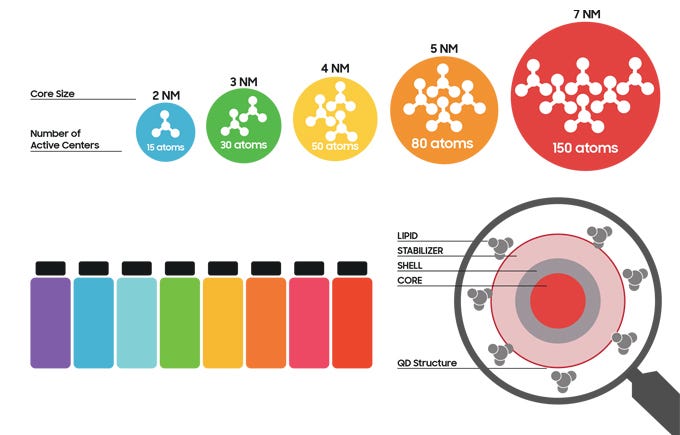
Imagine a semiconductor material — think silicon, for example. In its regular, chunky form, electrons and “holes” (which are basically empty spaces where electrons should be) can move around pretty freely. They have a continuous range of energy levels, like a vast staircase with infinite steps. But now, shrink that material down to just a few nanometers — we’re talking about 2 to 10 nanometers, which is roughly the size of a few dozen atoms. Suddenly, something truly magical happens.
At this minuscule scale, those electrons and holes find themselves “confined.” Their movement is severely restricted to that tiny space. And as a direct result, their energy levels aren’t continuous anymore. They become discrete, like the distinct notes you get from plucking a very short guitar string, or the specific orbits of an electron around a single atom.
This quantum confinement is the secret sauce. It means that the size of the Quantum Dot directly dictates its properties, especially how it interacts with light.
- Tunable Color: Get this: a smaller Quantum Dot made from the exact same material will emit blue light. Make it slightly bigger, and it emits green. Make it a bit larger still, and it glows red. This incredible, precise, size-tunable emission is a game-changer.
- Tunable Bandgap: Beyond just color, their electronic bandgap (the energy needed for an electron to jump to a higher energy level) is also size-tunable. This affects not only how they emit light but also how efficiently they absorb it and conduct electricity.
This inherent tunability, combined with their remarkably high quantum yield (meaning they’re super efficient at converting absorbed energy into emitted light) and excellent photostability (they resist fading over time), makes Quantum Dots an incredibly versatile nanomaterial with almost limitless potential.
Beyond the Bit: Quantum Dots in Quantum Sensing
Quantum sensing is all about using the mind-boggling sensitivity of quantum states to detect even the most minute changes in their surroundings with unheard-of precision. And guess what? Quantum Dots, with their finely tunable energy levels, are turning out to be exceptional tools in this exciting, emerging field.
Here’s a glimpse into how QDs are revolutionizing sensing:
- Ultra-Sensitive Biomedical Imaging & Diagnostics:
- The Edge: Traditional fluorescent dyes used in medicine often fade quickly and can’t change their color. QDs? They’re tough, bright, and can be tuned to emit any color. This allows researchers to create super specific and sensitive “tags” for cells, tissues, and tiny biological molecules.
- Real-World Potential: Imagine Quantum Dots engineered to attach only to cancer cells. When illuminated, they’d glow brightly, allowing doctors to detect cancer much earlier and with greater precision. Scientists are already exploring their use in tracking how drugs move through the body, sniffing out pathogens like viruses or bacteria even when they’re present in tiny amounts, and even visualizing complex cellular processes in real-time. Being able to “paint” different parts of a cell with different colored QDs (simply by adjusting their size!) offers an unparalleled view inside living systems.
- High-Precision Magnetic Field & Temperature Sensing:
- The Edge: The tiny electronic “spins” within certain Quantum Dots can be incredibly sensitive to external magnetic fields or even slight changes in local temperature. We can read out this sensitivity by observing subtle shifts in their light emission.
- Research in Action: This opens up possibilities for miniature, incredibly accurate sensors. Think guiding autonomous vehicles with pinpoint precision, improving navigation systems, or even mapping brain activity by detecting minuscule magnetic field fluctuations. On the temperature front, QDs could lead to super-accurate, non-invasive thermometers for everything from industrial processes to delicate biological samples.
- Environmental Monitoring: QDs are also being developed into highly sensitive detectors for barely-there traces of pollutants, heavy metals, and toxins in our water or air. This offers rapid, precise environmental analysis, helping us keep our planet cleaner.
Lighting the Quantum Network: Quantum Dots in Quantum Communication
Quantum communication, especially something called Quantum Key Distribution (QKD), promises truly unbreakable encryption. It works by encoding information in the quantum properties of individual light particles. The absolute core requirement for such secure networks? Reliable, on-demand single photons. And guess what? This is where Quantum Dots truly shine.
- Quantum Dots as Ideal Single-Photon Sources (SPS):
- The Edge: For QKD to be foolproof, you need a source that emits exactly one photon at a time, right when you need it, without fail. QDs, when carefully designed and excited, can be engineered to do just that. Their unique energy structure allows them to release one photon at a time, almost like a tiny, perfectly controlled light gun.
- Research in Action: Scientists are making huge strides in growing QDs precisely where they’re needed on a chip. This means we could create integrated circuits that can generate, manipulate, and detect single photons all on one tiny platform. While getting perfectly “on-demand” and ultra-pure single-photon emission at room temperature is still a challenge, continuous breakthroughs in controlling their light-emitting characteristics are bringing us closer to a robust, hack-proof quantum internet.
- Entangled Photon Sources: Beyond just single photons, QDs also hold incredible promise for generating entangled photon pairs. Entangled photons are like two coins that, no matter how far apart, will always show the same face when flipped. They’re crucial for more advanced quantum networking protocols, the intriguing concept of quantum teleportation, and even for building distributed quantum computers where information is shared between quantum processors located far from each other.
Next-Gen Energy & Materials: Quantum Dots in Quantum-Enhanced Photovoltaics & Optoelectronics
The incredible versatility of Quantum Dots extends far beyond sensing and communication, reaching into areas that could fundamentally change how we generate and use energy every single day.
- Quantum Dots for Ultra-Efficient Solar Energy (Photovoltaics):
- The Edge: Standard solar cells are good, but they hit a ceiling. A lot of the high-energy light from the sun gets lost as wasted heat. Quantum Dots, however, can exploit a phenomenon called Multiple Exciton Generation (MEG). This means that when a high-energy photon hits a QD, it can actually generate more than one electron-hole pair. In simple terms, one incoming light particle can produce multiple electrical carriers, potentially boosting solar cell efficiency far beyond the limits of traditional silicon cells.
- Research in Action: Researchers are now developing next-generation QD solar cells that aren’t just more efficient but also flexible, even transparent! They can be made using low-cost, solution-based printing methods. Imagine solar cells integrated into windows, wrapped around curved building facades, or even woven into fabrics — it would vastly expand how we capture solar power.
- Beyond QLEDs: Advanced Optoelectronics:
- The Edge: While QLED TVs are just the beginning, QDs are set to revolutionize other light-based electronic devices. Their precise, tunable light emission makes them ideal for creating even more energy-efficient LEDs, micro-LED displays with truly unparalleled color and brightness, and high-performance light emitters and detectors across the entire light spectrum, from visible to infrared.
- Research in Action: This includes applications in advanced night vision systems, incredibly high-resolution medical imaging devices, and sophisticated spectroscopic tools for analyzing materials with unprecedented detail.
- Thermoelectric Materials: QDs also show promise in thermoelectric applications. This means they could convert waste heat directly into electricity (or vice-versa), offering a sustainable solution for energy recovery and managing heat in electronic devices.
The Road Ahead: Challenges and Opportunities
While the potential of Quantum Dots feels almost boundless, bringing these next-generation quantum technologies from the lab to our everyday lives involves navigating some significant engineering and scientific hurdles:
- Scalability and Uniformity: Imagine needing billions of perfectly identical QDs for a single device. Producing them consistently, with precise size and optical properties, remains a significant manufacturing challenge.
- Stability and Durability: For long-term applications, QDs need to maintain their performance without degrading. Protecting them from environmental factors like oxidation or constant light exposure (photobleaching) is crucial.
- Toxicity Concerns: Especially for biomedical applications, researchers are pouring efforts into developing “green” and biocompatible QDs that are non-toxic and can safely biodegrade within the human body.
- Integration: Seamlessly weaving QDs into complex devices and systems — from tiny integrated circuits to living biological environments — demands cutting-edge nanoscale fabrication techniques.
Despite these challenges, the opportunities they present are truly immense. Continuous advancements in nanoscale synthesis, clever surface chemistry, and smart hybrid material integration are rapidly addressing these issues. Being able to precisely engineer materials at the quantum level is opening doors to entirely new technologies we haven’t even fully conceived yet, driving innovation across countless sectors.
Globally, leading research hubs and ambitious startups are pouring resources into QD development. And right here in India, institutions like the IITs, IISc Bangalore, and various national research labs are actively contributing to breakthroughs in QD synthesis and exploring their myriad applications, helping to foster a rapidly growing ecosystem for quantum and nanotechnologies.
A Nano-Sized Leap Towards a Quantum Future
So, there you have it. Quantum Dots are so much more than just fascinating nanomaterials. They are fundamental building blocks for a future where the incredible, sometimes counter-intuitive, rules of quantum mechanics are harnessed for tangible, everyday benefit.
From enabling ultra-sensitive medical diagnoses and powering truly secure communication to unlocking new frontiers in energy efficiency and pushing the boundaries of material science, these tiny titans are poised to deliver a quantum leap across our technological landscape.
The journey from the lab bench to widespread use is complex, but the remarkable versatility and sheer quantum prowess of these nanoscale wonders assure us that Quantum Dots will remain at the very forefront of the next quantum revolution, illuminating a brighter, more connected, and more efficient future for us all.
메타데이터
- post_id
- a4e2a4f2ccfc
- slug
- quantum-dots-the-tiny-titans-powering-the-next-quantum-revolution-beyond-qubits-a4e2a4f2ccfc
- url
- https://medium.com/@jithinyakkara/quantum-dots-the-tiny-titans-powering-the-next-quantum-revolution-beyond-qubits-a4e2a4f2ccfc
- canonical_url
- https://medium.com/@jithinyakkara/quantum-dots-the-tiny-titans-powering-the-next-quantum-revolution-beyond-qubits-a4e2a4f2ccfc
- author_url
- https://medium.com/@jithinyakkara
- status
- ok
- fetched_at
- 2026-07-19 04:58:24