The Strange Psychology of Clients Who Pay More
(And Why You Should Charge Them)
The Strange Psychology of Clients Who Pay More
(And Why You Should Charge Them)
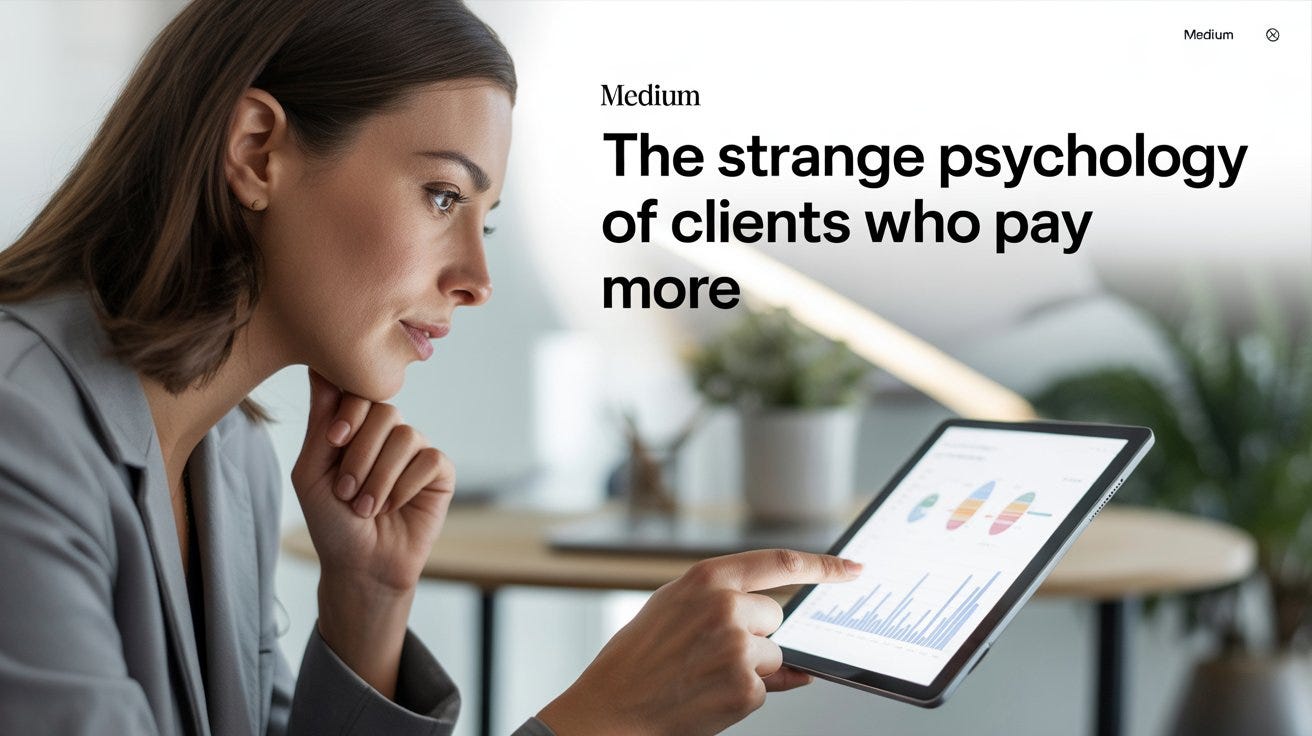
Image Created by AI
Picture this: You quote $500 for a project. Client vanishes. You quote $2,000 for the same scope. The client says, “Sounds good, invoice me.”
Same you, same pixels, same deadline. Only the number changed. What just happened inside your buyer’s brain?
Welcome to the quiet super-power every freelancer, agency, coach, and coffee-shop owner forgets they own: price psychology.
Today, we’ll unpack two biases, anchoring and contrast, that make people happier when they pay more, and why your fear of “going high” is costing you cash and client love.
1. The $90 Beer on the Beach
Economist Richard Thaler once asked volunteers to imagine a friend buying them a beer on the sand.
- Group A was told the beer came from a run-down grocery store.
- Group B was told it came from a fancy hotel.
Same beer, same sand, same sunset. Group B said they would gladly pay almost twice as much. Context rewrote the value in real time. Your proposal PDF is that context.
2. Anchoring: First Number Wins
Humans cling to the first digit they see like a drunk to a lamppost. Judges give harsher sentences when prosecutors ask for more before the defense speaks. Buyers think a $3,000 sofa is a bargain if the showroom parked it beside a $10,000 sofa.
Your “anchor” can be:
- The first package on your pricing page
- A verbal number you drop on a discovery call
- The competitor price you reference in an email
Once the anchor is thrown, every later number is judged relative to it. Low anchor → “expensive” later. High anchor → “reasonable” later.
Practical cheat sheet:
- Always speak your premium option first.
- Put the biggest number on the left side of your proposal.
- Never open with “We can start small at $300…” unless you want to fight uphill the rest of the call.
3. Contrast Bias: Make the Middle Look Sexy
After the anchor grabs the brain, contrast polishes the illusion. Sales pages do it with decoys:
- Starter: $29 (bare bones)
- Professional: $79 (sweet spot)
- Enterprise: $299 (bells, whistles, concierge)
The eye sees three columns, the brain sees one obvious deal. Most people pick Professional because it looks cheap next to Enterprise.
Freelancers can copy this in a one-page proposal:
Package A — “Fire-Extinguisher” $1,200 • 1 revision • 1-week delivery
Package B — “Cruise Control” $3,800 • 3 revisions • 2 strategy calls • 2-week delivery
Package C — “Lunar Landing” $9,500 • Unlimited revisions • Slack access • 4-week delivery
Guess which one suddenly feels just right? (Hint: not the cheapest.)
4. Why Expensive Clients Are Easier
Counter-intuitive, but proven in the wild:
- Support tickets drop 7× when users pay $199 instead of $9.
- Free-training no-shows hover around 50%; paid-training no-shows fall below 5%.
- High-fee coaching clients finish homework faster, refer friends sooner, and rarely haggle.
Money buys commitment. Commitment buys results.
Results buy testimonials that let you raise fees again. It’s a virtuous circle disguised as a heart attack.
5. Killing Your Guilt Voice
“But what if they say no?” Some will. Good. Your goal isn’t universal, yes, it’s profitable, yes.
Ramit Sethi tells students: “If your product works, it’s your moral obligation to charge premium prices and reach the people who will actually implement it.”
Cheap clients ask for the moon, blame you for gravity, and pay late. Premium clients want outcomes, not babysitting. Charge them, or you rob them of skin in the game, and yourself of a sane inbox.
6. How to Start Tomorrow Morning
- Triple your largest current quote.
- Add two higher “decoy” tiers above it.
- Present prices highest → lowest in every email, call, or PDF.
- When the client flinches, stay quiet; let the anchor sink.
- After the shocked silence, ask: “Which part of the scope would you like to adjust to fit your budget?” (They almost always pick the original.)
Do it once, you’ll sweat. Do it five times, you’ll never go back.
Closing Thought
Your price is not just a number; it’s a story your client tells themselves about their future. Tell a bigger story, get a bigger check, deliver a bigger transformation. The strange psychology is simple: people don’t pay more because they’re rich; they feel rich because they paid more.
Stop arguing with the bias. Start charging for it.
메타데이터
- post_id
- a4ec272cf4bd
- slug
- the-strange-psychology-of-clients-who-pay-more-a4ec272cf4bd
- url
- https://medium.com/activated-thinker/the-strange-psychology-of-clients-who-pay-more-a4ec272cf4bd
- canonical_url
- https://medium.com/activated-thinker/the-strange-psychology-of-clients-who-pay-more-a4ec272cf4bd
- author_url
- https://medium.com/@naumanch456
- status
- ok
- fetched_at
- 2026-06-20 20:29:01