Virginia’s Leap Forward into Passenger Rail
The new Long Bridge will allow for a doubling of passenger trains
Virginia’s Leap Forward into Passenger Rail
The new Long Bridge will allow for a doubling of passenger trains
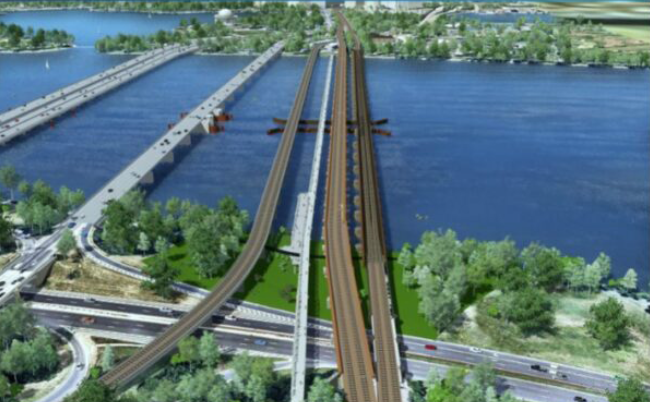
This is a rendering. The new bridge will be located at he far right. image, trains.com
A new two-track railroad bridge crossing the Potomac Rier in now under construction. The Potomac River separates Washington D. C. from Virginia. The rail bridge that is now in use is a two- track bridge that handles freight, Amtrak, and Virginia Railway Express (VRE) trains. After the new bridge is completed, freight and passenger trains will use separate tracks. One of the largest problems Amtrak has faced from its earliest days has been the fact that Amtrak uses freight tracks in most places. The mixture of freight and passenger trains works to Amtrak’s disadvantage. This is not a story merely about a new bridge, it is a story about the growth of a regional passenger train network as well as a story about what good government looks like.
While the interstate highway system was built and the airline industry grew, passenger railroads went into a step decline in the USA. Amtrak was established in 1971 to save a skeleton passenger rail network.
This is a story about the grueling task of finding solutions and it does not start in 2026 when construction work along the Potomac River began in earnest. In 2005, the Commonwealth of Virginia established the Rail Enhancement Fund while Mark Warner was governor. Funding was to be used for all types of railroads, i.e. freight, intercity and commuter. In the first year, funding was $23 million. (1) It was not a large amount of funding, but it seems that the measure encouraged the germination of all sorts of ideas and ambitions. At the time, Governor Warner indicated,
“People have been talking for years about the critical need for us to reinvest in rail. Today, we are putting money behind the promise with a predictable, stable funding source for improvements to our rail infrastructure.”
The unpredictability of the way forward
In September of 2008 the United States faced a financial crisis of epic proportions. President George W. Bush moved his government into a crisis management mode. In October of the same year, President Bush signed the Passenger Rail Investment and Improvement Act into law. The act provided $10 billion for Amtrak over the next four years. It reauthorized and stabilized Amtrak and required Amtrak to develop a methodology for sharing costs with states that supported passenger rail routes. The Act was unusually generous for a GOP measure. That needs to be understood in the context of the Great Recession and the number of limited options that the GOP had, ready in hand, for a response.
In partnership with Amtrak, the Commonwealth of Virginia established a route between Lynchburg and New York Penn station (NYP) in 2009. The cost of establishing the route was low because the route followed a portion of the Crescent route, so that train stations, track and signals were already in place. A ridership of 30,000 was expected in the first year but the route carried 100,000 passengers. The Crescent route connects NYP to New Orleans and stops in Lynchburg at night, so that the new route offered the only daytime service to and from Lynchburg.
The success of the Lynchburg route encouraged implementation of plans for additional routes in Virginia. A route between Norfolk and NYP began late in December of 2012. A newly constructed Norfolk station was opened in December of 2013. The station was likely funded primarily through the 2009 Recovery and Reinvestment Act. VP Joseph Biden convinced President Barack Obama to steer recovery funding into passenger rail projects. A route was established originating from Newport News. The Lynchburg route was extended to Roanoke, and a second Roanoke train was added in 2017 after infrastructure was completed to accommodate the second train.
The 2019 pandemic caused cancellations and drastic reductions in passenger rail services in Virginia and elsewhere. After riders began to return to Amtrak, Virginia service not only was restored to previous levels, but a third train was added to the Norfolk route (weekdays only). By this time rail traffic in northern Virginia, and particularly on the Long Bridge had reached capacity.
The railroad bridge that crosses the Potomac River that is now in use is called the Long Bridge and was completed in 1904. In 1943 improvements to the bridge were completed. Improvements allowed heavier loads and allowed for faster speeds as well. CSX (a freight railroad company) owns the bridge. Amtrak began to use the bridge when Amtrak was established in 1971 and VRE has used it since VRE was established in 1992.
The Virginia government was committed to finding a way to expand passenger rail within the state because interstate highways and state highways were clogged with automobile traffic.
A novel and bold step forward
In 2019 Governor Ralph Northam finalized an agreement aimed at the construction of the new bridge. The agreement involved the Commonwealth of Virginia, the federal government, Amtrak, CSX, and VRE. The $3.7 billion deal is aimed at separating passenger rail from freight traffic. The deal was novel and bold.
The project will dramatically expand rail capacity for Virginia Railway Express (VRE) and Amtrak over a 10-year period. The project as described by Governor Virginia Gov. Ralph Northam, includes state acquisition of 225 miles of track and 350 miles of right-of-way from CSX and the construction was the new bridge. (2) Governor Northam proposed a 4-cent increase in the state gasoline tax to help fund the deal.
Governor Northam and other elected officials held an event in Arlington to announce $729,000,000 in federal funding, secured for Transforming Rail in Virginia (TRV) Phase 2 projects. The funding will support the completion of a new Long Bridge as well as improvements to L’Enfant Station, (in Washington D. C.) and lay a third track along key sections of the corridor in Prince William, Stafford, and Spotsylvania Counties. Later announcements revealed funding for the Alexandria Fourth Track project and other improvements. The key objective of all of this investment is separation of freight traffic from passenger rail traffic.

Map of Northeast Regional routes. Virginia is near the bottom of the map where Richmond stands out. Above Richmond is Washington D.C. Above D. C. to the right is New York.
Connected
Taking a small step away, the new Long Bridge project can be seen for the impact it will have on the eastern half of the national passenger rain network. It lies between two other major rail construction projects. To the north is the Gateway Hudson tunnel project. In one stage the project is a replacement project. When new tunnels are completed, the 116-year-old North River tunnels that are now in use will be rejuvenated. The North River tunnels are the most important pieces of infrastructure in the national passenger rail network. The cost of the new tunnels is $16 billion. When the tunnels are completed in 2036 the entire eastern half of the national network will be invigorated. Tunnel construction will double the passenger rail capacity in and around NYP and northern New Jersey.
The passenger rail traffic that moves across the Potomac River, say, moving northward, now originates in Virginia, North Carolina, Georgia, Florida, Louisiana, and Illinois. All of that Amtrak traffic travels at least as far north as NYP, once its leaves Union Station (Washington D. C.), thus it all uses the North River tunnels. Capacity increase at the Potomac River crossing and the capacity increase at the Hudson River crossing complement one another. One investment would not be nearly as impactful without the other.
A major passenger rail development lies south of the Potomac River as well. The Commonwealth of Virginia and the State of North Carolina have joined together and purchased an abandoned rail alignment that is located between Richmond and Raleigh. The alignment is called the S-Line, and the project is called R2R. The Federal Railroad Administration in 2023 awarded NCDOT -Rail a $1.09 billion grant as part of a $1.3 billion funding package for the first portion of rail construction. That $1.3 billion is the cost for a stretch of railroad between Raleigh and Wake Forest.
One train per day makes a trip each way between Charlotte and NYP now. That train is called the Carolinian. Once R2R and the new Long Bridge are complete at least three trains per day will make that same trip both ways.
Trains originating in Norfolk, Newport News and Roanoke will double in number. VRE commuter trains using the new Long Bridge will double in number.
Success
Annual ridership — this volume represents state supported routes only, not VRE commuter rail or Amtrak Long Distance Division routes
· 2008–0
· 2022–1,021,452
· 2023–1,325,937
· 2024- 1,389,840
· 2025- 1,451,276 (3)
People chose to ride trains because they are the best option available at the time.
In December 2006 the “Washington, DC to Richmond Third Track Feasibility Study” was completed and issued. The study not only measured the feasibility of the new track but also included a preliminary cost estimate for the electrification of the proposed new track. In the following years the idea of electrification was dropped but the idea of laying an additional track in the CSX right of way moved forward.
The past 100 years have seen slow but steady progress in the engineering of diesel-electric locomotives. Those locomotives use diesel fuel as an energy source. Diesel-electric locomotives can now routinely generate speeds of up to 125 mph. That is a relatively recent development. That reality puts the need for electrification into a different framework. Electric train are faster but how fast do trains need to go?
Freight railroads have resisted the application of high speeds in right of ways (ROW) that they own. This posture also effects negotiations wherein states are attempting to purchase and then share ROWs. The effect of this is that passenger rail speeds will be limited to, say, 110 mph even if passenger rail operators purchase ROWs from freight railroads and lay down track themselves.

This is an Airo train traveling through the Rocky Mountains.
Innovation
Innovation has created options in the passenger railroad space. Dual mode locomotives are now available in the USA. Amtrak has some of these locomotives on order; they are known under the branding of ‘Airo trains.’ These locomotives can be switched between electric and diesel-electric propulsion. Airo trains will be used on many of the routes mentioned in this article (but not on VRE commuter routes).
The USA is the world’s largest oil producer. Diesel fuel is not in short supply in the USA. Electrification of corridors in Virginia would not produce meaningful economic benefits for Amtrak services in Virginia. Electrification would benefit VRE services because those trains stop frequently at stations and electrification offers substantially better acceleration. Average speeds could improve significantly if VRE routes are electrified. After the new Long Bridge is in place, Virginia should consider the electrification of rails from Union Station (D. C.) to Fredericksburg and to Manassas, where VRE commuter trains terminate.
A story about…
This is a story about the comeback of passenger railroading in the USA. It is a story about Amtrak, often a punching bag for politicians that bemoan government ownership, and a story about Amtrak’s determination to keep getting up, when knocked down. It is a story about local, state, and federal government working together and at the same time working with private enterprise in the very meaningful way. It is a story about what good government can look like.
(1) Associated Press, “Va. fund to provide $23 million annually for rail improvements,” June 17, 2005
(2) Trains News Wire, “Virginia, CSX announce major rail infrastructure plan,” Dec. 20, 2019
(3) Virginia Passenger Rail Authority Newsroom, “Amtrak Virginia Closes State Fiscal Yar with Record Ridership,” virginiapassengerrailauthority.org
메타데이터
- post_id
- a4fc6ace6ec3
- slug
- virginias-leap-forward-into-passenger-rail-a4fc6ace6ec3
- url
- https://medium.com/write-your-world/virginias-leap-forward-into-passenger-rail-a4fc6ace6ec3
- canonical_url
- https://medium.com/write-your-world/virginias-leap-forward-into-passenger-rail-a4fc6ace6ec3
- author_url
- https://medium.com/@bwritt1
- status
- ok
- fetched_at
- 2026-07-13 06:23:13