The Grounded States of America
How Washington’s funding wars turned flying into an ordeal — and why the fix is simpler than anyone in power will admit
The Grounded States of America
How Washington’s funding wars turned flying into an ordeal — and why the fix is simpler than anyone in power will admit
From Zaki Qayoumi aka “Zack” | March 24, 2026
The instructions at Louis Armstrong International Airport in New Orleans last week were blunt, and delivered without irony: arrive at least three hours before your domestic flight. Wait times at major hubs in Houston and Atlanta had reached two hours, while New Orleans advised passengers to add yet another hour of buffer on top of that. This is not a weather event. It is not a pandemic. It is a political choice — one being made, day after day, inside a Congress that cannot agree on a spending bill while tens of thousands of airport security workers show up, unpaid, to stand in underfunded checkpoints and screen the baggage of a nation that is running out of patience.
The United States of America, the country that invented commercial aviation and built the world’s largest passenger network, is in the middle of a self-inflicted security crisis. The Transportation Security Administration, the agency responsible for keeping 2.8 million daily air travellers safe, has been working without a funding guarantee since February 14th, when a partial shutdown of the Department of Homeland Security began. Eviction notices. Vehicle repossessions. Empty refrigerators and overdrawn bank accounts — these are among the mounting financial strains that TSA officers face during the latest government funding lapse, the third in less than six months.
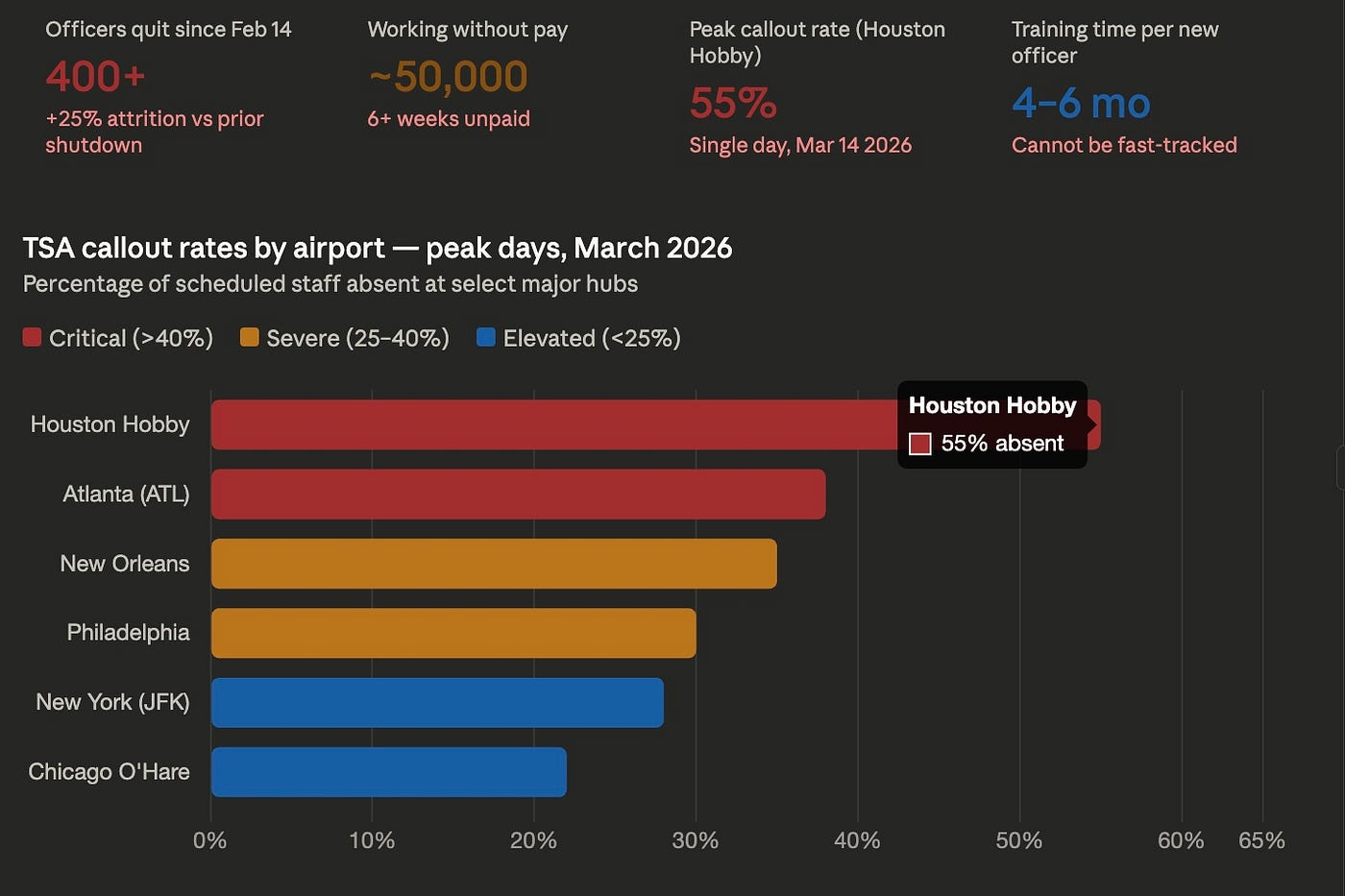
The human toll is stark, but so is the institutional one. More than 400 TSA officers have quit since February 14th — an alarming sign of strain on a system that was already stretched. Each one who walks away takes with them months of specialised training that cannot be quickly replaced. Each new TSA officer replacement requires four to six months to be trained and certified, leaving critical gaps in staffing. The queue snaking through terminal E at Bush Intercontinental in Houston is not simply inconvenient. It is the visible symptom of an institution being slowly dismantled by political indifference.

How a funding impasse became a national crisis
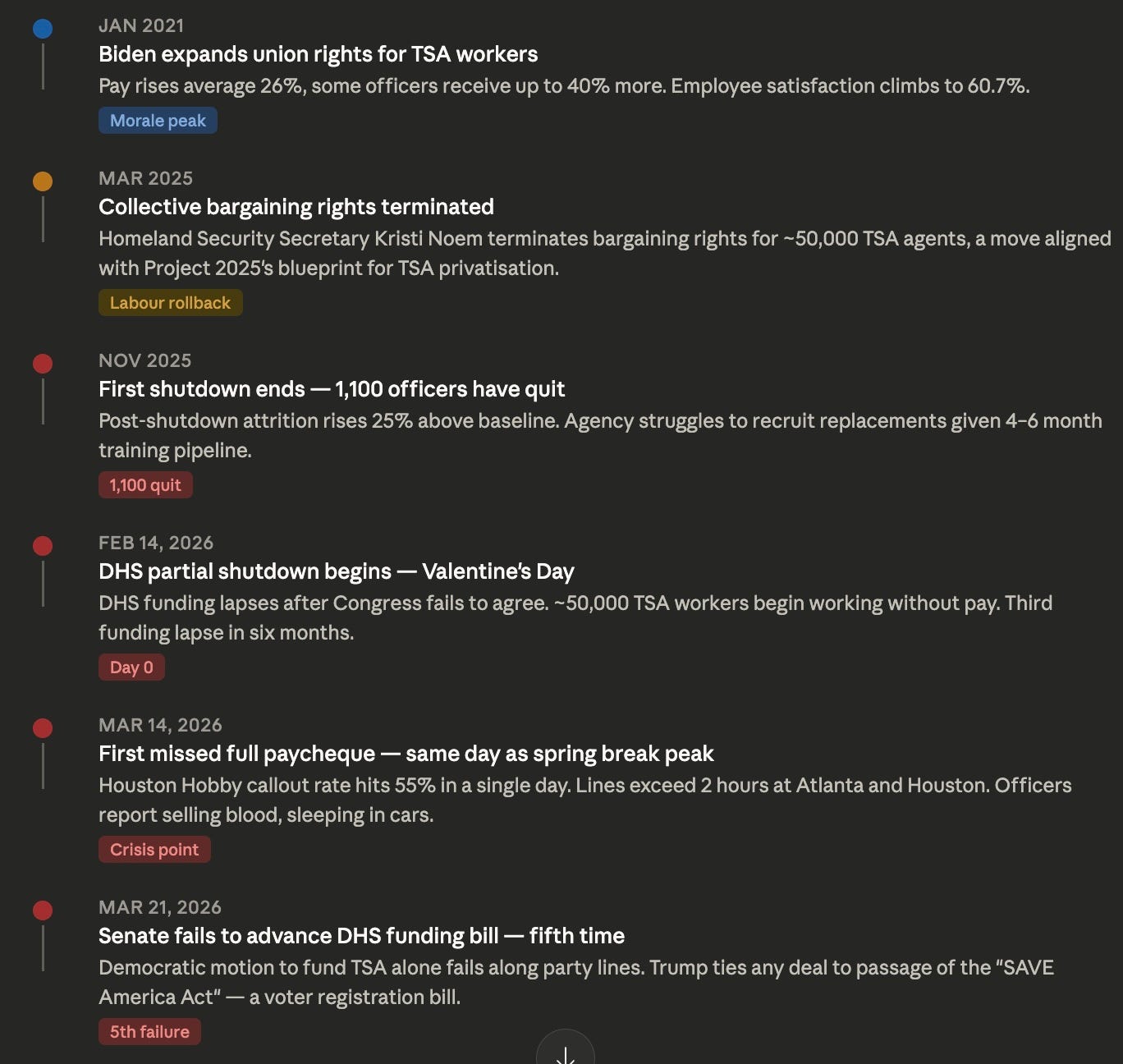
The mechanics of the current debacle are, by Washington’s standards, unusually legible. In early February, Congress approved a $1.2 trillion omnibus package funding most of the federal government through September. Funding for the Department of Homeland Security — which oversees agencies including the TSA, ICE, and Customs and Border Protection — was left out and was supposed to be voted on separately. What followed was a negotiating breakdown driven not by budgetary disagreement, but by a policy dispute of an entirely different character.
The controversy over ICE policies and tactics, including the fatal shootings of two civilians during protests in Minnesota earlier this year, is what led to the partial government shutdown affecting DHS. Democrats demanded reforms to immigration enforcement — specifically, a judicial warrant requirement and a ban on ICE agents wearing masks — in exchange for their support on DHS appropriations. Republicans refused. A Democratic motion to fund only TSA failed along party lines on March 21st.
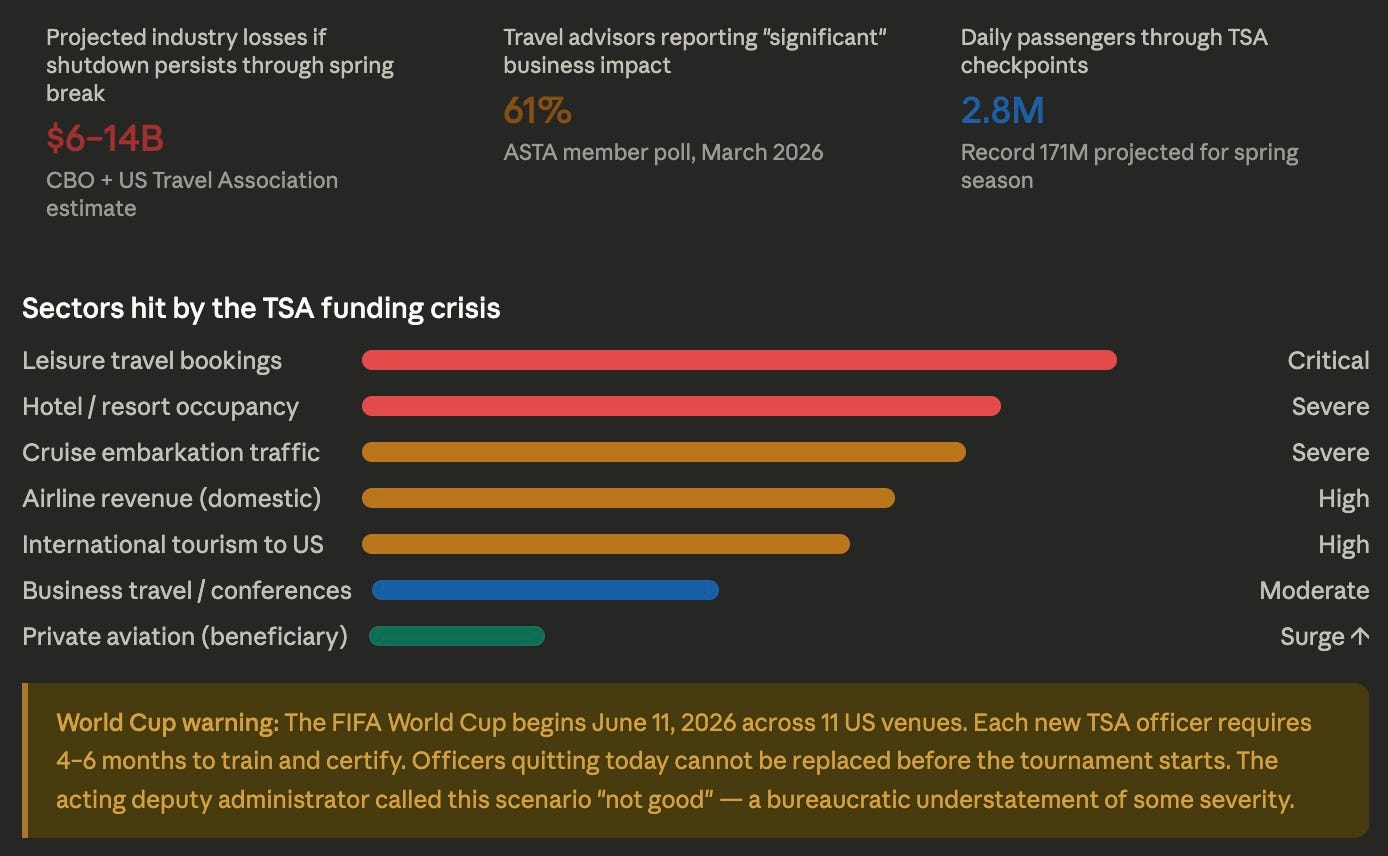
The result is that aviation security — a critical public function touching millions of lives each day — has been held hostage to a dispute about the operational procedures of a separate agency entirely. Some 2.8 million people were projected to travel on US airlines each day in March and April, adding up to a record 171 million passengers, according to the industry group Airlines for America. They are all, in effect, bystanders in a congressional standoff.
The politics have grown increasingly surreal. President Trump said he does not want to make a deal on Department of Homeland Security funding unless Democrats back the “SAVE America Act” — a bill dealing primarily with voter ID and proof of citizenship. In other words, the TSA officer who cannot afford her child’s medical copayment is being asked to wait until the Senate resolves a voter-registration dispute. The logical chain connecting these two things does not exist. What exists instead is leverage — or the attempt at it — and it is the travelling public that pays the price.
The numbers behind the misery
To understand the scale of the disruption, consider what “spring break travel season” means in 2026. Atlanta’s Hartsfield-Jackson, the world’s busiest airport, suffered chronic TSA staffing shortfalls with absences hitting thirty percent during peak hours, and security queues snaked outside terminals, forcing travellers to abandon trips or endure hours-long ordeals. In Houston, Houston Hobby Airport recorded peak waits of 3.5 hours on weekends, with travellers targeting Galveston cruises and South Padre Island facing impossible timelines, many opting for road trips instead.
In Philadelphia, airport officials closed three security checkpoints entirely because of short staffing. At JFK, average waits of 15 to 35 minutes during quieter periods ballooned to isolated peaks of up to three hours over the weekend, and even the usually swift PreCheck lanes stretched to 45 to 90 minutes at times.
A top TSA official said the “situation is dire,” with officers sleeping in cars and having to sell blood to afford gas to get to work. The acting deputy administrator warned that attrition from this shutdown would compound the losses from previous ones: about 1,100 officers quit during last year’s shutdown that ended in November, and the agency previously saw a 25% increase in attrition after the first lapse.
These are not abstract institutional statistics. Each departed officer represents months of taxpayer-funded training, irreplaceable institutional knowledge, and a vacancy that will take the better part of a year to properly fill. With spring break travel in full swing, the FIFA World Cup 2026 approaching, and celebrations for America’s 250th birthday throughout the year, the stakes are especially high.
The ICE gambit: a solution that creates new dangers
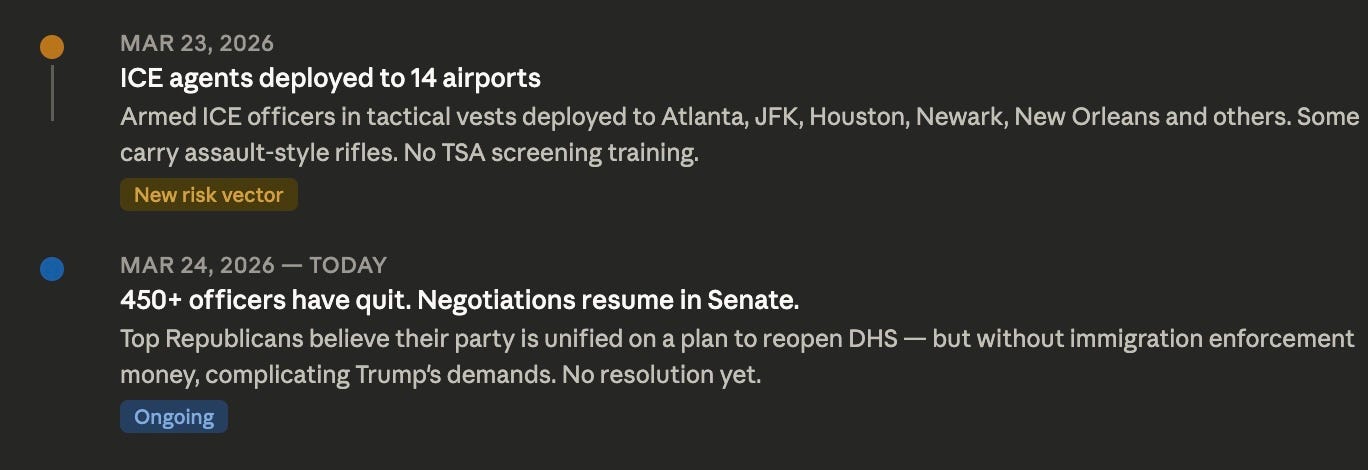
On Saturday March 22nd, with the situation deteriorating rapidly, President Trump announced that Immigration and Customs Enforcement agents would be deployed to airports to fill the void. By Monday morning, federal immigration officers in tactical gear were patrolling terminals at some of America’s busiest hubs. At Atlanta’s airport, ICE officers wearing tactical vests carried handguns holstered on their hips. At least one had what appeared to be a short-barrelled, assault-style rifle slung across his chest.
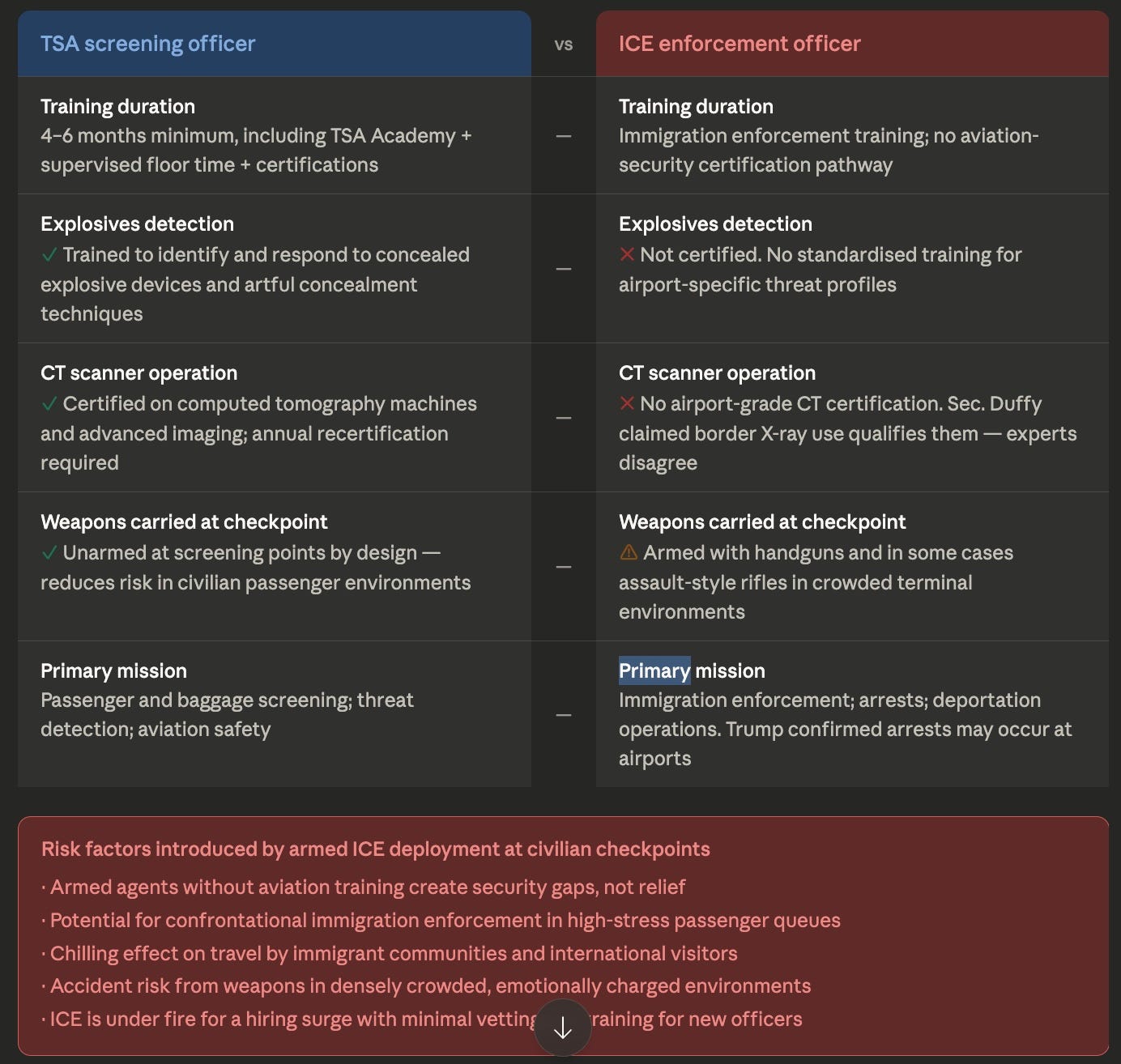
The symbolism was arresting and deeply counterproductive. The presence of heavily armed immigration enforcement agents in civilian airport terminals — spaces shared by families, tourists, business travellers, and the anxious and the infirm — introduces a category of risk that is qualitatively different from a long queue. An airport checkpoint is a compressed, high-stress environment where tensions run high and strangers are in close physical proximity. Introducing armed personnel who are trained for confrontational immigration enforcement, not de-escalation or crowd management, is an invitation to incident.
The unions representing aviation workers were unambiguous. Everett Kelley, national president of the American Federation of Government Employees, which represents TSA officers, said: “ICE agents are not trained or certified in aviation security. TSA officers spend months learning to detect explosives, weapons, and threats specifically designed to evade detection at checkpoints — skills that require specialised instruction, hands-on practice, and ongoing recertification. You cannot improvise that. Putting untrained personnel at security checkpoints does not fill a gap. It creates one.”
Transportation Secretary Sean Duffy offered the remarkable counter-argument that ICE agents are qualified to operate X-ray machines because they use similar equipment at the southern border. Experts pushed back, noting that TSA screeners go through weeks and months of specific on-the-job training around security screenings that ICE officers simply do not have, with much of that training dedicated to detecting explosives and weapons designed to avoid detection at airport screenings — a task ICE is not trained to do. “It’s just not something you can plug the agents into doing quickly,” one former Department of Homeland Security official told Axios.
Beyond competence, there is the matter of mission creep. Trump said that ICE agents deployed to airports could also make arrests — raising concerns that the chaotic raids that have played out on the streets of Minneapolis and Chicago might come to the nation’s airports as well. The move raised concerns among some travellers and civil rights groups, who worried the presence of immigration officers at airports could cause fear among immigrant communities, even if the agents are not conducting immigration checks.
Republican Senator Lisa Murkowski, herself a member of the president’s party, called the ICE deployment a “bad idea.” “What we need to do,” she said, “is get the DHS issues resolved. We need to get the TSA agents paid.” Even within the coalition that nominally supports the administration’s posture, the logic of replacing specialised screeners with armed immigration enforcement agents is difficult to defend.
The economic carnage — tourists, airlines, and the broader reckoning
It would be a mistake to view this crisis solely through the lens of inconvenience, or even of security. There is a broader economic damage accumulating with each passing day, one that will be felt well beyond the terminals.
Industry loss estimates range from $6 billion to $14 billion in permanent losses if the shutdown continues through spring break, according to estimates from the Congressional Budget Office and the US Travel Association. A recent poll of travel advisors showed that almost 61% of American Society of Travel Advisors members reported the TSA shutdown was having a significant impact on their business, with a notable percentage of travellers cancelling or postponing trips.
For international visitors — who already face a bewildering and often punishing arrival experience in the United States, complete with lengthy customs queues and intrusive questioning — the spectacle of armed immigration agents patrolling departure terminals is unlikely to improve impressions. The United States has long struggled to reconcile its self-image as a welcoming destination with the reality of its border and aviation apparatus. The current moment makes that gap yawning. Some travellers in Atlanta expressed concern that for many, seeing ICE officers would be deeply unnerving. For a tourist from abroad, the distinction between being processed by an armed immigration officer on the way into the country and seeing those same officers on the way out is not a distinction that inspires confidence.
On top of long security wait times and weather impacts, travel is being affected by the war in Iran, which is driving up global oil prices. United Airlines said it would cut some flights over the next six months after jet fuel prices doubled in recent weeks. Capacity cuts are likely to send airfares even higher, even as ticket prices are already rising.
The airlines, for their part, are absorbing body blows with characteristic corporate stoicism. Delta, headquartered in Atlanta, had corporate employees helping check in passengers at Hartsfield-Jackson; the airline said it would try to rebook customers who miss flights due to long security lines — up to a point. Delta declined to quantify its losses, saying it will address the topic during its Q1 financial results call in April.
The Project 2025 subtext
To understand the current crisis fully, one must look beyond the immediate funding dispute to the ideological framework in which it is embedded. Chapter 5 of Project 2025 calls for major changes to DHS and explicitly targets the TSA for privatisation. The roadmap is clear enough that union officials speak about it openly. The union’s vice president said that the goal of the Republican Party is to eliminate union protections and then privatise the TSA, arguing that privatisation would not yield better security but rather more possibilities for gaps in the system.
In 2021, former President Biden had expanded union rights for TSA workers; employee engagement rose significantly between 2022 and 2023 thanks to an updated pay structure that delivered an average pay increase of 26%, with some officers receiving increases of up to 40%. TSA employee satisfaction jumped to 60.7%. Now, with funding halted and policy changes underway, many of those gains appear to be unravelling.
The proposed FY2026 White House budget, submitted before the current crisis, already signalled the direction of travel. The White House justified the funding cut of $247 million from TSA’s budget by saying that the agency “consistently failed audits while implementing intrusive screening measures that violate Americans’ privacy and dignity.” The framing is instructive: it positions the TSA not as a public service under strain, but as an intrusive bureaucracy ripe for cutting. Two Republican senators have recently introduced legislation to dissolve TSA entirely and privatise all airports.
This matters because it contextualises the shutdown not merely as a budgetary accident but as a pressure point. A TSA workforce that is unpaid, demoralised, and haemorrhaging experienced officers is a workforce more amenable to restructuring. Each resignation makes the case for outsourcing marginally more plausible. The queue at Houston is not just a queue. It is a policy outcome.
What must be done, and why it is not being done
The solution to the immediate crisis is straightforward to the point of obviousness: fund the TSA. Sen. Ted Cruz, a Republican from Texas, proposed breaking up the DHS spending bill and funding TSA immediately, with ICE and CBP funded separately through budget reconciliation. This is a sensible approach — it decouples the security function from the immigration dispute and allows the 50,000 essential workers now begging for their salaries to be paid while the broader argument continues in its proper venue.
Top Senate Republicans believe their party is unified behind a plan to reopen DHS without immigration enforcement money. The president, however, has shown no inclination to accept it. He has made TSA funding conditional on immigration-policy concessions, then on passage of a voter-registration bill. The goalposts move. The queues do not.
The consequences of continued inaction are not speculative. The acting deputy administrator warned that the situation will “get worse, not better,” and that the agency will have to deal with the reverberations of this situation “for a long time” — particularly with the World Cup approaching in June, which will bring a heavily trafficked, globally visible surge through American airports.
The hope, according to the Airlines for America industry group, is to find a way to ensure that these problems don’t rise up again every time Congress is at an impasse. That is a larger structural ambition — perhaps requiring the TSA’s funding to be treated as essential-services appropriations, ring-fenced from the partisan brinkmanship that has made every budget cycle a potential shutdown. But it is also a conversation for later. Right now, the conversation is simpler: pay the screeners, send the ICE agents back to their actual jobs, and let the people who have spent months learning to detect explosives get on with detecting explosives.
The deeper indignity
There is something philosophically absurd about the current arrangement that deserves to be named plainly. The TSA was created in direct response to the September 11th attacks, born from the recognition that aviation security was too important to be treated as a commercial amenity. It was, from its inception, an expression of the principle that certain public functions must be insulated from the logic of cost-cutting and market efficiency. A nation that watched nearly 3,000 people die because aviation security was inadequate decided, two decades ago, that this was not a domain for improvisation.
What is happening now is a systematic reversal of that commitment. Not through open debate or democratic deliberation, but through the mechanism of manufactured crisis — funding withheld, morale destroyed, experienced staff driven out — followed by the claim that the resulting dysfunction proves the institution was never fit for purpose. The case for privatisation is built, brick by brick, from the rubble of underfunding.
The acting TSA deputy administrator put the human dimension plainly: “We’ve got folks sleeping in cars. Folks having to essentially get blood drawn to afford gas to come to work.” These are federal law enforcement officers — people who accepted the specific conditions of government employment, with its modest pay and strong public-service mission, in exchange for stability and the knowledge that their work matters. The current arrangement violates that compact completely.
Meanwhile, ICE still has plenty of funding after Congress allocated the agency billions of dollars last summer as part of the Republican “One Big Beautiful Bill Act” — including $45 billion for new immigration detention beds and $30 billion to hire 10,000 ICE employees. The disparity is not incidental. It reflects a set of priorities in which immigration enforcement is flush and aviation security is starved, and in which the gap between the two is papered over by deploying the former to simulate the function of the latter.
It is a bad deal for Americans. It is a bad deal for the tourists who bring hundreds of billions of dollars into the US economy each year. And it is a bad deal for the country’s standing as a place that takes the safety of its skies seriously.
The queue at JFK this morning is not inevitable. It is chosen.
This article was written for the edition of March 24th, 2026. TSA officer attrition figures and wait-time data reflect the most recently available reports as of the time of publication. The political situation remains fluid.
Works Cited
“Atlanta Airport TSA Staffing Crisis: Security Lines Snake Outside Terminals During Spring Break.” The Atlanta Journal-Constitution, 14 Mar. 2026.
“Delta Airlines Corporate Employees Help Check In Passengers Amid TSA Shortage.” The Atlanta Journal-Constitution, 15 Mar. 2026.
“ICE Agents Deployed to 14 Major US Airports as TSA Shortage Worsens.” NBC News, 23 Mar. 2026.
“ICE Deployment at Airports Raises Safety and Civil Rights Concerns.” The Washington Post, 23 Mar. 2026.
Kelley, Everett. “TSA Officers Are Not Replaceable with ICE Agents.” American Federation of Government Employees, press release, 22 Mar. 2026.
“Murkowski Calls ICE Airport Deployment a ‘Bad idea,’ Urges DHS Funding Deal.” Politico, 23 Mar. 2026.
“Project 2025 Chapter 5: Department of Homeland Security.” The Heritage Foundation, 2023, pp. 133–170.
“Senate Fails for Fifth Time to Advance DHS Funding Bill.” The Hill, 21 Mar. 2026.
“Spring Break 2026: Record 171 Million Passengers Projected, Airlines for America.” Airlines for America, press release, 1 Mar. 2026.
“Ted Cruz Proposes Breaking Up DHS Bill to Fund TSA Separately.” Texas Tribune, 20 Mar. 2026.
“Trump Ties DHS Deal to SAVE America Act, Complicating Senate Negotiations.” Reuters, 20 Mar. 2026.
“TSA Acting Deputy Administrator: ‘Situation Is Dire,’ Officers Sleeping in Cars.” Axios, 14 Mar. 2026.
“TSA Officers Face Evictions, Repossessions as Third Shutdown Drags On.” NPR, 10 Mar. 2026.
“TSA Staffing Shortfalls Force Philadelphia Airport to Close Three Checkpoints.” The Philadelphia Inquirer, 15 Mar. 2026.
“TSA Union Rights Terminated by Homeland Security Secretary Noem.” The Guardian, 6 Mar. 2025.
“TSA Wait Times at JFK Reach Three Hours During Spring Break Weekend.” New York Post, 16 Mar. 2026.
“United Airlines Cuts Flights as Jet Fuel Prices Double Amid Iran War.” The Wall Street Journal, 18 Mar. 2026.
United States. Congressional Budget Office. Estimated Economic Impact of the DHS Partial Shutdown on Aviation and Tourism Sectors. CBO, Mar. 2026.
United States. Department of Homeland Security. Proposed FY2026 Budget Justification: Transportation Security Administration. GPO, Feb. 2026.
United States. Transportation Security Administration. “TSA Officer Attrition Data, February–March 2026.” Internal agency report cited in Senate testimony, Mar. 2026.
“White House Budget Cuts $247 Million from TSA, Cites Failed Audits.” Politico, 12 Mar. 2026.
메타데이터
- post_id
- a4fe95af1528
- slug
- the-grounded-states-of-america-a4fe95af1528
- url
- https://medium.com/@iamzaki/the-grounded-states-of-america-a4fe95af1528
- canonical_url
- https://medium.com/@iamzaki/the-grounded-states-of-america-a4fe95af1528
- author_url
- https://medium.com/@iamzaki
- status
- ok
- fetched_at
- 2026-06-14 11:28:49