Your Real Resumé is in Your Cells
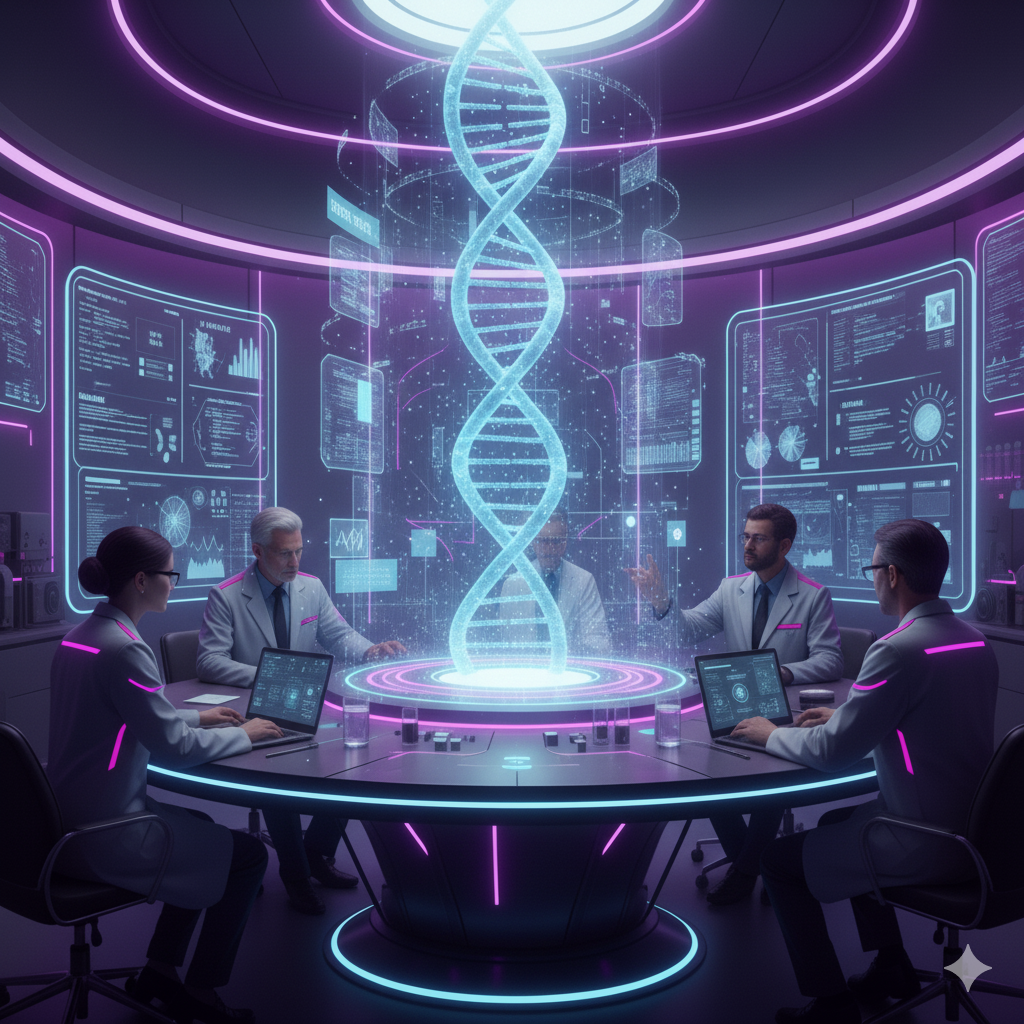
Our cells contain more information about yourself than you can imagine!
Your Real Resumé is in Your Cells
Source: JSTOR daily
Our cells contain more information about yourself than you can imagine!
It’s like your resumé outlining all the details about yourself! From your height, physical features, or even your current of future health conditions!
To further understand this, let’s get a closer look into what DNA is.
What is DNA?
We all have traits, let’s take Emma Watson as an example: Emma has light brown/hazel eyes, paled skin, brunette hair and a few freckles. Her traits are coded by her DNA! However not every trait Emma owns is due to her DNA and some traits are influenced by external factors as well.
Some examples being her hair length, which can be a result of her cutting her hair or how she maintains it. Her height which could be influenced based on how active she is. Lastly, her weight can be a result of her physical exercise and food intake.
Source: Wiki Feed
DNA is short for deoxyribonucleic acid. DNA is a type of nucleic acid, nucleic acids are made up of nucleotides. A nucleotide is made up of 3 parts:
- Deoxyribose (a type of sugar)
- Phosphate (You may have heard DNA had a phosphate backbone)
- Nitrogenous base
Source: U.S National Library of Medicine
The 4 bases
There are 4 nitrogenous bases Adenine (A), Thymine (T), Guanine (G) and Cytosine (c ).
Each base has a pair, A pairs with T and C pairs with G. Here’s a mnemonic to remember this:
Apples on a Tree ( A and T base pairs) and Car in the Garage ( C and G base pairs).
The 3 parts of the nucleotide form 2 strands. The strands are structured together to form a double helix structure.
There are 3 different types of DNA:
a) Non-coding DNA (parts of your DNA that don’t code for any traits or proteins)
b) Non-activated DNA (parts of your DNA that are regulated.)
c) Activated DNA (parts of your DNA that is coding for things like proteins or traits)
The role of chromosomes
Your DNA is compacted into chromosomes. Chromosomes are made up of chromatin (which are made up of DNA and proteins). DNA is wrapped around proteins called histones. The negatively charged phosphate backbone of DNA and positively charged histones attract which keeps the DNA wrapped around the histones. All of this is compacted tightly which results as your chromosome.
Source: Project 8p
You inherit 23 chromosomes from both your parents (23 x 2). So in total you have 46 chromosomes in the nucleus of your cell.
DNA vs. RNA
Along with DNA another very important substance is RNA. It plays a very important role and is essential to understand for processes such as protein synthesis!
Source: ThoughtCo.
RNA is very similar to DNA. DNA and RNA are both Nucleic acids. They both contain a nucleotide consisting of 3 parts:
- Phosphate
- Sugar
- Base
There are really only 2 major differences between the two:
- RNA is single stranded
- RNA has base pairs of A, U (Uracil) , C and G
U is basically in replacement of T so A and U go together!
What’s the big deal with proteins?
Portions of your DNA make up Genes that have a role of coding for proteins, however not all genes code for proteins specifically.
For example: A specific gene related to your eye colour may code the protein needed to create the pigment of your eye.
You may be wondering ,“Olivia, do you mean this protein?!?”👇
Source: Verywell health
I’m talking about the proteins in your body! The proteins in your body are able to:
- Transport nutrients
- Build structures in your body
- Act as enzymes (an enzyme is a substance that can break down and build on to the substances they attach to)
- Protect the body against diseases and so much more!!
Producing proteins
The production of these proteins is called: Protein Synthesis
There are 2 steps to this process:
- Transcription
- Translation
The big mission
Pov: You’re the CEO of a big company that builds houses in Canada, you’re in a crisis with losing your contract if you don’t build 500 homes. You need bricks to build those 500, which are supposedly in France. You personally cannot go because you need to stay in the company and regulate everything. So instead you send your assistant to go bring the bricks that your company needs so the homes can be built. So the assistant copies the specific information on the bricks needed and goes to France to give your supplier the information. But the supplier cannot understand the brick information because it is written in english. Therefore the assistant hires a translator to translate the information in french. Then the supplier is able to read the list and produce the bricks needed to build the houses.
1. Transcription
Source: Owlcation
This situation is very similar to the transcription process.
DNA — CEO
mRNA — The assistant
rRNA — The suppliers
tRNA — Translator
Protein — The bricks
Amino acids — Clay
Peptide bond — Mortar
In this case, DNA is the CEO that needs a supply of protein to build structures in the body. It cannot travel outside the nucleus. Therefore it sends mRNA (messenger RNA), the details of the supplies. Messenger RNA copies the information given by DNA and goes to the ribosome where rRNA (ribosomal RNA) would produce the proteins.
However since the supplier is in France, they only understand french and need a translator. This is where the process of translation kicks in!
2. Translation
Source: Peak Proteins
Amino acids building blocks for proteins just like clay is the key substance bricks are made up of. However just like different homes have different bricks, there are many types of Amino acids.
Proteins are made up of more than one amino acid held together by a bond known as peptide bond! Just like mortar holds bricks together.
Since there are many amino acids in our body. tRNA (transfer RNA) would bring the Amino acids together so that rRNA would produce the proteins. But how would tRNA know which Amino acids to bring together? (Similar to how would the brick supplier produce the bricks if he can’t read the instructions?)
Here’s why the instructions copied by the mRNA is translated by tRNA and then copied in 3’s or triplets. The 3 bases it reads tells the tRNA what Amino Acid it brings. The 3 letters are called a Codon.
Example: UAG
UAG would have a complimentary Anticodon that would be its pair (which in this case would be) AUG.
All anticodons will carry an amino acid according to its 3 letters. AUG would have the amino acid Methionine. There is an mRNA codon chart that tells which amino acid each codon codes for!
Source: Socratic
At the end of the mRNA there is a stop codon, when the rRNA translates it, it would indicate the protein is completed!
In the end with the use of transcription and translation the proteins and the bricks are built!
Having 6 fingers is related to genetics!?
Source: National human Genome Research Institute
Genes are portions of your DNA that are able to code for proteins or a trait.
Each parent contributes an Allele which is a variant of a gene. Alleles are normally represented by letters. Capital letters refers to a dominant allele and lowercase letters refers to recessive alleles. The letter combo can be: TT, Tt or tt. (T is used as an example)
A dominant allele means you either have TT or Tt (See there’s at least 1 uppercase T).
A recessive allele is only expressed if there is no dominant allele such as tt. (No uppercase T).
These 3 combinations (TT, Tt and tt) are known as Genotypes. A genotype is the Genetic makeup that helps determine the phenotype. The Phenotype are the physical characteristics based on a gene.
Source: BBC
A Polydactyl is someone born with extra fingers or toes. This is related to genetics and specifically alleles, genotypes and phenotypes!
Someone who has a Genotype homozygous (PP) or heterozygous (Pp) dominant trait allele will inherit a polydactyl.
Off springs to someone who has a Polydactyl needs to carry only one dominant allele to inherit a Polydactyl.
There is a 50% probability of the offspring having polydactyly and 50% of not having it (normal).
Therefore those of us who only have 5 fingers is a recessive allele trait, means we have a Genotype of pp instead of Pp or PP. Resulting in our phenotype (physical characteristic) of 5 fingers and toes.
Diving deeper into the field of Genetics
You’re now informed on the role your DNA plays and how much it influences the way you are!
Biotech companies such as 23andMe, My heritage, and Ancestry can take a sample of your DNA (such as in your saliva ) to trace your roots and certain health care conditions!
Source: Review Geek
Diving deeper into DNA is a field called personalized medicine. Personalized Medicine can diagnose your potential genetic diseases and your treatment is customized according to your specific Genotypes and Phenotypes!
Further Study:
Here are some excellent resources to further understand the topics I’ve explained above! I highly suggest you try and explore these topics outside of my article as well!!
- *Amoeba sisters Protein synthesis*
- *Alleles vs. Genes*
- What is genomics
- DNA, Hot Pockets, & The Longest Word Ever: Crash Course Biology #11
- *6 precision medicine companies making their mark*
- How 23 and me works
TL;DR
- Traits and Proteins are coded in your DNA.
- External factors along with DNA affect your traits.
- DNA is short for deoxyribonucleic acid and is made up of 3 parts: Phosphate, Deoxyribose (Sugar) and a Nitrogenous Base.
- There are 4 Nitrogenous bases Adenine (A), Thymine (T), Guanine (G) and Cytosine (C ) in DNA.
- You have Non-coding DNA, Non-activated DNA and Activated DNA.
- Your DNA is compacted into chromosomes.
- One side of the DNA is read as 5’ to 3’ and the other 3’ to 5’.
- Portions of many DNA bases make up Genes.
- Genes have a role of coding for proteins/traits.
- Proteins are vital for your body.
- The production of proteins (known as protein synthesis) Has 2 steps: Transcription and Translation.
- RNA is very similar to DNA, but is single stranded and has Uracil (U) instead of Thymine (T) in it’s bases.
- Allele is a variant of a gene.
- These 3 combinations are known as genotypes. A genotype is the genetic makeup that helps determine the phenotype.
- Phenotype is the physical characteristics based on a gene.
- Biotech companies such as 23andMe, My heritage and Ancestry can take a sample of your DNA (such as in your saliva ) to trace your roots and certain health care conditions!
- A field that dives deeper in DNA is personalized medicine.
Who’s Olivia?
Hey! I’m a high schooler passionate writing, Genomics 🧬 and future of food🥕!
I love to read, explore and seek ways to grow and become the best version of myself!
Let’s stay in touch, follow my journey on:
Or sign up here for my personal monthly newsletters (to read all the awesome stuff I’m doing!) 😉
Bye for now! 👋
메타데이터
- post_id
- a513774d08f
- slug
- your-real-resumé-is-in-your-cells-a513774d08f
- url
- https://medium.com/@oliviatk8/your-real-resum%C3%A9-is-in-your-cells-a513774d08f
- canonical_url
- https://medium.com/@oliviatk8/your-real-resum%C3%A9-is-in-your-cells-a513774d08f
- author_url
- https://medium.com/@oliviatk8
- status
- ok
- fetched_at
- 2026-07-27 15:46:57