Beyond the Screen: Mastering Component-Level Scoped ViewModels in Android Jetpack Compose
For years, Android architectural guidelines defined ViewModel instances as screen-level state holders. They were rigidly tied to large…
Beyond the Screen: Mastering Component-Level Scoped ViewModels in Android Jetpack Compose

For years, Android architectural guidelines defined ViewModel instances as screen-level state holders. They were rigidly tied to large lifecycle containers: an Activity, a Fragment, or a NavBackStackEntry. While this paradigm successfully protected UI state across configuration changes like screen rotations, it introduced massive architecture headaches for granular, reusable components.
If you needed a dedicated, business-logic-heavy state holder for individual pages inside a HorizontalPager, or an complex state engine for reusable list items within a LazyColumn, you were out of luck. You either had to hoist all sub-component states into a massive, monolithic screen-level ViewModel, or clumsily build custom, fragile ViewModelStoreOwner implementations.
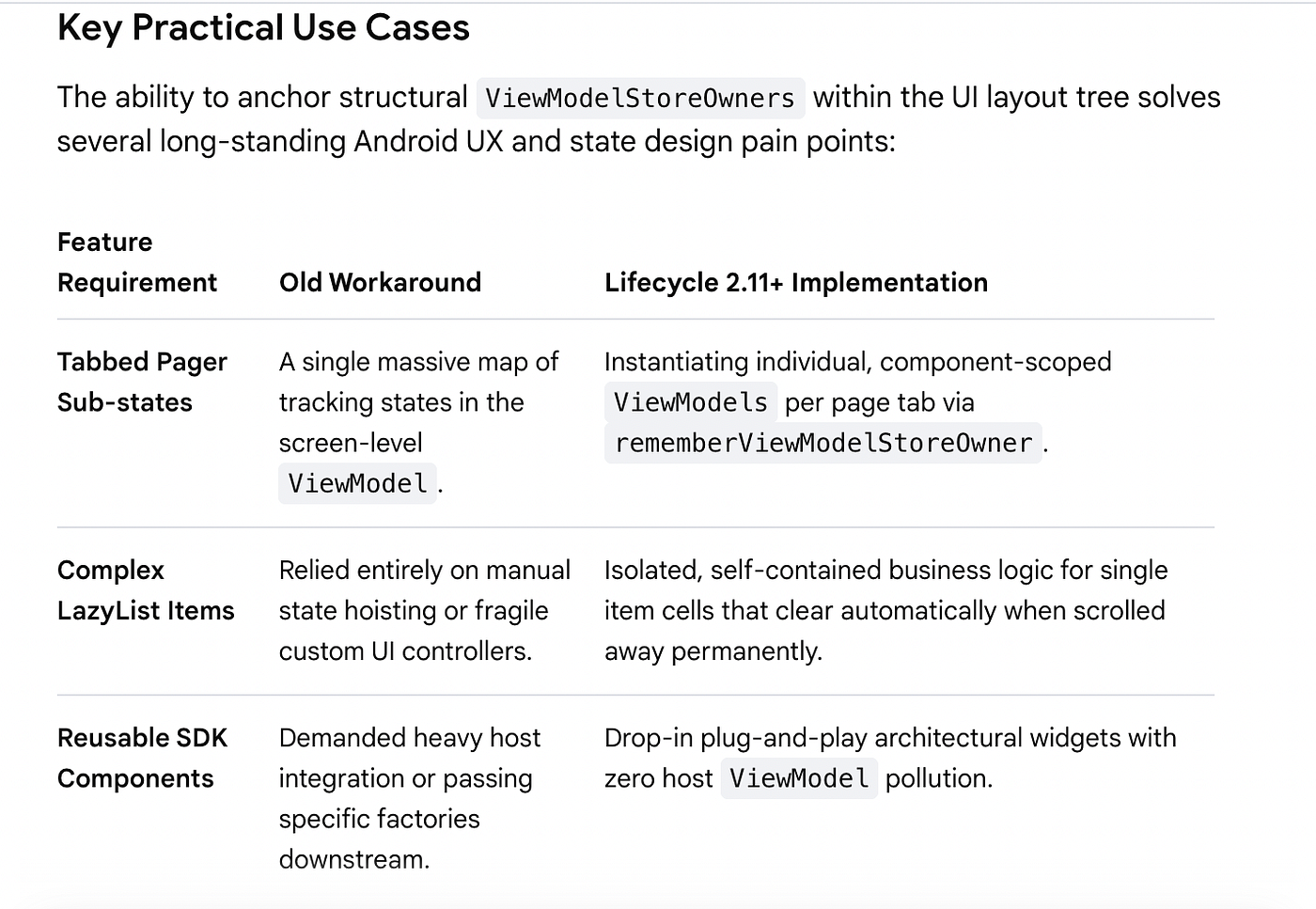
With the release of Jetpack Lifecycle 2.11.0, Google bridged this architectural gap. The framework introduces native component-level scoped ViewModel APIs natively designed for the Jetpack Compose hierarchy: rememberViewModelStoreOwner() and ViewModelStoreProvider.
The Problem with Traditional Screen-Scoped ViewModels
Traditionally, the viewModel() composable function resolves dependencies by finding the nearest ViewModelStoreOwner via LocalViewModelStoreOwner.current. In a Jetpack Compose environment, this owner is almost always the hosting screen destination.
The Problem with Traditional Screen-Scoped ViewModels
Traditionally, the viewModel() composable function resolves dependencies by finding the nearest ViewModelStoreOwner via LocalViewModelStoreOwner.current. In a Jetpack Compose environment, this owner is almost always the hosting screen destination.
// In older architectures, this always points to the Screen/Activity level owner
val screenViewModel: MyViewModel = viewModel()
This rigid scoping led to critical limitations:
- Over-Hoisting State: Reusable UI components (like a complex rich text editor or a video player widget) had to pass events up and poll state down from a single global screen
ViewModel. - Lifecycle Mismatch: When a smaller component permanently left the UI tree, its associated data and running asynchronous coroutine tasks remained trapped in the screen-level
ViewModeluntil the user backed out of the entire screen.
The New Dawn: Component-Level Scopes
The Jetpack Lifecycle 2.11.0 library update completely shifts the paradigm. You can now scope a ViewModel directly to the exact call-site of a specific composable function. The core superpowers of these new APIs are clear:
- They seamlessly survive configuration changes (such as device rotation or switching to dark mode).
- They are automatically cleared and destroyed when that specific composable permanently exits the Composition hierarchy.
Core APIs: Implement Scoped ViewModels
The framework delivers two primary tools to instantiate sub-screen scopes:
**rememberViewModelStoreOwner()**
This API provisions a local ViewModelStoreOwner that is unique to the lifecycle position of the composable wrapper.
import androidx.lifecycle.viewmodel.compose.rememberViewModelStoreOwner
import androidx.lifecycle.viewmodel.compose.viewModel
@Composable
fun ReusableFeatureWidget() {
    // 1. Create and remember a local UI-tied owner
    val localWindowOwner = rememberViewModelStoreOwner()

    // 2. Pass the local owner into the viewModel provider factory
    val componentViewModel: WidgetViewModel = viewModel(viewModelStoreOwner = localWindowOwner)
    // The widget logic operates completely isolated here...
}- How it works: When
ReusableFeatureWidgetis removed from the composition tree permanently, the framework automatically triggersonCleared()onWidgetViewModel, terminating any innerviewModelScopecoroutines cleanly.
**ViewModelStoreProvider** with Keys
When building highly dynamic collections like horizontal carousels or infinite scroll lists, you often need to hoist state ownership just slightly above the component itself to prevent premature destruction. ViewModelStoreProvider handles this explicitly.
import androidx.lifecycle.viewmodel.compose.ViewModelStoreProvider
import androidx.lifecycle.viewmodel.compose.rememberViewModelStoreOwner
@Composable
fun DashboardPager(tabItems: List<String>) {
    val provider = remember { ViewModelStoreProvider() }

    HorizontalPager(state = rememberPagerState { tabItems.size }) { index ->
        val tabKey = tabItems[index]

        // Scope the ViewModelStore to the combination of the provider and unique key
        val tabOwner = rememberViewModelStoreOwner(provider, tabKey)

        CompositionLocalProvider(LocalViewModelStoreOwner provides tabOwner) {
            TabPageContent() // Any viewModel() invoked inside here becomes tab-scoped!
        }
    }
}
Ecosystem Compatibility
One major benefit of these native Lifecycle primitives is that they do not break existing toolsets. They cleanly preserve full architectural compatibility with core libraries:
- SavedStateHandle: Works flawlessly out of the box. If the operating system kills the process under memory pressure, the state provider hooks into the standard saving mechanisms seamlessly.
- Dependency Injection (Hilt): Standard DI factories interact reliably with the newly generated local context providers.
Summary
The introduction of component-level scoped ViewModel state transforms state management in Jetpack Compose. By discarding the old limitation that bound ViewModels solely to entire screen destinations, Android engineers can finally build highly modular, fully self-contained UI widgets that manage their own lifecycles, safely handle heavy business logic, and survive orientation shifts without leaking memory.
To take advantage of these layout-scoped features, make sure your app module’s dependencies are updated to use the latest versions via the Android Jetpack Lifecycle Release Channel.
메타데이터
- post_id
- a5324a262e03
- slug
- beyond-the-screen-mastering-component-level-scoped-viewmodels-in-android-jetpack-compose-a5324a262e03
- url
- https://medium.com/@shabarishbk/beyond-the-screen-mastering-component-level-scoped-viewmodels-in-android-jetpack-compose-a5324a262e03
- canonical_url
- https://medium.com/@shabarishbk/beyond-the-screen-mastering-component-level-scoped-viewmodels-in-android-jetpack-compose-a5324a262e03
- author_url
- https://medium.com/@shabarishbk
- status
- ok
- fetched_at
- 2026-06-20 20:29:01




