The View from the Bass Section
Munich has named Petr Popelka its next Generalmusikdirektor. His opera record is short, brilliant, and loud.
The View from the Bass Section
Munich has named Petr Popelka its next Generalmusikdirektor. His opera record is short, brilliant, and loud.
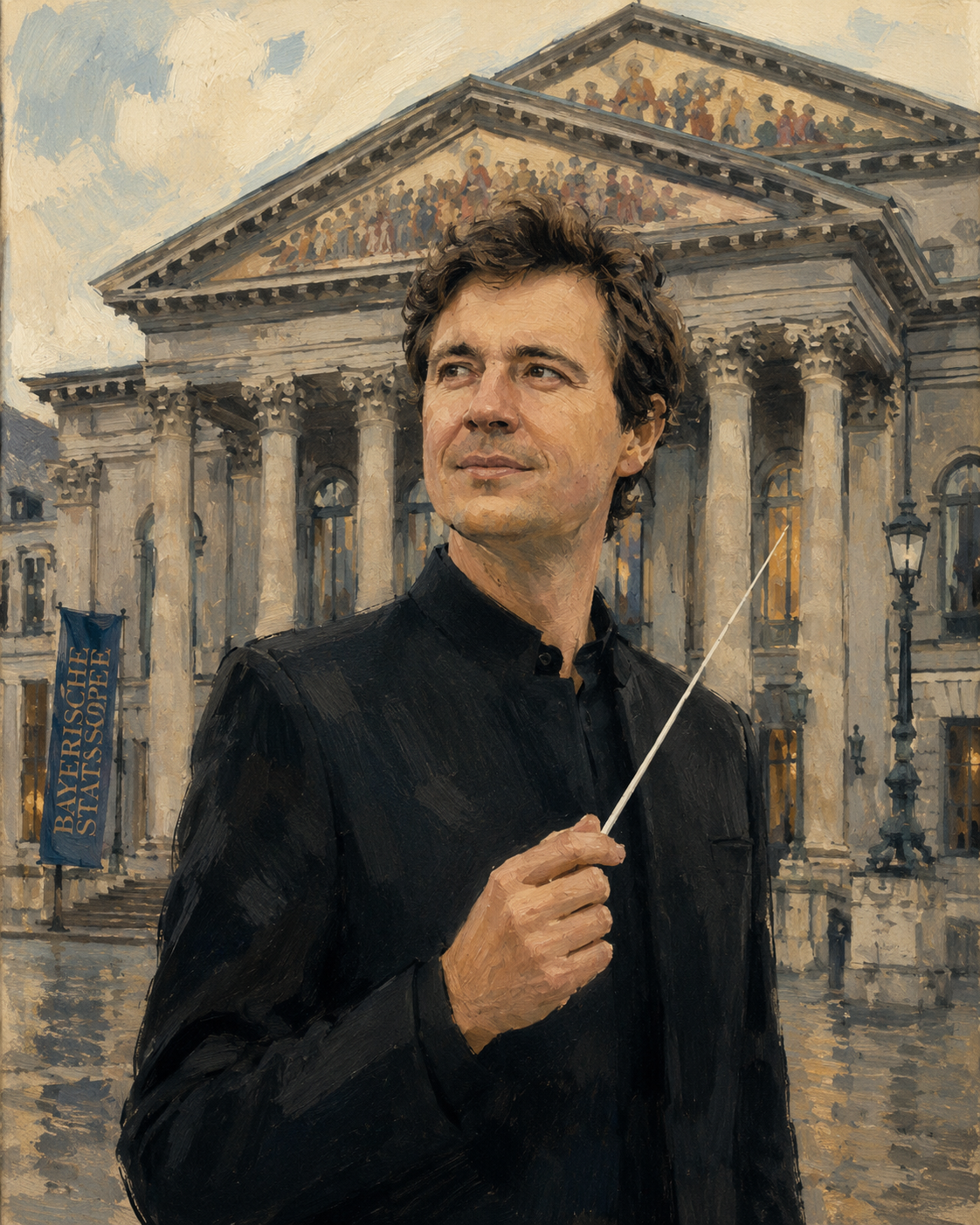
For nine years Petr Popelka heard opera from underneath. As deputy principal double bassist of the Staatskapelle Dresden from 2010 to 2019, he sat at the harmonic floor of the Semperoper pit, where Elektra, Salome, and Der Rosenkavalier first detonated. A bassist never gets the tune. He gets the foundation, the pulse, and a decade of watching conductors succeed or fail from the one chair where every miscalculation lands first.
On Wednesday the Bayerische Staatsoper announced that this bassist, now 40, will become its Generalmusikdirektor with the 2029/30 season, succeeding Vladimir Jurowski. Bavaria’s culture minister Markus Blume called him the orchestra’s wish candidate and described the chemistry between conductor and Staatsorchester as love at first sight. Intendant Serge Dorny praised a rare combination of musical substance and human quality. Strip the ceremony from those statements and one fact remains: the players asked for him.
The Munich post is the most scrutinized music directorship in opera. Kirill Petrenko held it from 2013 to 2020 with single-minded devotion and left for the Berlin Philharmonic as a legend. Jurowski, who arrived in 2021, has split his attention across several major positions. So the question hanging over the announcement is fair: what has this conductor actually done in an opera house?
Opera arrived in the first season of his conducting career. In December 2019, while still a member of the Staatskapelle, he led the Dresden premiere of Peter Eötvös’s Der goldene Drache at Semper Zwei. Staged productions have followed in Dresden, Oslo, Zurich, Vienna, Munich, and Berlin, and the reviews tell one story twice.
The first story is detail. His main-stage Semperoper debut came in July 2022 with Shostakovich’s The Nose in Peter Konwitschny’s staging. Concerti’s critic heard his former colleagues delivering brutally precise interjections, stupendous brass glissandi, and string runs of nearly irrational speed. In January 2023 he conducted a new Elektra in Oslo, with 97 players in a pit that bulged. NRK’s reviewer argued that the orchestra never turned massive or impenetrable. Strauss’s writing is a gigantic mosaic of detail, the critic wrote, and Popelka made every growling bass and trilling piccolo audible. The Scenekunst critic found the musical execution often breathtaking, the intensity never flagging for a second. In Tobias Kratzer’s Schwanda at the Theater an der Wien (November 2023), Die Deutsche Bühne heard shimmering orchestral color from the Wiener Symphoniker, then playing under their incoming chief conductor. And when Popelka took over Krzysztof Warlikowski’s Káťa Kabanová at the 2025 Munich Opera Festival, the French journal Première Loge called the Bayerisches Staatsorchester one of the undisputed stars of the evening. The critic filed the performance under nights one brags about having attended. Within a year, Munich had hired him.
The second story is weight. Concerti magazine’s Dresden notice added that the volume sometimes overshot. The Dagsavisen critic heard the Oslo orchestra, in places, showing more muscle than the soloists could answer. In a Zurich Don Giovanni (autumn 2023), Online Merker found the Philharmonia’s broad, romantic sound only partly reined in, with soloists at risk of being covered at the evening’s edges. In Stefan Herheim’s Fledermaus (October 2025), Bachtrack admired a muscular, swaggering account and found it, at times, “a hair too aggressive for Viennese lightness.” Four cities. Four orchestras. The same marginal note. This is a bassist’s vice. A musician formed at the bottom of the texture builds his sound from the floor up and trusts the singers to climb on top of it. The Káťa notices suggest the lesson is being learned. A Berlin Tosca run at the Staatsoper Unter den Linden closed this February to a long ovation. But a Generalmusikdirektor who buries his Isolde will hear about it by intermission.
The repertoire gaps are real. No Verdi. No staged Wagner production of his own, only revival performances of Tristan in Berlin. One Puccini run. One Mozart revival, and that one drew the balance complaint. Munich’s identity rests on Wagner, Strauss, and Mozart. Popelka has played that repertoire from the inside for a decade. Conducting it across a season, in a 2,101-seat theater, with casts who expect to be heard, is a different examination, and he has barely sat for it.
The institutional gap is larger than the musical one. Petrenko arrived in Munich having held music directorships at two opera houses and a staff conducting post at a third. Popelka has run three symphony orchestras and zero opera houses. A Generalmusikdirektor plans seasons, builds ensembles, arbitrates between stage and pit, and absorbs the blame for both. He also holds the Vienna Symphony post, and Munich has just spent five years learning what a part-time music director costs.
What Munich gets needs no embellishment. With Jakub Hrůša installed at Covent Garden since September, Popelka’s appointment puts Czech conductors atop two of opera’s commanding heights, at the exact moment Janáček has moved from specialty to center repertoire. Munich gets a conductor whom orchestral musicians choose. And it gets three years of runway, beginning with Rusalka at this summer’s festival, a return engagement that the announcement has turned into a victory lap.
The appointment is right, on one condition. Popelka must arrive the way Petrenko did, alone, with the Vienna post resigned and the singer’s half of the bargain learned. The talent is no longer the question. The reviews from Dresden, Oslo, Vienna, and Munich settled that. What remains unsettled is whether a man who rose this fast can hold still long enough for one house.
He spent nine years at the bottom of the orchestra, learning what conductors cost the people who play for them. In 2029, Munich finds out what that education is worth from the other side of the podium.
메타데이터
- post_id
- a54eb8682d44
- slug
- the-view-from-the-bass-section-a54eb8682d44
- url
- https://medium.com/@michael.landmankarny/the-view-from-the-bass-section-a54eb8682d44
- canonical_url
- https://medium.com/@michael.landmankarny/the-view-from-the-bass-section-a54eb8682d44
- author_url
- https://medium.com/@michael.landmankarny
- status
- ok
- fetched_at
- 2026-07-12 02:09:52