USD/CAD & Gold: The Market Is Repricing the Fed — But Inflation Has the Final Word
USD/CAD & Gold: The Market Is Repricing the Fed — But Inflation Has the Final Word
Weekly Macro & Technical Review
August 8, 2026
The biggest mistake traders can make after this week's U.S. jobs report is to look at the -23,000 payroll number and immediately conclude that the Federal Reserve is now dovish.
The market reaction was certainly dovish at first.
Treasury yields fell. The dollar weakened. Gold benefited. USD/CAD moved lower.
But the deeper story is more complicated.
The Fed is still dealing with inflation above target, energy-price shocks and geopolitical uncertainty. And next week's CPI and PPI releases will determine whether this week's labour-market shock actually changes the policy path.
For my trading framework, that means the same principle remains in force:
Fundamentals determine the directional probability. Technicals determine the trade location.
- THE WEEK'S BIGGEST MACRO SIGNAL: U.S. LABOUR MARKET WEAKNESS
The U.S. economy unexpectedly lost 23,000 jobs in July, against expectations for roughly 80,000+ jobs.
June payrolls were also revised down to just 20,000.
The unemployment rate nevertheless declined to 4.1%.
At first glance, that sounds contradictory.
But the decline in unemployment was accompanied by weaker labour-force participation, meaning the unemployment improvement does not necessarily represent stronger employment conditions. Reuters reported that markets consequently reduced the probability of a September Fed hike to around 40%, from 55% previously.
This is exactly why I don't treat one headline number in isolation.
The market is asking:
Is the U.S. economy cooling enough to remove the need for further tightening?
Right now, the answer is becoming increasingly:
Possibly.
But not confirmed.
- TREASURY YIELDS: THE FIRST CONFIRMATION
This is where our macro framework becomes particularly important.
The weak employment report produced an immediate Treasury reaction.
The 10-year yield fell to around 4.60% intraday, while the 30-year yield briefly dropped to roughly 5.17% before recovering.
By the end of the session, the 10-year yield was around 4.64%.
That matters enormously for both of our instruments.
For Gold:
Lower yields reduce the opportunity cost of holding a non-yielding asset.
For USD/CAD:
Lower U.S. yields reduce one of the major supports for the USD.
Therefore:
US labour weakness → lower Fed-hike expectations → lower Treasury yields → weaker USD → bullish Gold / bearish USD-CAD
That is the first part of the chain.
- BUT THIS IS WHERE THE FED STORY GETS INTERESTING
The July FOMC decision was not simply "dovish."
The Fed held rates at 3.50%–3.75%, but the vote was 9–3, with Beth Hammack, Neel Kashkari and Lorie Logan preferring a 25bp hike.
That is important context.
The Fed itself continues to describe economic activity as expanding at a solid pace, while acknowledging that inflation remains elevated and that energy-related supply shocks are contributing to price pressure.
So we currently have two competing forces:
Dovish force
Weakening labour market
Hawkish force
Inflation + energy/geopolitical risk
That is why I would describe the current Fed environment as:
Hawkish uncertainty transitioning toward policy neutrality — not yet a confirmed dovish pivot.
And this distinction matters for Gold.
- NEXT WEEK IS ABOUT INFLATION
The July employment report has already shifted rate expectations.
Now the market needs confirmation.
And we get it through:
Tuesday — ADP
The private employment data gives the market another look at labour-market momentum.
Wednesday — CPI
This is the main event.
Thursday — PPI
This provides another measure of upstream price pressure.
The official BLS calendar confirms CPI on August 12 and PPI on August 13, both at 8:30 a.m. ET.
The interpretation is straightforward.
Scenario A — Soft CPI + Soft PPI
This would reinforce:
weak employment → lower inflation pressure → lower Fed tightening probability → lower yields → weaker USD
That would be a strong macro environment for Gold and potentially another leg lower in USD/CAD.
Scenario B — Hot CPI + Hot PPI
Now the story changes.
The market could say:
"The labour market is weakening, but inflation is still too sticky for the Fed to relax."
That could push yields and the dollar higher again.
Gold could struggle.
USD/CAD could rebound.
Scenario C — Weak employment + hot inflation
This is the most dangerous scenario for traders.
The Fed gets a stagflation-style dilemma.
And markets can become extremely volatile because neither the traditional "buy bonds" nor "sell bonds" narrative is clean.
🇨🇦 5. CANADA JUST GAVE USD/CAD ANOTHER REASON TO FALL
The Canadian employment report was the other major piece of the puzzle.
Canada added approximately 75,000 jobs in July, while unemployment declined to 6.4%, its lowest level in two years.
That creates a striking relative divergence:
United States Canada
-23K jobs +75K jobs Unemployment ↓ partly because participation weakened Unemployment ↓ Fed hike expectations ↓ Canadian labour momentum improved Treasury yields ↓ CAD receives relative support
This is precisely the type of divergence our USD/CAD framework is designed to capture.
But there is another variable:
🛢️ Oil
Canada's currency remains highly sensitive to the energy complex.
And this week reminded us why we cannot analyse USD/CAD using U.S. and Canadian economic data alone.
Middle East developments and Strait of Hormuz uncertainty have repeatedly pushed crude higher, creating an inflation/yield feedback loop.
Oil ↑ → inflation expectations ↑ → yields ↑ → Fed expectations become more hawkish → USD can strengthen
But if geopolitical risk eases:
Oil ↓ → inflation pressure ↓ → yields ↓ → Fed tightening expectations ↓ → USD weakens
This is why oil + yields + Fed expectations remain central to my USD/CAD framework.
🇨🇦 USD/CAD TECHNICAL REVIEW
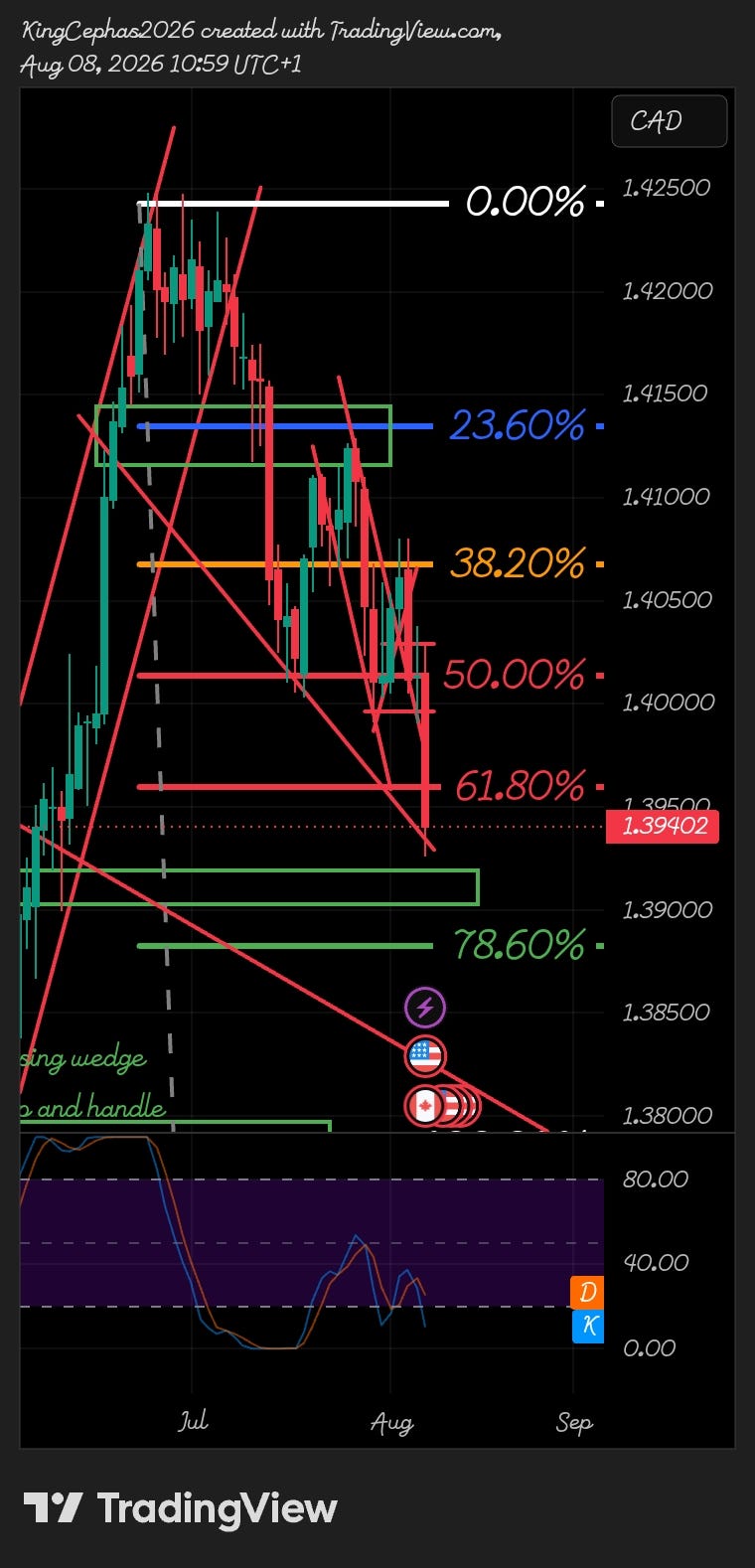
The latest chart shows USD/CAD around 1.3940.
The pair has broken below the 61.8% Fibonacci region around 1.3955, following rejection from the higher resistance zones.
The major Fibonacci structure remains:
23.6% — ~1.4140
38.2% — ~1.4067
50.0% — ~1.4015
61.8% — ~1.3955
78.6% — ~1.3885
The technical picture is therefore increasingly bearish.
Immediate structure
The old 50% region around 1.4015 is now an important recovery test.
If price rallies back toward 1.4015 and fails, the bearish structure remains intact.
A recovery through 1.4067 would be much more significant.
And a sustained break above the 1.4120–1.4145 supply zone would substantially weaken the bearish thesis.
Downside
Below 1.3955:
1.3900
becomes the first major psychological/structural target.
Then:
1.3885
the 78.6% Fibonacci area.
🟡 6. GOLD: THE MACRO PICTURE IS IMPROVING
Gold is currently receiving support from the most important macro variable in our framework:
Real and nominal yield expectations.
The July jobs report caused Treasury yields to fall and Gold to rise sharply during Friday's session. Market commentary also noted that the weaker labour data reduced pressure for a near-term Fed hike.
But Gold has an important complication.
Geopolitical risk can produce two opposite reactions.
Normally:
Geopolitical risk ↑ → Gold ↑
But if geopolitical risk causes:
Oil ↑ → inflation ↑ → yields ↑ → Fed hawkishness ↑
then Gold can actually fall despite the geopolitical risk.
We saw this dynamic earlier in July when renewed Middle East fighting pushed oil, the dollar and Treasury yields higher, weighing on Gold.
That is why simply saying:
"War = buy Gold"
is an incomplete trading model.
Our Gold framework instead asks:
What did the geopolitical event do to oil, yields, the dollar and real rates?
That's the higher-quality question.
🟡 GOLD PROBABILITY SCORE™
Based on the current macro configuration, my Gold Probability Score™ is moderately bullish, rather than aggressively bullish.
Supporting Gold
✅ U.S. employment deterioration ✅ Lower September hike expectations ✅ Treasury yields falling after NFP ✅ Softer USD reaction ✅ Potential for softer inflation expectations
Limiting factors
⚠️ Inflation remains above the Fed's target ⚠️ Energy prices remain vulnerable to geopolitical shocks ⚠️ The Fed has not formally pivoted dovish ⚠️ CPI/PPI have not yet confirmed the disinflationary direction
Current assessment:
Gold Probability Score™: 68/100 — Bullish
The score rises substantially if next week's CPI and PPI confirm softer inflation.
It falls if inflation reaccelerates and Treasury yields regain momentum.
🇨🇦 USD/CAD MACRO SCORE™
The USD/CAD fundamental picture is currently more decisive.
CAD-positive factors
🇨🇦 Strong Canadian employment 🇺🇸 Weak U.S. employment 📉 Lower U.S. rate-hike expectations 📉 Lower Treasury yields 🛢️ Potential oil support
USD-positive risks
🔥 Inflation surprise 🔥 Oil-driven inflation 🔥 Renewed Middle East escalation 📈 Treasury yield rebound 📈 Fed repricing
Current assessment:
USD/CAD Macro Score™: 72/100 bearish
That does not mean "short at market."
It means the fundamental probability currently favours CAD over USD, while the technical structure provides the trade location.
📊 THE CROSS-ASSET MAP
This is the relationship I am watching next week:
U.S. CPI/PPI ↓
↓
Fed hike probability ↓
↓
Treasury yields ↓
↓
DXY ↓
↓
Gold ↑
USD/CAD ↓
But if:
CPI/PPI ↑
↓
Fed hike probability ↑
↓
Treasury yields ↑
↓
DXY ↑
↓
Gold ↓
USD/CAD ↑
And then there is the wildcard:
🛢️ OIL
Oil can disrupt the entire chain.
🔭 NEXT WEEK'S TRADING PLAN
I don't want to predict the number before the data arrives.
I want to trade the reaction.
USD/CAD
Bearish preference: A recovery into 1.4015–1.4067 followed by rejection.
Bearish continuation: Clean acceptance below 1.3955, opening the path toward 1.3900–1.3885.
Bullish invalidation: Sustained recovery above 1.4067, with a larger structural warning above 1.4120–1.4145.
Gold
I want to see:
Lower yields + weaker DXY + soft inflation
before upgrading the Gold bullish probability materially.
A hot CPI/PPI combination accompanied by rising yields would be a warning that the current Gold bullish narrative is premature.
🧠 THE BIG LESSON FROM THIS WEEK
The market has changed its question.
Before the employment report, the debate was increasingly:
"When will the Fed hike again?"
After the employment report, the question is becoming:
"Does the Fed still need to hike?"
But next week's inflation data will decide whether that question survives.
That's why I am not treating Friday's market reaction as the final signal.
NFP changed the probability.
CPI and PPI will validate or reject it.
And that is exactly how I want to approach both Gold and USD/CAD:
Macro establishes the probability. Treasury yields and DXY provide confirmation. Oil provides the Canadian/geopolitical transmission mechanism. Technical structure provides the entry.
That keeps the analysis from becoming a headline-driven trade.
Next week's key events
Tuesday: ADP employment Wednesday: U.S. CPI Thursday: U.S. PPI Canada: No major Tier-1 catalyst; wholesale and manufacturing data are the main scheduled Canadian releases.
The market has already made its first move.
Next week, we find out whether it was right.
This article is for market analysis and education, not financial advice.
메타데이터
- post_id
- a55abb7e2f58
- slug
- usd-cad-gold-the-market-is-repricing-the-fed-but-inflation-has-the-final-word-a55abb7e2f58
- url
- https://medium.com/@peterduitinfo/usd-cad-gold-the-market-is-repricing-the-fed-but-inflation-has-the-final-word-a55abb7e2f58
- canonical_url
- https://medium.com/@peterduitinfo/usd-cad-gold-the-market-is-repricing-the-fed-but-inflation-has-the-final-word-a55abb7e2f58
- author_url
- https://medium.com/@peterduitinfo
- status
- ok
- fetched_at
- 2026-08-09 13:04:28



