Men’s Sport Coats 101: The Versatile Wardrobe Piece You’re Underusing
There’s a jacket hanging in a lot of men’s wardrobes that gets worn twice a year at best.
Men’s Sport Coats 101: The Versatile Wardrobe Piece You’re Underusing
There’s a jacket hanging in a lot of men’s wardrobes that gets worn twice a year at best.
It fits reasonably well. It looks good when they do wear it. But most of the time it stays on the hanger because they’re not quite sure when it’s appropriate, what to wear it with, or whether it crosses some invisible line between too dressed up and not dressed up enough.
That jacket is usually a mens sport coat and the reason it doesn’t get worn enough has nothing to do with the jacket itself.
The sport coat is genuinely one of the most flexible pieces in men’s dressing. It handles the space between casual and formal better than almost anything else in a wardrobe. It works on weekends, in professional settings, at social events, and at occasions where a suit would feel like overkill but a plain shirt would feel underdone.
The problem is that most men were never taught how to use it.
This guide fixes that. You’ll learn what separates a sport coat from a blazer, which fabrics and fits to look for, how to wear one across different occasions, and what specific styling choices make the difference between looking sharp and looking confused.
Sport Coat vs. Blazer vs. Suit Jacket: Understanding What You’re Working With
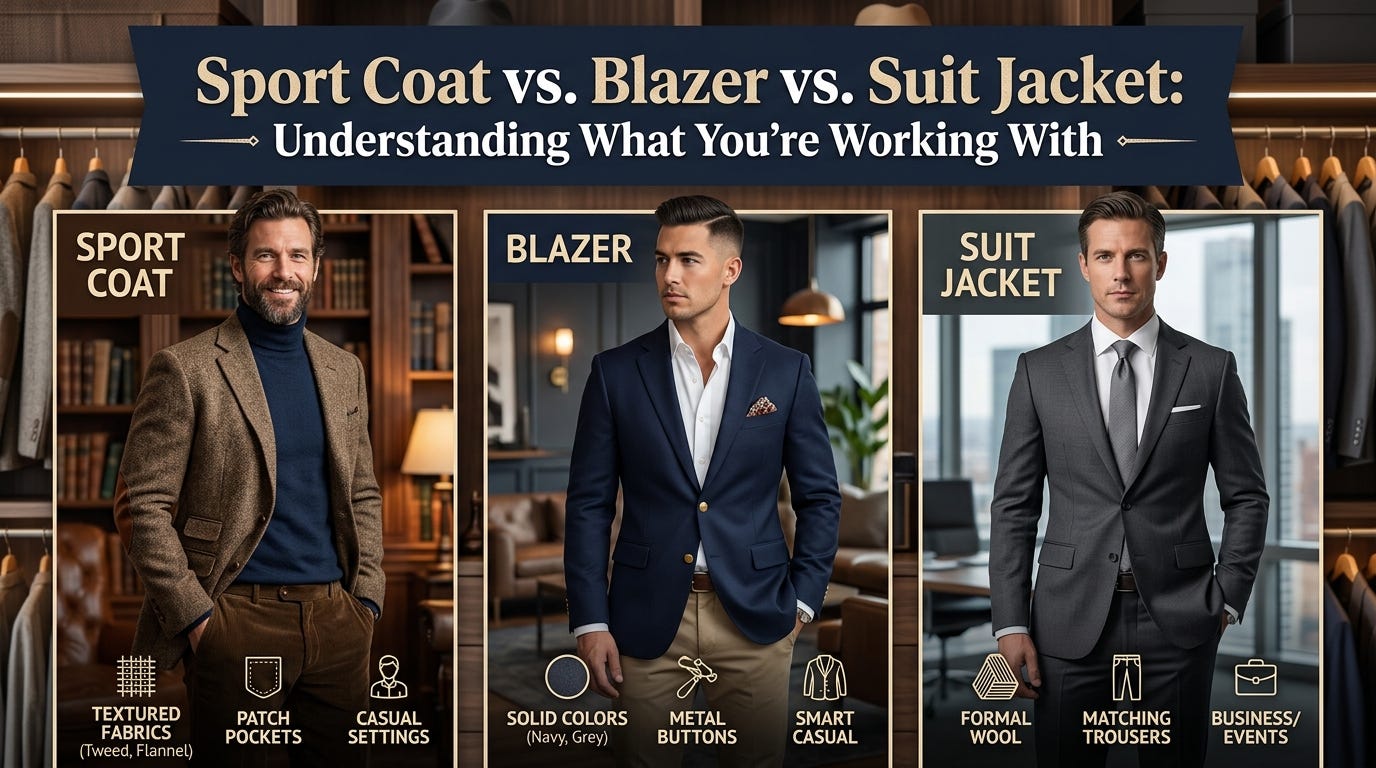
These three terms get used interchangeably in casual conversation. They mean different things, and the distinction matters when you’re buying or styling any of them.
A suit jacket is the top half of a matched two-piece or three-piece suit. The jacket and trousers are cut from the same cloth in the same batch, meaning the color and texture are guaranteed to match. A suit jacket worn without its matching trousers looks noticeably unbalanced the color fades differently over time, and the mismatch becomes visible.
A blazer is typically a solid-colored jacket most often navy, black, or grey designed to be worn as a separate piece rather than as part of a matched suit. Classic blazers often feature metal buttons, a heritage detail that connects them to their naval and sporting club origins.
A sport coat also called a sports jacket or mens sports jacket is a jacket built from patterned or textured fabric. Tweed, houndstooth, herringbone, plaid, windowpane check these patterns are woven into the fabric itself. The sport coat is designed to stand alone, and the pattern is a central part of its character.
In everyday conversation, people call all three of them blazers. That’s fine. But when you’re shopping specifically for a sport coat, you’re looking for fabric with visible pattern or texture not a plain solid-colored jacket.
That pattern is what gives the sport coat its personality, its versatility across casual settings, and its ability to anchor an outfit without requiring a tie, a dress shirt, or any formal accessories.
The History That Explains Why Sport Coats Work the Way They Do
Understanding where the sport coat came from helps clarify how it’s meant to be used today.
The jacket originated in nineteenth-century Britain as outerwear for hunting, shooting, and outdoor sporting activities. It needed to be durable enough for fieldwork, comfortable enough for extended wear, and practical enough to handle unpredictable weather.
Tweed was the fabric of choice heavyweight, tightly woven, and resistant to both wind and moisture. The looser cut allowed full range of movement. The pockets were deep and functional, not decorative.
What emerged was a jacket that was intentionally relaxed, intentionally rugged, and intentionally designed for active outdoor life rather than formal occasions.
That heritage explains something important about how the modern sport coat works: it carries a built-in permission for casualness that a blazer or suit jacket doesn’t. A sport coat in tweed or herringbone doesn’t need a tie to look intentional. It doesn’t need formal trousers to look put together. The fabric itself communicates considered, relaxed dressing.
Knowing that changes how you wear one.

Fabric Guide: What Each Material Actually Means for How You Use the Jacket
Fabric determines the sport coat’s weight, character, occasion appropriateness, and how long it lasts. It’s worth spending real time on this before buying.
Tweed: The Original and Still the Best for Casual Authority
The tweed sport coat is the jacket this category was built around. Woven from rough-spun wool, tweed is heavy, textured, and visually rich. The weave typically creates a salt-and-pepper effect with subtle color variation that reads differently in different lighting.
A tweed sport coat works for autumn and winter settings country weekends, outdoor events, casual professional environments, and social occasions where the goal is to look deliberately, comfortably well-dressed without appearing formal.
What it doesn’t suit: warm weather, formal settings, and occasions where a lighter visual weight is appropriate. Tweed is a winter fabric. Wearing it in July creates immediate visual dissonance regardless of how well it fits.
Herringbone: Structured Pattern, Flexible Occasion Range
Herringbone weaves a V-shaped pattern into the fabric through alternating diagonal lines. The effect is subtle at a distance and clearly visible up close which makes it one of the most sophisticated-looking patterns available without being visually loud.
Herringbone sport coats work across more seasons than tweed, particularly in lighter wool weights. They suit professional settings, smart-casual social occasions, and weddings where a full suit isn’t required.
Houndstooth: Bold but Manageable
The houndstooth check its distinctive broken tooth pattern is a more assertive choice than herringbone. It draws attention in a way subtler patterns don’t, which is either an advantage or a complication depending on how you want to use the jacket.
Smaller-scale houndstooth reads as refined and professional. Larger-scale patterns become a genuine statement piece. Choose scale according to how much visual work you want the jacket to do.
Plaid and Windowpane: The Personality Options
Plaid and windowpane check sport coats are for men who want the jacket to be the clear focal point of the outfit. These patterns are bold, immediately visible, and require clean, simple pieces around them to avoid visual overload.
They work in casual social settings, creative professional environments, and occasions where expressive dressing is welcomed rather than discouraged.
Linen and Cotton Blends: Warm Weather Solutions
Lightweight linen or cotton sport coats fill the seasonal gap that heavier fabrics leave. They breathe well, work in spring and summer settings, and bring the sport coat’s relaxed character into warm-weather occasions.
The trade-off is structure lighter fabrics don’t hold their shape through a long day the way wool does. Wrinkles are part of the linen experience, and most settings that suit a linen sport coat are relaxed enough that wrinkles don’t matter.
Fit: The One Factor That Makes or Breaks Any Sport Coat
A sport coat’s casual heritage gives it some tolerance for relaxed fit but not unlimited tolerance.
The shoulder seam remains non-negotiable. It must sit exactly at the edge of your shoulder. Even half an inch of overhang makes any jacket look borrowed. The shoulder is also the one measurement that cannot be corrected through tailoring everything about the jacket’s structure flows from that single point.
Beyond the shoulder:
Chest The jacket should button without pulling across the chest. You should be able to slide a flat hand into the chest with slight resistance, not looseness.
Length A sport coat’s hem should cover the seat of your trousers. The classic guideline is that the jacket hem should align roughly with your knuckles when your arms hang naturally.
Sleeve length About half an inch of your shirt cuff should be visible below the jacket sleeve. Too much jacket sleeve reads as a poor fit; no shirt cuff visible means the sleeves are too long.
Body Sport coats traditionally allow more room through the body than suit jackets. A slight relaxed feel is appropriate and part of the jacket’s character. Full boxiness is not.
When shopping mens sport coats online, always compare your chest, shoulder, and torso measurements against the specific brand’s size chart before ordering. Sizing varies between manufacturers, and a size 40 Regular from one brand may fit very differently from another.

How to Wear a Sport Coat for Different Occasions
The sport coat’s real value is its range. Here’s how to use it across the settings where it genuinely works.
The Professional Setting (Business Casual)
A herringbone or solid-texture sport coat over dress trousers and a dress shirt handles most business casual environments cleanly. Add a tie if the environment calls for it; leave it out if the culture skews relaxed.
The mens blazer jacket distinction matters here: if your workplace is on the formal end of business casual, a cleaner solid blazer may read as more appropriate than a strongly patterned sport coat. Use your environment as the guide.
The Smart Casual Weekend
This is where sport coats do their best work.
A tweed or herringbone sport coat over dark slim-fit jeans and a plain crew-neck sweater is a complete, considered outfit that requires minimal thought. Add leather loafers or clean leather boots and you’re dressed for most weekend occasions brunch, shopping, a casual dinner, visiting friends.
The sport coat does the heavy lifting. The pieces around it are plain and unpatterned, which lets the jacket’s texture or pattern carry the outfit’s visual interest.
The Casual Social Event
Garden parties, informal weddings, outdoor gatherings, and relaxed evening events all suit a sport coat. Pair with chinos or dress trousers depending on the dress code, a simple Oxford shirt or linen shirt, and either loafers or suede boots.
A polo ralph lauren blazer or similar heritage-brand sport coat in classic patterns works particularly well in these settings because the construction quality reads as effortless rather than trying too hard.
The Creative or Smart Workplace
Bold houndstooth, larger plaid patterns, and windowpane check sport coats work well in creative industries, media, and design environments where expressive professional dressing is normal and expected.
Keep the shirt and trousers plain. One patterned piece at a time is almost always the right call.
Building Outfits Around a Sport Coat: What Actually Works
The core principle of sport coat styling is contrast the jacket needs pieces around it that are clearly plainer and less textured than the jacket itself.
Combination 1 The Classic Weekend Tweed sport coat + white OCBD shirt + dark slim jeans + brown leather boots
Combination 2 Smart Casual Professional Herringbone sport coat + pale blue dress shirt + charcoal dress trousers + leather loafers
Combination 3 Relaxed Evening Windowpane check sport coat + black crew-neck tee + dark trousers + Chelsea boots
Combination 4 Warm Weather Event Linen sport coat in olive or tan + white linen shirt + cream chinos + suede loafers
Combination 5 Layered Winter Look Tweed sport coat + fine-gauge turtleneck sweater + dark wool trousers + leather brogues
In each case, the sport coat provides the visual interest and the surrounding pieces provide the foundation. When the shirt, trousers, and footwear are clean and uncompetitive, the jacket works.
Common Sport Coat Mistakes and How to Avoid Them
Pairing a patterned sport coat with a patterned shirt. Two patterns at once require significant experience to pull off. When starting out, always pair a patterned sport coat with a solid shirt.
Treating it like a suit jacket. A sport coat worn with matching trousers in an attempt to create a suit looks like exactly what it is someone trying to create a suit from separates. Contrast between jacket and trousers is not optional.
Wearing it in the wrong season. A heavy tweed sport coat in August, or a lightweight linen jacket in January, creates immediate visual disconnection from the environment regardless of how well the jacket fits.
Ignoring the pocket square as an option. A simple white or linen pocket square in the chest pocket adds finishing detail to a sport coat without over-formalizing it. Worth considering for social events.
Buying a sport coat without trying the shoulder fit. Everything about the jacket depends on that seam sitting correctly. If you’re buying online, measure your shoulders precisely and compare against the size chart before ordering.

FAQ: Men’s Sport Coats Answered Directly
Q: What is the difference between a sport coat and a blazer? A sport coat features patterned or textured fabric tweed, herringbone, houndstooth and is designed as a casual separate. A blazer is typically solid-colored with cleaner, more formal construction. Both are worn without matching trousers.
Q: Can I wear a sport coat to a business meeting? Yes, in business casual environments. A herringbone or subtle-pattern sport coat over dress trousers and a dress shirt is appropriate and looks considered. For formal business settings, a suit or solid blazer is more appropriate.
Q: What trousers work best with a sport coat? Dark jeans, chinos, or dress trousers in plain colors charcoal, navy, olive, tan, or black. Avoid trousers with patterns or textures that compete with the jacket.
Q: Is a tweed sport coat too old-fashioned for 2026? No. Tweed sport coats in modern slim or tailored cuts look sharp and current. The fabric’s heritage gives it a quality that synthetic alternatives don’t replicate. The cut is what determines whether it reads as current.
Q: How should a sport coat fit across the shoulders? The shoulder seam should sit exactly at the edge of your shoulder no overhang, no pulling inward. This is the one measurement that cannot be corrected through tailoring.
Q: Can I wear a sport coat without a shirt and tie? Absolutely. A sport coat over a plain tee, a crew-neck sweater, or an open-collar shirt is a completely appropriate and common approach in casual and smart-casual settings.
Q: What’s the most versatile sport coat fabric to own first? Herringbone wool in a mid-weight. It works across three seasons, suits both professional and casual settings, and the subtle pattern complements a wide range of trouser and shirt combinations.
Q: How do I care for a wool sport coat? Hang it after wear to let the fabric recover its shape. Brush with a soft clothes brush to remove surface debris and prevent pilling. Dry clean only when genuinely necessary frequent dry cleaning shortens the life of wool fabric.
Conclusion
Mens sport coats don’t get the attention they deserve and that’s mostly because men underestimate how much work they can do.
The jacket handles professional and casual settings equally well. It works across seasons when you choose the right fabric. It requires less coordination effort than a suit and produces better results than a plain shirt or sweater when the occasion calls for something more considered.
Start with a herringbone or tweed sport coat in a neutral color grey, tan, or earthy brown. Get the shoulder fit right. Keep the pieces around it clean and simple. Build from there once you understand how the jacket works in your specific wardrobe and life.
Whether you’re looking for a tweed sport coat for the colder months, a lightweight mens sports jacket for spring events, or a textured sports jacket that handles everything from the office to the weekend, the right option is worth finding and wearing regularly.
For a curated selection of sport coats and men’s outerwear built around quality fabric and modern fit, visit Mensusa.
메타데이터
- post_id
- a569f04b447d
- slug
- mens-sport-coats-101-the-versatile-wardrobe-piece-you-re-underusing-a569f04b447d
- url
- https://medium.com/@albertonardoni8/mens-sport-coats-101-the-versatile-wardrobe-piece-you-re-underusing-a569f04b447d
- canonical_url
- https://medium.com/@albertonardoni8/mens-sport-coats-101-the-versatile-wardrobe-piece-you-re-underusing-a569f04b447d
- author_url
- https://medium.com/@albertonardoni8
- status
- ok
- fetched_at
- 2026-07-09 15:12:33