The Oldest Subscription On Earth Is Sitting At Your Dinner Table (And You Can Never Cancel It)
Before apps learned recurring revenue, tyrants learned to tax the edible choke point
The Oldest Subscription On Earth Is Sitting At Your Dinner Table (And You Can Never Cancel It)
Before apps learned recurring revenue, tyrants learned to tax the edible choke point

The Oldest Subscription On Earth Is Sitting At Your Dinner Table (by author)
Somewhere in ancient China, long before modern governments, patriotic posters, and officials, someone looked at salt and understood how power really works.
Tax a person directly and the person can see the hand reaching into the pocket. Tax land and the landowners start sharpening their little legal knives. But a grain of salt is small enough to ignore, cheap enough to mock, and necessary enough to become a trap. This is why the history of salt reads less like a cute origin story of trade than the first draft of tyranny with better seasoning.
A state with a salt policy can make “a hundred times the profit” because power works best at the edible choke point where choice runs out.
People can delay buying cloth. They can repair a tool, stretch a harvest, water down wine, curse the tax collector, bribe the clerk, hide a coin, move a goat, marry badly, flee town, become a monk, or make a very long speech about liberty in a tavern. They still have to eat. Before refrigeration, they also had to preserve what they ate. Before modern transport, they had to move food without watching it rot into a stinking mess.
Salt did that. It kept meat from turning, fish from liquefying, cheese from becoming a science experiment, armies from starving, cities from depending entirely on the mood of the next harvest.
Because whoever controls the spice controls the universe.
[embed]
China found the cheat code before Machiavelli found a desk
The beauty of salt is that it looks fair while landing cruelly. A rich family and a poor family both need salt. A large household buys more. A child counts. A grandmother counts. A soldier counts. A mule dragging imperial grain probably counts in spirit, if some clerk can find a way to invoice the animal.
The Guanzi, attributed to the world of Guan Zhong, framed the choice with the cold elegance of someone inventing tax policy in a bad mood. The Chinese state didn’t merely tax salt. It controlled production, distribution, prices, merchants, and labor. The state could decide who made salt, where it moved, how much it cost, and who could sell it.
By the third century CE, the salt monopoly could account for almost 90 percent of state revenue in some Chinese regimes. A government budget where almost every public coin, the soldier’s rice, the official’s salary, the canal repair, and the frontier post comes back to a white mineral everyone needs in a bowl.
That’s a government with a salt addiction, forever fighting about who should control it (the government or private merchants), how to fund wars, why regular people keep getting stuck with higher prices, and why “public safety” so often turns into “do what you’re told.”
A late imperial illustration of salt production methods (Source: Salt mafias and rebellion in medieval China)
The surprising part isn’t that the debate happened more than two thousand years ago. The surprising part is how current it sounds if you change the nouns.
Replace salt with energy. Replace iron with chips. Replace frontier defense with national security. Replace the imperial court with a televised hearing where everyone pretends the lobbyists didn’t write half the sentences.
It all still comes down to this: how much should the government be allowed to control the basic stuff everyone needs to live?
China kept answering with salt. Dynasties rose, fell, changed robes, changed capitals, enemies, slogans, and the monopoly survived like a cockroach with a tax code. Even in the twenty-first century, China still had a state-dominated table-salt system. In 2016, the government announced it was “ending” a 2,000-year-old state grip on salt prices but the biggest player was still the state itself, so it is basically the same monopoly with a new label.
Two thousand years is a long time for a seasoning policy. It lasted because the lesson worked: power doesn’t need to control everything; it needs to control what everyone passes at a dinner table.
Aquaculture and Salt Production near Bo Hai, China (Source: NASA)
The goose starts hissing, a living wall of thorns and a handful from the beach
The *gabelle*, France’s salt tax, added the part every bureaucracy eventually contributes to a human need: humiliation.
The tax varied wildly by region, which meant one village might live under one salt reality and the next under another. In some areas, people over eight years old had to buy a fixed annual quantity. Seven kilograms of salt is roughly a bowling ball made of white grains and a monarchy was telling a child that this bowling ball was compulsory because the crown had expenses. And you couldn’t legally use that required salt for every purpose either.
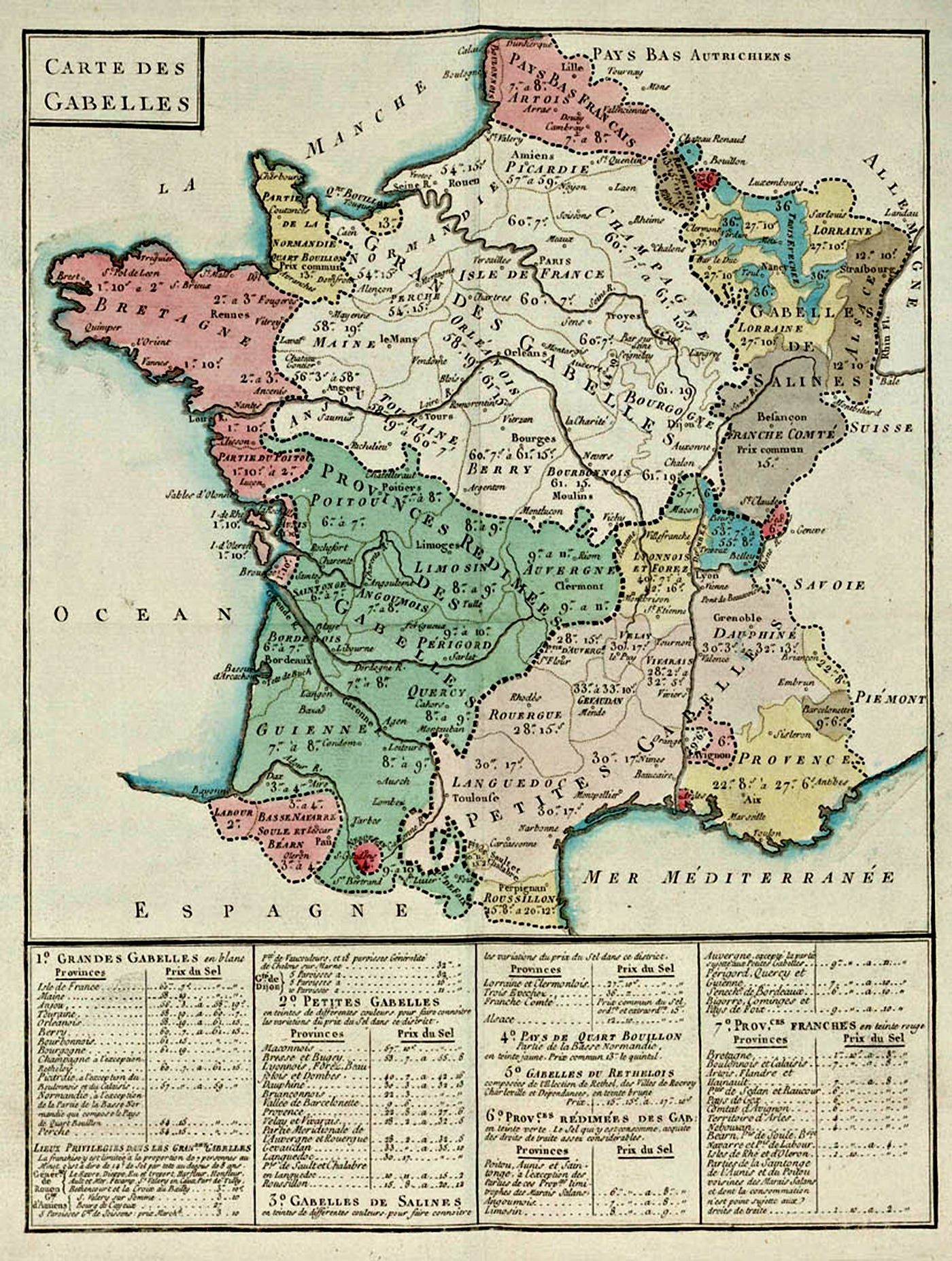
Source: Map of the gabelle — Taxation France 1781
A recent economic-history paper on extractive taxation explains why the salt tax was more than just annoying. By 1789, the gabelle and other “everyday” taxes made the French state feel intensely personal — not some distant palace problem, but something you ran into in the market, in the kitchen, and in the price of ordinary life.
Jean-Baptiste Colbert, Louis XIV’s finance minister, supposedly said taxation should be like plucking a goose: get the feathers without making it squawk. The gabelle did the opposite. It made people squawk loud. It pushed them into smuggling, recruiting cousins with carts, slipping across provincial borders at night and, eventually, forming some very strong opinions about the monarchy.
The French Revolution had larger causes than salt. Debt, grain, privilege, war, bad harvests, aristocratic exemptions, Enlightenment ideas, the usual combustible furniture of a collapsing order. But salt made inequality edible and turned the state into a bad taste in the mouth.
Salt had revealed the rule: when power finds a body-level tax, it keeps coming back to the wound.
Russia found the same lever in 1648 and pulled it hard enough to burn Moscow. The state had tried to raise money by replacing other taxes with a universal tax on salt. salted fish mattered to ordinary diets, especially for people with no comfortable cushion between work and hunger. The new tax pushed up the price of salted fish, grievances piled onto corruption, and Muscovites brought the complaint into the street.
Then British colonialism took the salt tax to India and gave it the most British possible upgrade: a hedge. Not a metaphor — an actual, living hedge.
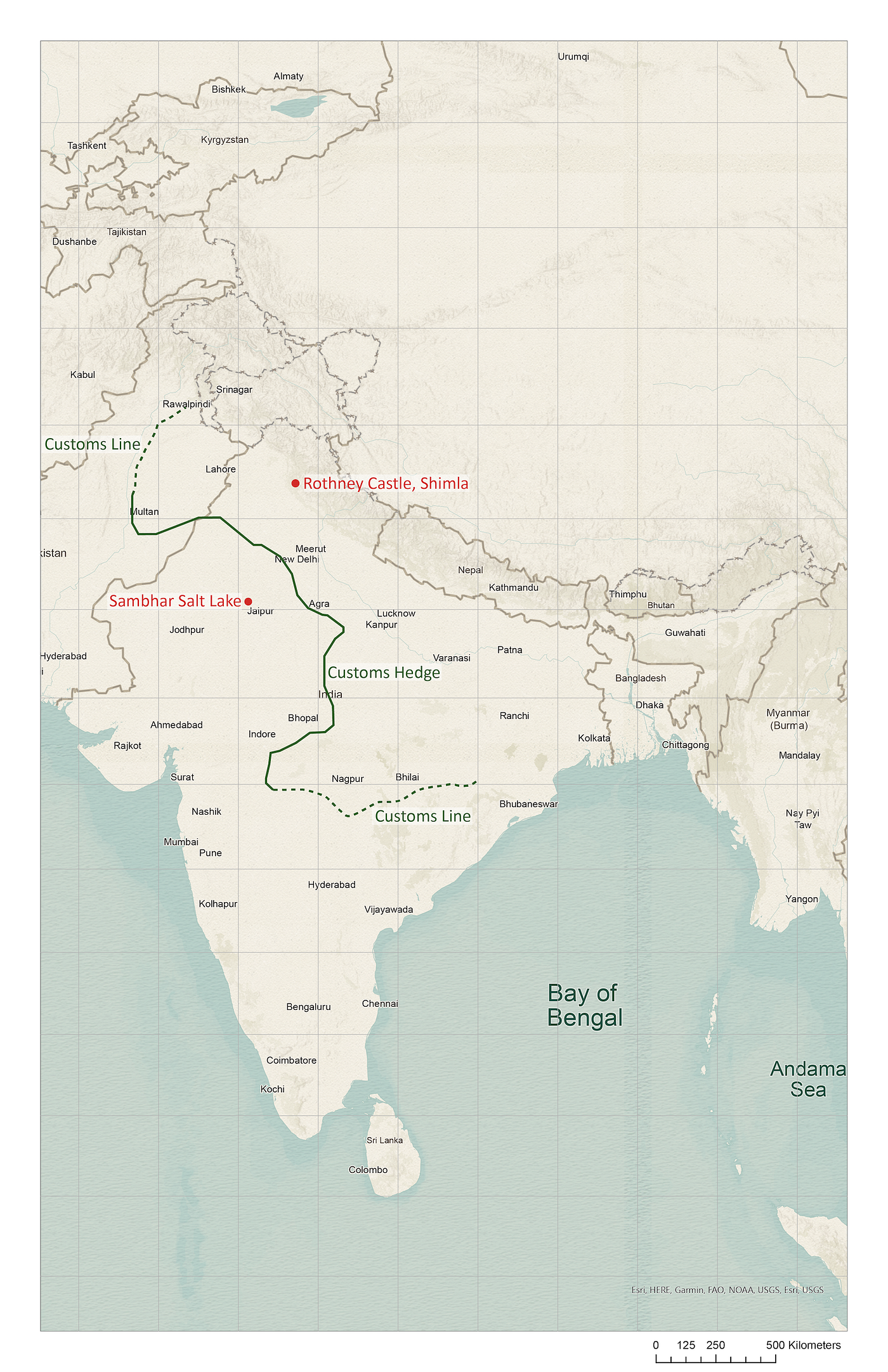
Map showing the Inland Customs Line, adapted from Roy Moxham’s book The Great Hedge of India, along with the rough locations of Sambhar Salt Lake and Rothney Castle (Source: The Empire’s Salt Tax: Uncovering the Forgotten Hedge of India)
The British built a long, thorny barrier (prickly pear, acacia, Indian plum, anything sharp and miserable enough) and used it like a border checkpoint for salt. It was called the Inland Customs Line, and it ran for thousands of kilometres across India to enforce the salt tax and catch smugglers. At its peak it took thousands of workers and more than a thousand customs posts to run. The Great Hedge sounds ridiculous but empires often do their cruelty through paperwork, budgets, and logistics — and sometimes that logistics looks like a wall of thorns.
Britain had managed to turn salt into a border and made ordinary people pay for a substance many could have gathered along the coast. The empire didn’t merely want land, labor, cotton, opium, revenue, ports, soldiers, obedience, and applause. It wanted the salt in the pot.
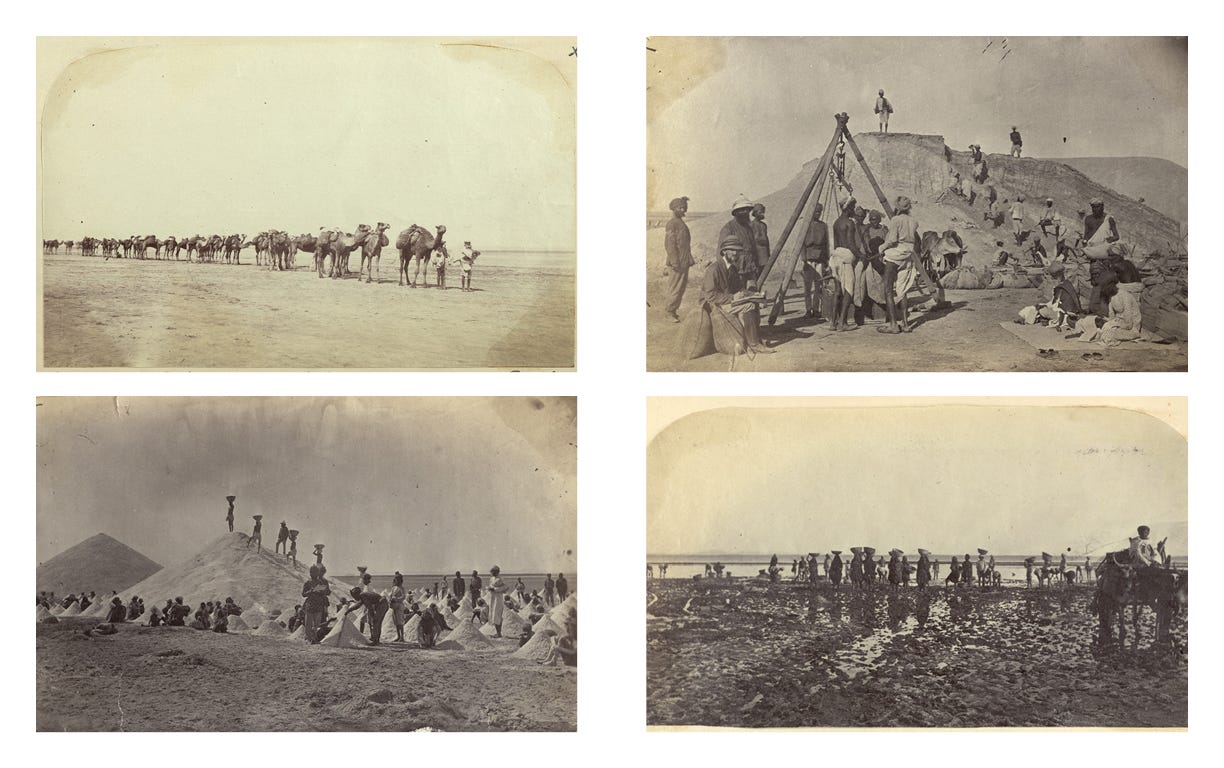
Captions clockwise from top-left: A Katar or String of Camels Taking Away the Salt; Filling Salt into Bags and Weighing the Salt; Extraction of Salt from Bed of Lake; Measuring Labourer’s Work and Storing Salt. Photographs from Sambhar Lake, India, 1870s (Source: The Empire’s Salt Tax: Uncovering the Forgotten Hedge of India)
By 1930, Mahatma Gandhi had plenty of grand targets available where imperial abuse could no longer hide behind official language. Land taxes. Political rights. Textile imports. The whole ugly machinery of British colonial rule sat there like an overstocked buffet of injustice.
He chose salt.
“Even the salt he must use to live is so taxed,” Gandhi wrote to Viceroy Lord Irwin, arguing that the tax becomes almost obscene through its fairness: it falls on everyone, so it crushes those with the least room to bend. The salt law was small enough to fit in a hand and large enough to reveal the whole empire.
Then Gandhi walked.
Twenty‑four days. Two hundred and forty miles. Sandals. Sun. Cameras. Villages. A sixty‑year‑old man in a robe had reached the Arabian Sea, bent down, and lifted a pinch of salt the law said he wasn’t allowed to touch. And in that tiny, ordinary fistful, the British Empire suddenly looked petty, reduced to policing seawater.

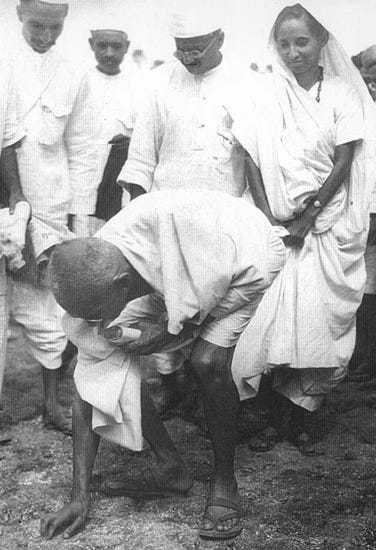
Source: Gandhi’s Salt March, The Tax Protest that changed Indian History
Gandhi was arrested. But Sarojini Naidu helped lead the next stage at the Dharasana Salt Works. Protesters advanced without striking back. Police beat them down in waves. Webb Miller’s contemporary report on the Dharasana raid carried the brutality abroad. The salt law had done what good resistance strategy does: pick the ordinary thing, expose the system behind it, force power to defend the indefensible in daylight.
A handful of salt didn’t free India alone. But empires depends on distance. It needs the violence to feel administrative, the extraction to feel technical, the obedience to feel boring. Gandhi made the abstraction small enough to fit between two fingers and gave millions of people a simple way to see the empire’s structure.
Once you see the leash, you start wondering why you’re wearing it.
To feed crops and load guns at the same time
The salt in a pot helped rulers tax hunger. The salt in a desert helped rulers tax fertility, explosives, borders, and the right to keep eating. Same trick, larger stage.
In the Atacama, the driest desert on Earth had preserved beds of nitrate salts known as caliche. And inside that crust sat one of the nineteenth century’s great imperial temptations: fertilizer and gunpowder in the same geological body. Yes, nitrate salt could help farmers pull more food from exhausted soil and also help armies pull bodies apart. And by the late nineteenth century, European agriculture wanted more nitrogen, and European militaries wanted more explosives.
[embed]
The nitrate fields of the Atacama answered both appetites.
UNESCO’s account of the saltpeter works at Humberstone and Santa Laura describes more than two hundred nitrate plants and company (ghost) towns spread across the desert, where Chilean, Peruvian, and Bolivian workers processed the mineral that fed farms and armed states.
Then governments did what governments do when a necessary mineral sits under a contested map: they found a legal reason to reach for it.
In 1878, Bolivia imposed a ten-cent tax per quintal on nitrate exports by a Chilean company operating around Antofagasta. A quintal was about 100 pounds, roughly the weight of a sack you’d regret agreeing to carry. Ten cents sounds ridiculous, almost adorable, until it sits on top of a mineral that feeds Europe, arms armies, attracts British capital, and makes governments smell revenue from across a desert.
Chile occupied Antofagasta in February 1879. Peru entered through its alliance with Bolivia. And the War of the Pacific began.
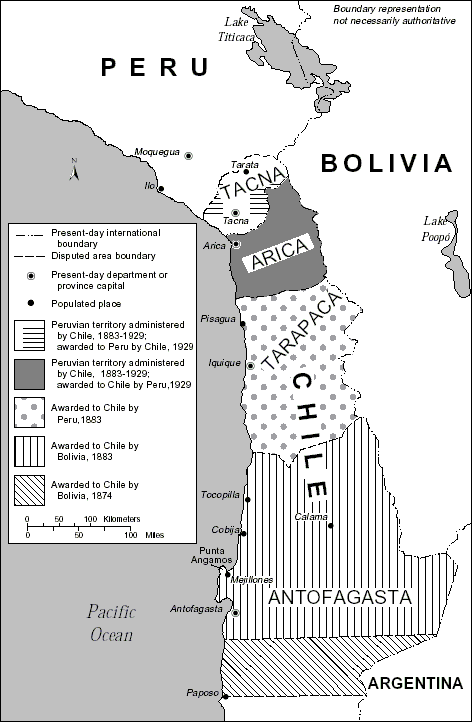
Map showing changes of territory due to the War of the Pacific (Source)
The war lasted until 1884, killed thousands, gave Chile control of nitrate-rich territory, and left Bolivia without a coastline. A study of the war’s fiscal aftermath describes the prize with brutal neatness: nitrate export taxes later supplied at least half of Chilean government revenue.
Half a state budget from desert salt.
That’s the China lesson again, stripped of porcelain and court ritual. Control the mineral, control the revenue. Control the revenue, build the state. Control the state, redraw the border. Somewhere underneath the theory, workers carry sacks through dust while men in capitals discover strategic necessity.
For a while, Chilean nitrates looked like a mineral crown. They fed European crops, armed European militaries, financed public works, pulled investors into one of the most hostile landscapes on Earth, and proved again that power loves any substance sitting between hunger and survival.
Then chemistry found a way to grab the sky.
The air around us is mostly nitrogen, which sounds like abundance until you learn plants can’t use it in that form. It’s everywhere and unavailable, nature’s version of locking bread behind glass. By the end of the nineteenth century, the world had a nitrogen problem. More people needed grain. Farms needed fertilizer. Natural nitrate deposits mattered so much that countries had fought over guano islands in Peru.
Untl Fritz Haber found the laboratory trick. Carl Bosch made it industrial. The Haber-Bosch process forced nitrogen from the air and hydrogen, later mostly from fossil fuels, through heat, pressure, and a catalyst until ammonia (maybe the major technological improvement of the twentieth century that helped make the modern food system possible) came out the other side. Food and guns walked through the same door.
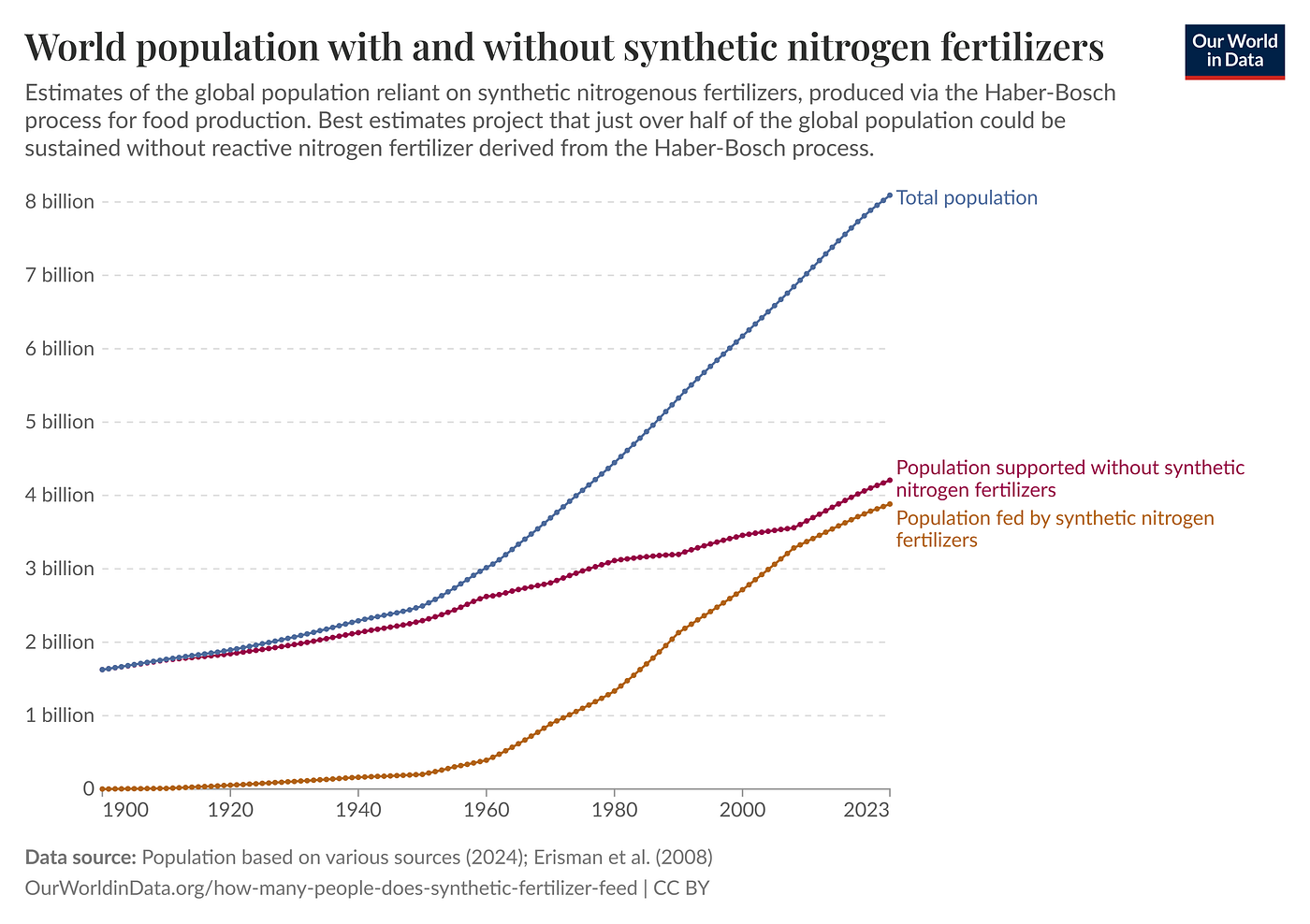
(Source: OurWorldInData)
Salt’s old power didn’t disappear when chemists replaced Chilean nitrates. It mutated. The gate moved from the desert deposit to the pressure vessel, the gas field, the fertilizer plant, the shipping route, the loan, the export ban, the war premium, the price spike. The mineral monopoly became an industrial dependency.
That’s why all of this belongs in the same story as China, France, and Gandhi. Salt keeps showing up wherever people don’t really have a choice: eating, keeping food from spoiling, growing crops, fighting wars, running a country, surviving.
And the tyrant’s playbook doesn’t particularly care which version of the “salt gate” it gets to control. It can be a tax on table salt, a law that says you can’t gather salt from the beach, a desert full of nitrate deposits, or a fertilizer plant that turns air into ammonia.
The logic is always the same: if people have to come back for it, whoever controls the supply gets leverage.
The crown was always in the shaker
Today, salt is too cheap to respect. And that may be the weirdest victory of industrial civilization. We made one of history’s most fought-over substances so available that it now feels like a smiling afterthought: soup, bread, frozen dinners, sauces, deli meat, fast food, crackers, noodles, cheese, the harmless little sandwich eaten beside the laptop while your read this.
The old salt monopolies worked by keeping salt scarce and expensive. The modern version does the opposite: it floods the world with salt then tucks it out of sight. It’s not just what you shake onto fries. It’s the ingredient that makes cheap food taste better, last longer on shelves, behave in factories, survive long shipping routes, and feel more obsessively satisfying.
And then the advice lands on the person eating lunch: use less salt.
Wonderful. The empire is hiding in the recipe, but the blame gets handed to whoever’s holding the shaker. The edible choke point keeps changing costume: the crown got smaller, and learned to fit inside the serving size.
Population Exceeding Recommended Sodium Limit in the US (Source: Sodium Reduction in the Food Supply)
WHO recommends adults stay under 2,000 milligrams of sodium a day, roughly less than five grams of salt, just under a teaspoon. The 2026 fact sheet on sodium reduction says global intake remains far higher. The world is over-seasoned by default, exactly where power likes to live.
That is the thread running through the whole story. Salt was never just a mineral. It was the first small thing rulers learned to make unavoidable.
China made it bureaucracy. France made it grievance. Britain made it colonialism with thorns. Gandhi made it rebellion. Chilean nitrate made it war and fertilizer. Haber-Bosch made it air turned edible. The supermarket made it a formulation choice and handed you the blame in milligrams.
Yet, on the table, it still looks harmless. A little white pile beside the pepper, pretending it hasn’t run half the world.
I help curious minds who need a relatable pen put their sharpest ideas into words: stories, perspectives, and insights that actually get read. Reach out!
***If you want to support my work, here is the place to do so.* If not, thanks for reading anyway!
메타데이터
- post_id
- a5705cc2cd52
- slug
- the-oldest-subscription-on-earth-is-sitting-at-your-dinner-table-and-you-can-never-cancel-it-a5705cc2cd52
- url
- https://medium.com/southern-winds/the-oldest-subscription-on-earth-is-sitting-at-your-dinner-table-and-you-can-never-cancel-it-a5705cc2cd52
- canonical_url
- https://medium.com/southern-winds/the-oldest-subscription-on-earth-is-sitting-at-your-dinner-table-and-you-can-never-cancel-it-a5705cc2cd52
- author_url
- https://medium.com/@rickylanusse
- status
- ok
- fetched_at
- 2026-07-11 12:05:32