The Hidden Cost of Cognitive Packet Loss
Why inconsistency is often a cognition problem before it becomes a branding problem
The Hidden Cost of Cognitive Packet Loss
Why inconsistency is often a cognition problem before it becomes a branding problem
By Chris Polczer — Founder, FreedomWayGlobal
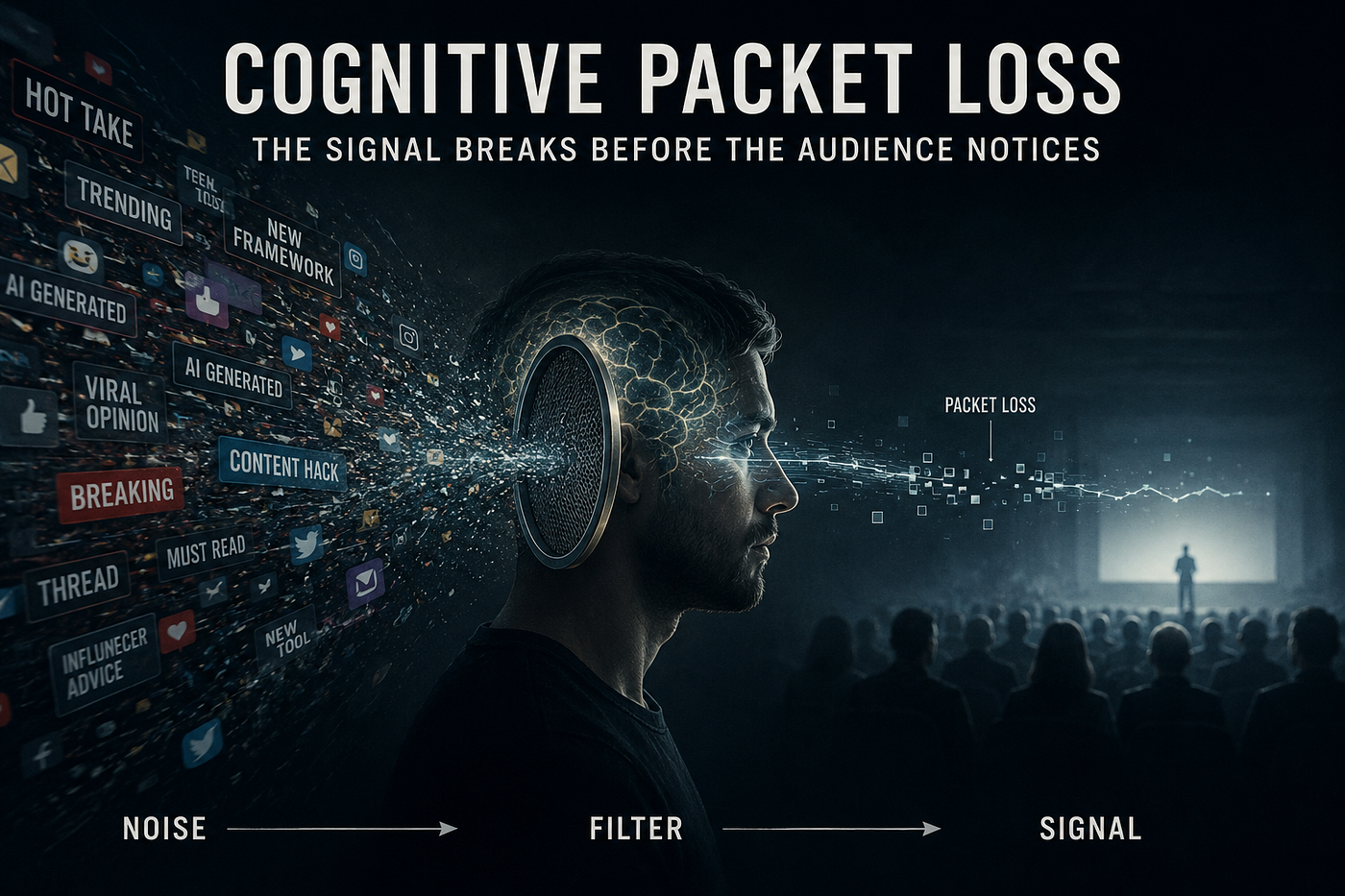
Cognitive Packet Loss — when the filter breaks, the signal fragments before it reaches the audience.
Most people think inconsistency is a branding problem.
They adjust the color palette. Rewrite the bio. Reposition the niche. Change the posting frequency.
And the inconsistency continues.
Because the branding didn’t break first.
The thinking did.
The signal collapses internally before the audience notices
There is a specific failure pattern that repeats across creators, founders, and knowledge workers in 2026.
It does not look like failure at first. It looks like curiosity. Open-mindedness. Staying current.
A new framework arrives and it seems worth integrating. A strong voice makes a compelling argument and it shifts the framing. An algorithm rewards a different angle and the content adjusts. An AI tool generates a direction that feels fresh and the creator follows it.
Each input is reasonable. Each adjustment makes sense in isolation.
But the cumulative effect is fragmentation.
The internal thinking system — the stable lens through which reality gets interpreted — absorbs so many external signals that it loses coherence. The output becomes inconsistent not because the person lacks discipline, but because the system underneath has been quietly destabilized by continuous interruption.
This is cognitive packet loss.
What packet loss means in a thinking system
In network architecture, packet loss describes what happens when data fragments fail to reach their destination intact. The connection does not drop completely. It degrades. The signal arrives corrupted, incomplete, or out of sequence.
The same dynamic happens in human thinking systems under sustained input overload.
The person does not stop thinking. They keep producing. But the internal compression the process of taking in raw experience and converting it into coherent meaning becomes unreliable.
The signs are recognizable.
Every significant new input feels like it changes everything.
Direction shifts frequently without clear structural reason.
The voice that was distinct six months ago now sounds like a synthesis of whatever was consumed most recently.
Repositioning happens not because the market changed, but because the internal signal lost stability.
This is not a content strategy problem.
It is a cognition infrastructure problem.
And in the current environment, it is accelerating.
The modern input problem
The volume of high-quality, high-velocity input available in 2026 is unlike anything that existed a decade ago.
Newsletters from exceptional thinkers. Podcasts from category-defining operators. AI tools that generate frameworks on demand. Social feeds that surface the strongest takes from the most compelling voices continuously, algorithmically, without pause.
None of this is noise in the traditional sense. Most of it is genuinely valuable.
But the aggregate effect on a thinking system that has no stable internal structure is the same as noise: fragmentation.
The problem is no longer lack of information.
The problem is that the cognitive infrastructure required to receive, filter, and integrate that information without losing signal integrity is not being built at the same pace that input velocity is increasing.
People are consuming faster than they are integrating.
And integration the slow, structural process of making new information genuinely yours is what builds a stable thinking lens.
Without it, input becomes interference.
The lens becomes the signal
Here is what actually makes certain voices recognizable over time.
It is not the topics they cover.
Naval Ravikant, Nassim Taleb, Dan Koe — the subjects they address shift, expand, and evolve. What stays consistent is something underneath the topics.
It is the way reality gets compressed into meaning.
The interpretive lens. The stable set of principles and frameworks through which all incoming information gets processed before it becomes output. The intellectual signature that makes a piece of writing immediately recognizable even without a byline.
Over time, people do not recognize creators by wording alone.
They recognize the consistent way reality gets compressed into meaning.
This is why copying another creator’s style eventually fails even when the execution is technically skilled.
Style is the surface expression of a thinking system.
Without the underlying system, the style is a costume.
It does not hold under pressure, under new topics, or over time.
The lens is the signal.
And a fragmented lens produces fragmented signal regardless of how much content gets produced.
AI makes this harder before it makes it easier
This point requires precision because the easy version of it is wrong.
AI is not the problem.
AI is an amplifier.
And amplifiers do not determine the quality of what gets amplified they increase the magnitude of whatever is already present.
A creator with a stable internal lens uses AI to move faster within a defined direction. The thinking system remains intact. The output velocity increases. The signal gets stronger.
A creator without a stable internal lens uses AI and experiences acceleration in a different direction:
more ideas, more possible angles, more generated frameworks, more content that could be published and less clarity about which of it is actually theirs.
AI can amplify thinking.
It can also amplify fragmentation if no stable internal lens exists underneath.
The specific risk in 2026 is not that AI replaces human thinking.
It is that AI makes it easier to outsource the compression process the slow, effortful work of converting experience into genuine perspective and never notice that it happened.
The output continues.
The signal degrades.
Sovereign signal
There is a term worth naming directly for what the alternative looks like.
Sovereign signal is a stable internal interpretive system that does not collapse under new input, does not lose identity under trend pressure, and remains coherent even when external noise reaches saturation.
It is not rigidity.
A sovereign signal system absorbs new information and genuinely integrates it which is different from being destabilized by it.
Integration changes the system.
Fragmentation only adds volume.
Sovereign signal is built through specific practices:
Deliberately limiting input sources rather than consuming everything valuable.
Taking time to interpret before publishing.
Developing a small number of core frameworks and testing everything against them rather than acquiring new frameworks continuously.
Building output from genuine conviction rather than pattern-matching to what currently performs.
These are not productivity techniques.
They are cognitive infrastructure decisions.
And in an environment where input velocity continues to increase, the people who build this infrastructure deliberately will have an asymmetric advantage over those who do not.
What this means for the AI era
The rarest people in 2026 may not be the fastest creators.
They may be the ones who can absorb massive amounts of information high-quality, high-velocity, continuously arriving without losing the integrity of their own signal.
Not because they consume less.
But because they have built a thinking system stable enough to hold its shape under pressure.
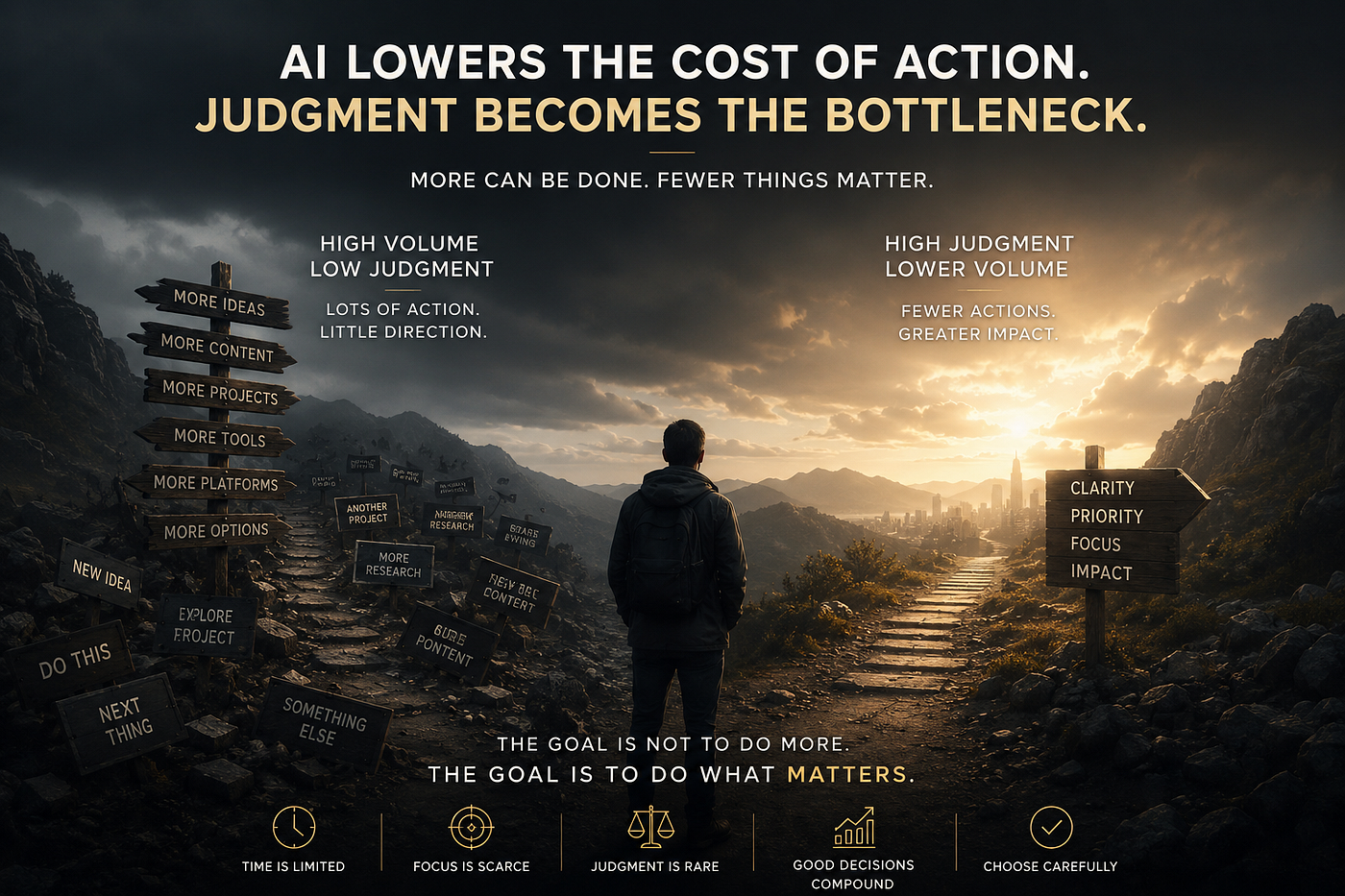
Execution is becoming abundant.
Judgment is becoming scarce.
And underneath judgment is something more fundamental:
the capacity to interpret reality through a lens that is genuinely yours.
That capacity does not come from better tools.
It does not come from smarter prompting or more sophisticated workflows.
It comes from the decision to build internal cognitive infrastructure with the same intentionality that most people currently apply only to external systems.
The signal you protect is the signal your audience eventually trusts.
Where to start this week
Identify the last three times you significantly changed your direction, voice, or positioning.
For each one:
Was the change driven by a genuine internal shift in understanding or by an external input that destabilized the existing signal before it had time to compound?
The answer tells you whether your thinking system has sovereign stability or whether it is currently operating in packet loss mode.
You cannot fix cognitive fragmentation by producing more.
You fix it by rebuilding the compression layer the internal process that converts input into genuine perspective before it becomes output.
Start there.
Everything downstream gets cleaner when the lens holds.
Chris Polczer is the founder of FreedomWayGlobal — a decision philosophy and system architecture brand exploring signal, systems, and human judgment in the AI era.
→ Start here: https://start.freedomwayglobal.com
This series is not about more output.
It is about building systems that stay readable under pressure.
— FreedomWayGlobal
메타데이터
- post_id
- a57cd3d970ee
- slug
- the-hidden-cost-of-cognitive-packet-loss-a57cd3d970ee
- url
- https://medium.com/freedomwayglobal/the-hidden-cost-of-cognitive-packet-loss-a57cd3d970ee
- canonical_url
- https://medium.com/freedomwayglobal/the-hidden-cost-of-cognitive-packet-loss-a57cd3d970ee
- author_url
- https://medium.com/@freedomwayglobal1978
- status
- ok
- fetched_at
- 2026-06-13 07:35:29