Michael Foot: The Legacy of Real Labour
Remembering the best of us
Michael Foot: The Legacy of Real Labour
Remembering the best of us
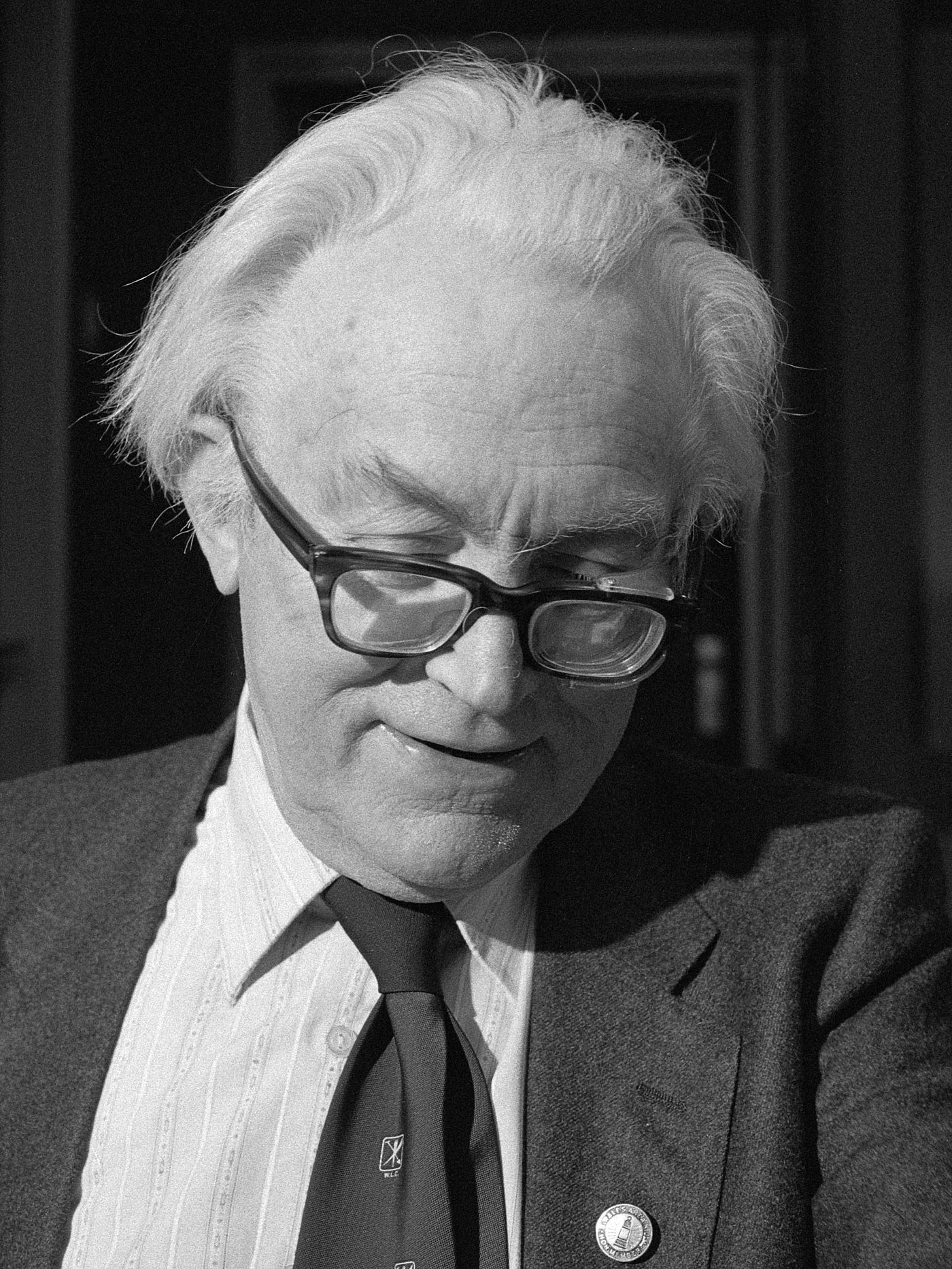
Michael Foot attending a meeting of Scandilux (a cooperation forum between the Social Democratic parties of the North European NATO countries) on 19 October 1981 in The Hague Image Source: Nationaal Archief/Wikimedia Commons Image License: Creative Commons CC0 1.0 Universal Public Domain Dedication.
Michael Foot occupies a rather odd, if not unfortunate, spot in the annals of Labour Party history. He is no doubt best known for his failure in the 1983 general election, which resulted in massive losses for Labour and a landslide for Margaret Thatcher, enabling her to carry out her assault on the working class at the peak of neoliberalism. This loss served as the main justification for Labour to completely marginalise the left and move in a Thatcherite-friendly direction in the following years under Neil Kinnock and subsequently, John Smith and Tony Blair.
Still, Michael Foot was a leader of the Labour Party at a very difficult time. Upon his death in 2010, people from the Labour Party remembered him as working to hold the Labour Party together and potentially saving it from collapse and oblivion. Even Tony Blair, who joined Labour while Michael Foot was leader, shared this view of him.
Who was Michael Foot, though? Whenever we hear about him today, if we even do, it’s almost always through the lens of a cautionary tale on what Labour should not do, i.e., embracing left-wing policies. We seldom hear anything about Michael Foot, his life, or his ideas. I thought I’d give a little background on Michael today, considering he is a bit of a personal hero of mine.
Michael Foot was born in 1913, and he happened to born in the city of Plymouth, the same city I was born in, albeit many decades later. He also happened to live for a time in the Cornish village of St Cleer, where I grew up and lived for 16 years. As a result, I feel a certain degree of commonality and connection to Michael Foot, a fellow West Country person.
As for his background, Michael hardly had the upbringing of a figure you’d consider for a hard-left socialist firebrand he went on to become. Instead, his father, Isaac Foot, was a Liberal Party MP and much of his family were very liberal in their political leanings. Michael himself also spent much of his early political life as a liberal, even proudly declaring himself one in speeches during the 1930s. Throughout his early years, he was also frequently acquainted with the likes of Liberal Prime Minister David Lloyd-George, and other noted Liberals through his father.
Once Michael grew more mature and into his 20s, he began to become more interested in socialism, even befriending the infamous firebrand of the Labour left, Barbara Castle herself. Even during this early period of his 20s, when he ran as a Labour candidate in the 1935 general election, Michael was a staunch critic of the arms race, something which would go on to characterise his politics for the rest of his life.
Michael was also the primary author of the book, Guilty Men, which criticised the British Conservative government of Neville Chamberlain for its appeasement policies with Hitler. Foot and his colleagues during this time recognised the very real dangers posed by fascism, and became very involved in opposition to the Tory government.
Once the war was over, Michael would finally be elected as a member of parliament for Plymouth and would finally rise to become a Labour MP. During this time, he became associated with the socialist left of the Labour Party, authoring the Keep Left pamphlet with other Labour left figures such as Ian Mikardo. Foot also became heavily associated with the Health Secretary of the Attlee government, Nye Bevan, who became his political hero.
Michael Foot’s admiration for Nye Bevan was obvious and would last for the remainder of his life. During the civil war in Labour during the 1950s, when Labour were in somewhat of an electoral wilderness, Foot stood beside Bevan in almost every aspect of his politics, seeing the socialism of Bevan as the only path forward for Labour. They would differ, however, when it came to the topic of unilateral nuclear disarmament, something Bevan did not support but Michael did.
Despite being voted out of office in 1955, Michael would return to parliament as a Labour candidate in the 1960 general election, this time in the constituency formerly belonging to the recently deceased Nye Bevan, Ebbw Vale. Michael’s next stint in parliament would cover the remainder of his career as a politician until he stepped down for the 1992 general election.
Throughout the remainder of his time in parliament and indeed, the rest of his life, Michael Foot became a passionate voice of the Labour left. He even spoke at the 1968 Labour Party conference, another time of intense turmoil for the party, as a leading figure of the left opposition to the government of Harold Wilson.
Foot’s left-wing positions and credentials happened to be the main reason why he was selected to be the employment secretary under the government of Harold Wilson in 1974, the first time he would hold a cabinet position despite many years as a notable Labour Party figure. He would go on to pass some notable legislation aimed at protecting trade unions and workers' rights during the time he was in this role. In the remaining years of the Labour government of James Callaghan, he served as leader of the House of Commons before the election of Margaret Thatcher.
During this time, Michael Foot was also an immensely productive and prolific writer. Perhaps his most famous work is his massive two-volume biography of his hero, Nye Bevan, which is still very readable and well-regarded to this day. He was also a frequent writer for socialist magazines such as Tribune, as well as regularly contributing to newspapers while sitting as an MP.
Perhaps ironically is how, during the latter years when he was Labour leader and subsequently a backbench MP, Michael became more known for his work as a writer than a member of parliament. At around the time he became leader of the Labour Party, he published his first collection of essays, *Debts of Honour*, which really gave a taste of the breadth of Michael’s knowledge and talent as a writer and orator. It also showed he was a very accomplished and regarded literary critic, in particular his essay on William Hazlitt, another hero of Michael’s.
Even after Labour’s defeat at the 1983 election, Michael swiftly began work on writing *Another Heart & Other Pulses*, an analysis of Labour’s loss in 1983. Foot took responsibility for Labour’s election loss, stating that they “didn’t have the leadership” to win. Ironically, leadership of the Labour Party was something Michael took up begrudgingly; he’d not intended to be leader but was persuaded to do so after the party thought he would be more suitable to unite the party than Denis Healey on the right or Tony Benn from the left.
1986 saw Michael publish another collection of essays, *Loyalists and Loners*, in which he would analyse various figures in the Labour Party both from its past and at the time he wrote. His essay on Labour right figure Hugh Gaitskell is particularly enlightening, as Michael correctly points out that the splitting of the Labour Party and the marginalisation of other factions in the party, including kicking people out, has always come from the Labour right, not the left.
Michael’s writings have gone on to become very noteworthy in British political history. As I already mentioned, his biography of his hero Nye Bevan is still very popular and very readable to this day. His essays are also very brilliant and worthy of being read by all who want to understand British politics and one of the best voices in Labour history.
It is Michael’s writings which have influenced me quite strongly since having read them, and it’s also partly through inspiration from Michael that I generally consider myself an essayist/writer. Michael’s commitment to socialism and social justice was legendary; his commitment to ending the arms race and nuclear disarmament was unwavering throughout his entire life. In 2003, despite being aged 90, Michael spoke at the anti-Iraq war protests in London, giving an impassioned speech at Hyde Park against the war as well as in favour of nuclear disarmament.
Now, all of this is not to paint Michael Foot as some messianic, perfect figure. Like all people, and especially all politicians, he had his blind spots. His refusal to support gay parliamentary candidate Peter Tatchell, as well as refusing to take an explicitly pro-gay stance as Labour leader so as to avoid “Loony left” portrayals in the media, was pretty poor, to say the least, as was his (early) support for zionism on the grounds of viewing Israel as a safe haven for Jews. As we’ve seen, this is not and never has been the point of Israel or zionism; it has always been a matter of colonialism, and considering Michael was broadly anti-colonial throughout his career, this is a point of criticism which should be made.
Michael’s blind trust in the bourgeois parliament of Westminster is also a major blight in his political thinking. He didn’t realise that Westminster and the wider state were tools of class rule; they could never be used as vehicles to bring about real change, something Michael realised all too well.
With all of that being said, I cannot deny that Michael Foot is a figure I consider to be deeply interesting for a number of the reasons I’ve laid out here. He is one of only a few Labour leaders to have come from the left of the party, along with George Lansbury and Jeremy Corbyn, and he remained a steadfast fighter and advocate for socialism and justice until the day he died.
For more stories about politics, history, social justice, and the people who shaped our world, follow Fourth Wave. Also check out our Livestreams and sign up for our Newsletter. Let’s grow the community! Have you got a story or poem that focuses on women or other targeted groups? Submit to the Wave!
메타데이터
- post_id
- a59c2d435bd5
- slug
- michael-foot-the-legacy-of-real-labour-a59c2d435bd5
- url
- https://medium.com/fourth-wave/michael-foot-the-legacy-of-real-labour-a59c2d435bd5
- canonical_url
- https://medium.com/fourth-wave/michael-foot-the-legacy-of-real-labour-a59c2d435bd5
- author_url
- https://medium.com/@LauraWestford
- status
- ok
- fetched_at
- 2026-07-15 14:44:23