How Digital Infrastructure Can Help Scale Up Green Energy Transition
The global green energy transition is no longer a policy document. Green hydrogen facilities, green methanol plants, and integrated…
How Digital Infrastructure Can Help Scale Up Green Energy Transition
The global green energy transition is no longer a policy document. Green hydrogen facilities, green methanol plants, and integrated renewables-to-chemicals projects are actively breaking ground across the globe. Capital is committed. Engineering is underway.
Yet a structural risk sits beneath the ambition: the data problem.
Green energy projects are among the most complex industrial assets ever built — combining electrolyzers, photovoltaic fields, wind arrays, gasification furnaces, synthesis reactors, and hydrogen storage in a single integrated facility. Each system generates its own engineering data, runs on its own software platform, and arrives with its own vendor documentation. Without a deliberate digital infrastructure strategy from the first day of engineering, that data fragments, degrades, and ultimately disappears — leaving operators managing billion-dollar assets with incomplete records and no practical path to recovery.
The cost of reconstructing asset data after commissioning routinely exceeds the cost of capturing it correctly from the start. For green energy assets with 30-year operational lifespans, that is not a theoretical risk — it is a near-certainty without the right infrastructure.
This article explains what industrial AI-powered digital infrastructure looks like for green energy projects, why it matters at the scale now being deployed, and how DMS’s proven capabilities — the unified data model, progressive digital handover, and operational digital twin — address the specific challenges of this emerging asset class.
Why Green Energy Projects Face a Unique Data Management Challenge
Green energy assets differ from conventional oil & gas and chemical plants in ways that sharply amplify data management complexity. Understanding why is essential before choosing a solution.
Multi-domain process integration
A single green hydrogen facility may combine photovoltaic generation, wind power, electrolysis (PEM or alkaline), hydrogen purification, compression, storage, and downstream synthesis — for green ammonia or green methanol. Each domain has specialist engineering teams, dedicated software tools, and distinct data conventions. In practice, a single project may produce engineering data across six to ten incompatible systems. Without a unifying data layer, these systems cannot communicate, and asset information cannot flow from design through operations without manual, error-prone translation.
Greenfield construction with compressed timelines
Most green energy projects are built from scratch, meaning there is no legacy asset data to draw on. At the same time, commercial pressure to meet production milestones compresses delivery timelines. The combination creates acute risk of data gaps at the construction-to-operations handover — precisely when complete and accurate asset records are most critical. Once a facility is in production, the window and budget for data remediation effectively close.
Safety, regulatory, and audit requirements
Hydrogen storage and handling carries significant safety requirements. Green energy facilities operating in regulated markets — including the UAE, EU, South Korea, and Japan — face growing requirements for documented asset integrity, inspection records, and auditable operations data. Incomplete digital records are not merely an operational inconvenience; they create material compliance and insurance exposure over the life of the asset.
Long operational lifespan with compounding data debt
Green energy infrastructure is designed to operate for 25 to 30 years or more. Data decisions made during the engineering and construction phase determine the quality of asset information available for the entire operational life of the facility. Facilities that begin operations with incomplete records accumulate data debt — the ongoing cost and risk of working with degraded asset information — that compounds over every maintenance cycle, every inspection, and every regulatory audit.
The Three Capabilities Green Energy Projects Need
DMS’s approach to green energy digital infrastructure is built on three integrated capabilities, each addressing a distinct phase of the asset lifecycle: design, handover, and operations.
Capability 1: Unified data model — eliminating data silos across disciplines and project phases
In conventional project delivery, each engineering discipline maintains its own data model. Civil, structural, process, instrumentation, electrical, and piping teams work in separate software environments. When data needs to move between disciplines, or between design, construction, and operations, it must be manually translated — introducing errors, omissions, and version conflicts at each step.
DMS’s PIMCenter platform establishes a unified data model that serves as the single source of truth for all engineering objects across the project: equipment, pipelines, instrumentation, documents, and spatial data. Every object is defined once and shared throughout the asset lifecycle — without re-entry, reformatting, or manual reconciliation.
For green hydrogen and green methanol projects specifically, this means that data from electrolysis systems, gas purification units, photovoltaic arrays, synthesis reactors, and hydrogen storage can all be managed within a single platform — with consistent tagging, attribute definitions, and cross-system traceability. When an operations engineer needs to understand the relationship between an electrolyzer’s maintenance history and its current performance data, that information exists, is complete, and is findable in seconds.
Key outcomes of implementing a unified data model:
• Single asset register covering all process units — no duplicate or conflicting records
• Consistent equipment coding across design, procurement, construction, and operations phases
• Automatic propagation of design changes across all connected data objects and documents
• Full cross-discipline traceability from P&ID to 3D model to physical asset to maintenance record
• Interoperability with CFIHOS, ISO 15926, and other international process industry data standards

Capability 2: Progressive digital handover — from paper archives to live digital assets
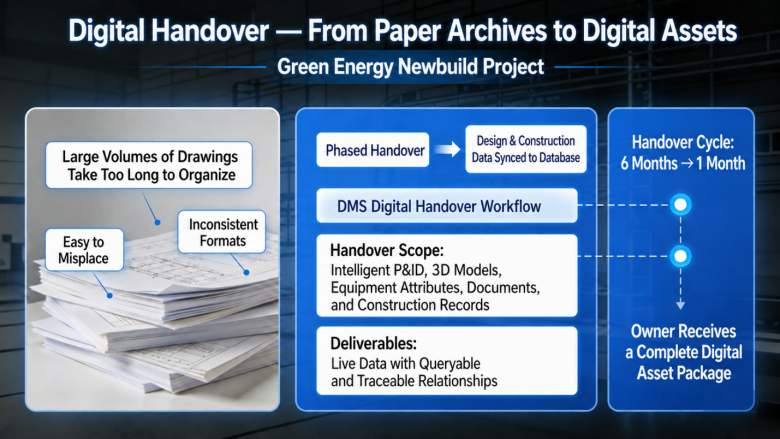
The traditional project handover model is structurally broken. Under conventional practice, EPC contractors compile drawings, equipment records, inspection certificates, and construction documentation at the end of the project — a process that typically takes four to six months after mechanical completion. By that time, owners are managing assets in production with incomplete information, and the cost of gap-filling is high and rising.
DMS’s digital handover platform uses a progressive delivery model: engineering data and construction records are captured, validated, and structured continuously throughout the project lifecycle — not assembled retrospectively when the project is closed out. This is not a different document management system; it is a different project delivery discipline.
The digital handover package delivered to the asset owner under this model covers:
• Intelligent P&IDs with linked equipment and instrumentation records, revision-controlled and query-ready
• Full 3D plant model with complete attribute data on every tagged item
• Equipment datasheets, vendor documentation, and test certificates linked to their physical assets
• Construction progress records, quality inspection results, and non-conformance reports
• Commissioning data, pre-start-up safety review records, and initial baseline operating data
In projects where DMS has implemented this model, the final handover cycle has been compressed from six months to approximately one month — and owners receive a complete, queryable digital asset package on or before the plant commissioning date.
A digital handover is not a deliverable. It is a discipline — one that must begin at the first day of engineering, not the last day of construction.
Capability 3: Operational digital twin — plant intelligence from day one
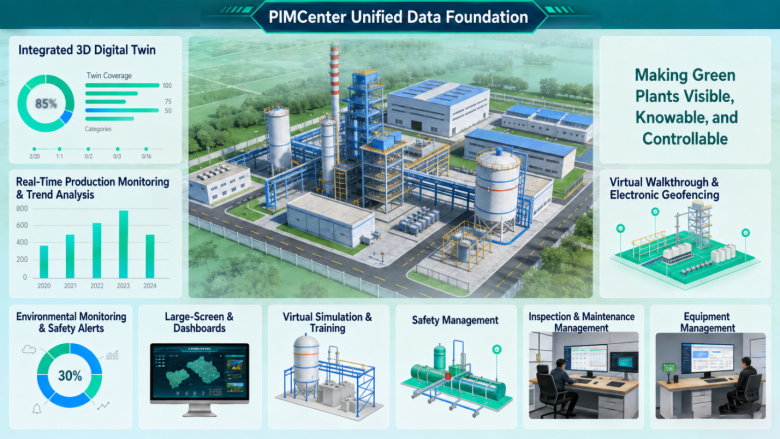
A digital twin is the operational layer that transforms an engineering data model into a live decision-support environment. DMS builds 1:1 digital twin environments using its eZWalker Tesla 3D visualization engine — integrating real-time sensor data, operational performance feeds, video surveillance, and safety monitoring systems into a single spatial interface that mirrors the physical plant at every moment.
For green energy facilities, operational digital twins address specific operational challenges:
• Real-time electrolyzer performance monitoring linked to spatial asset context and maintenance history
• Hydrogen storage pressure and safety status integrated into the 3D plant model with alert routing
• Anomaly detection with asset-specific operational profiles and maintenance recommendation outputs
• VR-enabled remote inspection and operator training, reducing requirements for on-site access
• Audit-ready regulatory reporting with complete, timestamped data provenance
The operational digital twin is not a visualization tool. It is the primary interface through which plant managers, safety engineers, and maintenance teams interact with their assets — informed by complete, accurate, real-time data from the first day of operations.
Proven at Scale: Green Hydrogen and Green Methanol Reference Projects
Sinopec Kuqa Green Hydrogen Pilot Project — Xinjiang, China
The Kuqa project is China’s first 10,000-tonne-scale photovoltaic-to-hydrogen demonstration facility — a defining milestone in the industrialization of green hydrogen technology. Commissioned by Sinopec’s green energy subsidiary, it integrates photovoltaic generation, alkaline electrolysis, hydrogen purification, compression, and storage in a single integrated facility.
DMS delivered the complete digital infrastructure:
• Unified data model covering all process units across engineering disciplines
• Full 3D digital twin built on the eZWalker Tesla engine, with real-time data integration
• Safety monitoring systems embedded in the spatial asset model with live alert feeds
• VR operations center enabling remote facility orientation and emergency scenario training
The Kuqa project established DMS as the reference implementation for green hydrogen digital infrastructure in China’s emerging industrial-scale market — and the blueprint for subsequent green energy digital deployments.
Goldwind Green Energy 500,000 t/yr Green Methanol Project — Inner Mongolia, China
The Goldwind green methanol project is a landmark in the integration of green hydrogen synthesis and methanol production at industrial scale: 500,000 tonnes per year capacity, built in two phases combining biomass gasification, air separation, and methanol synthesis.
At this scale, data governance is a project-critical function, not an administrative task. A 500,000-tonne green methanol facility involves tens of thousands of tagged equipment items, pipeline segments, and instruments — each requiring accurate, traceable records from design through a 30-year operational lifespan.
DMS is delivering the unified digital foundation for the Goldwind project — ensuring complete data continuity across design, construction, and operations phases, and preventing the data fragmentation that reliably affects large-scale industrial projects built without systematic data infrastructure.
FAQs
Q: What is a digital twin for a green hydrogen plant?
A: A digital twin for a green hydrogen plant is a real-time virtual replica of the physical facility, built on a unified engineering data model and connected to live sensor and operational data. It integrates equipment records, P&IDs, 3D spatial models, and real-time process feeds into a single interface — enabling operators to monitor performance, detect anomalies, and manage maintenance with full asset context. DMS builds green hydrogen digital twins using its eZWalker Tesla 3D engine on top of the PIMCenter unified data platform.
Q: What is digital handover in EPC project delivery?
A: Digital handover is the structured transfer of all engineering, procurement, and construction data from an EPC contractor to a plant owner in a machine-readable, queryable, and cross-referenced format — replacing traditional paper-based or PDF archive handover. A complete digital handover covers intelligent P&IDs, 3D models, equipment datasheets, inspection records, and commissioning data. Progressive digital handover, as implemented by DMS, captures and validates this data continuously during project construction, compressing the final handover timeline from 4–6 months to approximately 1 month.
Q: Why do green energy projects have higher data management risk than conventional plants?
A: Green energy projects — particularly green hydrogen and green methanol facilities — combine multiple process domains (electrolysis, renewable power, synthesis, and storage) that each produce engineering data in different formats and systems. As greenfield projects with compressed delivery timelines, they have no legacy data to draw on and face significant risk of data gaps at the construction-to-operations handover. Without a unified data model from the start of engineering, owners typically receive incomplete asset records and spend 6 to 18 months post-commissioning attempting to reconstruct them at significant cost.
Q: What is PIMCenter and how does it support green energy projects?
A: PIMCenter is DMS’s industrial platform for plant information management. It provides a unified data model for all engineering objects — equipment, pipelines, instrumentation, documents, and spatial data — across the full asset lifecycle from design through operations. For green energy projects, PIMCenter enables data continuity across multiple process domains (electrolysis, PV generation, synthesis), supports progressive digital handover workflows, and provides the data foundation for operational digital twins. It is designed for process industries including oil & gas, petrochemicals, chemicals, and green energy.
Q: How much does digital handover reduce project data loss risk?
A: Traditional paper-based or static PDF handovers for large industrial projects typically take 4–6 months after mechanical completion and routinely result in data gaps — missing equipment records, incomplete inspection documentation, and inconsistent tagging. Using DMS’s progressive digital handover model, the final handover cycle is compressed to approximately 1 month, data is captured and validated continuously during construction (not assembled retrospectively), and owners receive a complete, queryable digital asset package at or before the commissioning date.
The Bottom Line: Digital Infrastructure Is a Prerequisite, Not a Feature
The global green energy sector is at an inflection point. Projects that were demonstration-scale two years ago are now being replicated at five to ten times the capacity. Engineering and data management practices appropriate for a pilot facility are not adequate for an industrial-scale green hydrogen hub or a 500,000-tonne green methanol complex.
Asset owners, EPC contractors, and investors in green energy infrastructure face a clear decision: establish sound digital data foundations during engineering and construction — when the marginal cost is manageable — or deal with the consequences of incomplete asset records during operations, when the cost in maintenance inefficiency, safety risk, regulatory exposure, and lost operational intelligence is an order of magnitude higher.
DMS brings over 20 years of deployment experience in China’s most demanding process industries — oil & gas, petrochemicals, and refining — to the emerging green energy sector. Its three-capability model provides a systematic, proven answer to the data challenges that will determine whether green energy projects achieve their operational and commercial objectives over their full 30-year lifespans.
Green energy is the world’s largest infrastructure build of the next three decades. The data decisions made during engineering will determine operational performance for the life of these assets. Getting the digital foundation right is not optional — it is the work.
About DMS
DMS Co., Ltd. is a Chinese industrial AI and digital infrastructure company founded in 2002, specializing in plant asset lifecycle management (ALIM), plant information management (PIM), and AI-driven digital transformation for energy, oil & gas, chemicals, and process industries.
메타데이터
- post_id
- a59faf14f00a
- slug
- how-digital-infrastructure-can-help-scale-up-green-energy-transition-a59faf14f00a
- url
- https://medium.com/@overseadms/how-digital-infrastructure-can-help-scale-up-green-energy-transition-a59faf14f00a
- canonical_url
- https://medium.com/@overseadms/how-digital-infrastructure-can-help-scale-up-green-energy-transition-a59faf14f00a
- author_url
- https://medium.com/@overseadms
- status
- ok
- fetched_at
- 2026-06-09 15:37:30