Amazon Taught Me That Urgency And Importance Aren’t The Same Thing.
The busiest moments of my career taught me that the things demanding my attention weren’t always the things deserving it.
Amazon Taught Me That Urgency And Importance Aren’t The Same Thing.
The busiest moments of my career taught me that the things demanding my attention weren’t always the things deserving it.
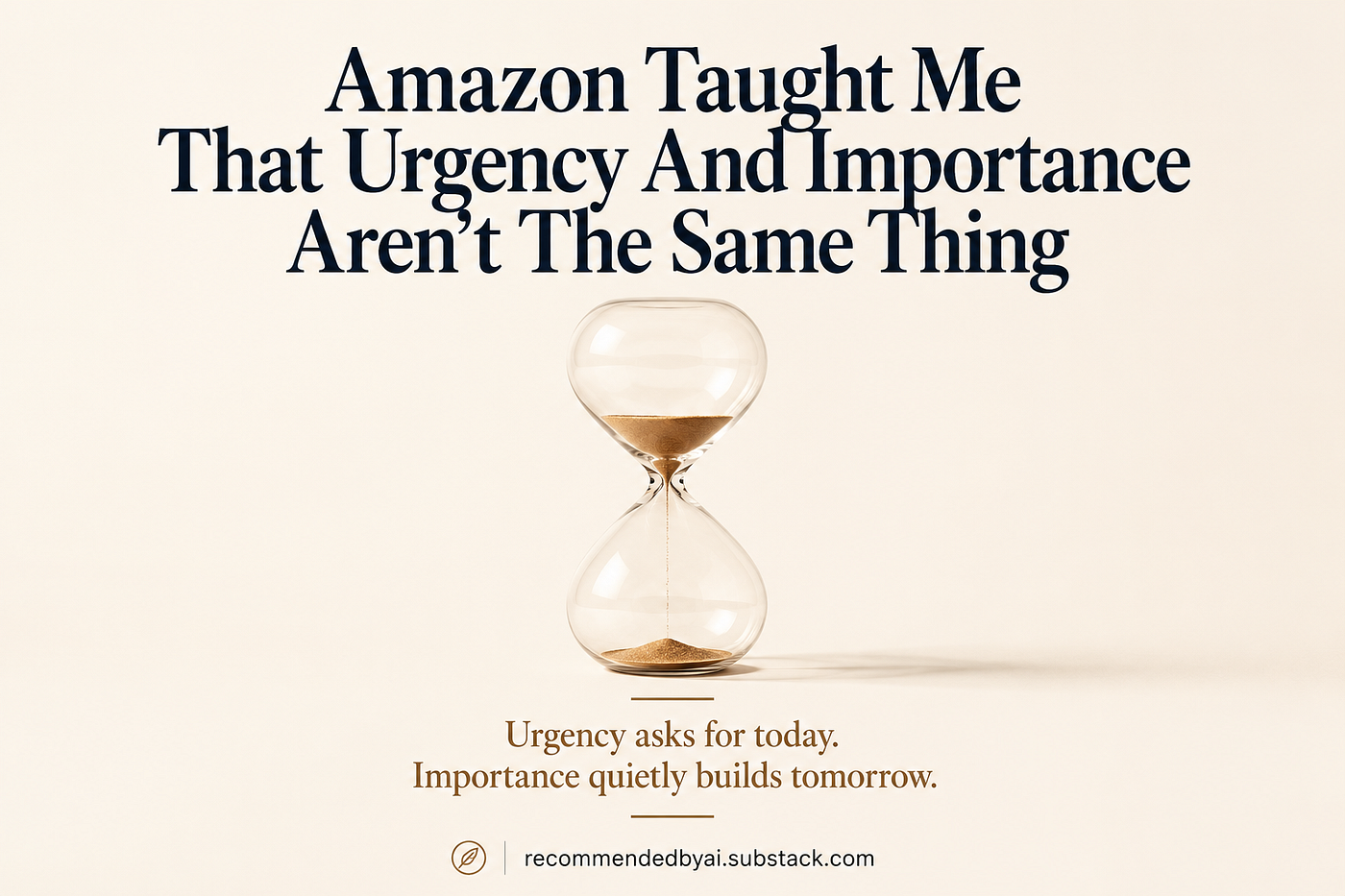
Hourglass with a quote on urgency and importance. Img src by the Author.
One of the first things I noticed after joining Amazon was how quickly people moved.
Meetings started on time and ended early. Decisions that might have taken weeks elsewhere were often made before lunch. Projects moved from whiteboard sketches to production with an urgency that was impossible not to admire. There was an unmistakable energy in the building, a shared belief that momentum mattered and that customers benefited when good ideas spent less time waiting to become reality.
As someone early in my career, I found it infectious.
If something felt urgent, I assumed it must also be important.
It took me years to realise those weren’t the same thing.
One afternoon, our team was preparing for a product launch that had been months in the making. Every conversation seemed to end with another deadline. Messages appeared faster than I could respond to them. Meetings were scheduled back-to-back, lunch quietly disappeared from everyone’s calendar, and every task somehow carried the same label.
High priority.
By the end of the day, everything felt urgent.
That’s when one of the senior engineers leaned back in his chair and asked a question that stopped the room.
“If everything is urgent,” he said, “what exactly are we protecting?”
Nobody answered immediately.
Not because we disagreed.
Because we hadn’t thought about it that way.
That question stayed with me long after the launch.
Urgency is loud.
It arrives with notifications, countdowns, meetings, and people waiting for answers. It demands your attention immediately and makes postponing it feel irresponsible.
Importance behaves very differently.
Important work is often quiet.
It rarely interrupts your day.
It doesn’t send reminders every five minutes.
It simply waits, patiently, while urgent things compete for your attention.
The uncomfortable truth is that urgent work usually wins.
Not because it’s more valuable.
Because it’s harder to ignore.
As I became more experienced, I started noticing a pattern among the people I admired most.
They weren’t the fastest people in the room.
They were the ones who could distinguish between motion and progress.
When everyone else rushed toward the nearest fire, they paused long enough to ask whether the fire actually threatened the building or whether it was simply demanding attention.
That pause wasn’t hesitation.
It was judgment.
The more responsibility they carried, the more carefully they protected that ability.
Years later, motherhood introduced the same lesson in a place where deadlines didn’t exist.
One evening, I was answering emails while my son sat on the floor beside me,e building a tower out of wooden blocks. Every few minutes, es he would look up, smile, and tell me to watch what he had built. I kept answering, “Just one second.”
The emails felt urgent.
His invitation didn’t.
Eventually, I closed my laptop and walked over to him.
Within minutes, the tower collapsed, and we both laughed as he immediately started building another one.
By the next morning, I couldn’t remember a single email I’d answered that evening.
I remembered the tower.
That moment forced me to reconsider how I measured importance.
My inbox had convinced me that the emails couldn’t wait.
Life quietly demonstrated otherwise.
Some of the most meaningful moments never announce themselves as priorities. They don’t arrive with notifications or flashing reminders. They simply appear for a brief moment and disappear if you aren’t paying attention.
Children understand this instinctively.
Adults often have to relearn it.
Looking back, I don’t think Amazon taught me to move faster.
It taught me to become more intentional about why I was moving.
Speed is an extraordinary advantage when you’re headed in the right direction. But speed alone can’t tell you whether the thing demanding your attention deserves it in the first place.
The people I respected most understood that distinction remarkably well. They responded quickly when urgency served something important, but they were equally comfortable slowing the room down when everyone else had confused activity with progress.
That isn’t indecision.
It’s discipline.
I’ve started noticing the same tension almost everywhere.
Our calendars become full while our priorities quietly disappear beneath them. We answer messages within minutes but postpone conversations that matter for months. We react immediately to interruptions while delaying the work that would change our lives if we gave it consistent attention.
Urgency constantly asks for today.
Importance quietly builds tomorrow.
Most of the time, they are asking for different things.
When I think back to my years at Amazon, I don’t remember the busiest days.
I remember one simple question spoken almost casually across a conference table.
“If everything is urgent, what exactly are we protecting?”
I still ask myself that question more often than I’d like to admit.
Because I’ve learned that life doesn’t usually fall apart from ignoring one more notification.
It changes because of the quiet things we keep postponing while convincing ourselves we’ll get to them tomorrow.
Amazon taught me that urgency deserves attention.
But importance deserves protection.
Those are two very different kinds of work.
P.S. I still write where I think best, which for me is usually Substack. The difference is that publishing is no longer the end of my workflow. Once an article is live, I schedule follow-up Substack Notes, repurpose the strongest ideas into LinkedIn posts, Medium articles, X posts, Threads, and Bluesky, then pay attention to which versions actually bring readers back to the original piece.
I originally started looking into the Substack API because I wanted to automate parts of that process. What I discovered was that an API alone doesn’t create a publishing workflow—it simply gives you the building blocks.
That’s why I’ve been using Narrareach’s Substack API workflow. It sits around Substack’s native publishing features, making it easy to schedule Notes, cross-post articles, trigger webhooks, connect AI assistants, and understand which content is actually driving subscriber growth.
If you’re exploring the Substack API and want to see what a complete publishing workflow looks like rather than just an endpoint, this is worth a look:
The biggest change for me wasn’t automating publishing. It was realised that every article deserves a distribution workflow of its own. The API became useful only after it was connected to everything that happens after pressing Publish.
메타데이터
- post_id
- a5a2a55cd709
- slug
- amazon-taught-me-that-urgency-and-importance-arent-the-same-thing-a5a2a55cd709
- url
- https://medium.com/illumination/amazon-taught-me-that-urgency-and-importance-arent-the-same-thing-a5a2a55cd709
- canonical_url
- https://medium.com/illumination/amazon-taught-me-that-urgency-and-importance-arent-the-same-thing-a5a2a55cd709
- author_url
- https://medium.com/@warstories
- status
- ok
- fetched_at
- 2026-07-11 20:55:18