How does an Aircraft fly?
Seat belts fastened, cabin lights dimmed; you are just 6 hours from that long-awaited vacation. You begin to wonder — ‘How does an aircraft…
How does an Aircraft fly?
Seat belts fastened, cabin lights dimmed; you are just 6 hours from that long-awaited vacation. You begin to wonder — ‘How does an aircraft soar through the sky?’ and it definitely does not include any sacrificial ritual as Agamemnon did to set sail for Troy.
An aeroplane has 4 Fundamental forces acting while it flies — Lift(Navy), Weight(Red), Thrust(Green) and Drag(Black).
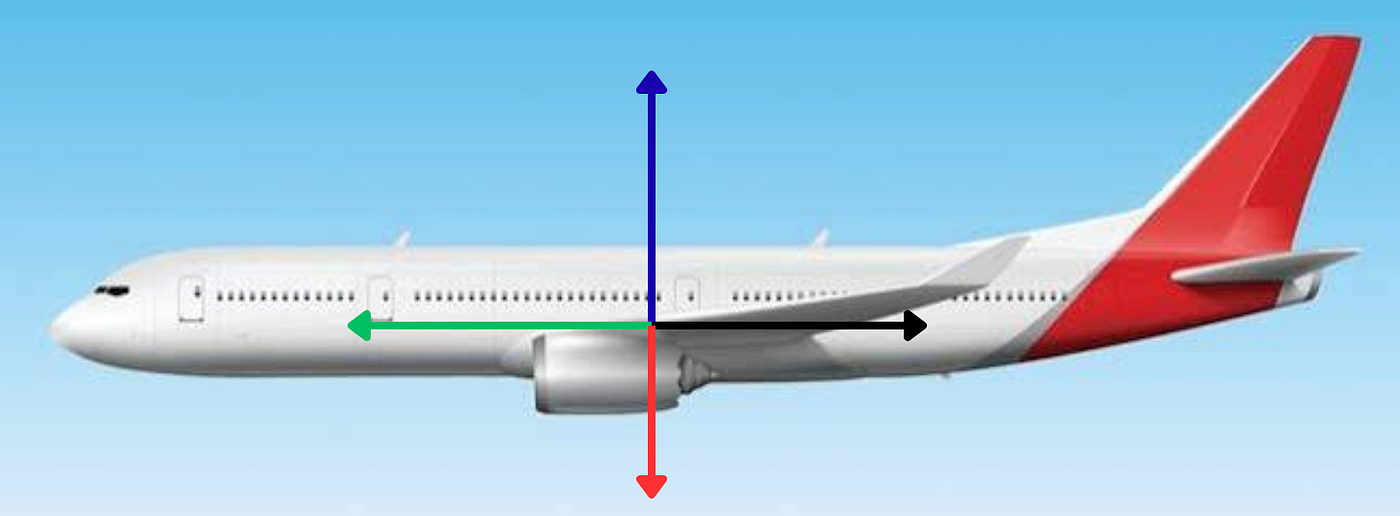
A picture depicting the forces acting on an aircraft during flight
Lift is the force that allows the aircraft to take off, and is produced by the wings of the aircraft. As the engines produce a driving force — thrust, the aircraft’s wings displace the air around their unique shape, creating a pressure difference across the top and bottom surfaces. The wing’s unique shape (cross section) has a curved upper portion and a flatter lower part.

The wing and it’s unique cross section
As it displaces the surrounding fluid, the air travelling over the top portion of the wing must travel a longer distance than the air travelling under the bottom portion of the wing; this causes the air on the upper portion to speed up, trading thermal energy for speed (kinetic energy), in turn lowering the pressure. And on the bottom portion of the wing, which features a slight camber, the air gets compressed, slowing it down and trading speed (kinetic energy) for thermal energy, which causes pressure to increase (Temperature increases, pressure increases, and vice versa). Hence, a low-pressure region is formed above the wing, on the top surface, while a high-pressure region is formed below the wing, on the bottom surface. The surrounding air wants to equalise this pressure difference; this equalising force that acts upwards is known as Lift (high-pressure regions move towards low-pressure regions). Also, as the speed increases, air is deflected downwards by the wing, causing a net upwards force (Newton’s 3rd law of motion).

How the wing produces lift
Drag is the frictional force the fluid (air) creates as the aircraft travels through it. It is an opposing force, so it is opposite to the direction of the driving force and is perpendicular to lift. Weight as a force is very self-explanatory; it is the pull of Earth’s gravity on the aircraft which acts downwards. (Lift and Weight are opposite, Thrust and Drag are opposite)
During the take-off and climb stages, lift and thrust are greater than weight and drag. During cruise, the forces are balanced, and during the descent phases, weight and drag become greater than lift and thrust, which helps bring the plane down.
To conclude, the unique cross-sectional shape paired with the driving force provided by the engines causes an aircraft to soar through the sky, connecting the corners of the world in a matter of hours. Allowing people to meet family, make a new life, or just take that long-desired vacation.
메타데이터
- post_id
- a5a77ba5a8b2
- slug
- how-does-an-aircraft-fly-a5a77ba5a8b2
- url
- https://medium.com/@atharvalimaye1402/how-does-an-aircraft-fly-a5a77ba5a8b2
- canonical_url
- https://medium.com/@atharvalimaye1402/how-does-an-aircraft-fly-a5a77ba5a8b2
- author_url
- https://medium.com/@atharvalimaye1402
- status
- ok
- fetched_at
- 2026-08-06 19:19:56