Florence in One Day - A Realistic Walk Through the Renaissance City
Florence is presented as a city that can be understood in one day if the route is disciplined, realistic, and focused on the historic…
Florence in One Day - A Realistic Walk Through the Renaissance City
Florence is presented as a city that can be understood in one day if the route is disciplined, realistic, and focused on the historic centre. This Florence itinerary is designed especially for first-time visitors arriving at Santa Maria Novella railway station, the most practical entry point for day-trippers. From there, the route forms a compact walking loop of about 7 to 8 kilometres, connecting the religious, civic, artistic, riverside, and panoramic highlights of Florence.
The strength of the plan lies in its balance. It does not try to include every museum, church, palace, and garden, because that would make the day exhausting and superficial. Instead, it combines two major art experiences, essential outdoor monuments, realistic food breaks, and an evening viewpoint. The result is a first encounter with Florence that feels full, but not absurdly rushed.
The day begins at Firenze Santa Maria Novella, close to the western edge of the historic centre. The first short walk leads toward Piazza Santa Maria Novella and the exterior of the Basilica of Santa Maria Novella. The church is important, but entering it immediately would take too much time if the plan also includes the Accademia and the Uffizi. For this reason, the square and façade are enough at the beginning.
From Santa Maria Novella, the route continues toward Piazza del Duomo along Via dei Banchi and Via de’ Cerretani. The walk is about 650 metres and usually takes 8 to 10 minutes. This early stretch shows how compact Florence is. The dome appears gradually above the streetline, and the visitor quickly understands that the historic centre is best explored on foot, not by taxi or bus.
The first major paid visit is the Accademia Gallery, reached from the Duomo area by walking north along Via Ricasoli. This is placed early in the morning to reduce the impact of crowds. The main reason to visit is Michelangelo’s David, carved between 1501 and 1504. The statue is more than a museum masterpiece: it belongs to Florence’s civic and Renaissance identity. A focused visit of 60 to 75 minutes is enough for David, the unfinished Michelangelo figures, and the essential rooms.
After the Accademia, the route turns toward San Lorenzo, about 500 metres away. This district links the Medici family, religious architecture, market life, and the commercial texture of Florence. The Basilica of San Lorenzo is important, but the itinerary recommends seeing the exterior unless the visitor decides to sacrifice another major stop. This area is also a good place for the first short pause: an espresso, water, and 15 minutes of rest before returning to the Duomo.
Piazza del Duomo is the architectural heart of the route. Here, the Cathedral of Santa Maria del Fiore, Brunelleschi’s Dome, Giotto’s Bell Tower, and the Baptistery of San Giovanni form one of the most important monumental groups in Italy. The cathedral dominates the skyline through scale and position, while the dome remains the great symbol of Renaissance engineering. Giotto’s Bell Tower, 84.7 metres high, stands separately and helps visitors read the square as a complete ensemble.
For a one-day visit, the Duomo complex is best appreciated from outside. Entering the Baptistery, climbing the dome, climbing the bell tower, or visiting the museum can all be worthwhile, but each requires time and planning. The itinerary keeps the pace realistic by focusing on the exterior relationships between the cathedral, dome, bell tower, and baptistery. This avoids turning the morning into a queue.
From the Duomo, the walk continues south along Via dei Calzaiuoli, with a short detour to Piazza della Repubblica. This square occupies an area linked to the ancient Roman forum and later market district, though its present appearance is more spacious and modern than the medieval streets nearby. It works mainly as an orientation and resting point, not as a long stop.
The next essential space is Piazza della Signoria, dominated by Palazzo Vecchio. This square represents Florence’s civic and political identity. The fortified palace, tower, statues, copy of Michelangelo’s David, and Loggia dei Lanzi make the piazza feel like an open-air museum. The itinerary recommends admiring Palazzo Vecchio from outside rather than entering, unless another major museum is removed from the day.
After Piazza della Signoria, the plan includes a real lunch break. The most efficient option is Mercato Centrale, about 900 metres away, because it offers many food choices and keeps the visitor close to the afternoon route. Lunch should take 60 to 75 minutes, including walking, ordering, eating, sitting, and recovering. Simple Tuscan food is recommended: a sandwich, pasta, ribollita, pappa al pomodoro, cured meats, cheese, or another quick local plate.
The afternoon is built around the Uffizi Gallery. From Mercato Centrale, the walk back to the Uffizi through the Duomo and Piazza della Signoria area is about 1.1 kilometres and takes 14 to 16 minutes. The museum stands between Palazzo Vecchio and the Arno, in a building designed by Giorgio Vasari in the 16th century. It is one of the great Renaissance collections of Europe, but a one-day route should limit the visit to about 90 minutes or 2 hours.
Inside the Uffizi, the main advice is to avoid trying to see everything. The visitor should focus on the development of Florentine painting and the key Renaissance rooms, especially works connected with Botticelli, Leonardo da Vinci, Michelangelo, Raphael, Titian, Caravaggio, and other major artists. The Botticelli rooms deserve special attention, but pauses near the windows and corridors are also important because they show how the museum connects with Palazzo Vecchio, the Arno, Ponte Vecchio, and the Oltrarno.
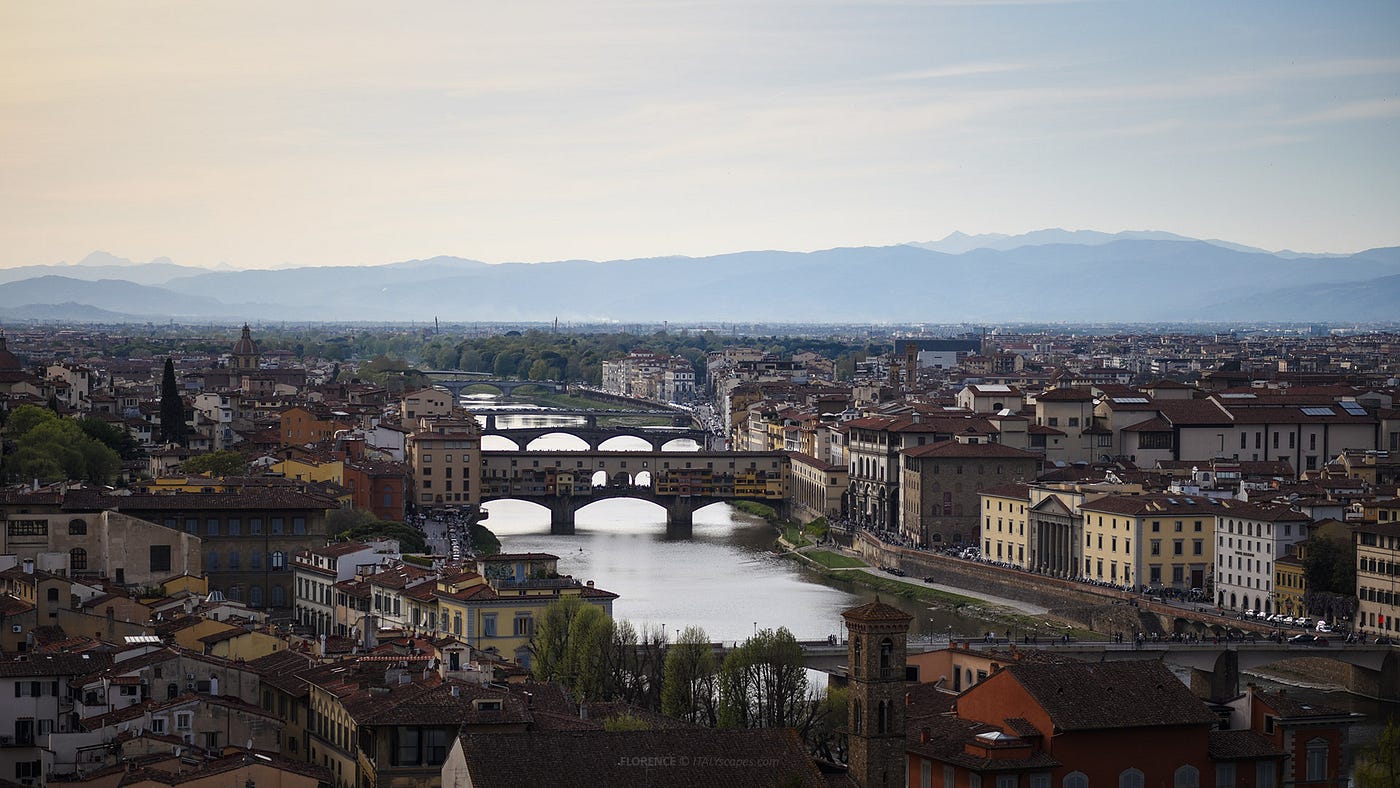
After the Uffizi, the route moves naturally to Ponte Vecchio, only 300 to 350 metres away. This is one of the easiest and most rewarding transitions in Florence, because the visitor leaves the museum and almost immediately reaches the river. Ponte Vecchio is the city’s oldest and most famous bridge, known for its built-in shops and goldsmith tradition. The best understanding often comes from pausing on the riverbank before crossing, because the bridge’s structure is clearer from the side.
Crossing Ponte Vecchio brings the route into the Oltrarno, the district beyond the Arno. From the bridge, the walk continues along Via de’ Guicciardini toward Palazzo Pitti, about 450 metres away. The palace and Boboli Gardens are too large for this compressed itinerary, so the exterior is enough. From there, the route moves toward Piazza Santo Spirito, another 450 metres away, for the second proper rest of the day. A 25- to 30-minute stop for coffee, gelato, or water is essential before the final climb.
The final destination is Piazzale Michelangelo, the classic panoramic terrace above Florence. From Ponte Vecchio, the walk is about 1.5 to 1.8 kilometres and takes 25 to 35 minutes, longer with pauses because of the uphill section. The most scenic route follows the south bank of the Arno, passes near Ponte alle Grazie, and climbs through San Niccolò and the Rampe del Poggi. Tired visitors can use a bus or taxi for this section.
Piazzale Michelangelo is the ideal ending because it visually gathers the entire day. From the terrace, visitors can identify the Duomo, Palazzo Vecchio, Santa Croce, the Arno bridges, Ponte Vecchio, and the dense historic centre. The square was created during 19th-century urban works and contains a bronze copy of David, echoing the morning visit to the Accademia. Spending 30 to 45 minutes here makes the route feel complete.
Dinner is best placed after the viewpoint, either in Oltrarno, San Niccolò, San Frediano, or near Santo Spirito. These areas offer a less monumental evening atmosphere than the Duomo zone. If returning to Santa Maria Novella station, the visitor should allow 25 to 30 minutes from Santo Spirito or about 15 to 18 minutes from Ponte Vecchio. The final message is simple: one day in Florence cannot include everything, but it can reveal the city’s essential structure if the route is focused, walkable, and paced with care.
메타데이터
- post_id
- a5af817df8bb
- slug
- florence-in-one-day-a-realistic-walk-through-the-renaissance-city-a5af817df8bb
- url
- https://medium.com/@ovidiu.tutunaru/florence-in-one-day-a-realistic-walk-through-the-renaissance-city-a5af817df8bb
- canonical_url
- https://medium.com/@ovidiu.tutunaru/florence-in-one-day-a-realistic-walk-through-the-renaissance-city-a5af817df8bb
- author_url
- https://medium.com/@ovidiu.tutunaru
- status
- ok
- fetched_at
- 2026-07-10 21:50:49