All You Need is a CANDU Attitude: A Beginner’s Guide to Canada’s Nuclear Reactors ⚛️🍁
CANDU Reactors are the crown jewel of the Canadian nuclear industry. Here’s why.
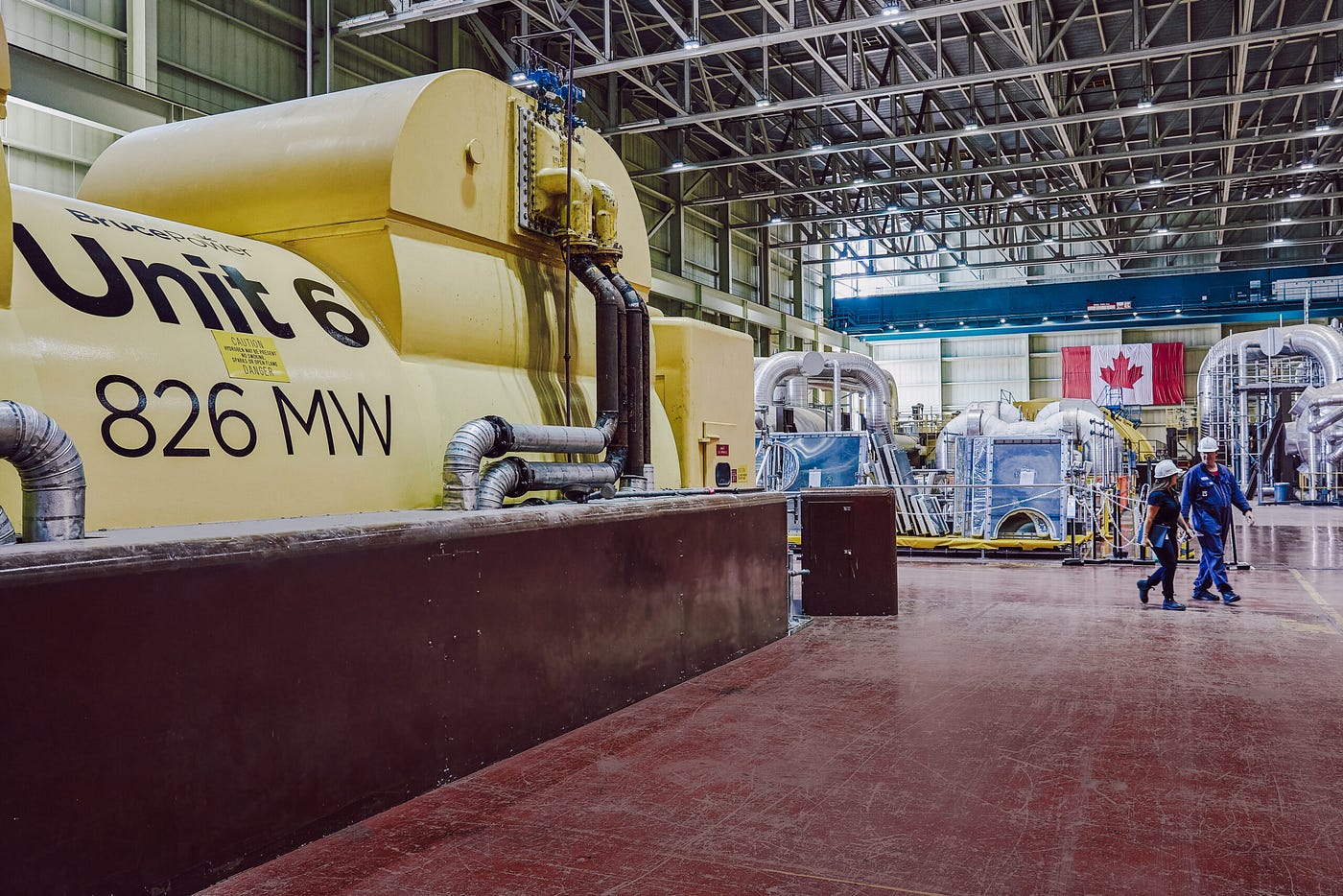
Bruce Power, Unit 6
All You Need is a CANDU Attitude: A Beginner’s Guide to Canada’s Nuclear Reactors ⚛️🍁
This was originally submitted as my first work term report to the University of Waterloo. Since then, the figures and numbers have been updated to reflect the current energy generation capacity in Ontario.
Preface
As the Province of Ontario plans for the future, it faces a significant impediment with energy production. Population growth, urbanization, and an increasingly electrified economy indicate that power demand in Ontario may double from 42,000 MW to 88,000 MW by 2050. Aligning with Canada’s Net Zero goals, the Government of Ontario is committed to ensuring that the expansion of the electricity grid will come from low-carbon-emitting sources. One of those sources is nuclear power, which accounts for about half of electricity output in Ontario.
Ontario Energy Output in 2024 (source: IESO)
In the future, Ontario’s reliance on nuclear power will only increase as electricity demand rises. This reliance on nuclear is due to many of its advantages as a viable source of electricity. Nuclear plants can reliably produce power for extended periods, unlike intermittent renewable sources like wind and solar. Designed to require less maintenance, nuclear power plants can deliver maximum power 92.5% of the time in a year. As aforementioned, nuclear power is also a low-carbon-emitting energy source that is environmentally friendly. According to historical data from 1971 to 2009, nuclear power prevented around 64 Gigatonnes of greenhouse gas emissions that fossil fuels would have otherwise produced. Furthermore, one uranium pellet will yield the same energy output as 480,000 litres of natural gas or 1 tonne of coal. Consequently, nuclear power has one of the highest energy densities of any source.
For this reason, uranium-fueled nuclear fission power emerges as the centrepiece in Ontario’s energy strategy to meet rising electricity demands. Uranium is a radioactive element with two primary isotopes: U-238 (non fissile) and U-235 (fissile). In general, nuclear fission is the process of splitting an atom’s nucleus. The heat from the nuclear fission of a Uranium atom is transferred to a coolant, which then dumps the heat into a steam generator. There, it follows a Rankine cycle, where water is turned into steam, steam then turns a turbine, and the turbine powers a generator to produce electricity. The steam is then cooled by a lake, river, or cooling tower and condensed back into water before being pumped back to complete the cycle.
Nuclear Fission Chain Reaction
By recognizing its reliability and environmental benefits, the provincial government has embarked on ambitious strategies to expand its nuclear output. The Darlington and Bruce Nuclear Generation Stations are undergoing reactor refurbishments to extend life to 2055 and 2064, respectively. Additionally, the provincial government has announced that the Pickering Nuclear Generation Station will soon start refurbishments. Beyond refurbishments, Ontario plans to build four new Small Modular Reactors (SMRs) at the Darlington plant to produce an additional 1,200 MW of electricity. There are also plans to build a third nuclear generation station (called Bruce C) at the Bruce Site to address increasing energy demands.

Pickering Nuclear Generating Station
Despite all these plans to expand nuclear, the universal stigma against this form of power generation remains high. Only 55% of Canadians are in favour of the use of nuclear energy. The caution with nuclear power comes from concerns over its safety. Egregious disasters like the Three Mile Island and Chernobyl incidents have worsened the public perception of nuclear power. However, these incidents represent the worst-case scenarios.
Nuclear energy is one of the safest forms of electricity production, with a death rate of only 0.03 per terawatt-hour. Renewables such as wind and solar have similar rates of 0.04 and 0.02, respectively, whereas fossil fuels such as coal and oil have rates of 24.62 and 18.43, respectively. Moreover, outdated reactor designs and inadequate security measures are to blame for previously mentioned nuclear disasters. The lessons learned have helped inform the Canadian Nuclear Safety Commission (CNSC), which results in the nation’s nuclear industry having some of the strictest safety regulations in the world. This omnipresent commitment to safety is ingrained in the nuclear industry’s culture, emphasizing continuous improvement, rigorous training, and transparent communication.
Within this context of safety, Canadian Deuterium Uranium (CANDU) reactors stand out. Engineered in Canada, CANDU reactors utilize deuterium oxide (also known as heavy water) as a moderator and coolant and unenriched uranium as the fuel. Deuterium is an isotope of hydrogen with one proton, one electron, and one neutron. In any case, CANDU is one of the safest nuclear reactor designs in the world and has resulted in zero deaths to date. Outside of Canada, nuclear plants in Pakistan, Argentina, South Korea, Romania, and China currently employ CANDU reactors or have in the past. The impeccably clean record of CANDU reactors is due to the robust safety systems that are in place.
Shutdown System 1: Cadmium Rods
Among the array of safety systems in CANDU reactors, Shutdown System 1 (SDS 1) is essential in ensuring reactor stability and control. SDS 1 is a fail-safe mechanism that promptly shuts down reactor power in an emergency, mitigating the risk of overheating and fuel damage. This would primarily be used when reactor power gets too high. SDS 1 consists of 26 or 28 cadmium control rods suspended above the reactor core, ready to deploy at any moment. The CANDU design utilizes cadmium because of its neutron absorption properties, which reduce a nuclear reactors’ criticality until it reaches zero. The International Atomic Energy Agency denotes criticality (k) as the capability to sustain a nuclear fission chain reaction.

Criticality (k) of a Nuclear Chain Reaction
A criticality of 1 (critical) will warrant a self-sustained nuclear chain reaction. A criticality less than 1 (subcritical) will decrease power, and a criticality more than 1 (supercritical) will increase power. Consequently, cadmium rods aim to ensure subcriticality in the event of a crisis to reduce reactor power in a supervised manner.
In a CANDU reactor, SDS 1 will detect any rapid increase in power using triplicated logic. Two out of three sensors must detect a power spike to cause a shutdown system to activate. Thus, even if one sensor is faulty and has incorrectly identified an increase in reactor power, redundancy is in place. Electronic clutches hold the cadmium control rods, and to activate those, the sensors cut off the power supply. Therefore, if anything cuts the power supply, the control rods are deployed still (called a fail-safe mechanism), thus maintaining safety.
Because the cadmium rods are hovered above the reactor core, the weight from the force of gravity helps the rods drop down into the reactor core to maintain safety. In addition to this, the cadmium rods are also spring assisted to go downwards even faster, allowing a CANDU reactor to shut down within a few seconds. Even in abnormal circumstances, SDS 1 avoids a nuclear incident quickly. Above electronic clutches, a cable suspends the control rods, which runs over a pulley. When engaged, the rods have no obstruction, but if retraction is needed, a motor will pull the rods up and allow the reactor to return to its original state. Criticality rises once again, and the plant can generate power.
SDS 1 is essential in ensuring worker, public, and environmental safety. By providing a dependable and effective means of decreasing criticality and absorbing neutrons using cadmium, SDS 1 ensures that CANDU reactors respond quickly to address any issues. Nonetheless, the dynamic approach to nuclear safety designed for CANDU reactors still has many other parts.
Shutdown System 2: Gadolinium Nitrate
In addition to cadmium control rods, Shutdown System 2 (SDS 2) is another salient safety feature implemented in CANDU reactors to provide additional oversight into reactivity levels. SDS 2 does not rely on SDS 1 to function, and both systems are independent.
SDS 2 uses gadolinium nitrate, which is also a neutron-absorbing compound like cadmium. It is a solution in water and decreases the criticality of the nuclear reactor by reducing the fission power. Gadolinium nitrate is colloquially called a “neutron poison” due to its effectiveness as a shutdown system. During regular operation, the gadolinium nitrate is stored in tanks beside the nuclear reactor, alongside the cadmium rods.

Gadolinium Nitrate and Cadmium Control Rod Safety Systems in a CANDU Reactor
Pressurized helium activates the gadolinium nitrate, pushing the solution to flood the reactor. Quick-acting valves (QAV) separate these two components, which open when a signal from the triplicate logic sensors is received. Like the cadmium control rods, the injection of gadolinium nitrate ensures the reactor power swiftly goes down, preventing any loss of regulation. Combining a physical system (SDS 1) and a chemical system (SDS 2), which act independently, gives CANDU reactors unprecedented safety. This dyad aligns with the “golden rule of reactor safety,” which aims to control reactor power, cool the fuel, and contain radioactive elements from reaching the environment. Preventing public radiation exposure is paramount; this rule informs all systems within a CANDU reactor.
Emergency Coolant Injection
In addition to the shutdown safety systems mentioned above, CANDU reactors have contingencies in place during the event of a Loss of Coolant Accident (LOCA). Heavy water is the moderator and coolant within a CANDU reactor. A pressure boundary is a physical barrier that separates this high-pressure reactor coolant system from the surrounding environment. However, if this pressure boundary breaks, the coolant water will escape faster than the system can replace it, which will cause a loss of coolant accident. If there is a lack of coolant, the reactor could heat up and release a large amount of radiation, endangering the populace.
To prevent a dangerous increase in reactor temperature during a Loss of Coolant Accident, an Emergency Coolant Injection (ECI) delivers a rapid and controlled coolant injection into the reactor core, replenishing the depleted coolant inventory. This auxiliary injection of coolant helps to stabilize reactor conditions, prevent fuel damage, and maintain core cooling capability until the restoration of standard cooling systems or until the shutdown of a reactor.
Triplicated logic sensors like those of SDS 1 and SDS 2 trigger the ECI to detect if the pressure in the Heat Transport System drops below 5.5 MPa or if the temperature rises too much. When this happens, the coolant is injected directly into the Primary Heat Transport System to cool the fuel. Instead of replacing the original heavy water coolant with more heavy water, the ECI delivers demineralized light water. Like the gadolinium nitrate in SDS 2, tanks beside the CANDU reactor hold this light water, and high-pressure nitrogen gas pushes it out.
The initial supply of the ECI — also sometimes called Emergency Core Cooling (ECC) — has exceedingly high pressure and can last up to three minutes to allow for the reactor to cool. A second supply at a lower pressure will feed into the reactor, which can last for an additional thirty minutes. Lastly, all the deuterium oxide coolant that leaks from the reactor is collected in the reactor building sump. This basin can then be recirculated back into the reactor to cool the fuel indefinitely.

High Pressure, Low Pressure, and Reactor Sump Injections of Emergency Coolant
Implementing all the ECI systems in CANDU reactors demonstrates an initiative-taking approach to contingency planning. Using a sump to collect the escaped coolant to be later pumped back into the reactor is a valuable and practical nuclear engineering design that ensures a CANDU reactors’ continued safe and steadfast operation, even under the most challenging circumstances.
Negative Pressure Containment System
The last barrier to prevent a radiation leak to nearby inhabitants and maintain safety is the Negative Pressure Containment (NPC) system. Negative pressure is an isolation technique where the air pressure inside a room or closed space is lower than the air pressure outside that space. An exhaust system continuously removes more air than is being supplied, creating negative pressure. This isolation technique is commonly used in hospitals to prevent cross-contamination of airborne diseases. Likewise, a CANDU reactor utilizes negative pressure to prevent the escape of radionuclides and keep the public safe.
A Vacuum Building maintains negative pressure at a nuclear station with multiple CANDU reactors. The Vacuum Building has a gauge pressure of 90 kPa, while the rest of the reactor containment sits at 3 kPa. In addition to keeping contaminants inside, the negative pressure containment system serves the secondary purpose of holding the radioactive steam from a LOCA. The negative pressure holds the internal radioactive atmosphere for as long as possible.
Implementing negative pressure containment systems in CANDU reactors exemplifies the nuclear industry’s commitment to safety and environmental protection. These systems provide a robust and reliable means of mitigating the consequences of potential accidents and ensuring the long-term sustainability of nuclear energy generation.
Conclusion
The safety systems implemented in Canadian Deuterium Uranium reactors play a pivotal role in ensuring the unfailing operation of nuclear power generation worldwide. Shutdown System 1 uses cadmium rods to absorb neutrons and decrease reactor power. Similarly, Shutdown System 2 uses gadolinium nitrate as a neutron poison to achieve the same result. During a Loss of Coolant Accident, an Emergency Coolant Injection can provide high-pressure replacement coolant for three minutes and low-pressure coolant for thirty minutes. Lastly, the Negative Pressure Containment, facilitated by a Vacuum Building, is designed to keep any radioactive contaminants inside the nuclear power plant. These safety systems mitigate the consequences of accidents and protect the public.
The comprehensive approach to nuclear safety in CANDU reactors renects an overall commitment of the entire Canadian nuclear industry. Facilitated by the Canadian Nuclear Safety Commission, CANDU reactors implement dedicated contingency planning, redundancies, and robust engineering design as part of the overall nuclear safety culture.
As Ontario continues to pursue its energy goals for the future, the safety systems of CANDU reactors stand firm. CANDU reactors demonstrate a capability to respond effectively to various operational challenges to dispel the negative press on nuclear power. Ontario can confidently navigate the evolving energy landscape while upholding its commitment to sustainability and public welfare.
메타데이터
- post_id
- a5b24ef53860
- slug
- all-you-need-is-a-candu-attitude-a-beginners-guide-to-canada-s-nuclear-reactors-️-a5b24ef53860
- url
- https://medium.com/@shaanbanday/all-you-need-is-a-candu-attitude-a-beginners-guide-to-canada-s-nuclear-reactors-%EF%B8%8F-a5b24ef53860
- canonical_url
- https://medium.com/@shaanbanday/all-you-need-is-a-candu-attitude-a-beginners-guide-to-canada-s-nuclear-reactors-%EF%B8%8F-a5b24ef53860
- author_url
- https://medium.com/@shaanbanday
- status
- ok
- fetched_at
- 2026-06-25 07:00:49




