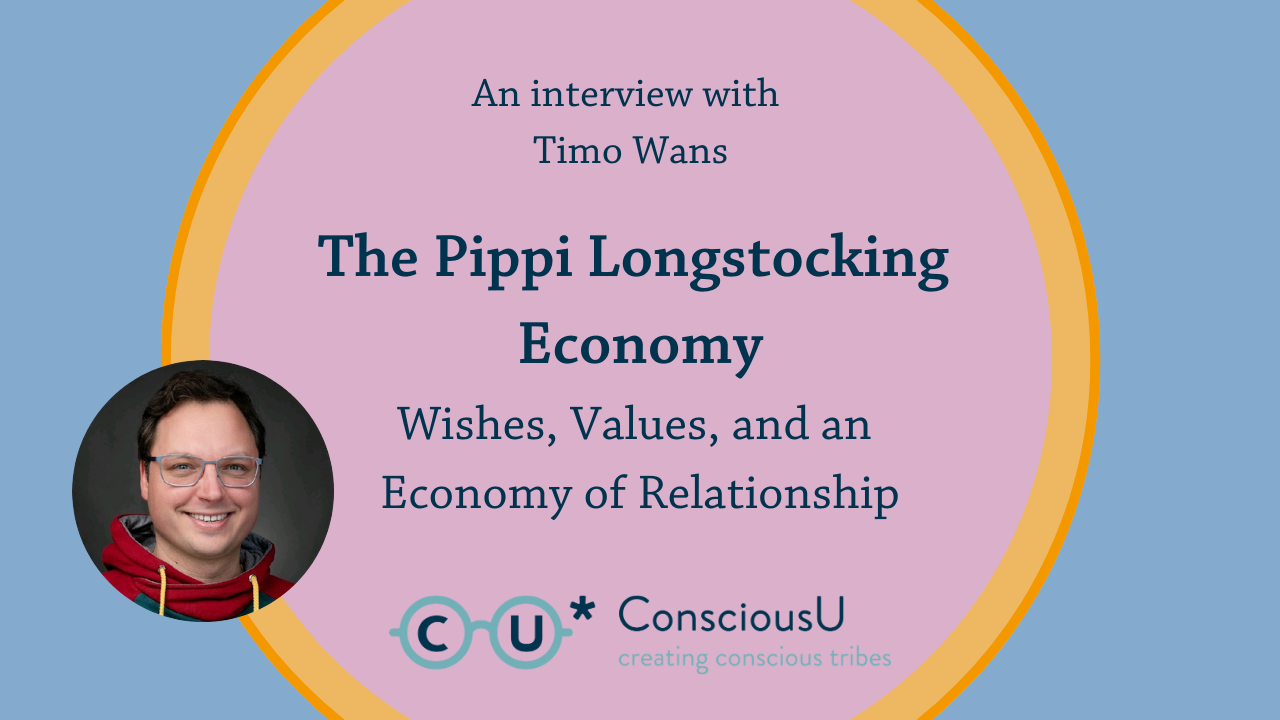
The Pippi Longstocking Economy: Wishes, Values, and an Economy of Relationship
An interview with economic sociologist and entrepreneur Timo Wans
The Pippi Longstocking Economy: Wishes, Values, and an Economy of Relationship
An interview with economic sociologist and entrepreneur Timo Wans
For our ConsciousU newsletter, we conduct a monthly interview. This is an excerpt, you can watch the complete interview with Timo Wans here (62 mins). To access all interviews with change makers at the intersection of inner work and collective action, join our free Conscious Tribes Community!
Community-supported economics is, in essence, insurance for the moment when the current system may no longer work.
**Timo Wans** is an economic sociologist who works with organisations and communities to develop solidarity-based funding models. His focus lies on designing processes that bring together transparency, needs-orientation, and the quality of relationships. Through Myzelium, he supports clients and projects in establishing contribution rounds as a social process — one that does not place profit at the centre, but rather prioritises needs, trust, relationships, and community.
Timo, what was your path into community-supported economics?
I never really fitted into existing systems, because I can’t do things that don’t interest me. I was always looking for ways to bring social, political and economic aspects together. During the economic crisis, I was studying at university and wanted to understand how the crisis of capitalism had come about. Economic sociologists explained it to me, but they left me with one question: ‘What do we do now?’
At some point, I came across the community-supported agriculture movement. What I encountered there initially felt like a kind of ‘Pippi Longstocking economics’ — they simply did things the way they pleased. Yet that experience led me to start a solidarity-based agriculture project myself, and over seven years ago I began to apply this concept to other areas as well.
How does the community-supported economy work?
In a community-supported economy, the emphasis is on transparency and inclusivity. For consumers, this means giving up the role of customer and instead taking on the role of member wherever they are involved. As a consuming member in such a system, I am a co-entrepreneur and, for example, take on one two-hundredth of the entrepreneurial responsibility.
In the classic market economy, entrepreneurs always bear the entire risk — even when there is little opportunity to make large profits, such as when running a zero-waste shop. The solution is to share that risk with all the people who want this service: by committing to consume, they take on a share of the operating costs.
Community-supported economics is often not about operating like the market, but about building an economy you actually want as an entrepreneur — building a world that makes sense to you.
It is about clarity and personal vision: ‘What would I do if I could truly do what I wanted, and convince people to finance it?’ Community-supported economics offers a business model that makes this possible. In the conventional market, this doesn’t work, because why should anyone take responsibility for what I want? As a result, in a sense everyone loses out — and above all, the planet does. In a community project, by contrast, we operate on the basic principle of taking good care of our own needs and those of the planet.
Capitalism is characterised by competitive relationships, even between entrepreneurs and customers. Entrepreneurs want more from customers than they are willing to pay, while customers want to pay less than what entrepreneurs actually need. The community-supported economy, by contrast, is based on transparency and inclusivity. In the shops we support, a key concern is ensuring that everyone can shop there. This is made possible by members contributing different amounts according to their means, while still being able to consume as much as everyone else. In this model, people who would otherwise be excluded from the conventional market because they have too little do get to participate. That is precisely what the contribution rounds are for.
What are contribution rounds and how do they work?
The first step of the community-supported approach is to clarify what the offer should look like, who has this need, and what is required to bring it into the world in a good way. In community building, an essential part of the process is structured in such a way that the entrepreneur, or group of people, engages others who say, ‘Yes, that’s exactly what the world needs.’ In doing so, participants give something like advance trust: they assume that the entrepreneurs are acting honestly and will do their best. Members, in turn, are told clearly what level of responsibility they need to take on so that, in the end, the project works for everyone.
This is then formalised by each member during the contribution round. First, it is stated clearly: ‘This is what I — or we, as entrepreneurs — would like to offer. If enough people take responsibility for this now, it can become a reality.’ Each individual then reflects: ‘What privileges, opportunities and living conditions do I have? And what contribution can I make?’ During the contribution rounds, figures (aka the needs of the provider) are made transparent– not to increase control, but because knowledge is necessary to take on responsibility in the first place, and to build confidence that the business model can work.
There are then several rounds in which we try to gather the required financial resources. There are many different ways of moderating contribution rounds. I usually proceed as follows: in the first round, I say, ‘Everyone pays what they want.’ I do this deliberately, to show that this principle on its own is insufficient, because usually the target has not yet been reached. This is when the questions begin: how important this offer is to each person, and where they might be able to shift something in their own consumption habits. For example, many people spend around 100 euro a month on subscription services; that money could, so to speak, be reallocated from the old world to the new. There are usually two further rounds, and in the end, you typically raise another 30 per cent on top.
The basic idea of community-supported economics is to turn towards the world on your doorstep and make many things possible — each person within the scope of their financial means, or through other forms of privilege, such as access to a lawyer.
This, too, can be shared within a contribution round. Imagine stepping out of your front door and finding multi-generational housing, a day-care centre, a car-sharing scheme, a vegan restaurant, a clothing shop and a zero-waste store — all made possible through collective effort. In the German city of Mannheim, for example, this is already a reality, with five projects located around twenty minutes apart.
What happens emotionally in these contribution rounds, especially for those who have ‘less’ and those who have ‘more’?
When the goal is reached, it is often a deeply emotional moment. People sometimes begin to cry, because they realise that they have been handed a great deal of power. They also see that the much-feared ‘free loader’ — the person who exploits the community — simply does not exist. People who have very little do not take advantage of this model. Those who have too little are, in fact, highly practised at giving more than they can afford so they can remain part of the community. The real problem lies elsewhere: those who have a lot often contribute too little in proportional terms, even if their absolute contribution is higher than that of others.
People with little money tend to spend a great deal of time within community, because they often have no real option to withdraw; they can only turn towards others. Wealthier people, by contrast, almost always have the option to leave. In doing so, they withdraw from the shared potential of society. If their money were instead to flow into community contexts, it would also nurture their own sense of security and closeness. And if everyone truly acted in line with their means, we would no longer face funding problems for anything at all.
At first glance, contribution rounds appear to be purely a financing tool. But at heart, they are something like the emotional and relational high point of this way of doing business. Once you engage with them, you very quickly arrive at questions such as: ‘What is your relationship with money?’ and ‘What is your view of human nature?’
What role does inner work play within the community-supported economy?
We have different types of members. What they have in common is that they need, or at least would like to have access to, a service that is in danger of disappearing. We do not have to convince everyone of this new model; instead, we create an economy that works in times of crisis. People then join in, even if the rules of the game are different from what they are used to.
In community-supported economies, much like at a family gathering, you encounter the full spectrum of people. Perhaps four out of a hundred would say that they do inner work. Personally, however, I find it far more interesting to observe those who have already done inner work — or practise it in their everyday lives without naming it as such. Take grandmothers in villages, for example: how well organised some of them are, and how much self-care they practise in their daily lives. They hold families together — and that, too, is economics. The same is true of people who do care work and manage to make everyday life function, for the most part, joyfully.
What is interesting is that this way of doing business sets certain trigger points, and you begin to see where each individual stands. This then raises the question of how many opportunities you want to build into the system to allow people to reflect on these issues within the economic model itself.
What role could the community-supported economy play for us and for our world in the coming years, decades — perhaps even centuries?
I regard community-based economics as a form of insurance. We insure ourselves against all kinds of risks, yet we tend to assume that the social system we have built will simply continue to function. But in the future, we may be living in a radically ageing society, perhaps in a world that is three degrees warmer. There is no company that has a viable business model for that scenario.
Community-supported economics is, in essence, insurance for the moment when the current system may no longer work.
At the same time, I see community-supported economics as a way of negotiating fundamental questions with people — not sometime in the future, but now. ‘What are our needs?’ ‘What resources do we have at our disposal to meet them?’ ‘How can we take responsibility for this together?’ Training and building these capacities is what we offer through my company Myzelium.
To access all interviews with change makers at the intersection of inner work and collective action join our free Conscious Tribes Community.
The Conscious Tribes Community supports you with ideas, practical tools, and free workshops to develop your consciousness and to build deep and authentic relationships.
메타데이터
- post_id
- a5c94b72be25
- slug
- the-pippi-longstocking-economy-wishes-values-and-an-economy-of-relationship-a5c94b72be25
- url
- https://medium.com/@ConsciousU/the-pippi-longstocking-economy-wishes-values-and-an-economy-of-relationship-a5c94b72be25
- canonical_url
- https://medium.com/@ConsciousU/the-pippi-longstocking-economy-wishes-values-and-an-economy-of-relationship-a5c94b72be25
- author_url
- https://medium.com/@ConsciousU
- status
- ok
- fetched_at
- 2026-07-07 10:08:12