Why Medical Q&A Sessions Break AI Subtitles More Than Presentations
Unstructured interaction, multi-speaker overlap, and voice separation challenges
Why Medical Q&A Sessions Break AI Subtitles More Than Presentations
Unstructured interaction, multi-speaker overlap, and voice separation challenges
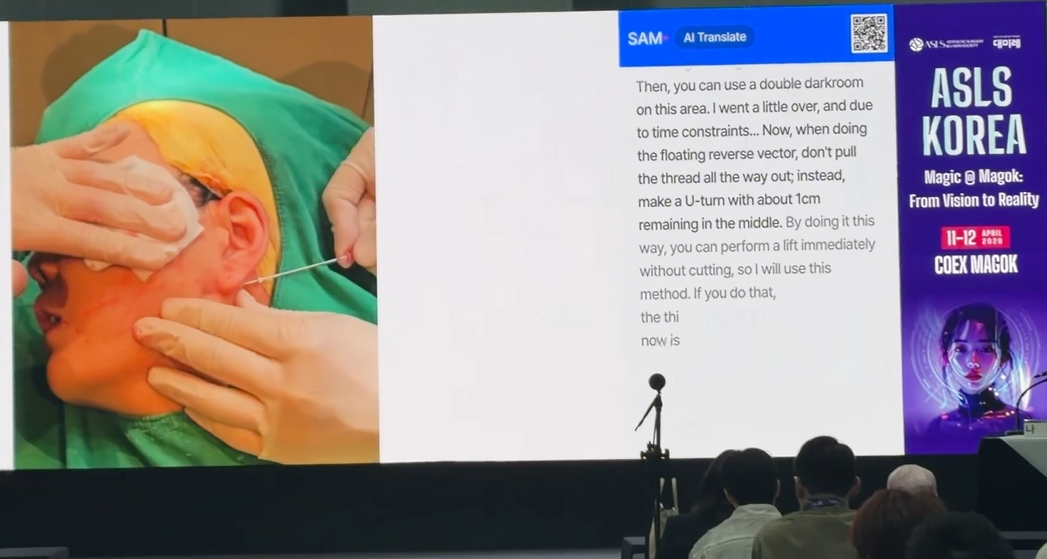
Most people assume that fast presentations are the hardest scenario for speech recognition.
In reality, the most difficult situation in medical environments is the Q&A session.
When structure disappears
Presentations usually follow a predictable structure. Even if the speech is fast, there is still a clear flow.
Q&A sessions are different.
Questions are unpredictable. Answers are formed in real time. Sentences are often incomplete, interrupted, or revised while speaking.
For a system, this removes the patterns it depends on.
When multiple voices collide
One of the biggest challenges in Q&A sessions is multi-speaker overlap.
A participant may begin asking a question while the speaker is still finishing a sentence. In some cases, two voices briefly overlap.
For humans, this is easy to resolve. We naturally focus on the dominant speaker.
For machines, however, overlapping speech creates ambiguity. It becomes unclear which voice should be prioritized, and which words belong together.
Why voice separation becomes critical
To handle overlapping speech, systems need a process often referred to as voice separation.
Voice separation attempts to distinguish and isolate individual speakers from a mixed audio signal.
Without this step, multiple voices are treated as a single stream, which leads to fragmented subtitles and incorrect interpretation.
Even a short overlap can disrupt the entire sentence structure.
The problem of unstable context
Q&A sessions also introduce rapid context changes.
A question may reference something mentioned earlier, skip key details, or introduce new terms without explanation.
For human listeners, context fills these gaps.
For systems, missing context creates uncertainty, especially when combined with overlapping voices.
Incomplete thoughts and real-time correction
In many cases, answers are not delivered in one clean sentence.
Speakers often start with a partial explanation, add clarification, and sometimes correct themselves mid-sentence.
This creates a moving target.
Should the system output immediately, or wait for a more complete version?

Either choice affects the quality of subtitles.
Why translation becomes even more fragile
When speech recognition becomes unstable, translation becomes even more difficult.
Translation depends on correctly grouped and ordered input.
If voice separation fails or multi-speaker overlap is not handled properly, the translated output can drift significantly from the intended meaning.
Conclusion
The biggest challenge in medical speech environments is not speed.
It is the combination of unstructured interaction, multi-speaker overlap, and the need for accurate voice separation.
Q&A sessions expose these limitations more clearly than presentations, because they remove the structure that most systems rely on.
If you’re interested in a more detailed breakdown of how these issues appear in real medical environments, I’ve summarized it in a separate post.
메타데이터
- post_id
- a5eab44bf8a1
- slug
- why-medical-q-a-sessions-break-ai-subtitles-more-than-presentations-a5eab44bf8a1
- url
- https://medium.com/@thegame.kr/why-medical-q-a-sessions-break-ai-subtitles-more-than-presentations-a5eab44bf8a1
- canonical_url
- https://medium.com/@thegame.kr/why-medical-q-a-sessions-break-ai-subtitles-more-than-presentations-a5eab44bf8a1
- author_url
- https://medium.com/@thegame.kr
- status
- ok
- fetched_at
- 2026-06-13 16:00:06





