The Barber’s Killer Rays
How ultraviolet light came to symbolize cleanliness, safety, and scientific progress
The Barber’s Killer Rays
How ultraviolet light came to symbolize cleanliness, safety, and scientific progress

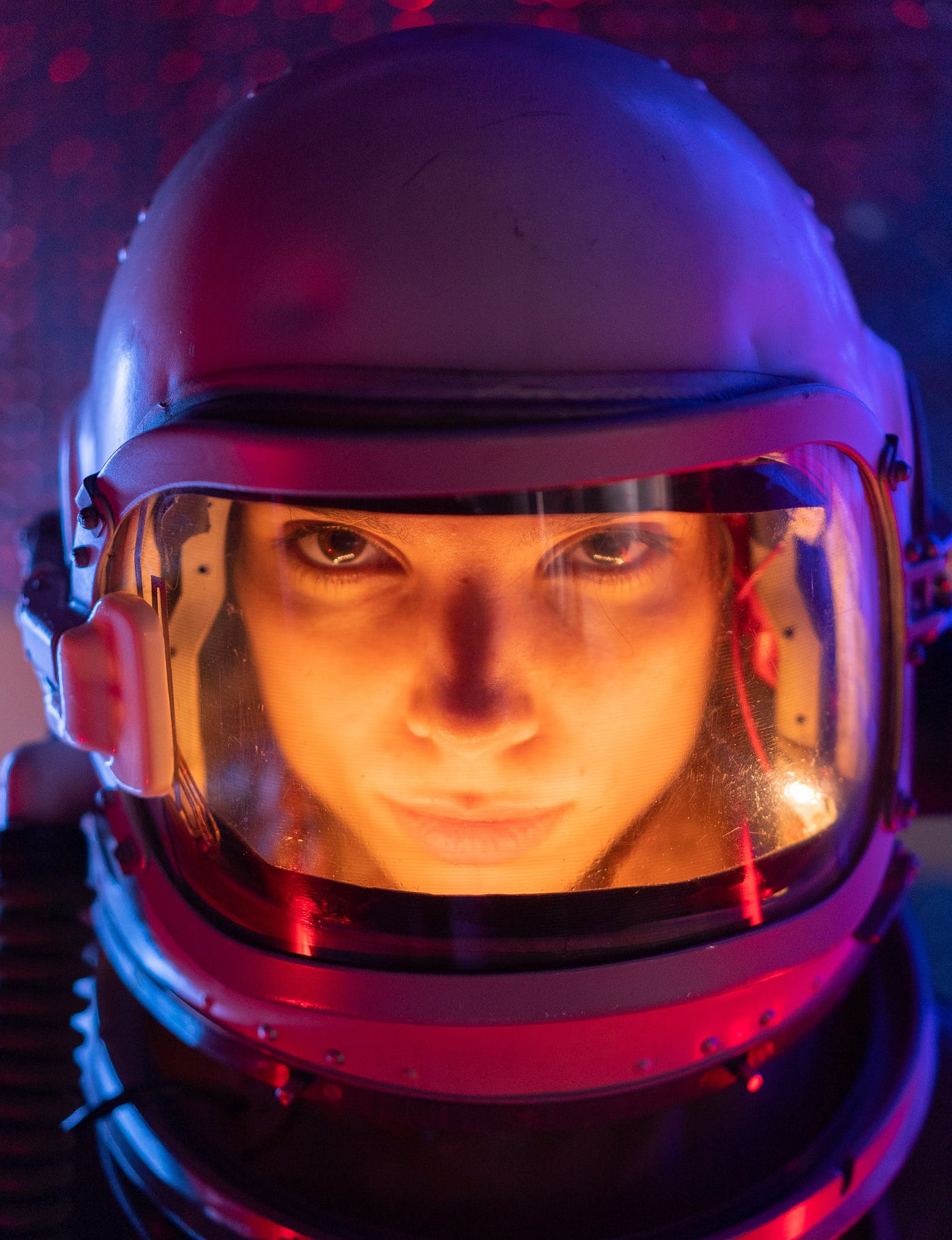
Image conceived by author, realized with AI and Photoshop
To the average customer stepping inside, a progressive barbershop in the first years of the twentieth century would have offered the reassuring, respectable smells of civilized grooming: bay rum, warm lather, talc, and hair tonic. Beneath that perfumed surface lay everything the proprietor could not entirely conceal: sweat, beard clippings, damp linen and wet wool, boot leather and street mud, and the smoke and chew of tobacco in all its forms — cigars, pipes, cigarettes, and plug. Then came the sterner odors of germ-killing reform: formaldehyde, carbolic acid, and the medicinal bite of ethyl alcohol.
Before the barbershop became a tidy stronghold of talc, tonic, and disinfectant, it was a crossroads of contagion. For centuries, the same razor might pass from cheek to cheek, the same unwashed comb through one scalp after another, the same soiled brush into a succession of beards, while towels, sponges, powder puffs, and clipping cloths gathered their invisible cargo of skin, hair, pus, blood, and sweat. The barber’s chair offered grooming, gossip, and respectability, but it also offered pathogens opportunity: ringworm, impetigo, lice, scabies, erysipelas, and the stubborn fungal infection long known as barber’s itch could travel by the ordinary instruments of the trade. Long before germ theory entered sanitary science, these dangers were hidden, disguised by fragrance and by the reassuring snap of linen that was often anything but clean. The twentieth-century reforms that demanded sterilized tools, fresh towels, washable surfaces, and regulated sanitation were therefore not mere bureaucratic fussiness, but a belated recognition that the neighborhood barbershop, for all its warmth and sociability, had once served — unintentionally but efficiently — as a neighborhood exchange for microbes, passing them from one human head to the next.
In the United States, barbershop reform came state by state, through a patchwork of licensing laws that gradually pulled the barber’s trade into the new sanitary order. Minnesota led the way in 1897, passing the first barber-licensing statute and binding the occupation to examination, inspection, sanitation, and official oversight. Within a few years, the clean barbershop had become a Progressive Era ideal.
Missouri’s regulations, discussed in 1902 in the Journal of the American Medical Association under the title “The Aseptic Barber Shop,” reveal how far the new thinking had advanced. Floors were to be scrubbed with hot water and lye. Razors, clippers, and scissors were to be dipped in formaldehyde. Brushes, combs, and towels were to be sterilized. Sponges and powder puffs — those soft, intimate reservoirs of other men’s skin and sweat — were banished altogether. Visible eruptions of the face or scalp were no longer merely unpleasant sights in the shaving chair; they were warnings written on the skin. By 1905, New York had gone further, formally requiring implements to be sterilized between uses. Other states soon followed, each confronting the same practical problem at the heart of modern barbering: how to kill a pathogen on a comb, razor, or pair of shears quickly, reliably, and cheaply enough that a busy barber would actually do it between customers.
The UV cabinet entered barbershop culture as a response to the new sanitary unease over invisible contamination, but it arrived with genuine scientific credentials. In 1877, the physician Arthur Downes and the researcher Thomas P. Blunt published experiments in the Proceedings of the Royal Society of London showing that sunlight could inhibit or kill microorganisms — the first systematic proof of light’s germicidal power. In the 1890s, British botanist H. Marshall Ward carried the work further, helping to show that the most bactericidal portions of sunlight lay not in warmth or ordinary brightness, but in the shorter, more chemically active rays — especially the violet, blue, and ultraviolet regions of the spectrum. Light was no longer merely illumination; it was beginning to appear as a force in its own right, one that could be enlisted in the campaign against disease.
The medical promise of this new science soon gained international recognition. In 1903, Niels Ryberg Finsen received the Nobel Prize in Physiology or Medicine for his use of concentrated light radiation to treat lupus vulgaris, the disfiguring cutaneous form of tuberculosis. Finsen’s work did not make ultraviolet light a general cure for tuberculosis, but it gave phototherapy legitimacy and joined two powerful ideas: the same invisible energies that could injure microbes could, under controlled conditions, be directed toward healing diseased tissue.
By the 1930s, artificial ultraviolet germicidal lamps had become a recognized sanitary technology, deployed especially in hospitals and other institutional settings. Low-pressure mercury lamps emitting around 254 nm — squarely within the UV-C band, the range most damaging to microbial DNA — became the standard germicidal source. Barbershops took up the technology eagerly. From roughly the mid-twentieth century onward, small tabletop UV cabinets became familiar fixtures, glowing with a reassuring violet light over razors, shears, combs, and clipper guards. They functioned at once as equipment and as theater: visible proof that the shop was modern and serious about hygiene. The cheerful neighborhood barbershop had become, in the eyes of reformers, something closer to a miniature operating theater — and the barber, whether he liked it or not, had been drafted into the work of hygiene.
For much of the twentieth century, the ultraviolet cabinet was a familiar emblem of sanitary modernity in barber and beauty shops across the United States and abroad. Its blue-violet glow suggested science at work: combs, scissors, razors, and clippers bathed in purifying rays behind glass. To customers it was reassuring; to inspectors and shop owners it offered visible proof that the old casual habits of the trade had given way to something cleaner, regulated, and modern. For decades the UV cabinet held that symbolic place beside the barber chair — part appliance, part visible pledge of cleanliness.
As infection-control standards tightened, the old aura around UV light began to dim; its reputation as a mighty germ killer in barber shops could no longer bear the full weight of modern scrutiny. Regulators and microbiologists recognized that ultraviolet light could not reliably reach instruments shadowed by hair, oil, dried blood, skin scale, or simple geometry — that the light, however blue and purposeful it looked, could not turn corners. What had once seemed a triumph of ultraviolet disinfection came to look more like a well-lit storage box. The cabinet did not disappear overnight; it slipped slowly from requirement to relic, surviving in some shops less as a reliable sterilizer than as a glowing artifact of an earlier faith in visible cleanliness.
UV light never lost its germicidal power; it lost its reputation as a casual all-purpose sterilizer. Controlled UV-C systems remain widely used to disinfect air, water, and exposed surfaces — in hospitals, laboratories, ventilation systems, and water-treatment facilities — where dose, exposure time, distance, and line of sight can be engineered with precision. It remains a powerful tool, but only under conditions that respect its limits: UV light cannot clean dirt, penetrate debris, or reach what shadow hides.
The loss is not merely technical. Something aesthetic vanishes when barber and beauty shops discard those blue-lit boxes. They surrender a small piece of mid-century theater: the glowing promise of cleanliness, the faint laboratory glamour beside the comb jar, clipper oil, curlers, shears, and tonic bottles, the sense that science itself is humming quietly behind the glass. Modern disinfectants may be better, faster, and more reliable, but they are also less visible. A jar of hospital-grade solution does its work without romance. The old UV box, even when overrated, gives the shop a peculiar charm — part appliance, part shrine, part electric talisman against the unseen.
메타데이터
- post_id
- a5fd41d19cc1
- slug
- the-germicidal-blue-glow-a5fd41d19cc1
- url
- https://medium.com/@jchjcck/the-germicidal-blue-glow-a5fd41d19cc1
- canonical_url
- https://medium.com/@jchjcck/the-germicidal-blue-glow-a5fd41d19cc1
- author_url
- https://medium.com/@jchjcck
- status
- ok
- fetched_at
- 2026-06-09 15:37:30