From Shared Vocabulary to Semantic Control
Why ODPV is becoming the semantic quality layer for AI-ready data product standards
From Shared Vocabulary to Semantic Control
Why ODPV is becoming the semantic quality layer for AI-ready data product standards
Data product standards need more than schemas. They need a shared language that stays consistent as the standards evolve. This becomes more important when the standards are not isolated documents, but a family of specifications that work together across product descriptions, catalogs, graphs, governance, value tracking, and AI agent interaction.
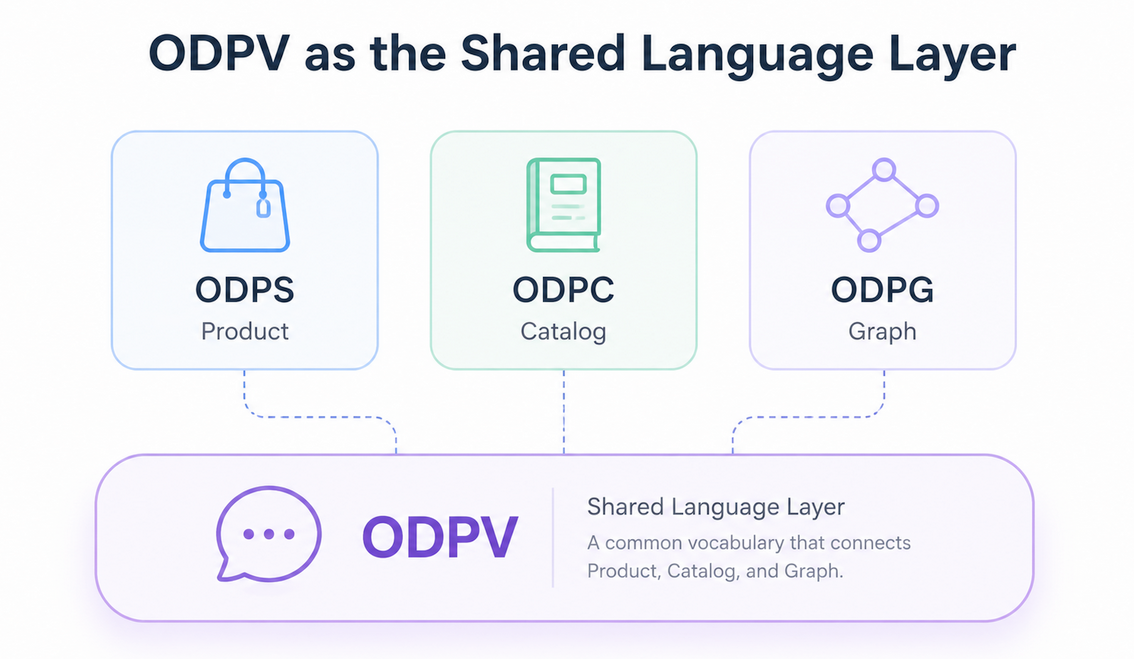
This is why the Open Data Product Vocabulary, ODPV, matters. ODPV gives the Open Data Products standards family a common language. It defines stable reference terms for data products, catalogs, graphs, governance concepts, value concepts, and relationship names. It is a practical controlled vocabulary, not a heavy ontology, and its role is to help specifications, tools, platforms, catalogs, graphs, and AI systems reuse the same terms with the same meaning. ODPV positions itself as the shared vocabulary layer across the Open Data Product family.
Why shared language is not enough
A vocabulary gives you approved terms and meanings. That is useful, but it is not enough when a standards family keeps evolving. New objects appear. New relationships are added. Existing terms get reused in new contexts. A schema might introduce a term that sounds correct, but is not yet part of the shared vocabulary.
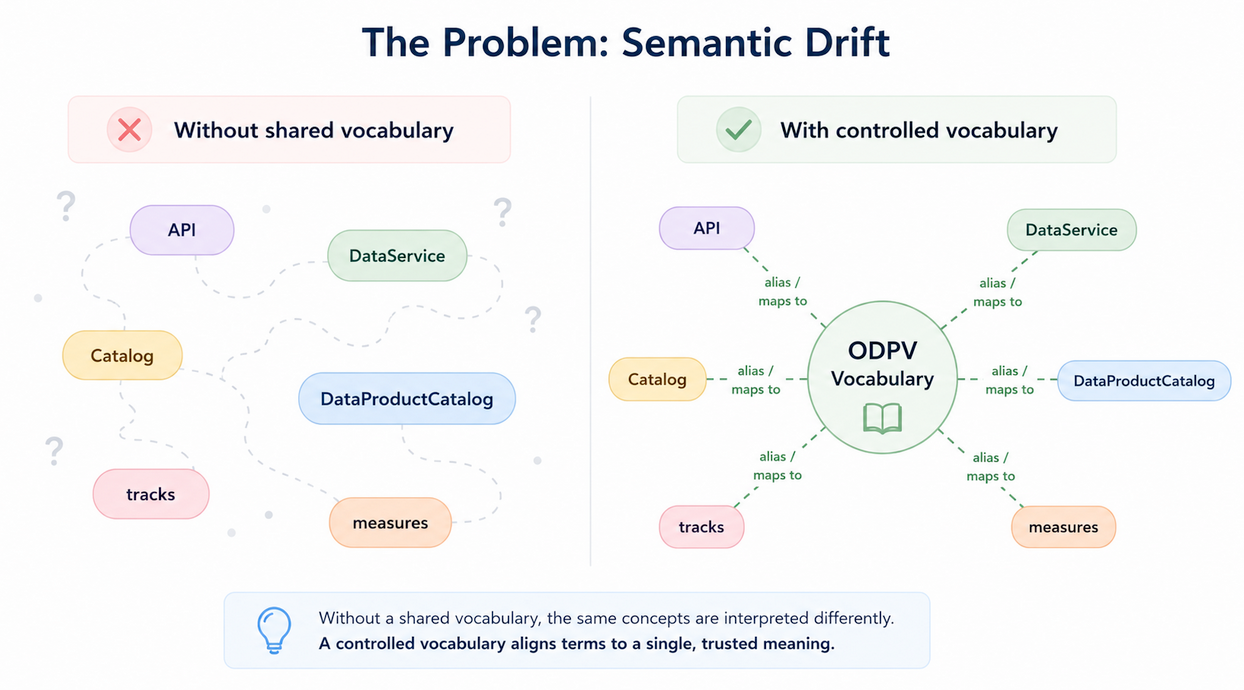
This is how semantic drift starts. One specification uses API while another prefers DataService. One relationship uses tracks while the vocabulary treats it as a form of measures. One catalog uses Catalog while the vocabulary defines DataProductCatalog. These differences may look harmless when viewed one by one. Across a standards family, they create friction for implementers, mapping work for platforms, and uncertainty for AI agents.
For humans, inconsistent terminology slows understanding. For platforms, it increases integration cost. For AI agents, it creates guesswork. Good context engineering should reduce guesswork, not make it part of the operating model.
Turning vocabulary into governance
The new ODPV cross-spec drift report changes the role of the vocabulary. It compares published Open Data Product family schemas against the canonical ODPV vocabulary. The current report checks ODPG, ODPC, and ODPS against the ODPV source vocabulary. It checks 49 terms and identifies 8 possible drifts.
This is a small technical feature with a large governance meaning. ODPV is no longer only a place where terms are defined. It is becoming the reference point used to check whether the wider standards family still speaks the same language.
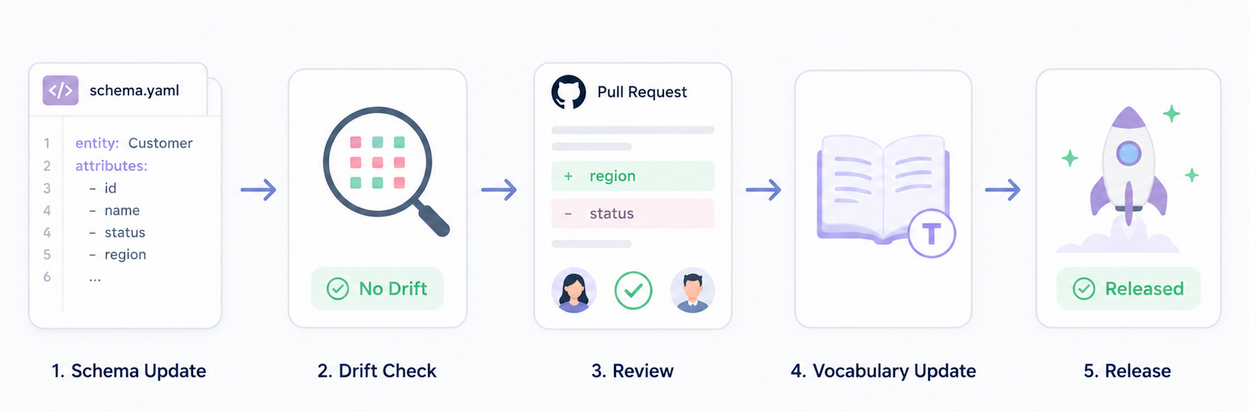
The report does not treat drift as failure. It treats drift as a review signal. When a term does not match the vocabulary, maintainers have a decision to make. They can add the term to ODPV, add an alias to an existing ODPV term, or update the source specification to use an existing vocabulary term. This turns semantic alignment into a practical governance process.

What the first drift report shows
The first drift report gives a useful picture of the current alignment across the Open Data Products family.
ODPG is clean against ODPV. The report checks 29 ODPG terms and finds 0 unresolved drifts. Node types such as DataProduct, UseCase, BusinessObjective, KPI, Domain, Dataset, Workflow, Agent, Capability, and StrategicOpportunity align with ODPV. Edge types such as uses, supports, contributesTo, measures, dependsOn, produces, consumes, governedBy, ownedBy, alignsWith, impacts, exposes, and identifies also align. Some terms map through aliases. For example, API maps to DataService, while tracks and monitors map to measures.
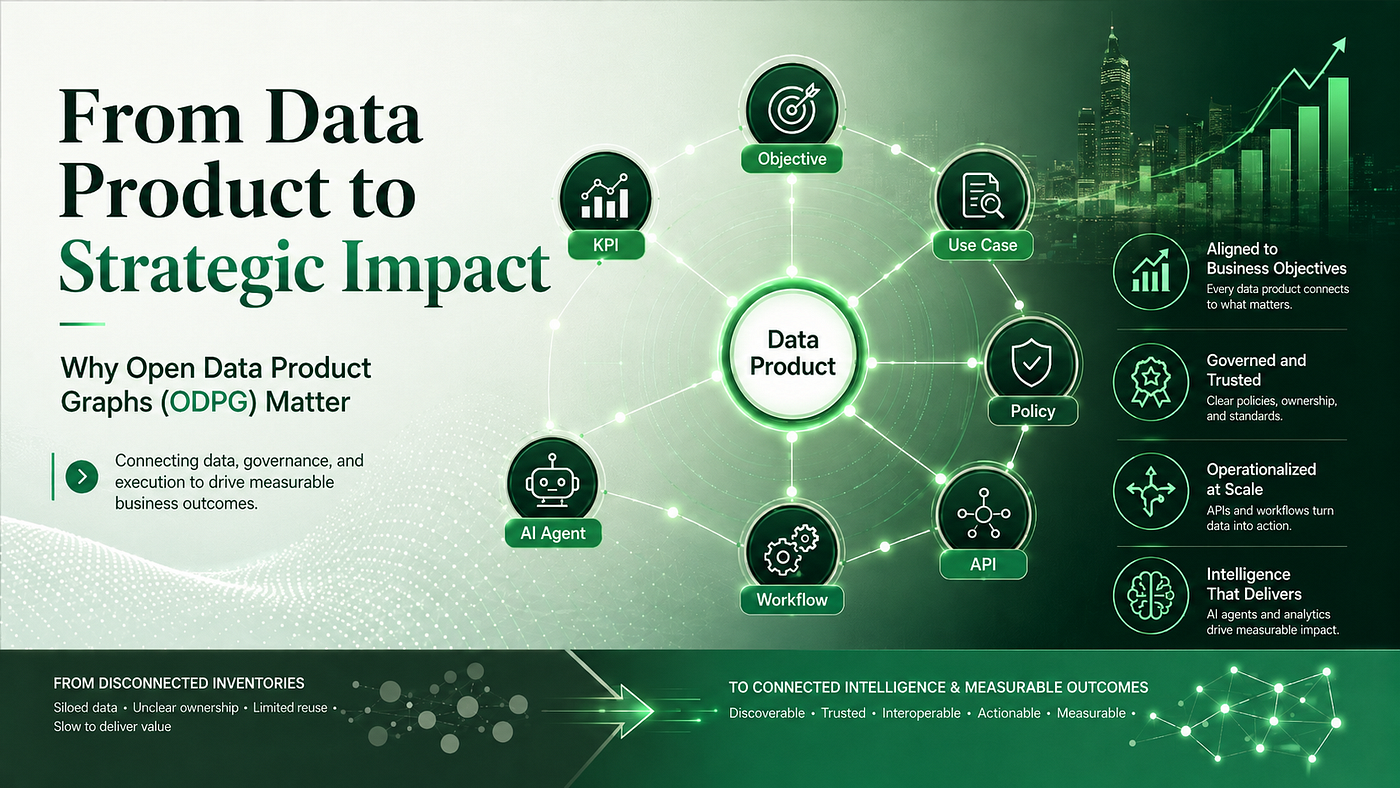
This matters because ODPG is where value relationships become visible. It connects products to use cases, objectives, KPIs, signals, policies, workflows, agents, and opportunities. If graph terminology drifts away from the shared vocabulary, the graph becomes harder to interpret, harder to validate, and harder for agents to traverse. The current report shows that ODPG is aligned with ODPV, which strengthens the graph layer of the standards family.
ODPC is also clean against ODPV. The report checks 9 ODPC terms and finds 0 unresolved drifts. Terms such as Owner, UseCase, KPI, BusinessObjective, and Signal match directly. Terms such as Catalog, ProductReference, ProductModel, and GraphReference map through ODPV aliases. This means the catalog layer is also aligned with the shared vocabulary.
The current drift could be in ODPS, and that would not be surprising. ODPS is the most mature and detailed product specification in the family. It includes many product-level components that existed before ODPV became the shared vocabulary layer. The report identifies 8 possible ODPS drifts: details, productStrategy, pricingPlans, dataAccess, paymentGateways, support, license, and dataHolder. Each of these should now be reviewed and either added as an ODPV term, mapped through an alias, or adjusted in ODPS if an existing term already covers the concept.

The spec drift checking is automated and runs weekly on Mondays. Results are stored in Github cross-spec-drift folder. History is also preserved for further analysis.
Why this matters for AI agents
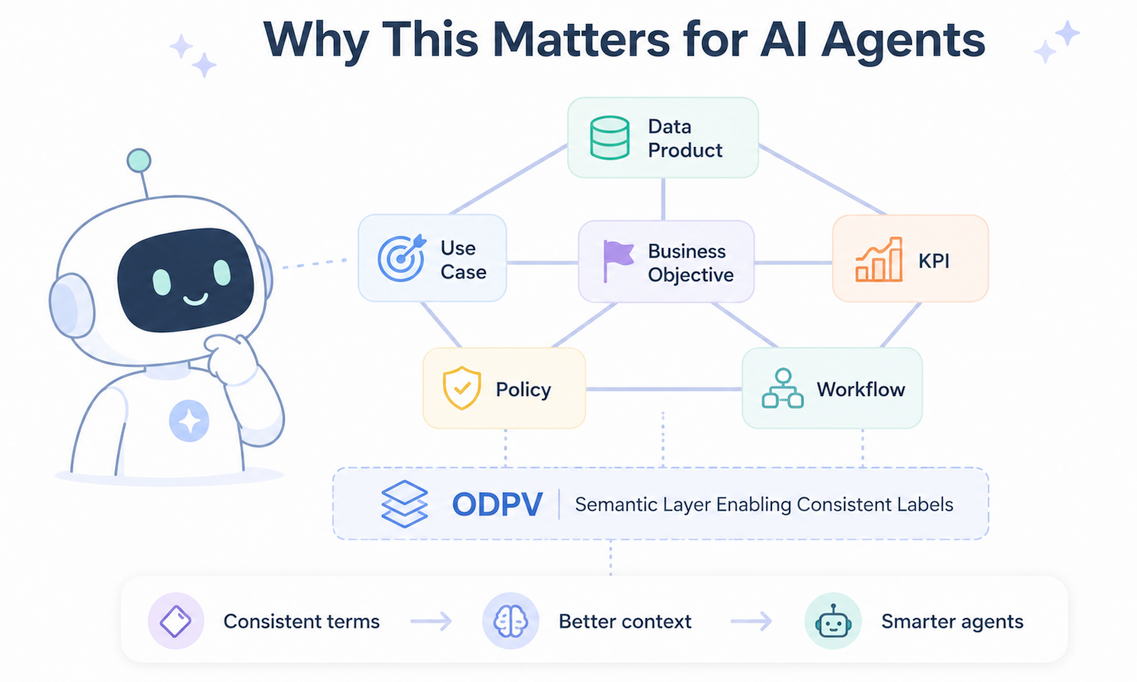
AI agents need more than access to data. They need structured context that helps them reason over products, use cases, business objectives, KPIs, signals, policies, APIs, workflows, and ownership.
If the language across specifications is inconsistent, the agent must infer meaning from context. That is risky. The agent might treat similar terms as different concepts. It might treat different concepts as the same thing. It might miss the intended relationship between a data product and a business objective, or between a use case and the KPI it supports.
A controlled vocabulary reduces this risk by defining shared meanings. A drift detector reduces the risk further by making divergence visible early. Together, they create a more stable semantic layer for AI-assisted catalog search, graph traversal, metadata validation, portfolio analysis, SDK tooling, and GraphRAG-style reasoning.
This is where ODPV becomes more than documentation. It becomes part of the operating model for AI-ready data product standards.
Why this is not just taxonomy
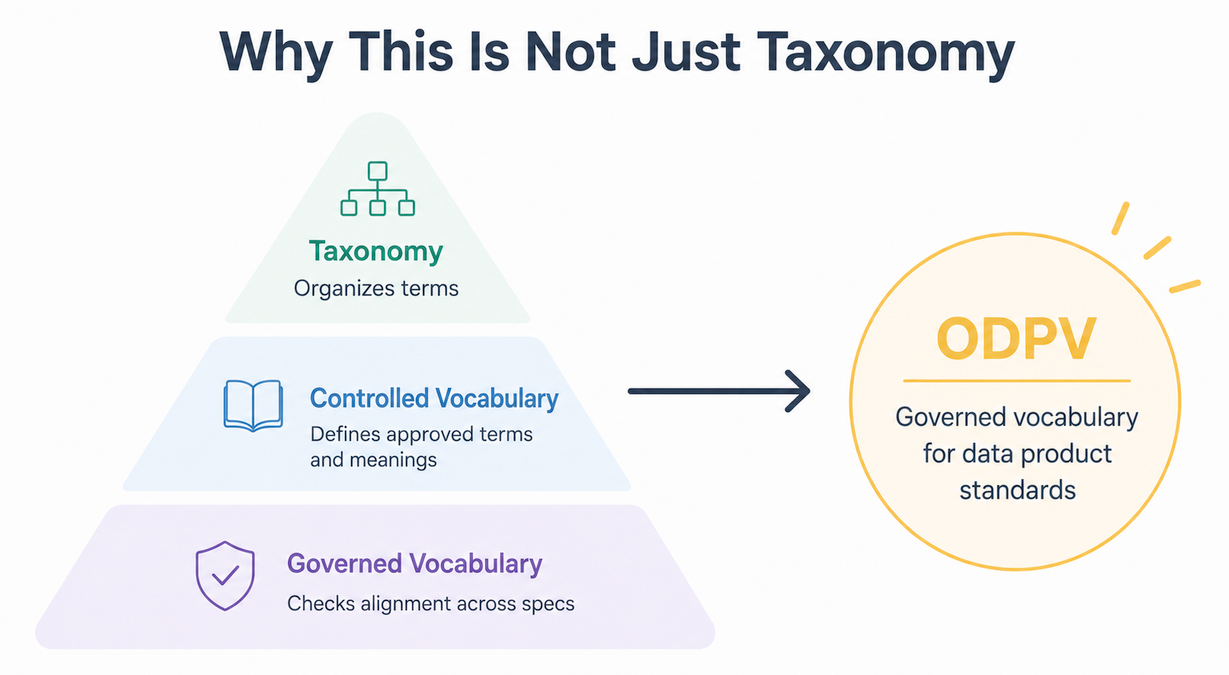
It would be easy to call ODPV a taxonomy, but that would be too narrow. A taxonomy organizes terms, usually through broader and narrower categories. ODPV does some taxonomy-like grouping, but its role is broader.
ODPV is a controlled vocabulary.
- It defines approved terms, aliases, meanings, and relationships across a standards family.
- With drift detection, it also supports governance over how those terms are used.
W3C SKOS describes a common model for knowledge organization systems, including thesauri, classification schemes, subject heading systems, and taxonomies. This wider framing fits ODPV better than the narrower taxonomy label.
The better framing is this:
ODPV is a governed controlled vocabulary for the Open Data Products standards family. It has taxonomy-like structure where useful, but its main value is semantic consistency across specifications, tools, platforms, and AI agents.
The bigger standards family picture
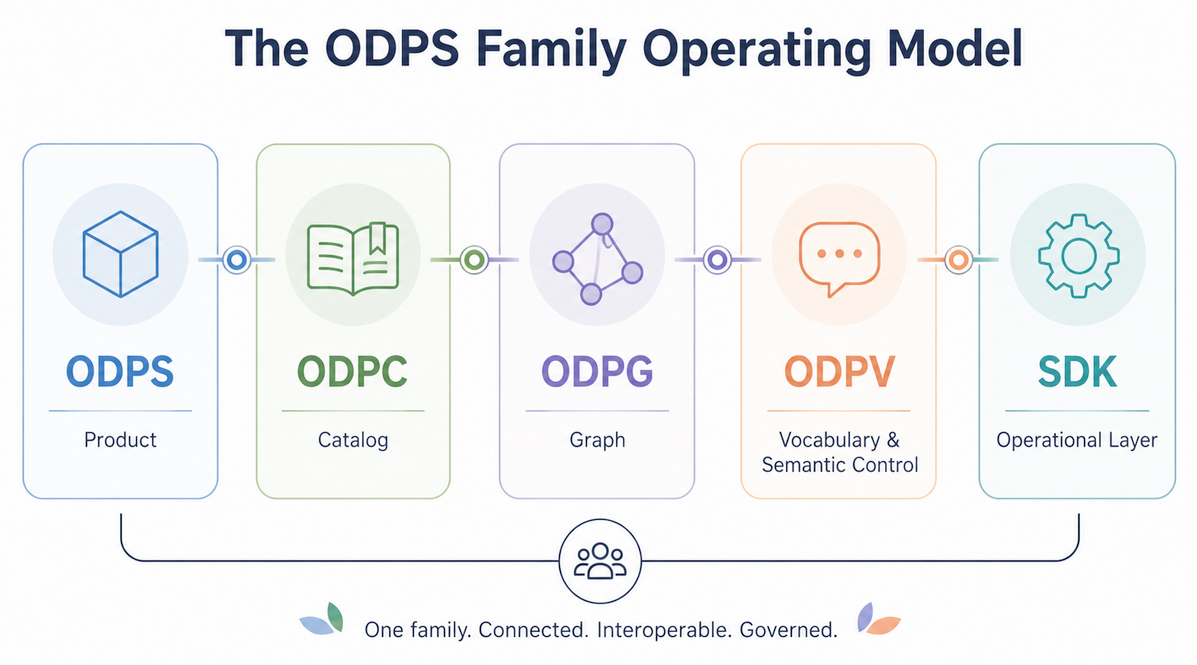
The Open Data Products family is becoming more than a set of separate specifications. Each part has a clear role, but the value comes from how the parts work together.
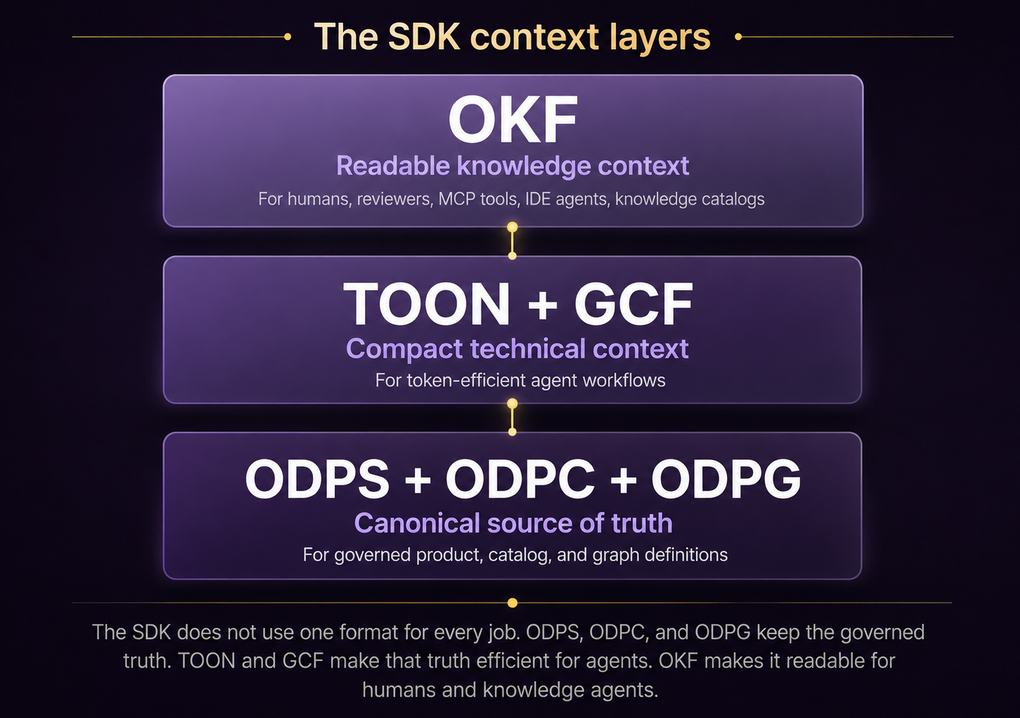
- ODPS defines the data product.
- ODPC organizes catalogs and portfolio-level objects.
- ODPG connects products, use cases, objectives, KPIs, signals, policies, workflows, and agents into a value graph.
- ODPV gives all of them a shared language.
The new drift detection process strengthens this model. It checks whether the shared language remains coherent as the specifications evolve. That gives maintainers a feedback loop. It gives implementers more confidence. It gives platforms more stable mappings. It gives AI agents cleaner context.
Governance should happen in code too
In data product management, governance should not only happen in documents, committees, and review meetings. Some governance should happen in code.
The ODPV cross-spec drift report is a practical example of that principle. It turns vocabulary alignment into something that can be tested. It makes semantic drift visible. It creates a structured way to decide whether a term should become official, become an alias, or be changed in the source specification.
This is important because standards need to evolve. The goal is not to freeze the language forever. The goal is to make changes visible, intentional, and consistent. That is what automated drift detection supports.
The lesson for AI-ready data product standards
The future of data product standards is not only about defining better schemas. It is about creating shared context that humans, platforms, and AI agents can trust.
ODPV started as the vocabulary layer of the Open Data Products family. With automated cross-spec drift detection, it is becoming something more operational. It is becoming the semantic quality control layer for AI-ready data product standards.
That is the real shift. The vocabulary defines the language, and the drift detector helps protect it as the standards family grows.
메타데이터
- post_id
- a61822b053cb
- slug
- from-shared-vocabulary-to-semantic-control-a61822b053cb
- url
- https://blog.opendataproducts.org/from-shared-vocabulary-to-semantic-control-a61822b053cb
- canonical_url
- https://blog.opendataproducts.org/from-shared-vocabulary-to-semantic-control-a61822b053cb
- author_url
- https://medium.com/@dr.jarkko.moilanen
- status
- ok
- fetched_at
- 2026-06-09 15:37:30